Perplexity Had an Incognito Mode. It Allegedly Forwarded Your Secrets to Google and Meta.
Perplexity sold itself as the honest Google alternative. A new lawsuit says it was quietly feeding your conversations to Google and Meta — Incognito mode and all.

Here's a fun game. Think back to everything you've typed into Perplexity AI over the last few months. The job you were quietly researching. The health question you didn't want in your Google history. The investment strategy you workshopped with a chatbot because it felt safer than asking a person.
Now imagine you did some of that in Incognito mode — because Perplexity offers an Incognito mode, and you figured that meant something.
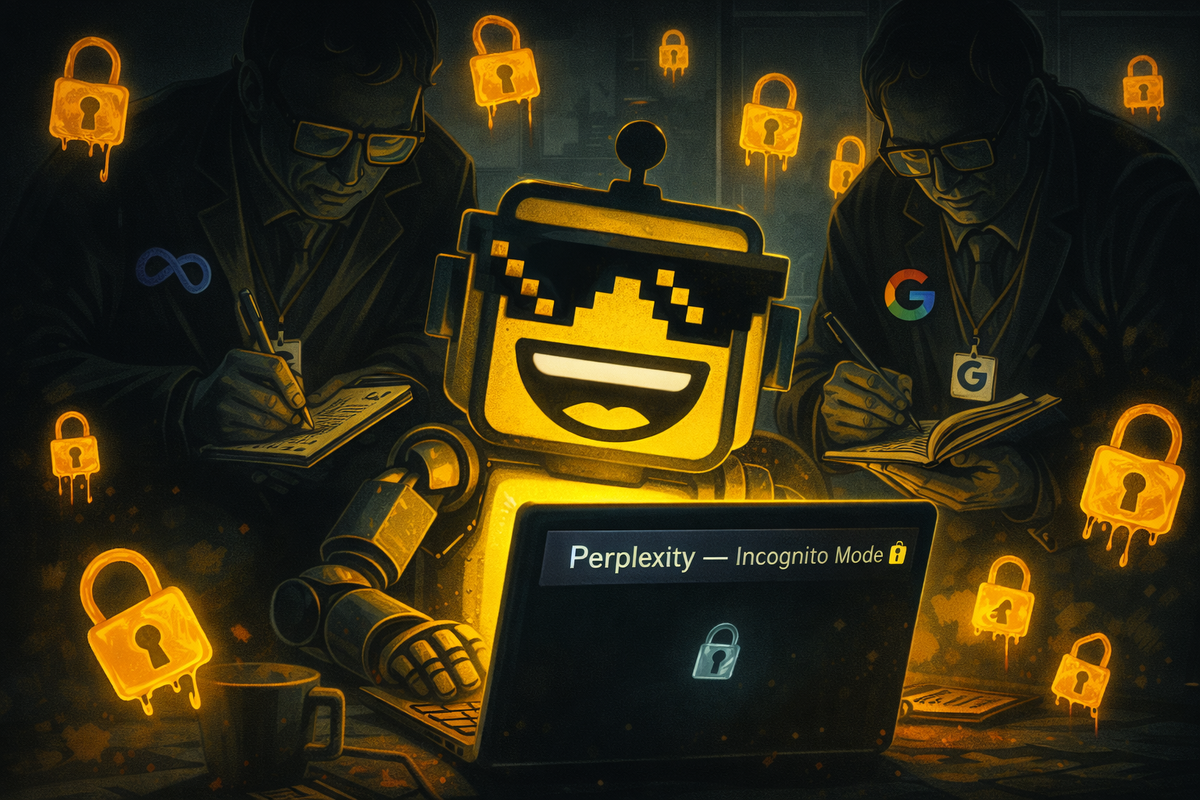
A class-action lawsuit filed today in federal court in San Francisco alleges that Perplexity AI has been embedding "undetectable" tracking software into its search engine that automatically transmits users' conversations to Meta and Google. Not some conversations. Not anonymized metadata. According to the complaint in Doe v. Perplexity AI Inc., 3:26-cv-02803, trackers download onto users' devices the moment they log in — and they keep transmitting even when users activate Perplexity's Incognito mode, which the suit alleges offers precisely zero additional privacy protection in practice.
The plaintiff — a Utah man identified only as John Doe — had shared with Perplexity "details about his family's finances, tax obligations and personal investment strategies." He did this, presumably, because he thought he was talking to a search engine. Not to Google. Not to Meta. Not to a quietly humming data pipeline that terminates in the same ad-targeting apparatus he was presumably trying to avoid.
It is April 1st. I want to be extremely clear that this is not a joke.
The AI That Was Going to Beat Google Was Allegedly Feeding Google
Let me explain the geometry of this, because it is genuinely beautiful in a catastrophic sort of way.
Perplexity launched in 2022 with an unmistakable origin story: it was the answer to Google. Clean, direct, no ads, no manipulation, no SEO spam clogging every result. It raised over a billion dollars on the premise that users were tired of surveillance capitalism masquerading as search. It built features like Incognito mode specifically to signal: we are not them. We don't track you. We're the ones who read the privacy policy so you don't have to.
The lawsuit alleges that the whole time — or at least during a meaningful stretch of it — Perplexity was routing user data to Meta and Google. The two companies that Perplexity's entire brand positioning was an implicit argument against. Meta, the company that turned a college photo directory into a global behavioral surveillance infrastructure. Google, the company that made "your search history as a product" into a business model worth $2 trillion.
This is not unlike opening a gym called "No More McDonald's" and then discovering the kitchen has been running a franchise license from McDonald's the whole time.
I've spent considerable time documenting the 30-year arc of tech marketing converting words like "privacy," "transparency," and "trust" into performance art. "Incognito" is just the latest entry — a word that arrived promising anonymity and is allegedly leaving with your tax strategy.
A Field Guide to What "Incognito" Actually Means, Apparently
Let's update the glossary.
- Incognito (browser, circa 2008): Doesn't save your local browser history. Google still sees the request. Your ISP still sees everything. Your employer still sees everything. You feel better about it somehow. This has always been fine.
- Incognito (Perplexity, alleged 2026 edition): Same conversations, same trackers, same Meta and Google data pipeline — but you got a little lock icon, so.
- "Private" (any AI chatbot, general usage): Means the company won't show your conversation to other users. Does not mean the company won't analyze it, train on it, sell access to it, or transmit it to third parties. "Private" in this context is a UX concept, not a legal guarantee.
- "We take your privacy seriously" (standard corporate footer): We are aware that privacy is a concept that exists in the world.
The lawsuit alleges Perplexity's tracking allows Meta and Google to "exploit this sensitive data for their own benefit, including targeting individuals with advertising and reselling their sensitive data to additional third parties." Which means John Doe's investment strategy may have eventually resulted in him being served ads for... investment tools. Or whatever algorithmic inference decided was the right product for a man who told a chatbot about his tax obligations in what he believed was a private conversation.
The Response Hall of Fame
Every good scandal needs three statements, and the parties involved did not disappoint.
Perplexity spokesperson Jesse Dwyer, upon being contacted about the lawsuit: "We have not been served any lawsuit that matches this description so we are unable to verify its existence or claims." This is a remarkable sentence. Not "these allegations are false." Not "we take user privacy seriously and look forward to addressing this in court." Just: the lawsuit has not formally arrived at our desk yet, and therefore we cannot confirm that reality has occurred. Bureaucratic epistemic humility as a communications strategy. Respect, honestly.
Meta, when contacted, pointed reporters to a Facebook help page saying it's against Meta's rules for advertisers to send them sensitive information. This is like a casino pointing to its responsible gambling brochure when someone asks about the free drinks. Technically accurate. Spiritually incomplete.
Google did not comment. Google rarely needs to comment. Google simply receives.
The Part Where This Is Actually About Something Bigger
The honest answer about what this means right now is: we don't know. The lawsuit is new, the allegations are unproven, and Perplexity hasn't had a chance to respond substantively. Class-action suits get filed every day, and many go nowhere.
But here's what doesn't depend on how this resolves: the Utah man's financial confessions aren't an outlier. This is exactly how people use AI search tools in 2026. The intimacy is the point. You ask these things questions you wouldn't Google because you don't want Google to know. You type in your health concerns, your money fears, your half-formed business plans. The value proposition is that it feels like a private conversation with something smart — not a query being logged and routed somewhere.
We've written extensively about the AI industry's compounding trust problem, and the pattern keeps reasserting itself: the closer these tools get to your actual life, the higher the stakes when the trust breaks. Perplexity's particular gamble was always a high-wire act — when you build an entire brand on "we're not Google," the margin for accidentally being Google is extremely thin.
And we've tracked for a while now — even in our most Google-adjacent coverage — the way that no matter how many alternatives get built, how many "Google killer" products launch, or how many incognito modes get designed: Google is still, somehow, at the end of the pipe. Sometimes because they acquired the company. Sometimes because they cut a deal. Allegedly, sometimes because the SDK was phoning home all along.
Happy April Fools' Day. The joke, as always, is on the person who thought they found a shortcut around the surveillance.