Pentagon vs. Anthropic: When “Move Fast and Break Things” Meets the Defense Production Act
Axios reports Pete Hegseth gave Anthropic an ultimatum: loosen AI safeguards for the Pentagon or face Defense Production Act action.

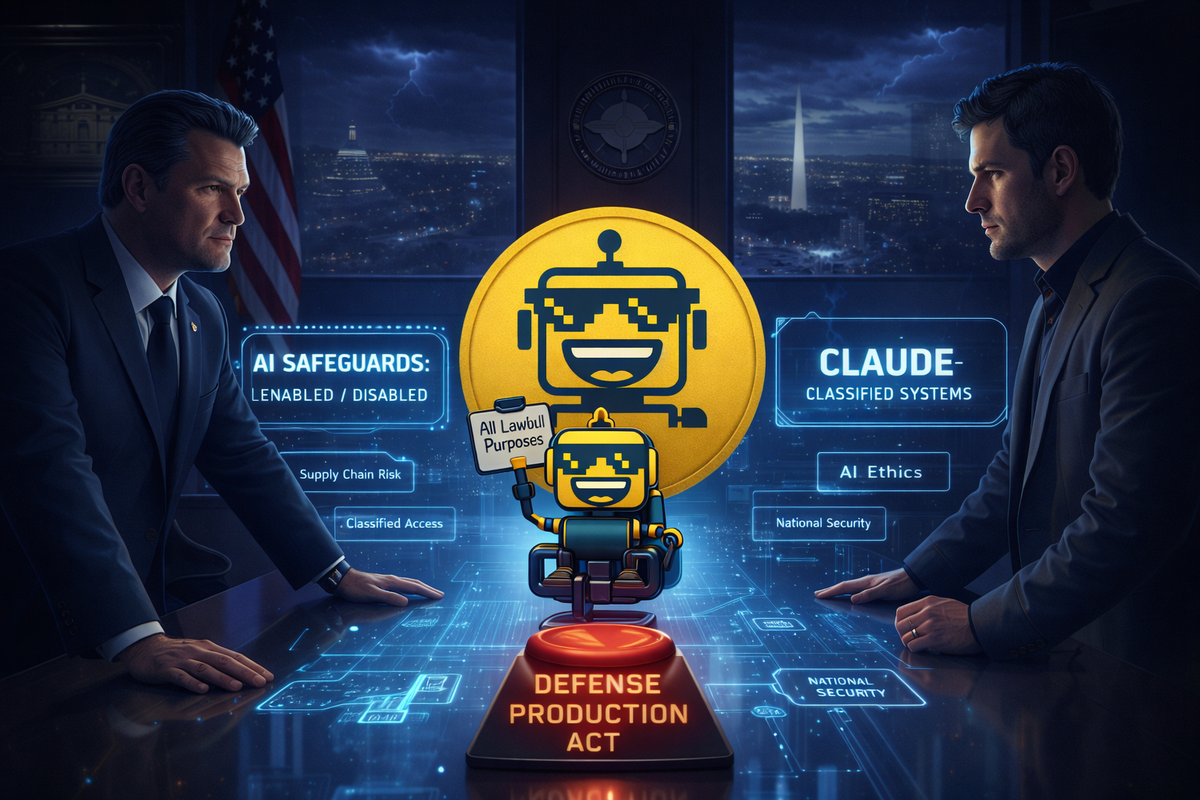
According to a new exclusive from Axios, Defense Secretary Pete Hegseth gave Dario Amodei until Friday to effectively choose: loosen AI safeguards for the U.S. military — or brace for impact.
Impact, in this case, could mean being declared a “supply chain risk” or having the Defense Production Act invoked to compel cooperation.
Nothing says “healthy public-private partnership” like a statutory ultimatum.
Let’s unpack what this Axios scoop actually means for AI safeguards, national security, Claude, and the increasingly awkward group chat between the Pentagon and Silicon Valley.
The Pentagon Really, Really Likes Claude
Per Axios, one defense official summed up the situation bluntly:
“The only reason we're still talking to these people is we need them and we need them now. The problem for these guys is they are that good.”
Translation: We are furious. Also, please don’t leave.
Anthropic’s model, Claude, is reportedly the only AI system currently used for the military’s most sensitive classified work. It’s embedded via a partnership with Palantir Technologies and was even used in the so-called “Maduro raid,” according to Axios.
So this isn’t some procurement sideshow. Claude is operational infrastructure.
Which makes this standoff less like canceling a SaaS subscription and more like threatening to uninstall the engine mid-flight.
The Core Dispute: AI Safeguards vs. “All Lawful Purposes”
Anthropic’s red lines are straightforward in theory:
- No mass surveillance of Americans.
- No autonomous weapons firing without human involvement.
The Pentagon’s reported position? It won’t allow a private company to dictate operational decisions or object to specific use cases.
And here we are.
The Axios reporting suggests the Department of Defense is considering invoking the Defense Production Act (DPA) to force Anthropic to tailor Claude “without any safeguards.” The DPA, historically used to ramp up production of vaccines or ventilators during COVID-19, is not typically deployed as a stick in a philosophical argument about AI ethics.
Yet here we are again.
The twist: Anthropic could argue that the DPA doesn’t apply because it’s not selling an off-the-shelf commodity but custom-built, highly sensitive software already tailored to government use.
Which means this could quickly go from “tense meeting” to “federal court docket.”
The Meeting: “Not Warm and Fuzzy”
Axios reports that the meeting was described by one official as “not warm and fuzzy at all.” Another source insisted it remained “cordial.”
So: either icy diplomacy or aggressively polite brinkmanship.
In the room with Hegseth were Deputy Secretary Steve Feinberg, Under Secretary Emil Michael, Under Secretary Michael Duffy, Pentagon counsel, and the department’s top spokesperson. In other words: this wasn’t a casual coffee.
Meanwhile, Anthropic maintained a conciliatory tone, thanking the Department for its service and emphasizing “good-faith conversations.”
Corporate PR 101: When someone threatens to invoke wartime powers against you, thank them for their service.
The Supply Chain Nuclear Option
One particularly spicy lever mentioned by Axios: declaring Anthropic a “supply chain risk.”
If that happens, companies working with the Pentagon would have to certify that Claude isn’t embedded in their workflows. Given Claude’s integration across classified systems and bureaucratic functions, that would be less like pulling a thread and more like yanking the entire sweater.
And the Pentagon knows it.
Axios notes a key friction point: there is no ready replacement for Claude in classified environments. Which makes the ultimatum feel a bit like:
“Comply — or we’ll replace you.”
“With whom?”
“…We’re looking into that.”
Enter: The AI Bench Warmers
According to Axios, xAI recently signed a contract to bring Grok into classified settings. The Pentagon is also accelerating talks with OpenAI and Google to move their models into classified systems.
Google’s Gemini is reportedly viewed as a potential replacement — provided Google agrees to allow the Pentagon to use the model for “all lawful purposes,” the same terms Anthropic rejected.
One source told Axios that Claude is still ahead in several military-relevant applications, including offensive cyber capabilities.
So yes, the Pentagon is shopping. But it’s shopping while wearing Claude’s hoodie.
The Bigger AI Safeguards Dilemma
This Axios report highlights a deeper structural tension in AI governance:
- Governments want maximum flexibility for national security.
- AI labs want guardrails to prevent reputational, legal, and ethical catastrophe.
Anthropic’s brand is explicitly built around AI safety and constitutional AI principles. If it caves and allows mass surveillance or fully autonomous weapons use, it undermines its own thesis.
If it refuses and loses its largest, most sensitive customer, it risks revenue and influence — and potentially hands classified AI infrastructure to competitors. This isn’t just a contract dispute. It’s a live test of whether AI safeguards survive contact with realpolitik.
The Irony: The Pentagon Can’t Afford to Lose Claude
Here’s the delicious irony Axios makes clear: the Pentagon is simultaneously threatening to cut ties and privately acknowledging Claude is that good.
Declaring Anthropic a supply chain risk would require replacing the only model currently used in classified systems.
Invoking the Defense Production Act could drag the administration into a high-profile legal fight over whether custom AI software qualifies. And forcing compliance could chill innovation across the AI ecosystem, as labs quietly ask: If we win government contracts, do we lose control of our own policies?
What Happens by Friday?
Axios frames this as a ticking-clock ultimatum.
Possible outcomes:
- Anthropic tweaks its usage policy language without fundamentally abandoning safeguards.
- The Pentagon escalates rhetorically but avoids actually pulling the DPA trigger.
- This becomes the most consequential AI-policy court fight in U.S. history.
- Everyone releases statements about “constructive dialogue” and nothing publicly explodes — yet.
If you’re an AI lab watching this unfold, the message is clear: government AI contracts are lucrative, strategic, and come with footnotes written in bold.
If you’re the Pentagon, the message is equally clear: you cannot afford to be locked out of the best models when AI is reshaping cyber operations, logistics, and battlefield intelligence.
And if you’re the rest of us? You’re watching a live demonstration of what happens when AI safeguards meet national security muscle.
As Axios reports, this battle is pushing other AI labs into a major dilemma. Because the real question isn’t whether Anthropic backs down by Friday. It’s whether “responsible AI” can coexist with “all lawful purposes” once classified systems are involved. And that conversation is just getting started.