
Pebble Index 01 Review: The Smart Ring That Remembers Your Thoughts So You Don’t Have To
Pebble’s new Index 01 smart ring is “external memory for your brain,” recording thoughts with a click, no charging, no cloud, and no creepy AI. A snarky deep dive into the simplest, smartest wearable of 2026.

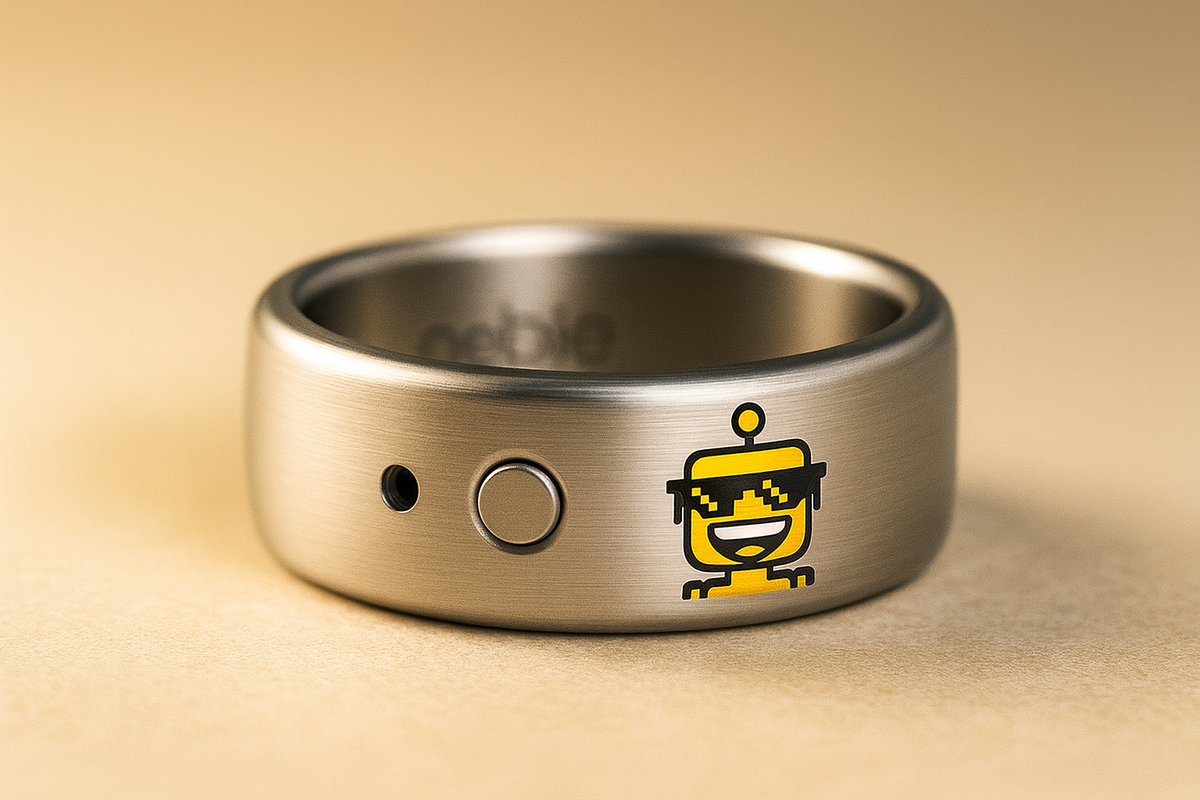
I’ve long had a fascination with Pebble’s products — long before SiliconSnark blossomed into today’s multipolar snark superpower (see Pebble Time 2 Is Back From the Dead — And Somehow Still Cool in 2025 and Pebble: The Smartwatch Comeback No One Saw Coming).
The company has always lived in that charming corner of tech where people build hardware because it should exist, not because some VC told them to juice ARR. . So when Pebble announced Index 01, a stainless steel ring that records your thoughts like a voice-activated horcrux for your fleeting ideas, I perked up instantly. Finally: a device for everyone who has ever walked into a room and immediately wondered why they were there.
A Ring That Records Your Brain Before It Crashes
Index 01 is Pebble’s latest creation — a tiny metal ring with a mic, a button, and zero of the usual wearable nonsense. You click it with your thumb, whisper your thought, and a local speech-to-text engine transcribes your fleeting genius before it drifts off into oblivion. A lightweight on-device LLM decides what you meant, logs the note or reminder, and does it all without talking to a server farm or pretending to “learn your preferences.” Your ideas stay on your phone, your privacy stays intact, and your brain gets outsourced to stainless steel like nature intended.
This entire concept was born when Pebble’s founder realized that his mind, like the rest of ours, is basically a slot machine where winning thoughts are “rare and immediately forgotten.” His actual examples — remembering pickup times, calling the pharmacy, logging a book recommendation, adding a meeting to the calendar — sound like the interior monologue of a parent whose entire life is held together by duct tape and caffeine. These moments don’t need AI therapy, emotional analysis, or a “journey map.” They just need to be remembered. Index 01 handles that beautifully.
Why Pebble Turned a Smartwatch App Into a Smart Ring
Originally, Pebble tried to build this as a Pebble watch app. It made sense on paper: the watch had a mic, Pebble fans practically sleep in the thing, and the UI was already familiar. But then the “two-handed problem” emerged. You needed one hand to raise the watch and the other hand to press the button. That sounds minor — until you actually try doing it while biking, carrying groceries, grilling, parenting, or performing one of the 14,000 daily tasks that require hands.
The solution was, almost poetically, a ring. The perfect form factor. Always accessible, always ready, always on your finger. Even Iron Man didn’t solve computing this elegantly. And unlike other smart rings, Index 01 doesn’t try to measure your sleep, judge your heart rate, track your steps, or scold you for not hitting 8,000 steps. It’s a ring that remembers things. Nothing more, nothing less.
The Design Philosophy: A Love Letter to People Who Hate Charging Cables
Pebble approached Index 01 with a simple question: What would it take to make a wearable you’ll never stop wearing? The answer was a ruthless adherence to practicality. The ring had to be tiny enough not to clink against your phone like a miniature brass knuckle. It had to survive showers, dishes, rain, and general human chaos. It needed a real, tactile, trustable physical button — the rarest of endangered species in consumer electronics. And above all, the battery needed to last years, not days, because everyone knows the second you take a wearable off to charge it, it’s gone forever. Lost to a drawer. Dead to the world. Immortalized only in your receipts folder.
Pebble chose silver-oxide batteries, the same kind in watches. They last two-ish years, after which the app politely notifies you, and you send the ring back for recycling. No chargers. No proprietary docks. No “fast charging mode.” It is possibly the most anti-Apple wearable ever designed, which only makes it more appealing.
A Future Gadget That Refuses to Act Futuristic
What makes Index 01 delightful is how aggressively unfuturistic it is. It has no speaker. No haptic alerts. No glowing halo. No AI co-pilot named Nova trying to help you process your emotions. It doesn’t track your health because Pebble is merciful. It doesn’t monitor your sleep, your location, your stress, or your biometric relationship with capitalism. It’s simply an input device — intentionally, proudly, defiantly so.
And yet, because this is Pebble, it’s absurdly hackable. If you want to route audio straight into your own app or a home-built automation service, you can. If you want the ring to control your Home Assistant setup, take photos, trigger webhooks, or manage your smart lights, that’s possible. Pebble hints at future upgrades where a double-click might launch a full voice agent — essentially turning Index 01 into a two-speed memory machine: simple mode for remembering your thoughts, advanced mode for asking, “When’s the next Caltrain?” and getting the response on your Pebble watch.
It’s a mature, balanced product philosophy: dead simple for people who just want to remember stuff, endlessly extensible for the six hardware hackers who will absolutely build a custom LLM pipeline to run on it.
The Most Human Tech Gadget Pebble Has Ever Made
That’s ultimately why Index 01 works so well. It isn’t trying to change your life, disrupt human cognition, or usher in a new era of wearable consciousness. It’s not angling to be your assistant, your coach, or your friend. It’s the first tech product in years that simply says: Relax. I got you. I’ll remember.
In a world overflowing with apps, feeds, alerts, notifications, and “AI companions,” Pebble managed to build something quietly radical: a device that respects your attention, respects your privacy, and respects your very limited brain RAM. For $75, it buys you the smallest, simplest, and possibly most needed luxury of all — the peace of knowing that the important little things won’t slip away.