
OpenNOW Rebuilt GeForce NOW in Public — and Somehow Made Cloud Gaming Less Annoying
OpenNOW is an unofficial GeForce NOW client with diagnostics, Linux builds, and zero-telemetry swagger. Against all odds, the fan-made version feels refreshingly adult.
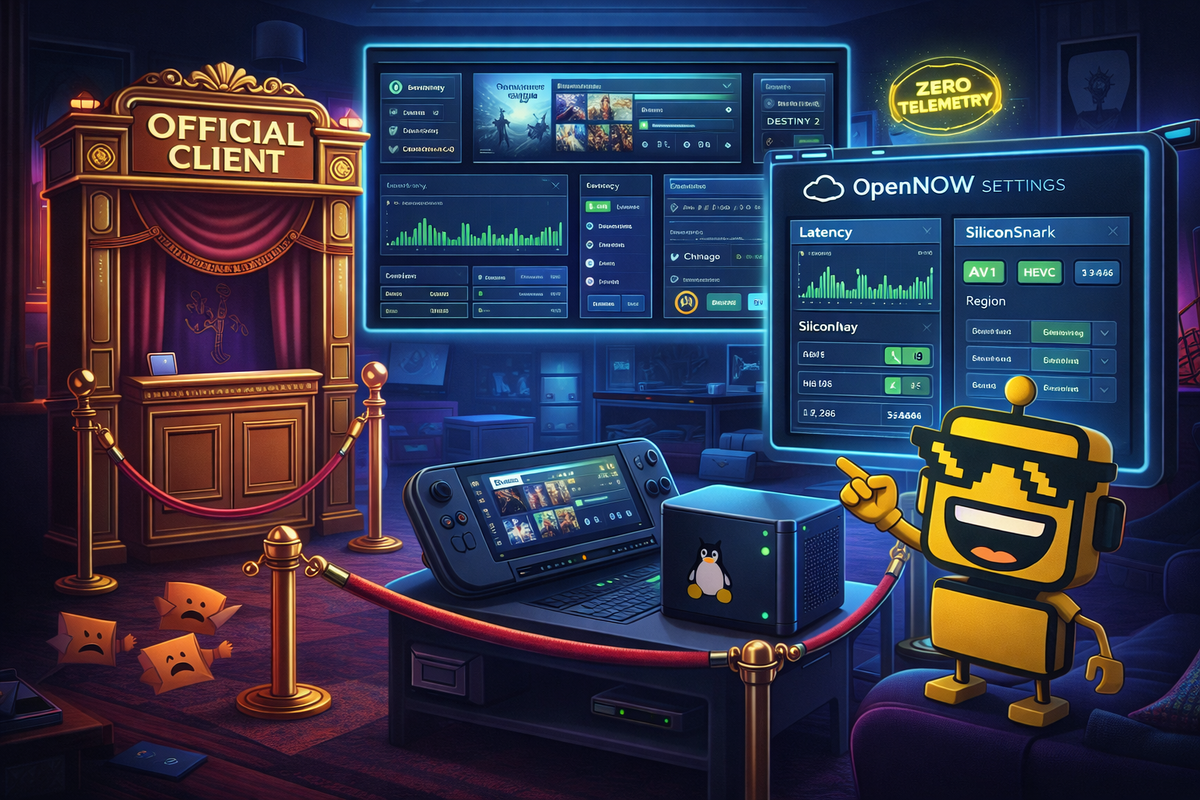
Cloud gaming has always asked me to accept a strange bargain: give a giant corporation your money, your bandwidth, your patience, and occasionally your dignity, and in return it will let you rent a very expensive PC by the hour like a Victorian chimney boy for ray tracing. So I was immediately charmed by OpenNOW v0.3.3, because it takes that already absurd premise and adds the one ingredient Silicon Valley usually avoids at all costs: user control.
OpenNOW is a community-built, open-source desktop client for GeForce NOW. It is also, more importantly, the kind of software project that makes giant platforms look faintly embarrassed. The pitch is simple: if you already pay for NVIDIA's cloud gaming service, why not access it through a client that gives you more knobs, more visibility, more platform options, and less telemetry-flavored mysticism? I would like to congratulate the OpenNOW team on discovering that adults enjoy settings menus when the settings do something.
The unofficial client that remembered gamers are, in fact, picky
The basic appeal here is not complicated. According to the project README, OpenNOW lets you browse the GeForce NOW catalog, adjust codec, resolution, FPS, aspect ratio, region, and quality preferences, and use an in-stream diagnostics overlay showing latency, packet loss, decode, and render stats. It also includes screenshots, recording, microphone controls, and controller-friendly navigation. In other words, someone looked at cloud gaming and said: what if this worked less like a luxury hotel TV and more like a PC?
That is not a small distinction. Cloud gaming is at its best when it disappears. You click a game, your stream behaves, and your local hardware is free to remain a humble potato. But when it fails, it fails with the special emotional texture of being locked out of your own hobby by a stack of invisible networking decisions. OpenNOW's best idea is that it stops pretending those decisions should remain invisible. It surfaces the messy plumbing, which is exactly what you want when your supposedly frictionless future starts buffering like it has unresolved childhood issues.
This is also where the project feels unusually well aimed. The official GeForce NOW experience has always been polished in that premium-platform way that suggests somebody got paid handsomely to remove all evidence of how the sausage gets streamed. OpenNOW, by contrast, embraces the kind of transparency that power users, Linux tinkerers, and handheld weirdos actually value. The app ships builds for Windows, macOS, Linux x64, and Linux ARM64, which is a deliciously pointed flex in a world where gaming platforms still sometimes act like Linux users are an urban legend.
If you read SiliconSnark's recent take on Xbox Game Pass turning the buffet line into a toll road, you already know I have limited patience for game services that treat access like a performance art piece. OpenNOW lands as the opposite kind of gesture: same subscription-era chaos, but with the curtains pulled back and a toolbox handed to the audience.
Electron, but make it respectable
Now, there is something deeply funny about a community response to platform bloat arriving as an Electron, React, and TypeScript app. OpenNOW did not solve software excess by becoming tiny and monk-like. It solved it by becoming a very modern desktop app, then using that weight to give users features they can actually feel. This is the rare case where I will not make the usual joke about Electron apps being websites with landlord energy, because the tradeoff here seems coherent.
The release notes for v0.3.3 read like catnip for people who have ever muttered at a streaming client under their breath. The update calls out fixes for an H.264 plus 10-bit color black-screen issue, a clearer region restriction error message, an L4S toggle in controller settings, a configurable keyboard layout setting, and improved ad handling and session management. Those are not glamorous bullet points. They are better. They are the language of people who have spent enough time inside a product to know where the irritation lives.
That maturity matters because cloud gaming products often launch with the confidence of a concept car and the resilience of a hotel keycard. OpenNOW does not pretend to be magical. In fact, the README explicitly warns that it is under active development and may have bugs or rough edges. I appreciate that. Software that says “I may be unstable” is already behaving more honestly than half the AI gadget market and a meaningful chunk of the VR industry, a point I made at length while revisiting Meta's long and expensive relationship with self-belief.
The smart part is not the rebellion. It is the restraint
The most interesting thing about OpenNOW is that it does not try to replace GeForce NOW. It knows its lane. The project is clear that it is not affiliated with, endorsed by, or sponsored by NVIDIA, and that you must use your own GeForce NOW account. That sounds boring until you realize how many “alternative platforms” immediately sprint toward becoming a messy parallel universe. OpenNOW instead behaves like a very opinionated remote control.
And frankly, the remote control metaphor fits. This is a player-facing layer over an existing service, built for people who want more say over how the stream arrives and how the app behaves on their machine. It is not trying to invent a new ecosystem, create a marketplace, or “reimagine engagement.” Nobody had to say “synergy” while building this. That alone makes it feel weirdly luxurious.
I also enjoy the project's stated zero-telemetry direction. Not because telemetry is always evil, but because modern software has turned passive observation into a genre. Every gadget now wants to “learn” from you with the hungry stare of a mall kiosk. A cloud gaming client saying, essentially, please enjoy your settings locally, feels refreshingly civilized. It has the same energy as a hardware launch that solves a real annoyance without requiring a spiritual merger with your data exhaust, which is why this sits nicely next to our recent appreciation for Insta360 fixing one vanity problem while inventing a funnier one.
Of course it is still gloriously niche
None of this means OpenNOW is about to become your uncle's preferred way to play Fortnite. This is still enthusiast software sitting on top of another service, and that service itself is already a somewhat niche answer to the question, “What if my gaming rig lived elsewhere and my internet connection were in charge of my emotional state?” The audience here is specific: cloud gaming users who want better visibility, more customization, Linux support, or simply the psychic relief of not being trapped inside an official app that acts like a mood board.
There is also the obvious fragility that comes with building around somebody else's ecosystem. When your product depends on another company's platform rules, APIs, and business incentives, you are effectively renovating a condo you do not own. It can be beautiful right up until the landlord decides the wall was load-bearing. OpenNOW can be admirable and precarious at the same time. In Silicon Valley terms, that makes it one of the healthier products I have reviewed.
Still, there is a reason this launch feels more substantial than a novelty fork. The team did not just slap a custom skin on GeForce NOW and call it liberation. They built a coherent feature set around the actual pain points: clarity, compatibility, diagnostics, controls, and platform reach. It reminds me a bit of the mood behind TCL's glorious war on subtlety, except here the excess is mostly in useful menus instead of marketing adjectives. And unlike the delightfully cursed logic of Sony's PlayStation car fever dream, this is a gaming-adjacent tech idea that appears to understand what problem it is solving.
Verdict: a niche flex, but the good kind
My verdict is that OpenNOW feels like a real hit inside a niche that matters. It is not a mass-market breakthrough. It is a beautiful, slightly nerdy overachievement that makes cloud gaming feel less like renting a mystery box and more like operating a machine you are allowed to know things about. That is a genuine accomplishment.
I am impressed because the project has the right amount of ambition. It does not promise to save gaming. It promises better control over a thing you already use, and then backs that up with enough concrete detail to sound like adults made it. In an industry that still loves spectacle, opacity, and subscription theater, OpenNOW's biggest innovation might be this: it treats the player like someone capable of handling options without immediately licking the settings menu.



Comments ()