NVIDIA GTC 2026: Jensen Huang Announces He Will “Accelerate Everyone,” Achieves Full AI Deity Status
I tuned into Jensen Huang’s NVIDIA GTC keynote from Boston expecting GPU announcements. Instead, I watched the man quietly running the AI economy explain how NVIDIA plans to “accelerate everyone.”

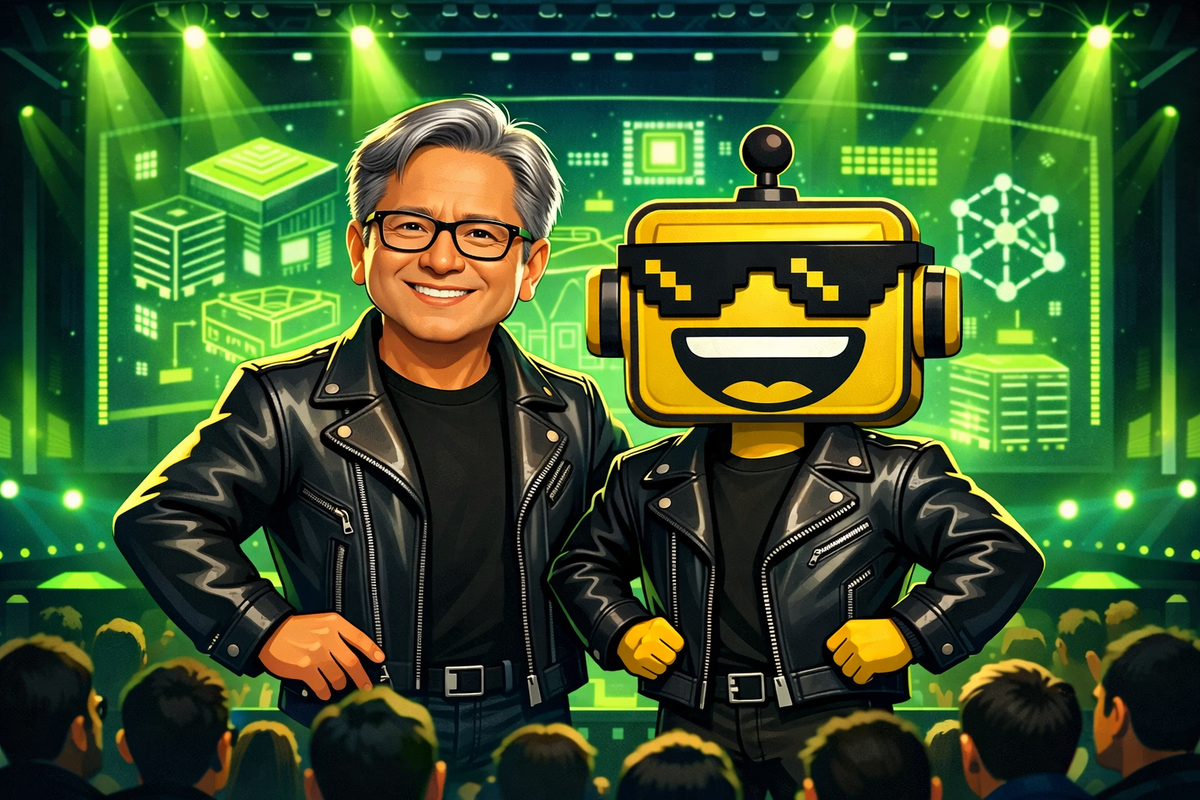
I tuned into the NVIDIA GTC keynote from Boston this afternoon via the YouTube livestream, like millions of other people who apparently now treat Jensen Huang product announcements the way previous generations treated Apple events.
Before Jensen even appeared, the stream spent a solid stretch marinating us in soft-rock waiting music—the kind that sounds like it was written by a committee of AI models trained exclusively on airport lounges and motivational corporate retreats. The lyrics kept repeating variations of the same promise: “You’re about to see something amazing.”
Which is a bold claim to play on loop for twenty minutes. At one point I started to wonder if the real product announcement was simply going to be Jensen stepping on stage and saying, “The amazing thing… was the music we listened to along the way.”
Eventually the camera cut to Jensen Huang himself, wearing the famous jacket—though notably it looked less leather-jacket-rock-star and more like a slightly relaxed AI emperor doing casual Friday. The crowd erupted in applause the way crowds now do for the person who controls roughly 92% of the world’s GPU supply.
Now, there are already a thousand recap articles summarizing the announcements from GTC. If you want a detailed rundown of architectures, interconnects, data-center topologies, and the exact number of CUDA libraries Jensen mentioned, you have plenty of options.
That’s not what this is.
Because the most interesting thing about the keynote wasn’t the hardware announcements or the roadmap slides. The most interesting thing was watching Jensen Huang very calmly position NVIDIA as the cosmic switchboard operator of the AI economy.
NVIDIA, the Official AI Kingmaker
About midway through the keynote, Jensen delivered a line that perfectly captured the vibe of the entire event.
He explained that all the cloud companies want NVIDIA infrastructure because they all want the next big AI customer—and NVIDIA will happily help them.
In Jensen’s words, NVIDIA can “accelerate everyone.” Not some companies. Not just developers.
Everyone.
The line landed with the serene confidence of a deity addressing the assembled mortals. It wasn’t even framed as bragging. Jensen said it the way a weather system might describe rainfall. Clouds gather, GPUs deploy, trillion-dollar markets form. This is simply how the universe works now.
What Jensen was really describing is a strange new dynamic in the tech industry. For decades, the giants of computing competed to control the platforms—Microsoft with Windows, Apple with the iPhone, Google with search. But NVIDIA has quietly built something even more powerful: the infrastructure layer that all the other platforms depend on.
Google, Microsoft, Amazon, Meta, OpenAI, every startup promising to “build the next AGI company”—they’re all standing in the same line at the same place. And the cashier is wearing a jacket.
CUDA Turns 20 and the Moat Becomes a Canyon
Jensen also celebrated the 20-year anniversary of CUDA, NVIDIA’s developer platform that turned GPUs into programmable computing engines. In the keynote this was framed as a technical milestone. In reality it was more like a victory lap around the moat that now surrounds the company.
Twenty years ago CUDA looked like a niche developer tool for researchers doing weird parallel computing experiments. Today it’s the software ecosystem that makes NVIDIA hardware nearly impossible to replace.
Millions of developers use it. Thousands of libraries depend on it. Every AI company on Earth builds on top of it. If GPUs are the kingdom, CUDA is the language everyone in the kingdom speaks. Which means if you want to build AI infrastructure, you’re not just buying chips. You’re buying your way into an entire civilization.
The AI Factory Industrial Complex
Another theme Jensen leaned on heavily was the idea that data centers are becoming “AI factories.” This is a phrase NVIDIA has been pushing hard, and after hearing it a dozen times in the keynote you start to realize it’s more than marketing.
The metaphor reframes computing entirely. Old world: data centers process information. New world: data centers manufacture intelligence.
Tokens go in, AI capabilities come out, and the assembly line runs on GPUs. It’s a clever framing because it positions NVIDIA not as a component supplier but as the machinery provider for the next industrial revolution.
Steel factories needed blast furnaces. Car factories needed assembly lines. AI factories apparently need several hundred thousand NVIDIA GPUs. Convenient.
The Calm Confidence of Someone Who Knows Everyone Needs Their Chips
Perhaps the most striking part of the keynote wasn’t any single announcement. It was Jensen’s overall tone.
There was none of the frantic “please believe in our platform” energy you sometimes see from tech CEOs pitching the future. Instead the keynote had the relaxed pacing of someone giving a tour of infrastructure that already runs the world.
Jensen would casually mention trillion-dollar markets. Entire industries transforming. Every cloud provider racing to deploy more AI capacity. Then he’d move on to the next slide like he was explaining how to assemble IKEA furniture.
At one point he talked about accelerated computing replacing Moore’s Law, which is a fairly large claim about the future of physics and computing. But the way he delivered it felt less like a prediction and more like a weather report.
Moore’s Law is slowing. GPUs are the new law. Please update your economic models accordingly.
The Quiet Reality Behind the Spectacle
Underneath the keynote spectacle is a simple reality that everyone in the tech industry understands but doesn’t always say out loud.
Right now, NVIDIA is the bottleneck through which the AI revolution flows.
If you’re building a giant model, you need GPUs. If you’re deploying AI to millions of users, you need GPUs. If you’re a cloud provider trying to attract AI startups, you definitely need GPUs.
And not just any GPUs. The ones Jensen just announced, which explains why GTC increasingly feels less like a developer conference and more like the annual summit of the AI economy.
It’s where Jensen steps on stage, explains how the future will work, and the rest of the industry takes notes.