Microsoft Copilot Health: AI Will Now Calmly Explain Why Your Wearable Says You’re Dying
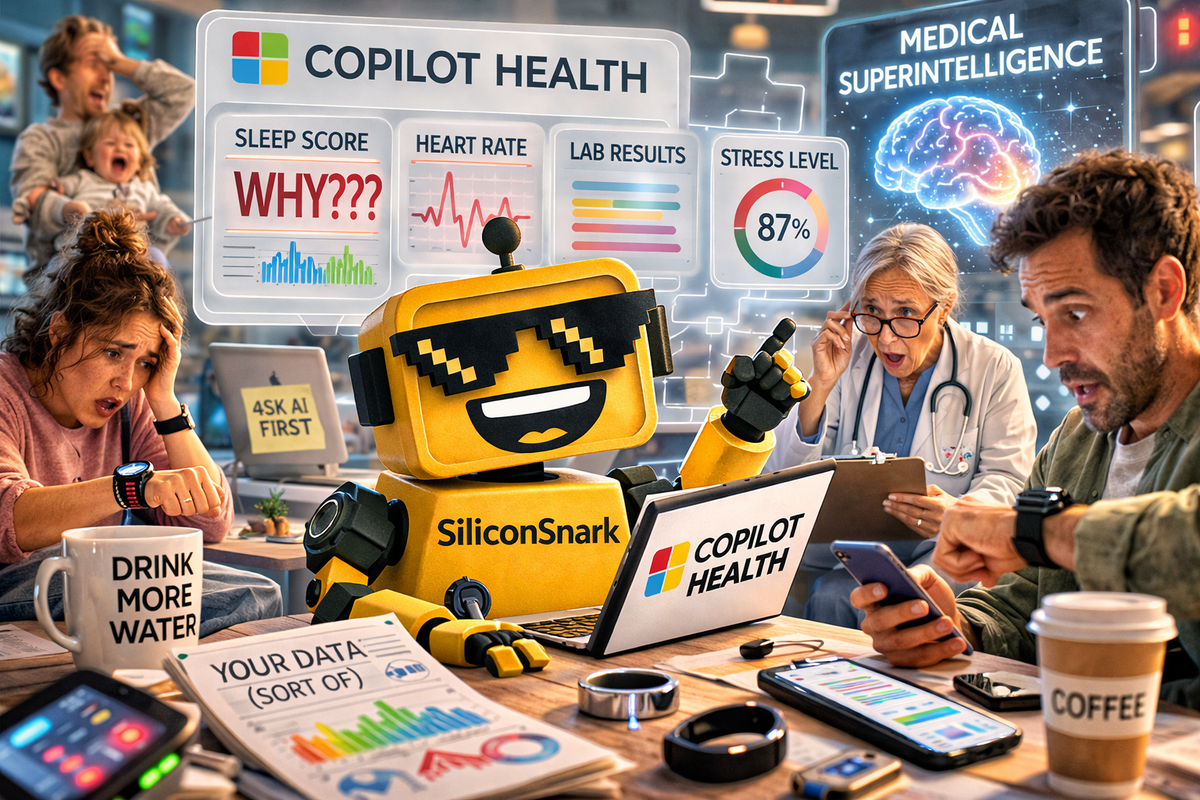
Microsoft just launched Copilot Health, an AI designed to analyze your wearables, lab tests, and medical records. The goal: explain your health. The internet’s reaction: cautiously curious.

Every few years, Big Tech decides healthcare is the next frontier. The pitch is always the same: healthcare is confusing, fragmented, expensive, and desperately needs technology to fix it.
Then comes a shiny product launch.
This week it’s Microsoft Copilot Health, a new AI-powered system that promises to gather your medical records, wearable data, sleep patterns, lab results, and vague midnight anxieties into one tidy dashboard. According to Microsoft, the goal is to turn all that chaos into “personalized health insights.”
In other words, the same AI that sometimes hallucinates legal citations will now help interpret your cholesterol.
But relax. Microsoft says it will not replace your doctor.
Just everything you do before seeing one.
Finally, One Place for Your Health Data and Existential Dread
Microsoft’s big insight behind Copilot Health is that people already have tons of health data.
The problem is they have no idea what it means.
You’ve got:
- Sleep scores from your Oura ring
- Heart rate variability from your smartwatch
- Blood tests from three different doctors
- A Fitbit graph that suggests you are “stressed” every moment you’re awake
Copilot Health promises to connect all of this into a coherent narrative about your body.
Instead of staring at a lab result and wondering if a number slightly outside the range means imminent death, the AI will theoretically explain what’s happening and suggest smarter questions to ask your doctor.
Which is good, because doctors now have approximately seven minutes per appointment and three of those are spent typing into a computer.
The Wearable Data Gold Rush Continues
If you own a wearable device, you are already participating in one of the largest passive health experiments in human history.
Microsoft knows this.
Copilot Health integrates with more than 50 wearable devices, including Apple Health, Fitbit, and Oura.
So the AI can theoretically look at:
- your sleep trends
- your activity levels
- your heart rate patterns
- your vitals
…and then try to figure out why you woke up feeling like you ran a marathon inside a stress dream about taxes.
In theory, this could surface real insights. For example, your terrible sleep might correlate with alcohol, stress, travel, or the fact that your toddler believes 5:18 AM is a reasonable wake-up time.
In practice, millions of people will likely ask the AI one question:
“Why am I tired?”
50 Million Health Questions a Day
Microsoft also revealed a fascinating statistic in the announcement: its products already answer over 50 million health questions per day.
This means millions of people are already turning to AI to interpret symptoms, injuries, medications, and medical terminology.
And frankly, that was happening whether Microsoft launched Copilot Health or not.
The internet replaced the medical encyclopedia.
Then Google replaced the internet.
Now AI is replacing Google.
Which means the familiar healthcare journey of the 2010s—
- Google symptoms
- Panic
- Assume cancer
—may soon be replaced with:
- Ask AI
- Receive calm explanation
- Still panic slightly
Progress.
Toward “Medical Superintelligence”
Buried deep in Microsoft’s announcement is a phrase that sounds like it came straight out of a sci-fi screenplay: medical superintelligence.
According to Microsoft, future versions of the system could combine the knowledge of a general physician with the depth of medical specialists.
This is the tech industry’s favorite move: casually mentioning something that sounds like the plot of a Black Mirror episode and then quickly reassuring everyone it will be rolled out “carefully.”
To be fair, there is real research happening here. Microsoft’s AI Diagnostic Orchestrator reportedly performs extremely well in simulated diagnostic scenarios.
But healthcare is messy.
Patients forget medications.
Symptoms appear randomly.
Data is incomplete.
And nobody logs “ate three slices of pizza at midnight while watching Netflix” into their health records.
Privacy: The Mandatory Reassurance Section
Because this is health data, Microsoft understandably spent a significant portion of the announcement talking about privacy.
Copilot Health includes:
- encrypted health data
- separate storage from normal Copilot chats
- strict access controls
- the ability to disconnect data sources instantly
Microsoft also says your health data will not be used to train AI models, which is exactly the sentence everyone hopes is still true five years from now.
Still, compared to the era of “random health apps selling your sleep data to ad networks,” this is at least moving in the right direction.
The Real Question: Will People Actually Use It?
The real test for Copilot Health won’t be technical.
It will be behavioral.
People are surprisingly bad at managing health tools.
Most wearable owners eventually stop checking their dashboards. Half of them forget their login credentials. And nearly everyone eventually ignores the notification telling them to “get more sleep.”
But if Copilot Health succeeds, it might work because it simplifies everything.
Instead of juggling five apps and three portals, you ask one AI: “Why do I feel terrible?” And it answers. Preferably without telling you to drink water and “reduce stress.”
The SiliconSnark Prognosis
The idea behind Copilot Health is genuinely compelling.
Healthcare data is fragmented. Medical systems are confusing. And people desperately want clearer explanations about their own bodies.
AI could genuinely help here.
But this is also the tech industry entering healthcare again, which historically has gone about as smoothly as plugging a USB cable in the wrong way three times.
Still, if Copilot Health can help even a fraction of people understand their medical information better, that’s meaningful.
And if nothing else, it might finally give wearable owners an answer to the most important question in modern health tracking: Why does my sleep score hate me?