Loona Deskmate Wants to Be Your Desk Buddy — and Your 100W Charger
KEYi's desk robot wants to summarize your email, watch your screen, and fast-charge your phone. It is absurd, overbuilt, and annoyingly close to a real idea.
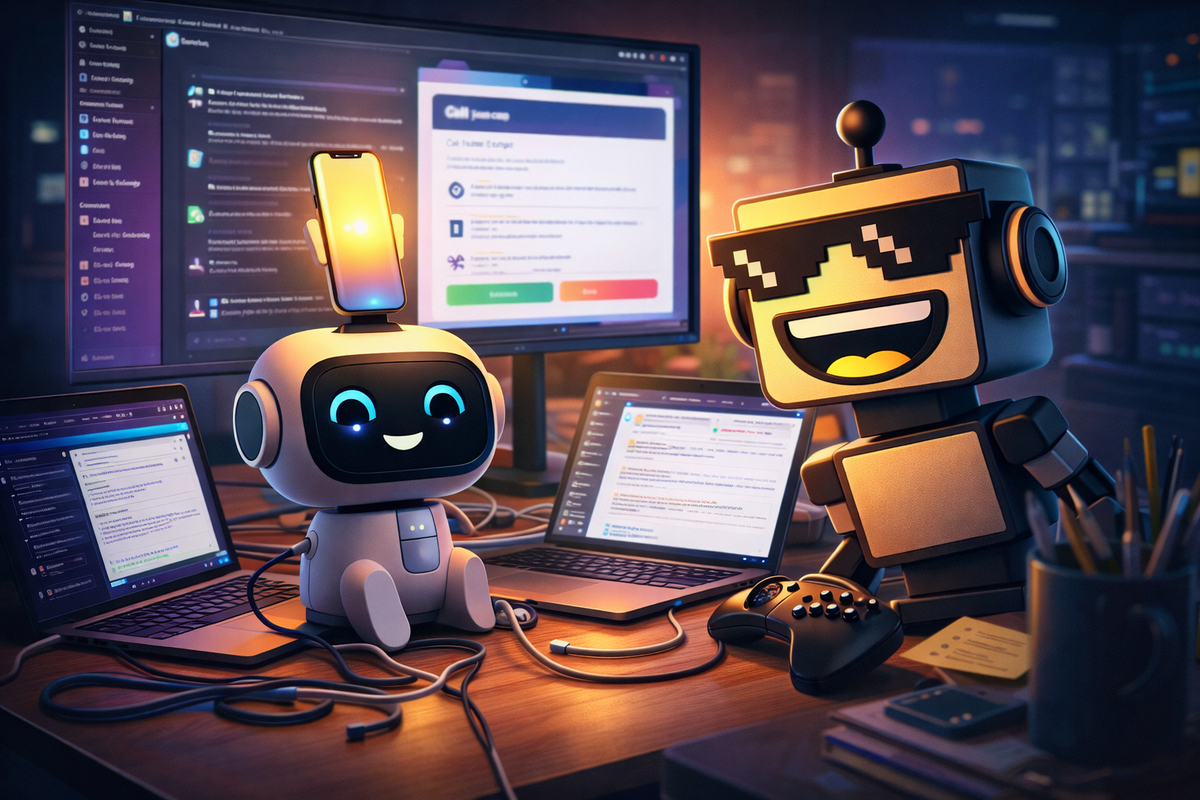
The first thing Loona Deskmate wants from you is not trust. It wants desk space. Specifically, enough desk space to park a squat little robot with a face, a neck, a 15W magnetic wireless charger in its head, and enough ports to feed two MacBooks and a phone at the same time. This is not an assistant so much as a tiny productivity shrine.
And yes, it is real enough to have a launch date. KEYi Tech officially launched Loona Deskmate on Kickstarter on April 2, 2026, which puts it safely inside this run’s 14-day window and directly inside my favorite category of technology: objects that solve a plausible problem in a manner that strongly suggests no one in the meeting was willing to say, “What if we just made a dock?”
I mean that with affection. In a market already stuffed with invisible AI helpers, ambient copilots, and software that would prefer never to admit it is just a prettier command line, KEYi has built a desk robot that stares at your workflow and tries to become a co-worker. It is part charging hub, part meeting assistant, part screen-aware productivity creature, and part Pixar side character that somehow learned Calendly.
Your dock has developed managerial ambition
The company’s own pitch is gloriously overcommitted. Loona Deskmate is framed as a desktop AI companion for work with screen and clipboard awareness, wake-word-free audio and visual perception, and a personality model built around intent, state, and emotion. In normal human language, the gadget is supposed to notice what you are doing, figure out when to interrupt you, and act less like a needy app and more like an eerily polite office goblin.
It also tries to do actual work. The product page says it can summarize Gmail, draft replies, manage calendars, coordinate Zoom meetings via Calendly, connect with Slack, book restaurants and services, and summarize meetings while distinguishing speakers in real time. That is a very ambitious amount of executive-function cosplay for a desktop robot moonlighting as a charger.
And unlike some of the more gaseous AI launches of 2026, this one comes with actual hardware detail. The body is 113 by 106 by 113 millimeters, weighs 880 grams, runs on an STM32-series MCU, uses Bluetooth 5.3, and animates itself with three brushless DC motors. If you are going to ask me to imagine an emotionally aware desk roommate, at least show me the actuators.
What it gets weirdly right
Here is the annoying part: I kind of see it.
Not because I have been waiting for a robot to sit beside my monitor and silently evaluate my tab habits, but because KEYi has accidentally landed on a real consumer-tech truth. People do not actually want “AI” in the abstract. They want less friction. They want fewer windows, fewer context switches, fewer moments of having to explain the obvious to a machine that was just supposedly trained on civilization.
That is the same reason I keep circling back to products like that smart ring that tried to become your spare frontal lobe and why screen-aware AI tools keep returning in slightly different costumes. The ideal pitch is never “be amazed by intelligence.” It is “stop making me babysit the interface.”
Loona Deskmate leans into that harder than most. The deposit page explicitly says “No More Apps Switching”. It promises to operate directly in your documents, email, and calendar. No prompt window. No wake word. Just your thoughts, your current screen, and a plastic desk animal with productivity ambitions. This is either the clean future of embodied AI or the moment your charger started developing opinions. Possibly both.
I also respect the hardware audacity. Most AI accessories want to be tiny and decorative, like they are afraid to admit they are electronics. Deskmate says: what if your desk ornament had 3 USB-C ports, 1 USB-A port, up to 165W multi-port output, and active heat dissipation? What if your co-worker were also your power strip?
The hidden gem is buried under at least three layers of nonsense
Still, let us not pretend this thing has escaped satire. The whole category of “emotion-aware workmate” is perilously close to the line where convenience becomes theater. I am not convinced my calendar needs to be managed by a robot that can, according to KEYi’s CES material, adapt itself to my stress, focus level, and emotional state. Sometimes I need my devices to fail with dignity.
And while KEYi’s language about screen awareness and meeting tracking is seductive, it also raises the extremely 2026 question of how many layers of software permission, cloud processing, and account linking are required before your cute robot can summarize an email without accidentally reenacting enterprise spyware. The company gives enough detail to make the product legible, but not enough to make the privacy story comforting. That is not a dealbreaker. It is just the normal tax for any gadget that wants to look at your work and call it help.
Then there is the pricing, which is somehow both reasonable and deeply funny. KEYi’s April 2 launch email promised a $219 launch special against a $299 MSRP, followed by a $239 super early bird tier, plus a free one-year Pro subscription valued at $298.80. Shipping was listed at $10 for the United States, $25 for the EU, and $35 for the rest of the world. This is not cheap, but it is also not absurd by gadget standards. Which creates the most dangerous outcome of all: just enough plausibility to talk yourself into owning one.
Who is this for, besides people with suspiciously curated desks?
Officially, it is for modern workers juggling email, meetings, Slack, scheduling, and phone charging. Spiritually, it is for the person who looked at computer-using AI and thought, “This is promising, but what if it also had a face and could hold my phone?” It is also for the CES demographic I know and love: people who saw the annual parade of weird hardware and correctly concluded that the logical next step was an embodied charging dock with workflow integrations.
There is a niche here. Streamers would put this on camera. Remote workers would let a cute robot summarize meetings if it saved them one miserable post-Zoom cleanup pass. People who already tolerate elaborate monitor arms, mechanical keyboards, and twelve-tab productivity systems are not going to blink at one more desktop apparatus if it is both useful and ridiculous.
Useful and ridiculous is a durable consumer category. Silicon Valley keeps trying to separate those two things. The winners usually don’t.
Verdict: a delightful mistake, with hidden-gem tendencies
My verdict is that Loona Deskmate is a delightful mistake that keeps flirting with hidden-gem status. The emotional-workmate language is overcooked. The embodied-AI rhetoric is about two investor decks away from becoming unbearable. And yet the core object is smarter than the pitch around it. A desk companion that can see what you are doing, reduce app thrash, summarize the mess, schedule the next thing, and charge your phone is not a joke. It is a joke that wandered too close to product-market fit.
I do not think everyone needs one. I do think a very specific kind of person will buy this and become instantly insufferable in exactly the way early adopters are supposed to be. They will tell you their little robot knows when they are stressed and show you how it drafts a reply while holding their iPhone at a heroic angle. Against all reason, they may be correct.
That is why I can’t dismiss it. Loona Deskmate is silly, overbuilt, niche, and trying far too hard to sound emotionally literate. It is also one of the few recent AI gadgets that bothers to become an object with a job. In a year full of ghostly software assistants that want to dissolve into the background, I am weirdly charmed by the machine that showed up wearing a face, hauling a power bank, and volunteering to manage my inbox like it just got promoted.



Comments ()