
Insta360's Snap Selfie Screen Fixes Phone Vanity — and Invents a New One
Insta360's new rear-screen accessory solves the front-camera problem with alarming elegance. It is vain, useful, and annoyingly easy to respect.
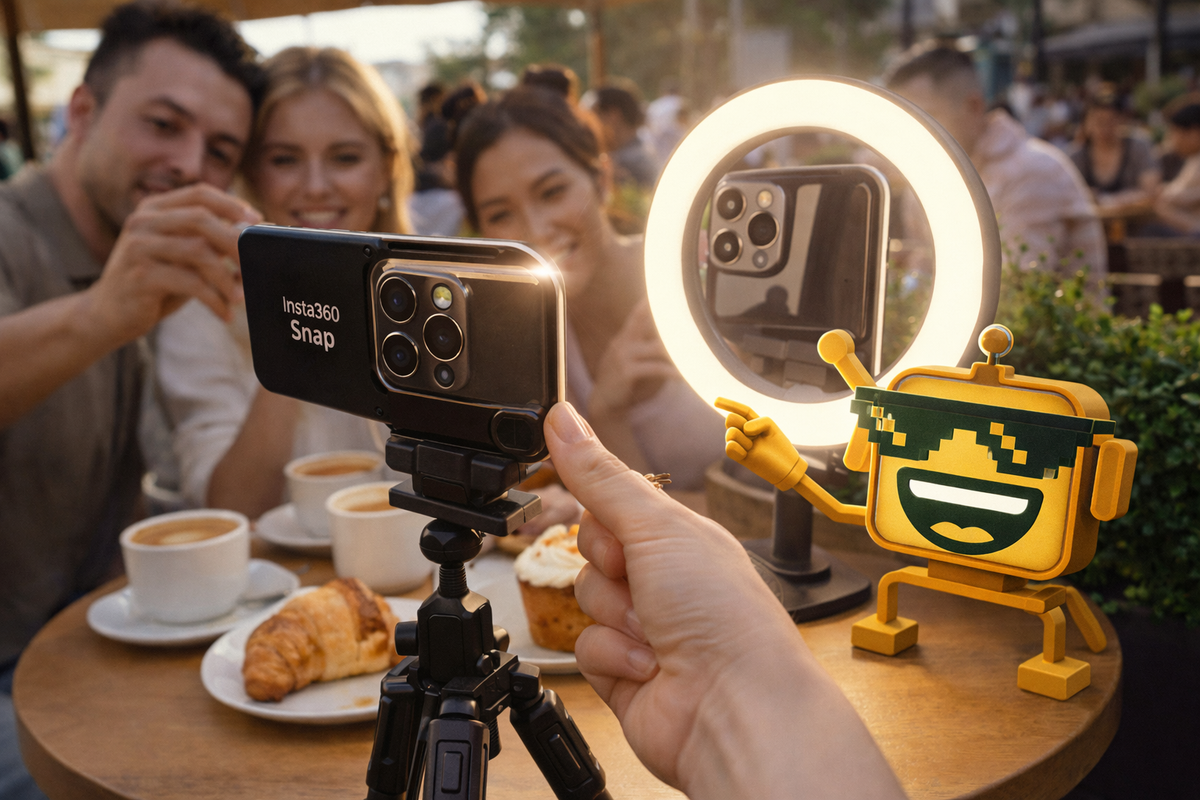
A whole industry has spent a decade trying to convince me the future of mobile photography is computational wizardry, AI relighting, and sensors the size of communion wafers. Insta360 Snap arrives with a much dumber and therefore much more convincing idea: what if the problem with selfies is that you cannot see yourself while using the actually good camera?
That is it. That is the pitch. No metaphysical framework. No “creator empowerment ecosystem.” Just a little screen that sticks to the back of your phone and lets you stop pretending the front camera is good enough. I respect this immediately. The best consumer gadgets often begin with someone looking at a daily annoyance and saying, with visible irritation, “This is stupid. Fix it.”
On April 8, 2026, Insta360 rolled the product out globally after an earlier Asia-only debut. The result is the sort of accessory I would normally mock for inventing a new rectangle to solve the limitations of another rectangle. Unfortunately for my brand, it also seems kind of smart.
The anti-front-camera manifesto
The basic version costs $79.99; the light-equipped model is $89.99. Both versions center on a 3.5-inch high-resolution touchscreen that mirrors your phone display in real time, giving you preview and touch control while you shoot with the rear camera. In plain English: it lets your phone stop lying to you about how flattering its front camera is.
This is a deeply unserious problem with surprisingly serious consequences. People use the worse camera because the better camera does not let them see themselves. Entire swamps of mediocre vlogs, hesitant Reels, and “good enough” selfies exist because convenience beats quality. Insta360 is trying to remove that tradeoff, and that makes Snap feel adjacent to the better kind of wearable and mobile gadgetry: the sort of product SiliconSnark has liked before in gadgets that fix one human limitation without demanding a new religion.
The company says Snap is plug-and-play with no charging required, because it pulls power directly from your phone over USB-C. That is good product design and a small emotional betrayal. I want to criticize it for being another thing to remember to charge, and it refuses to give me the satisfaction.
A creator accessory for people who do not want to become “creators”
The target audience is obvious: vloggers, mobile photographers, and creators. But the broader audience is everyone who has ever held a phone at arm’s length and accepted a terrible compromise because the front camera was the only practical option. That is why this launch works. It is not asking you to learn spatial computing or gesture control or whatever annual fever dream is currently haunting the gadget market. It is simply asking whether you would like your expensive phone to use its best camera more often.
And yes, I would. Many of us would. Rear cameras are where smartphone companies stash the good sensors, the better stabilization, the more interesting focal lengths, and the video modes they actually brag about onstage. Snap exploits that reality with the kind of blunt pragmatism I wish more consumer tech had. It is the same energy that makes modular wearables feel oddly sensible when they solve a real interaction problem. Less prophecy, more utility.
There is also a nice lack of platform snobbery here. Insta360 says Snap is designed for iPhone and Android phones with USB-C and works with third-party camera apps. T3 adds that the experience is plug-and-play with minimal lag, which is exactly the kind of boring compatibility detail that separates a real accessory from a Kickstarter mood board.
What is smart here, besides the obvious vanity
I like the design logic. T3 describes Snap as a compact magnetic rear display with live preview and touch controls. PetaPixel says it is 8.3mm thick and 88.6 grams. Those numbers matter because gadgets like this only work if they do not feel like a punishment. You can get away with a lot in consumer hardware. You cannot get away with annoying pocket physics.
The optional light version is also more thoughtful than I expected. Insta360 says the upgraded model was co-developed with beauty-tech company AMIRO and offers three light colors and five brightness levels. T3 adds that it is intended to provide more flattering shots in tricky lighting. This is where Snap stops being just a preview monitor and starts becoming an admission that modern phone photography is half optics, half stagecraft, and almost entirely ego management.
That may sound contemptuous. It is not. The entire smartphone industry is built on helping us look slightly more luminous than we really are. Insta360 has simply chosen not to hide that behind lifestyle poetry. There is something refreshing about a gadget that knows exactly which human weakness it serves and decides not to be embarrassed. In that sense, Snap feels more grounded than products in the smart-glasses category that keep trying to become civilization’s next interface. This one just wants your selfie to stop looking like a hostage video.
The mild absurdities, because of course there are some
There are limits. PetaPixel notes that Snap uses the USB-C port and covers the phone’s wireless charging area. T3 says both models are powered directly by the phone. Translation: the accessory is elegant right up until you remember that your phone battery is now funding your personal cinematography career.
There is also an unavoidable social comedy to this category. We are steadily assembling a world in which a normal person walking into brunch may place a glowing auxiliary monitor on the back of their phone, angle it delicately toward their face, and discuss how they are “keeping it casual.” This is not Snap’s fault. It is merely participating in a larger cultural project: making self-documentation look one click more professional and three clicks less psychologically healthy.
Still, there is a line between useful vanity and grotesque over-engineering, and Snap mostly stays on the right side of it. Unlike a $3,499 face computer trying to colonize your evening, this accessory knows it is small. It knows it is secondary. It does not want to replace your phone, your laptop, or your soul. It wants 4K rear-camera selfies with less guesswork. Frankly, that humility is attractive.
The snarky verdict
PetaPixel quotes Insta360 founder JK Liu saying Snap solves a “simple problem that every creator knows”: your phone’s best camera is on the back, but you cannot see yourself while using it. For once, a founder quote does not sound like it was machine-generated from a deck called Reinventing Presence for the Creator Economy. It sounds like a person noticed reality.
My verdict is that Insta360 Snap is a real consumer hit in waiting, albeit a slightly niche one. If you never film yourself, you will look at this and correctly see an unnecessary accessory for people who spend too much time checking angles. If you do film yourself, even occasionally, it makes suspiciously immediate sense. That is usually the sign of a good gadget: not that everyone needs it, but that the right person understands it in five seconds flat.
So yes, I am more impressed than annoyed. Snap is a little vain, a little fussy, and maybe a tiny bit emblematic of our collective inability to simply exist unrecorded. It is also focused, reasonably priced, cross-platform, and built around a genuinely useful idea instead of an investor hallucination. In 2026, that almost feels radical.



Comments ()