
Humanoid Robots, Explained: Why Factories, Startups, and Tech Billionaires Suddenly Want a Mechanical Workforce
Humanoid robots are leaving demos for factories and warehouses. This guide explains the tech, labor incentives, competition, safety issues, and hype.
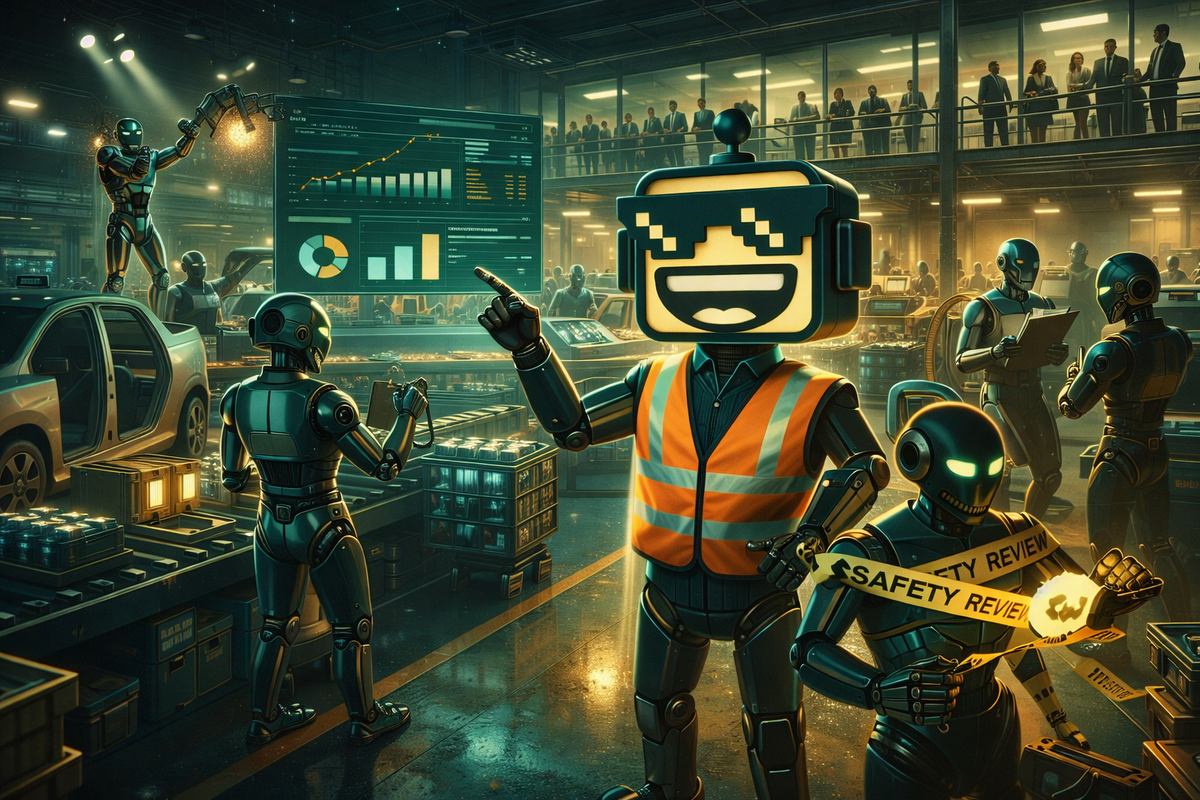
On February 27, 2026, BMW said it would deploy humanoid robots in production in Germany for the first time. That sentence deserves a slow reread, because it is the sort of corporate phrasing that can sound boring right up until you realize it means a major manufacturer is moving the humanoid-robot story one step farther away from conference-theater gimmickry and one step closer to “this now has a procurement budget.” BMW’s release said the Leipzig pilot would use Hexagon’s AEON humanoid robot, with additional testing in April 2026 and planned pilot integration in summer 2026. The same materials also leaned on a prior result from BMW’s Spartanburg plant in South Carolina, where Figure’s robot had already helped support production of more than 30,000 BMW X3 vehicles over ten months.
This is a very 2026 way for a category to become real. Not with one dazzling moon-landing moment. Not with a robot chef making one perfect omelet in a glass booth while venture capitalists applaud like seals at a yacht club. With a German automaker saying, in essence, that the previous pilot worked well enough to justify a new one somewhere even less cinematic.
That is the real why-now. Humanoid robots are no longer just a collection of unnerving demo clips, billionaire prophecies, and YouTube videos titled as if the singularity personally RSVP’d to brunch. They are becoming a serious industrial category because three things are happening at once. First, the hardware is better. Second, the AI stack for perception, planning, and manipulation is finally strong enough to make general-purpose behavior feel less like wishful branding. Third, companies are staring at labor shortages, ergonomics problems, uptime pressure, and decades of environments built for human bodies and deciding that maybe the cheapest way to automate more work is not to rebuild every facility from scratch, but to send in a machine roughly shaped like the employee the site was already designed around.
If that sounds practical, it is. If it sounds faintly sinister, it is also that.
SiliconSnark has been orbiting this topic for a while. In our earlier guide to the AI robot race, the point was that robotics had escaped the lab-and-toy trap and re-entered industry with serious intent. In our Apptronik coverage, the signal was that investors now treat humanoids like an infrastructure class rather than a novelty. In our CES piece on Boston Dynamics and Google DeepMind, the thesis was that physical AI had stopped asking for theoretical respect and started asking for deployment. This guide pulls those threads together into the bigger category story: why the humanoid form keeps coming back, what has actually changed technically, where the money and incentives are, who the real contenders are, where the hype still outruns physics, and what it means when the tech industry’s favorite new interface turns out to be a body.
The Nut Graph: This Is Not Really a Story About Cool Robots, It Is a Story About Expensive Human Environments
The easiest way to misunderstand the humanoid-robot boom is to frame it as a pure engineering vanity project. To be fair, the category has earned that suspicion. Technology has a long and glorious history of spending absurd sums to recreate something nature already shipped in volume. Every few years, somebody stands onstage beside a robot with two arms, two legs, and a heroic jawline and informs us that civilization is about to be transformed by a machine that looks suspiciously like an underpaid warehouse associate with better posture.
But the underlying business logic is not frivolous. Most workplaces were built for human reach, human grip, human mobility, human tools, human shelves, human ladders, human boxes, human buttons, and human nonsense. That includes warehouses, factories, hospitals, retail floors, back rooms, laboratories, and a depressing number of offices whose chairs are arguably a workers’ comp claim waiting to happen. Conventional automation works brilliantly when the task is stable enough that you can redesign the environment around the machine. Industrial robotics already dominates welding, painting, and countless repetitive motions because the line can be structured around a fixed robot’s strengths. The challenge begins in the awkward middle of the economy, where tasks are varied, spaces are messy, objects are inconsistent, and the work is just physical enough to be irritating, dangerous, repetitive, or hard to staff, but not so stable that a custom robot cell makes economic sense.
That is where the humanoid pitch becomes legible. If the world is already human-shaped, a robot with human-ish mobility and manipulation can in theory use the same aisles, racks, stairs, carts, bins, fixtures, handles, and workstations. It can go where people go without asking a company to rebuild the entire site into a robot cathedral. This is why Agility framed Digit’s deployment at GXO as an answer to “dull, dirty, and dangerous tasks” in human spaces. It is also why BMW keeps emphasizing physical AI as something integrated into existing manufacturing systems rather than as a museum exhibit for executives with PowerPoint access.
So this guide is about more than robotics. It is about labor markets, capital allocation, industrial design, safety regimes, AI progress, procurement psychology, and the eternal managerial dream of turning every inconveniently biological problem into software plus hardware depreciation. The human shape matters here, but mostly because the built world is already organized around it. The torso is the least mystical part of the story.
Why the Human Form Keeps Winning the Boardroom Pitch
There is a serious technical debate inside robotics about whether humanoids are actually the best answer for most jobs. Often they are not. Wheels are more efficient than legs on flat ground. Fixed arms can be cheaper, faster, and easier to maintain than full-body generalists. Specialized robots usually beat humanoids at a narrow task for the same reason a forklift beats a ballerina at moving pallets. This is not controversial. It is engineering adulthood.
And yet the human form keeps returning, because “best” depends on the environment, the task mix, and the cost of change. Humanoids are not trying to win every contest. They are trying to be good enough across many existing human contexts to unlock automation where purpose-built machinery either cannot go or cannot justify itself. That is different. It is the same reason the smartphone beat countless dedicated gadgets. It was rarely the perfect camera, perfect map, perfect music player, perfect remote, or perfect gaming handheld. It was the good-enough universal object already in your pocket. Humanoid-robot founders are chasing the same outcome for physical work: not the perfect machine for one job, but the first machine competent enough to do enough jobs in enough places that deployment scales faster than custom automation.
There is also a commercial storytelling advantage here. A humanoid robot photographs well, demos well, and satisfies investor pattern recognition in a way that “flexible mobile manipulator with modular end effectors” simply does not. Venture capital likes narratives that can be sketched on a napkin without losing the room. So does the press. “Robot worker, but person-shaped” has been legible for a century. It activates science fiction, labor anxiety, industrial ambition, and a certain genre of executive self-regard all at once.
That does not make the category fake. It means the category benefits from an unusually potent mix of practical logic and theatrical symbolism. Some of the companies exploit that shamelessly. Some genuinely need it because their fundraising burden is enormous. Hardware is expensive, data collection is expensive, simulation is expensive, supply chains are expensive, and every graceful piece of robot motion has a small bonfire of capex hiding behind it. A photogenic body helps. The fact that the photogenic body might also be genuinely useful in a warehouse is what turns the current moment from absurd to consequential.
If you want the shortest honest summary, it is this: humanoids keep winning attention because they fit the world, sell the future, and spare buyers from rebuilding everything first. That does not mean the thesis is proved. It means the thesis finally has enough industrial logic that serious people have started testing it outside a keynote.
The Short History: We Have Been Building Toward This Longer Than the Current Hype Admits
The modern humanoid boom did not begin with Optimus, Figure, or any other startup that recently discovered the torso and then behaved as if bipedalism had been invented during a seed round. The lineage is older and messier. Honda’s ASIMO, unveiled in the early 2000s after years of development, taught the broader public that a robot could walk in a way that felt weirdly human and still be mostly useless outside demos. Boston Dynamics spent years building some of the world’s most impressive machines, including the original hydraulic Atlas, and in the process trained an entire generation of viewers to equate “astonishing movement” with “commercially inevitable,” which are not the same thing. Academic robotics spent decades on locomotion, manipulation, balance, control, sensing, and planning while the market mostly waited for batteries, compute, machine learning, and component costs to catch up.
The crucial difference between then and now is not that robots suddenly learned to move. It is that the surrounding stack matured. Electric actuators improved. Batteries improved. Compute got cheaper and denser. Cameras and sensors got better. Simulation got more useful. Machine learning became dramatically more capable at perception and policy learning. And large AI models changed the economics of generalization by making it more plausible that one system could interpret messy instructions, map them onto variable environments, and recover when the world refuses to behave like a lab bench.
This is where the modern “physical AI” framing comes in. It can be a buzzword, yes. Silicon Valley will happily pour gravy over any noun if it thinks the market prefers sauce to structure. But there is a real distinction underneath the branding. Classical robotics often relied on highly engineered, brittle workflows in constrained spaces. The new push combines those hard-won robotics techniques with data-hungry learning systems that can perceive, adapt, and plan more flexibly in unstructured settings. Google DeepMind’s March 12, 2025 Gemini Robotics announcement was one of the clearest statements of that shift, presenting a vision-language-action model aimed at turning multimodal reasoning into motor output. On its current product pages, DeepMind says Gemini Robotics 1.5 can adapt across multiple embodiments, including Apptronik’s Apollo humanoid. In other words: the model world is trying to become the robot world.
That does not mean the old constraints vanished. Anyone telling you modern AI solved robotics outright should be sentenced to one week of trying to pick up a cable bundle with a gripper in an unlit room. But the recent progress is enough to move the conversation from “can a humanoid do an impressive trick?” to “can a humanoid do useful work for enough hours that a business cares?” That second question is the one that matters. It is also the question more companies can now plausibly attempt to answer.
What Changed Technically: From Video Models and Simulators to Hands That Occasionally Behave
Humanoid robotics is not one breakthrough. It is a stack of partial improvements that finally interact well enough to look like momentum. Start with perception. Robots need to know what is in front of them, where it is, whether it is moving, how graspable it is, and what counts as success in a task. Computer vision has become vastly more capable, especially once modern models began fusing text, image, and action more fluidly. A robot no longer has to treat every environment as a brittle puzzle hand-coded by a patient graduate student who has not slept since the Obama administration.
Then there is planning. A robot that sees the world but cannot break goals into steps is just a very attentive liability. The current crop of embodied-AI systems is promising better long-horizon reasoning, recovery from errors, and adaptation to new objects or instructions. DeepMind’s embodied reasoning work, Figure’s Helix platform, Tesla’s vision-and-planning rhetoric around Optimus, and NVIDIA’s simulation-heavy Isaac ecosystem all exist because the category now believes general-purpose policies can be trained, transferred, and fine-tuned faster than classical pipelines could be painstakingly engineered by hand.
Dexterity is the more brutal bottleneck. Walking is dramatic, but hands pay the rent. If a robot cannot grasp, align, insert, carry, hand off, place, and recover from contact with reasonable reliability, it does not matter how elegantly it strolls through the aisle like a runway model for industrial anxiety. That is why demos featuring folding clothes, manipulating small objects, or positioning parts with millimeter precision matter more than theatrical parkour. BMW’s reporting on Spartanburg highlighted exactly this unglamorous value: Figure 02 retrieved and positioned sheet-metal parts for welding with repeatable millimeter accuracy. Nobody is making a prestige TV series about repeatable part positioning. They should. It would be far more economically relevant than most robot dance clips on social media.
Simulation also deserves more respect than it gets in popular coverage. Robotics founders increasingly talk like game-engine executives with stronger opinions about actuators, because they need synthetic environments to train behaviors, test edge cases, and accelerate iteration before a robot ever touches a live site. Agility’s expanded NVIDIA relationship in March 2025 explicitly focused on Isaac Sim and Isaac Lab for training and testing Digit. Figure has similarly tied its roadmap to GPU infrastructure, pretraining data, and manufacturing via BotQ. This is one reason the humanoid race overlaps so heavily with the broader AI infrastructure story SiliconSnark has been covering in pieces like our coding-agents deep dive and our browser guide: the modern product advantage is increasingly the ability to turn data, compute, models, and interface control into deployment speed.
The Current Leaders: Different Companies, Different Theories of the Robot Future
The humanoid field looks crowded, but the contenders are not all selling the same future.
Figure is probably the most obvious pure-play symbol of the boom. The company has pushed hard on the thesis that a generalist humanoid platform, paired with its Helix embodied-AI stack, can move from factory pilots toward broader commercial and home use. In September 2025, Figure said it had exceeded $1 billion in committed Series C capital at a $39 billion post-money valuation, tying the raise to Helix, BotQ manufacturing, and deployments in homes and commercial operations. It is a huge number, a ludicrously confident number, and therefore a very useful number for understanding how seriously capital markets now take the category. Figure’s BMW work matters partly because it turns valuation theater into at least one measurable industrial reference case.
Apptronik is selling a more visibly industrial and partner-heavy roadmap around Apollo. In February 2025, Apptronik announced a $350 million Series A, saying the money would scale Apollo across logistics, automotive, electronics manufacturing, and related verticals. The company has leaned into a “human-centered” design pitch, which is both sensible and exactly the kind of phrase that can mean anything from thoughtful ergonomics to “please do not panic when it enters the room.” Still, Apptronik’s combination of NASA lineage, DeepMind collaboration, and explicit manufacturing ambitions has made it one of the most credible firms in the field. We covered that shift directly in our Apptronik piece, because it was one of those moments when robotics stopped sounding like a side quest and started sounding like an asset class.
Agility Robotics has arguably been the most grounded about near-term commercial logic. Digit is not trying to become your charming domestic helper by Friday. It is trying to do painful logistics work now. That sobriety matters. The company’s long-running focus on moving totes and operating in warehouses may be less glamorous than promises about household abundance, but it is exactly how real automation markets usually form: through repetitive problems with P&Ls attached. GXO’s multi-year agreement with Agility and later updates on Digit’s live deployment are among the strongest pieces of evidence that humanoids can make sense when the task, site, and operator incentives align.
Boston Dynamics occupies the prestige corner of the market. For years it was the company everybody used to measure “robot impressive” while skeptics used the same videos to ask whether any of that elegance would ever become a product. At CES 2026, that question got at least a partial answer when Boston Dynamics publicly demonstrated the new electric Atlas and said a product version was already in production for Hyundai, with deployment planned by 2028. Which is still not tomorrow, but it is a lot less hypothetical than a robot doing calisthenics for the internet’s emotional nourishment.
Tesla, Google, NVIDIA, and the Platform War Beneath the Robot War
Not every important player is trying to be “the humanoid company.” Some are trying to become the indispensable platform layer underneath the category. This is the same structural pattern SiliconSnark has tracked across AI assistants, AI browsers, and agent tooling. The surface product gets headlines. The substrate gets power.
Tesla remains the strangest case because it is simultaneously overexposed and underexplained. On the one hand, Tesla has been relentlessly public about Optimus as part of its broader autonomy mission. Its current AI & Robotics page says the company is building a general-purpose autonomous humanoid robot for unsafe, repetitive, or boring tasks, and Tesla’s April 22, 2025 shareholder materials said it planned builds of Optimus on its Fremont pilot production line in 2025 with wider deployment of bots doing useful work across Tesla factories. On the other hand, Tesla is also an expert practitioner of “show the future early and let the audience fill in the operational details with faith.” That is not useless. Sometimes it is how ambitious products get built. It is also how timelines become decorative. So Tesla belongs in any serious competitive map, but mostly as a company with enormous vertical integration advantages, massive real-world visual data habits, and an unusually high tolerance for announcing destiny before the plumbing is complete.
Google DeepMind is not trying to ship a branded humanoid of its own. It is trying to supply the intelligence layer that many robots may run on. That matters more than it sounds. If embodied foundation models become the equivalent of Android for physical agents, then the companies controlling those models can shape capabilities, tool use, safety frameworks, developer ecosystems, and partner dependency across the entire sector. DeepMind’s robotics program already lists partners and testers across multiple robot forms, and its public safety framing around Gemini Robotics makes clear that it wants a governance role as well as a technical one.
NVIDIA, meanwhile, wants to sell the picks, shovels, and simulated earth. If robots are trained in synthetic worlds, adapted with giant models, and deployed with heavy inference needs, then NVIDIA has already seen this movie and would like to invoice everyone in advance. Simulation tools, training stacks, reference models, and robot-specific compute infrastructure could make NVIDIA as central to physical AI as it became to generative AI. A category becomes strategically important when the chip company starts acting like the map was always going to lead here.
This means the humanoid contest is actually multiple contests nested together: the robot makers, the model makers, the simulation providers, the manufacturing partners, and the enterprise buyers all bargaining over who captures value. If that sounds familiar, it should. Tech history is full of glamorous devices sitting on top of much less glamorous dependency stacks.
Where the Money Is: Labor Gaps, Ergonomics, Resilience, and a Quiet RaaS Dream
The cleanest way to tell whether a robotics category is maturing is to ask what problem buyers think they are paying to solve. In consumer tech, the answer is often vibes, convenience, and occasionally vanity. In industrial robotics, the answer is usually some mix of labor availability, throughput, safety, flexibility, and risk. Humanoid robots are being pitched into exactly that bundle.
Labor is the most obvious incentive, but it is not quite the cartoon version critics and founders sometimes prefer. Companies are not only looking for “replace every worker with metal immediately,” though plenty of executives would no doubt frame that as a productivity enhancement in a tasteful keynote font. They are also trying to staff roles that are hard to recruit for, physically taxing, or too variable for classic automation to absorb. Agility has been unusually direct about this, describing tasks that are repetitive and difficult to hire for in fulfillment operations. BMW has emphasized ergonomics and physical strain, positioning humanoids as a way to move employees out of the most repetitive or awkward motions and toward supervision, quality, and process work.
Those claims should be read neither as pure benevolence nor as pure deception. They are incentive statements. A robot that can reliably handle painful, dull, or hard-to-fill tasks offers multiple forms of value at once: lower injury risk, less turnover pressure, more predictable throughput, and greater resilience when labor markets tighten. The IFR’s World Robotics 2025 executive summary says industrial-robot installations in 2024 reached the second-highest level in history and put operational stock at 4.66 million units. In other words, factories were already automating aggressively before humanoids became the new obsession. Humanoids are entering a market that already believes robots are normal capital equipment when the economics work.
Then there is the business model question. Humanoid founders love talking about generality, but buyers often love operating expenses and service-level assurances. That is why robotics-as-a-service keeps appearing around deployments. If a vendor can sell uptime, maintenance, software updates, safety integration, and performance targets as an ongoing service rather than a one-time hardware gamble, adoption gets easier. It shifts the buyer psychology from “we are purchasing an expensive science project” to “we are contracting for labor-like capability with warranties.” That may be the real gateway to scale. Not the perfect robot, but the robot that arrives with procurement language a CFO can live with.
SiliconSnark has seen a version of this incentive math all across the automation stack. In our robotaxi coverage, the real question was not whether autonomy looked magical in a video but whether operating economics and supervision models could close. In our assistant guide, the question was who gets to sit in the middle of intent and action. Humanoids combine both dynamics. They are an autonomy story with a labor invoice attached.
Why Warehouses and Auto Plants Come First
If you were designing a launch market for humanoid robots, you would not begin in the average family kitchen no matter how many glossy demo videos suggest otherwise. Homes are chaotic, under-structured, full of edge cases, full of pets, full of children, full of textured surfaces and irregular objects and social norms and unexpected obstacles and the kind of moral liability that makes insurance people reach for stronger coffee. Warehouses and auto plants, by contrast, may be large and busy, but they are still comparatively disciplined. Tasks repeat. Objects can be standardized. Workflows can be measured. Safety zones can be designed. Supervisors exist. Failures are costly, but legible.
This is why the current deployment map looks the way it does. Fulfillment centers. Manufacturing plants. Logistics corridors. High-volume environments with chronic ergonomic pain and a decent tolerance for gradual integration. BMW’s two-step progression from Spartanburg to Leipzig is practically a textbook example of category maturation: start where automation is already dense, choose a repeatable task, build trust with a workforce familiar with new systems, document the boring success metrics, and only then widen the footprint. The BMW material even notes that revised safety concepts and better 5G coverage were part of what the pilot taught them, which is exactly how real industrial rollouts sound when the magic smoke clears.
Agility’s Digit story follows the same logic. Moving totes may not stir the soul, but it does something much more valuable in an industrial context: it defines success clearly. Either the tote moved, on time, safely, at the right cost, without repeated intervention, or it did not. The less your deployment depends on public imagination, the better your odds of surviving contact with a spreadsheet.
That is also why healthcare, eldercare, retail, and household use remain more speculative in the near term even though every founder eventually mentions them. Apptronik’s February 2025 funding release explicitly pointed toward eldercare and healthcare in the future, which is sensible as a long-term market thesis. But those environments raise harder technical, ethical, and regulatory demands because the robot is interacting with vulnerable humans in less controlled settings. The distance between “can carry a bin in a factory” and “can safely assist a frail person at home” is enormous. Many demos will try to glide over that canyon with a violin soundtrack. Do not let them.
The Safety Problem: Standards Exist, but the Deployment Reality Is Still Catching Up
One of the more annoying habits in robot hype is the assumption that if a machine can perform a task, it is now merely a matter of “scaling.” This is how people talk when they have never had to design a safety enclosure, complete a risk assessment, or explain to legal counsel why the charismatic biped just clipped a shelving unit during a shift change.
Safety is not an accessory here. It is the category’s permission structure. OSHA says there are currently no specific OSHA standards for the robotics industry, while also noting that many robot accidents occur during non-routine conditions such as programming, maintenance, setup, and adjustment. OSHA’s standards and guidance pages point companies to frameworks like ISO 10218 and ANSI/RIA guidance for industrial robot systems. For service and personal-care contexts, ISO 13482:2014 remains the current standard, though ISO says a revised ISO/FDIS 13482 is under development. Translation: the standards picture is not empty, but it is also not a neat off-the-shelf solution for every humanoid deployment scenario now being pitched to investors and enterprise buyers.
This matters because humanoids are specifically attractive for human environments. That means their commercial promise is inseparable from the challenge of operating around people, not behind fences where the robot stays in its lane and the lane is bolted to the floor. The more general-purpose and mobile the machine becomes, the more safety engineering becomes a systems problem rather than a component checkbox. How does the robot perceive humans? What happens in close contact? How are fall risks handled? What fails safe when connectivity drops? What is the incident reporting chain? What counts as acceptable supervision? These are not peripheral questions. They are the difference between “pilot” and “insurance nightmare.”
To BMW’s credit, its own reporting did not pretend this away. The company openly cited revised safety concepts, extra barriers, partitions, and network improvements as part of what the Spartanburg work taught it. Agility’s more recent materials similarly frame safety as the gatekeeper to scale in logistics. That kind of operational honesty is one of the easiest tells separating serious deployments from demo culture. If a robotics company only wants to talk about model capability and never about site integration, safeguarding, training, maintenance, and incident handling, it is probably still raising money from people who have not had to own the consequences.
The Hype Problem: General Robots Are Still Mostly Narrow Workers Wearing a General-Purpose Costume
Now for the necessary act of emotional regulation.
Humanoid robots are getting more real. They are not remotely “solved.” The demos are improving faster than the deployments, and the valuations are often improving faster than both. A robot that can perform one sequence reliably in one environment over one defined shift is not the same as a robot that can fluidly substitute for a human worker across arbitrary physical tasks. A robot that can recover from one dropped object in a controlled video is not the same as a robot that can survive contact with the full entropy of real sites, real tools, real dust, real downtime, real people, real ambiguity, and real managers who have just asked it to do three contradictory things before lunch.
This is why terms like “general-purpose humanoid” should be treated as ambition statements, not settled descriptions. The real commercial path will likely look like constrained generality: robots that can handle a bounded family of tasks across multiple sites with enough flexibility to justify themselves, but nowhere near the open-ended competence implied by the most inflated rhetoric. That is still a huge deal. The world does not need a robot philosopher to justify the category. It needs robots that reliably do enough of the annoying physical work modern businesses actually pay to have done.
There is also a performative tendency in tech to confuse human-likeness with value. Humanoid movement is captivating because people instinctively map themselves onto it. But companies do not buy wonder. They buy output, reliability, safety, and cost curves. It is entirely possible that the biggest winners in physical AI will be systems that look only partially humanoid, or whose most useful capabilities come from the software, simulation, and fleet-management stack rather than from the spectacle of legs. Apptronik itself tacitly admitted part of this when it created Elevate Robotics in June 2025 to commercialize automation “beyond the limits of the human form.” That is not a contradiction. It is maturity. A serious robotics company should be attached to outcomes, not cosplay.
This broader realism is exactly why the current moment is more interesting than the old one. The category no longer needs to insist every robot is a household servant waiting to happen. It can survive as a serious market even if near-term reality is mostly factories, warehouses, and carefully defined workflows. In fact, it probably has to.
The Cultural Meaning: We Keep Rebuilding the Worker Because Society Refuses to Redesign the Work
Humanoid robots are not just engineering projects. They are social artifacts, and rather revealing ones. When a society decides that the easiest path to efficiency is to build machines that fit the exhausting jobs humans already do, it is saying something about both its ingenuity and its institutional imagination. Sometimes the statement is admirable. Reduce injuries. Fill hard-to-staff roles. Keep production moving. Improve ergonomics. Let people focus on tasks where judgment and creativity matter more. Those are all valid goals.
But there is another layer. The humanoid fantasy often lets industries avoid harder structural questions. Why are so many critical jobs physically punishing in the first place? Why are workflows designed around throughput rather than dignity until a robot ROI case finally makes redesign worth discussing? Why is the dream so often “replace the human-shaped worker” instead of “rebuild the system so less of the work is awful”? Technology does not create those priorities alone, but it can naturalize them with eerie efficiency.
This is part of why humanoids have such a strong cultural charge compared with other automation. A fixed industrial arm does not invite identification. A person-shaped machine does. It feels closer to substitution, even when the actual deployment is far more limited than the public imagination assumes. That emotional ambiguity is one reason the category keeps surfacing in pop culture as both salvation and threat. The robot is a helper, a co-worker, a servant, a status symbol, a labor competitor, a military nightmare, and an adorable appliance, sometimes all before the end of the same keynote.
SiliconSnark keeps running into this broader pattern across adjacent categories. In our health-AI deep dive, the big story was not that models were medically magical, but that institutions desperately wanted scalable intermediaries for expensive human bottlenecks. In our smart-glasses guide, the point was that companies want the next interface to be more intimate, ambient, and behavior-shaping than the phone. Humanoid robots sit at the intersection of those impulses. They are an interface and a labor instrument. They are software with shoulders.
What to Watch Next: The Metrics That Matter More Than Robot Choreography
If you want a serious scorecard for the next 12 to 24 months of humanoid robotics, ignore the most cinematic clips and watch six much duller things.
Watch hours worked in production. BMW’s shift lengths, component counts, and unit support numbers are far more useful than any clip of a robot doing kung fu for a festival crowd. Watch task breadth within a real site. Can the robot move from one tightly rehearsed duty to a bounded family of useful jobs? Watch intervention rates. How often does a human have to rescue the machine, reteach it, or reset it? Watch safety architecture. Are companies discussing actual safeguards, standards, and human-factors work, or only “intelligence”? Watch business model maturity. Are customers buying deployments or subscribing to a managed service? And watch manufacturing scale. The companies that survive this wave will not merely have clever policies; they will have supply chains, maintenance programs, spare parts, and the grim competence required to support fleets.
Also watch the boundary between industrial and consumer narratives. Figure talks about homes. Tesla talks about household assistance. Plenty of companies will keep dangling domestic use because it enlarges the TAM and flatters the imagination. But the practical center of gravity still looks industrial. If consumer home robots arrive meaningfully in the next few years, they will likely do so through a highly constrained wedge, not as the all-purpose metallic roommate of billionaire mood boards.
Finally, watch regulation and labor politics. The more these systems leave fenced industrial edges and move into mixed human spaces, the more scrutiny they will attract from regulators, insurers, workers, and the public. Humanoids can survive skepticism. They cannot survive repeated high-profile trust failures while claiming to be the safe, scalable future of embodied AI.
The shortest truthful takeaway is this: humanoid robots matter now because they are crossing the line from symbolic future object to operational experiment with real industrial backing. That does not mean the revolution is complete. It means the category has reached the stage where boring evidence finally matters more than mythology.
Which is lucky, because mythology has already done enough.
The next era will be decided by which companies can turn human-shaped ambition into reliable, safe, maintainable, financeable systems that fit into the world as it exists. If they manage that, the humanoid boom will not just be another round of robot theater. It will be one of the most consequential interface shifts in industry: the moment software stopped living only on screens and started reporting for the night shift. If they fail, we will still get some excellent demo videos, a few majestic write-downs, and an archive full of founders explaining that the real breakthrough was always just one funding round away.

Comments ()