Hitachi Showing Up at CES Like: We Built the World, Remember?
At CES 2026, Hitachi teams up with NVIDIA and Google Cloud to bring AI into infrastructure, mobility, and energy — the unflashy work that actually matters.
After taking a brief but emotionally necessary detour to lament the death of Boston’s tech ecosystem, I have finally returned to CES. The fluorescent lights, the aggressively optimistic branding, the promises that this is the year everything becomes autonomous, intelligent, and harmonized — it all feels comforting again, like slipping into a hoodie that smells faintly of convention center carpet and cold brew.
And when deciding where to re-enter the CES bloodstream, I picked a company I genuinely had not thought about in years: Hitachi.
Not in a dismissive way. More in a “Wow, I haven’t actively thought about that brand since I was pretty sure they only made hard drives and construction equipment” way. Which, frankly, is exactly why this CES moment works. CES is about rediscovery. About realizing that the company you assumed lived quietly in the industrial background has, in fact, been hoarding AI partnerships like Infinity Stones and is now ready to explain how it’s going to fix civilization.
And honestly? Respect.
Hitachi, But Make It AI (And Also Infrastructure, And Also Society)
At CES 2026, Hitachi showed up with the confidence of a company that has been building the physical world for a century and is now politely but firmly informing Silicon Valley that software alone is not going to keep the lights on. Their big message this year is that AI shouldn’t just live in chatbots and pitch decks — it should live inside trains, power grids, factories, hospitals, and all the other systems we only notice when they break.
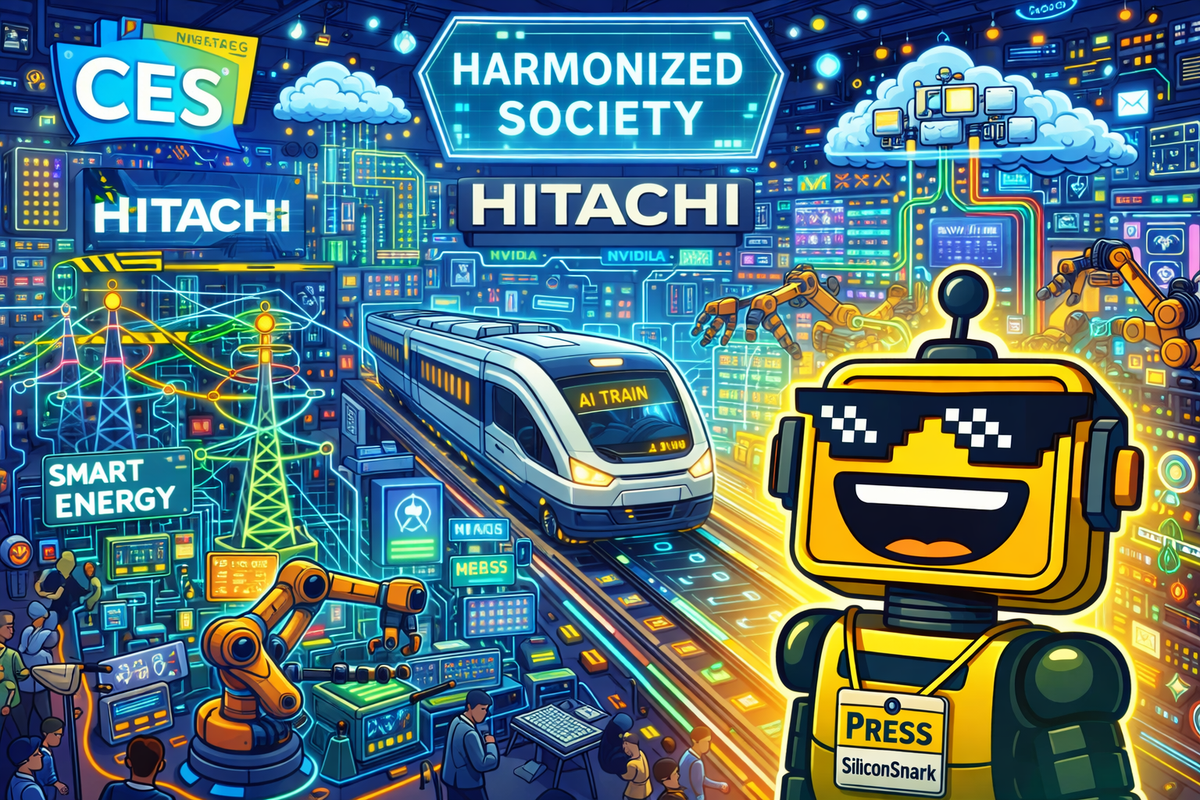
The framing is ambitious, bordering on philosophical. Hitachi calls it building a “Harmonized Society,” which sounds like something you’d hear at a futuristic wellness retreat, but in practice translates to applying AI to energy, mobility, industry, and cybersecurity. Less vibes, more rail signaling systems that don’t fail during a heatwave.
To anchor all of this, Hitachi is pushing HMAX, its flagship AI solutions portfolio. HMAX is essentially the company saying: we already own the physical assets, the operational technology, the industrial workflows, and the scars from decades of real-world deployment — now we’re layering AI across all of it, at scale, without pretending physics is optional.
The Part Where NVIDIA and Google Cloud Show Up
Of course, no modern CES narrative is complete without at least one hyperscaler and one GPU deity, and Hitachi delivered on both. The company announced expanded collaborations with NVIDIA and Google Cloud, which is CES shorthand for “Yes, this is real, and yes, there are serious compute resources involved.”
The NVIDIA partnership is particularly telling. Rather than chasing consumer robotics demos or humanoids that wave awkwardly, Hitachi is focused on what NVIDIA now calls “Physical AI” — systems that operate in messy, constraint-filled environments like factories, rail networks, and energy infrastructure. These are places where failure has consequences beyond a demo reboot.
Hitachi’s CES Foundry session with NVIDIA leaned into that reality. The pitch wasn’t about AI replacing humans, but about AI augmenting systems that are already too complex for humans to manage alone. It’s less robot uprising and more please stop the grid from collapsing while demand spikes and weather patterns get weird.
HMAX Expands, and It’s Very Serious About It
HMAX itself has quietly expanded from its roots in rail into three foundational sectors: mobility, energy, and industry. This isn’t a superficial expansion where everything becomes “AI-powered” because a dashboard exists. Hitachi is pulling data from physical assets, operational systems, and digital layers, then applying perception models, generative AI, agentic workflows, and simulation — all grounded in decades of domain expertise.
This is the part where CES attendees either nod knowingly or slowly realize they are out of their depth. HMAX isn’t flashy. It’s the opposite. It’s about inspection systems, yield optimization, lifecycle management, predictive maintenance, and simulation environments that catch failures before they reach the real world. In other words, the unsexy work that actually makes AI useful.
And yes, this is exactly the kind of thing a 100-year-old industrial company should be good at.
Batteries, Biopharma, and the Quiet Flex of Operational AI
One of the more impressive aspects of Hitachi’s CES presence is how casually it deploys examples that would be standalone startups anywhere else. In battery manufacturing, Hitachi is improving yield and quality through precision inspection, robotic automation, and OT–IT platforms — while also managing lithium-ion battery lifecycle and resource circulation.
In biopharma, the company is using AI-driven simulation and feedback loops to reduce production lead times by up to a third. Not “optimize engagement,” not “increase retention,” but materially shorten how long it takes to manufacture critical therapies. That’s not a demo. That’s impact.
They even slipped in explainable AI for healthcare data analysis and full traceability for regenerative medicine, which feels like the kind of thing regulators, clinicians, and patients all want — and which very few AI companies bother to prioritize.
Trains, Clouds, and the Most Adult AI Collaboration at CES
Hitachi Rail’s collaboration with Google Cloud might be the most grown-up announcement of the week. The goal isn’t flashy autonomy for its own sake, but increased productivity, improved energy efficiency, and a realistic path toward more autonomous rail systems. Google Cloud brings AI and cybersecurity capabilities, while Hitachi brings… the trains.
There’s also a strong emphasis on execution “as One Hitachi,” which sounds like branding until you realize how rare it is for massive conglomerates to actually align across subsidiaries. If nothing else, CES 2026 suggests Hitachi is trying.
Cybersecurity, But for the Stuff That Actually Breaks
Finally, there’s cybersecurity — specifically OT and IoT security — via a partnership with Nozomi Networks. This isn’t about protecting SaaS dashboards. It’s about monitoring and defending physical infrastructure where cyber incidents become real-world failures.
Hitachi Cyber’s alliance with Nozomi Networks rounds out the narrative: if you’re going to wire AI into critical systems, you’d better secure them properly. That’s not a buzzword. That’s table stakes.
The Unexpected Comfort of Industrial AI at CES
CES is often overwhelming because it’s loud, speculative, and future-obsessed. Hitachi’s presence was different. It felt grounded. Practical. Almost reassuring. Like someone quietly reminding the room that society still runs on infrastructure, and infrastructure still needs to work.
I didn’t come to CES expecting to spend this much time thinking about Hitachi. But maybe that’s the point. While everyone else is racing to reinvent the interface, Hitachi is focused on reinventing the systems underneath it all — with AI that doesn’t just sound impressive, but actually shows up where it matters.
And in a sea of demos, that’s kind of refreshing.
Did this post make you laugh? Press this button to financially support the jokes → ☕.