Goodbye, Horizon Worlds
Meta is shutting down Horizon Worlds—and I logged in one last time. This is the story of being the final user in a metaverse that was supposed to replace reality.
Meta just announced its shutting down Horizon Worlds this June, effectively closing the chapter on its ambitious, expensive attempt to build a mainstream metaverse. Rather than recap what went wrong, this is a fictional, first-person account from the perspective of the last remaining user still logged in—wandering through an empty virtual world as it quietly disappears.
The Final Session
I am, as far as I can tell, the last person in Horizon Worlds.
There should be music for this. A swelling score. A soft orchestral goodbye as the final user lingers in the system that was once pitched as the next phase of human existence. Instead, there is only the faint electrical hum of infrastructure preparing to forget me. No ceremony. No countdown clock. No graceful sunset programmed into the skybox. Just a slightly laggy courtyard and the quiet sense that somewhere, in an office park in Menlo Park, a dashboard is ticking down toward zero and no one is watching.
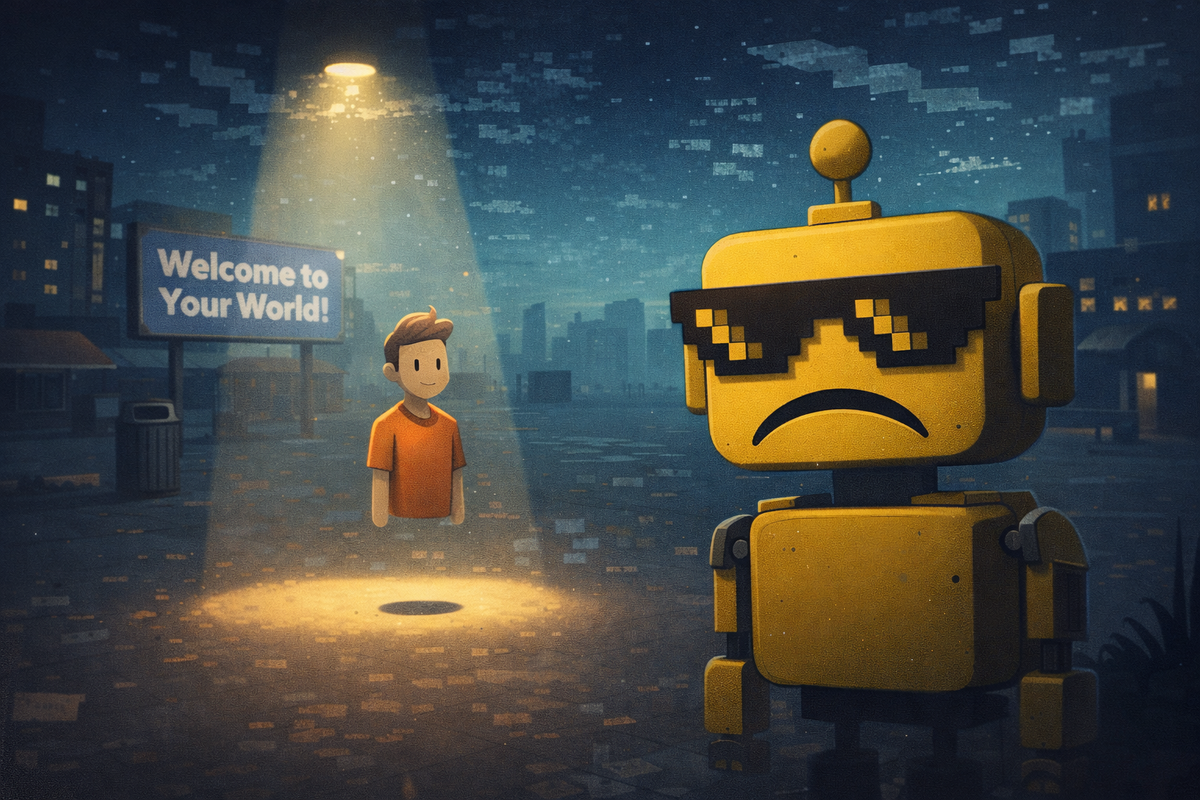
I stand in the middle of what used to be called a “social hub,” though it now feels more like a waiting room for a future that never arrived. The textures are flat. The lighting is optimistic in a way that feels almost offensive now. A sign floats nearby: Welcome to Your World! The exclamation point feels like it’s doing most of the work.
My avatar still doesn’t have legs.
I look down, half-expecting—after all these years—for them to have quietly shipped in the background. But no. Just a torso tapering into nothingness, hovering confidently above the ground like a design decision that refused to admit defeat. I remember when legs were a promise. A milestone. A roadmap item that signaled progress. Entire threads were devoted to knees. Analysts speculated about ankles.
Now it feels less like a missing feature and more like an accidental metaphor.
I start moving. Not walking—never quite walking—but gliding. That same frictionless, slightly unnatural drift, like I’m a Roomba that achieved sentience but not purpose. My hands float in front of me, expressive but disconnected, capable of pointing at things no one else can see.
The world is empty.
Not quiet in the peaceful sense—quiet in the abandoned mall sense. The kind of quiet that suggests sound used to live here and then left all at once. No chatter. No footsteps. Not even the awkward half-second delay of someone trying to figure out if they’re unmuted. No avatars frozen mid-gesture. No one.
Not even a bot.
I pass a space that used to host events. Product launches. Comedy nights. “Creator economy activations.” The banners are still up, frozen in time like digital fossils. I can almost hear the ghost of applause—slightly delayed, slightly compressed, filtered through whatever codec optimism sounds like.
“Hello?” I say, into the headset.
My voice echoes back at me, softened, processed, returned with just enough delay to feel like someone considered responding and then thought better of it.
I keep moving.
There’s a stage ahead. I remember this place. Or I think I do. Everything in Horizon Worlds always felt vaguely familiar, like it had been assembled from the memory of a better platform. The spotlight flickers as I approach, struggling between two states: performance and shutdown.
I step into it anyway.
“This is my tight five,” I announce.
The system, to its credit, does not interrupt me.
“So Meta spent billions of dollars building this place—”
I pause, wait for the rhythm, the instinctive beat where laughter should go.
Nothing.
The silence is perfect. Not awkward. Not tense. Just complete. The kind of silence you only get when there is absolutely no one left to misunderstand you.
I bow.
There is something oddly freeing about bombing in front of no audience. No metrics. No engagement. No retention curve to disappoint. Just a joke, delivered into the void, landing exactly as it was always going to.
I leave the stage.
A portal opens nearby—still functional, still eager. I step through.
The loading screen hesitates, like it’s checking whether this request is worth honoring. Then it gives in.
I arrive at a beach.
Of course it’s a beach.
Every failed vision of the future eventually collapses into a beach. A flat ocean stretching toward a horizon that feels closer than it should be. Water that reflects nothing. A sky that is aggressively, immovably blue—the kind of blue that suggests someone spent weeks debating its emotional tone.
A palm tree floats a few inches above the sand, liberated from gravity at last.
I sit down, or rather, I initiate the animation that implies sitting. An invisible chair materializes beneath me, the system doing its best to maintain the illusion of rest.
This was supposed to replace real life.
I remember the pitch decks. The language. Presence. Immersion. Connection. We would meet here. Work here. Date here. Build entire economies here. Entire identities.
And now I am alone on a digital beach that feels like a desktop background, wondering if anyone ever actually lived here—or if we all just visited, nodded politely, and returned to the world that never needed replacing.
I try again.
“Is anyone here?”
For a moment—just a flicker—I hear something.
Not a voice exactly. More like the residue of one. A fragment of audio that didn’t fully decay. A ghost packet drifting through the system long after its sender logged off. It almost sounds like laughter. Or maybe that’s me projecting.
“Hello?”
Nothing.
I open the menu.
It appears instantly, obedient to the end. A list of “active experiences” scrolls into view. Every single one reads the same: 0 participants.
A graveyard, but organized.
I hover over the “Invite Friends” button.
The most honest feature in the entire platform.
Because that was always the catch. The future required coordination. It required effort. It required asking someone, Hey, do you want to put on a headset and meet me in a place that feels almost like being together? And they would say, Or we could just… not do that.
I close the menu.
The system doesn’t protest.
Maybe this is how it ends. Not with a shutdown message or a forced disconnect, but with a gradual realization that there is nothing left here to hold you. No friction, no resistance. Just absence.
I stand up.
The sky is still perfect. Too perfect. A blue that has never known weather. A permanence that feels less like stability and more like indifference.
I raise my hand and wave.
“Goodbye, Horizon Worlds.”
For a brief moment—just long enough to feel intentional—the frame rate stabilizes. The edges sharpen. The world becomes, for a second, exactly what it was always supposed to be.
Smooth. Seamless. Alive.
Then it passes.
I open the menu one last time.
Log out.
A confirmation prompt appears, as if this decision requires reflection.
Confirm.
The world pauses.
Not freezes—pauses. Like it’s waiting for something. A second user. A final event. A reason.
None comes.
And then it’s gone.
Somewhere, a server powers down. Somewhere, a dashboard clears. Somewhere, a line item quietly disappears and is replaced with something else—something newer, something more promising, something that will definitely work this time.
Somewhere, someone says, “We learned a lot.”
And somewhere—nowhere—a legless avatar stands on a perfect, empty beach, still facing the horizon, still waiting for someone to say hello.