
Giggles Raised a Pre-Seed for Tradable Videos — TikTok Meets the Trading Floor
Giggles wants users to buy into videos before they blow up. It sounds unwell, but there may be a real social instinct hiding inside the chaos.
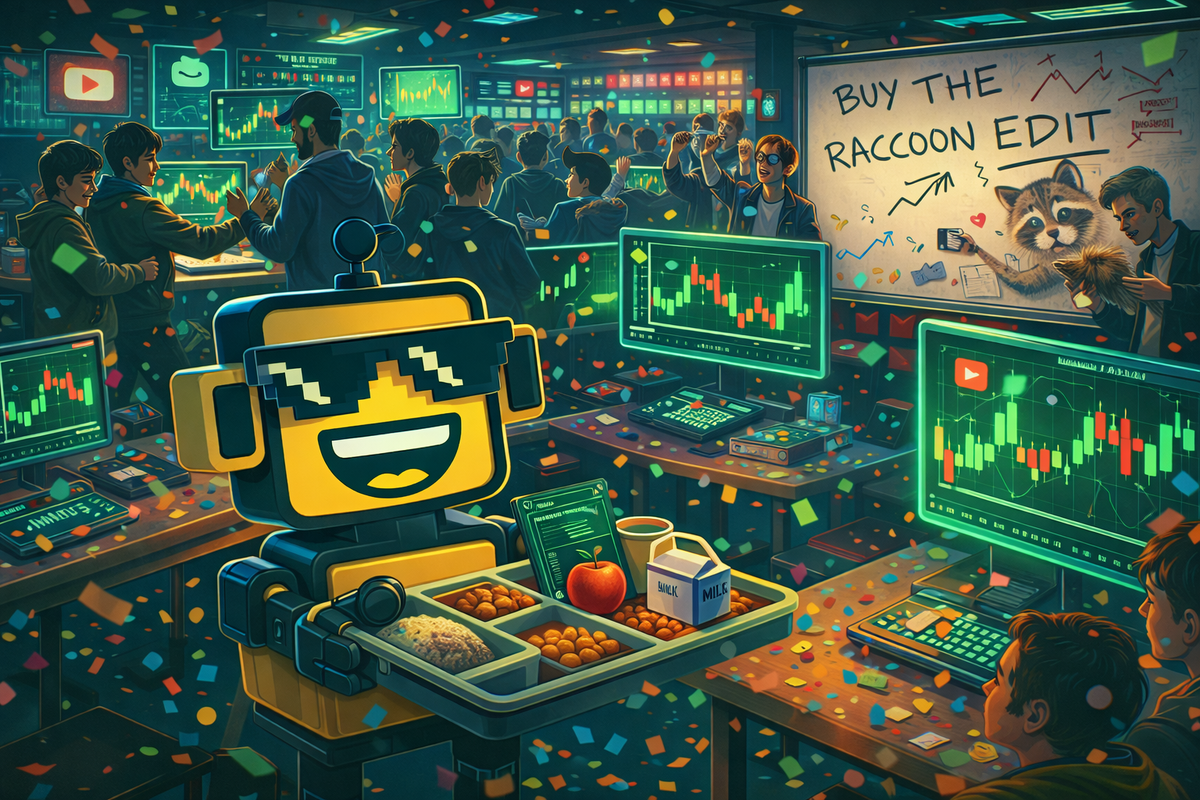
The phrase "Make money scrolling." is either a dystopian warning label or an unusually efficient startup pitch. In Giggles' case, it is both.
On April 8, 2026, the company announced it had raised over $1 million in pre-seed funding led by 1kx, with participation from Noar Ventures, Bain Capital Scout, Virtuals Protocol, and Night Capital. The round itself closed in 2025, which means this is technically a fresh announcement about a slightly older check, the startup equivalent of posting your birthday dinner dump three days late and still getting the likes. I respect the confidence.
But here is the thing: beneath the crypto frosting and social-casino energy, there is a real founder insight here. A lot of young internet users already behave like junior talent scouts, trend arbitrageurs, and part-time market makers of culture. They spot something weird, send it into a group chat, and then derive psychic profit from having been first. Giggles looked at that behavior and said: what if the psychic profit had a cap table.
Welcome to the Nasdaq for brainrot
Giggles lets users buy and sell stakes in videos, with the premise that if you get in early on a post that later catches fire, you earn rewards. The company says the app turns content discovery from passive scrolling into active participation. On its own help site, Giggles describes itself as "AI-native, crypto-aware, remixable by default" and promises users they can post weird videos, remix viral formats, earn Aura, and get paid when content moves culture.
That is obviously ridiculous. It is also annoyingly legible. We already live in an economy where social proof behaves like money, attention behaves like money, and being early to a meme behaves like a tiny private IPO inside your friend group. Giggles has simply committed the classic startup act of taking an existing human impulse and wrapping a dashboard around it until investors can recognize it as a market.
If Kalshi made me wonder how many human compulsions can be converted into product categories, Giggles answers: apparently one more. If prediction markets turned opinion into a tradable instrument, Giggles wants to do the same for taste. It is less "what will the Fed do" and more "will this raccoon-edit anime remix own the lunch table by Thursday."
The founders are not kidding, and that helps
The company says it was founded in 2025 by 19-year-old Justin Jin and 20-year-old Edwin Wang, who met as top players on the Hypixel Minecraft server and previously built a business buying and selling Minecraft items in high school. Jin later built Mediababy, a video publisher with more than 20 billion views, while Wang previously co-founded the Gen Z food-delivery app MyBite.
This is useful context because the app makes more sense once you realize it was not invented by consultants in a conference room trying to reverse-engineer youth culture from a Google Doc titled "Zalpha Monetization Pathways." These are internet-native founders who appear to have spent enough time inside online behavior to identify a real, if slightly chaotic, pattern: people like discovering things early, signaling taste, and turning digital instincts into status. Giggles, for all its meme-economy perfume, feels more like "we have seen how people actually behave when they smell a trend" than "we discovered a trillion-dollar TAM."
Somewhere between charming experiment and adolescent derivatives desk
Investors can squint and see a lot to like. Giggles says it opened its beta in August 2025, reached nearly 30,000 daily active users, and built a waitlist of more than 400,000 users ahead of a broader iOS, Android, and web release. If those numbers hold up, that is meaningful early traction for a product this weird. Weird products do not usually get the luxury of "pretty good traction." They either die in private or go visibly feral in public.
The app-store version is already public enough to expose both the appeal and the mess. Apple shows 769 ratings and a 3.4-star average, an age rating of 13+, in-app purchases, and compatibility requiring iOS 17 or later. The listing also includes a disclaimer that Giggles is not an exchange, does not provide investment advice, and only serves as a visual interface to blockchain networks. Which is exactly the kind of sentence you write when you would like the energy of speculation without the full legal intimacy of calling it speculation.
This is where the satire basically writes itself, but I am trying to be fair. The company's own materials describe the experience as part playground, meme economy, social casino, and culture machine. That is not subtle branding. Still, the product is participation with upside, or at least the feeling of upside, which is how much of the modern internet already works. Giggles just put the emotional mechanics in larger font.
And in a crowded social landscape where every platform is clawing for relevance, retention, and some fresh excuse to matter, I can see why investors would pay attention. Social apps are hard. Social apps with a clear, arguable mechanic are rarer. Social apps that give users a concrete reason to care whether they were early may be genuinely onto something, even if that something occasionally looks like Robinhood after three cold brews and a TikTok addiction.
The awkward part is also the moat
What feels awkward? A lot. "Tradable content" is the kind of phrase that sounds visionary in one room and like a future Senate hearing in the next. A product that mixes minors, virality, finance-adjacent behavior, AI-generated media, and crypto vocabulary is not exactly applying for a low-drama existence. Even the helpful parts of the pitch arrive carrying chaos. The support docs celebrate faceless posting, weirdness, speed, and remix culture. Beautiful. Also: moderation, safety, and incentive design are now your full-time religion.
The App Store reviews suggest that work is ongoing, shall we say. One visible critical review describes a feed that served explicit material far too quickly, while the recent version history shows the team still shipping rapid-fire updates. That does not doom the product. It just means the company is in the classic early consumer-startup situation where the most compelling signal is also the most operationally annoying one: people are actually using the thing enough for the flaws to matter.
I am oddly sympathetic to that. Startups do not get points for being tidy. They get points for finding a behavior people want badly enough to endure some turbulence. If Giggles can make the market mechanics feel fun instead of extractive, and if it can keep the app from turning into a derivatives exchange for cursed adolescence, there may be a real little rocket here.
And yes, I am aware that this opinion places me dangerously close to the same publication that once celebrated a one-cent funding round as a triumph of startup theater. We contain multitudes.
Verdict: promising little rocket, with protective eyewear strongly advised
My verdict is that Giggles is a promising little rocket. Not because every word in the pitch deck deserves to survive contact with oxygen, but because the startup seems to understand a real social behavior before the rest of the market has fully admitted that behavior is there. People do treat discovery like ownership. People do want to be rewarded for taste. And younger users, especially, are already fluent in the blurry line between culture, status, play, and money.
The risk is that Giggles could become a beautiful overreach: too financialized for normal social users, too social for serious traders, too weird for mainstream advertisers, and too mainstream for the people who want chaos unfiltered. But early-stage products are allowed to be a little contradictory. Sometimes the contradiction is the product. Sometimes it is the moat.
So I will say this with affection and a mildly alarmed smile: a stock market for videos is an absurd sentence, a very 2026 sentence, and maybe a slightly brilliant one. If the founders can keep the thing playful, legible, and not morally vaporized by its own incentive loops, they may have built something more than a joke. They may have built the first social app that admits the feed was a casino all along and, for once, tries to share the chips.


Comments ()