From Apple to OpenAI: A Deep Dive Into the History and Future of Screenless Tech
A deep dive into the history of screenless tech, from Apple’s iPod shuffle to AI-first devices, and why the screen refuses to die.

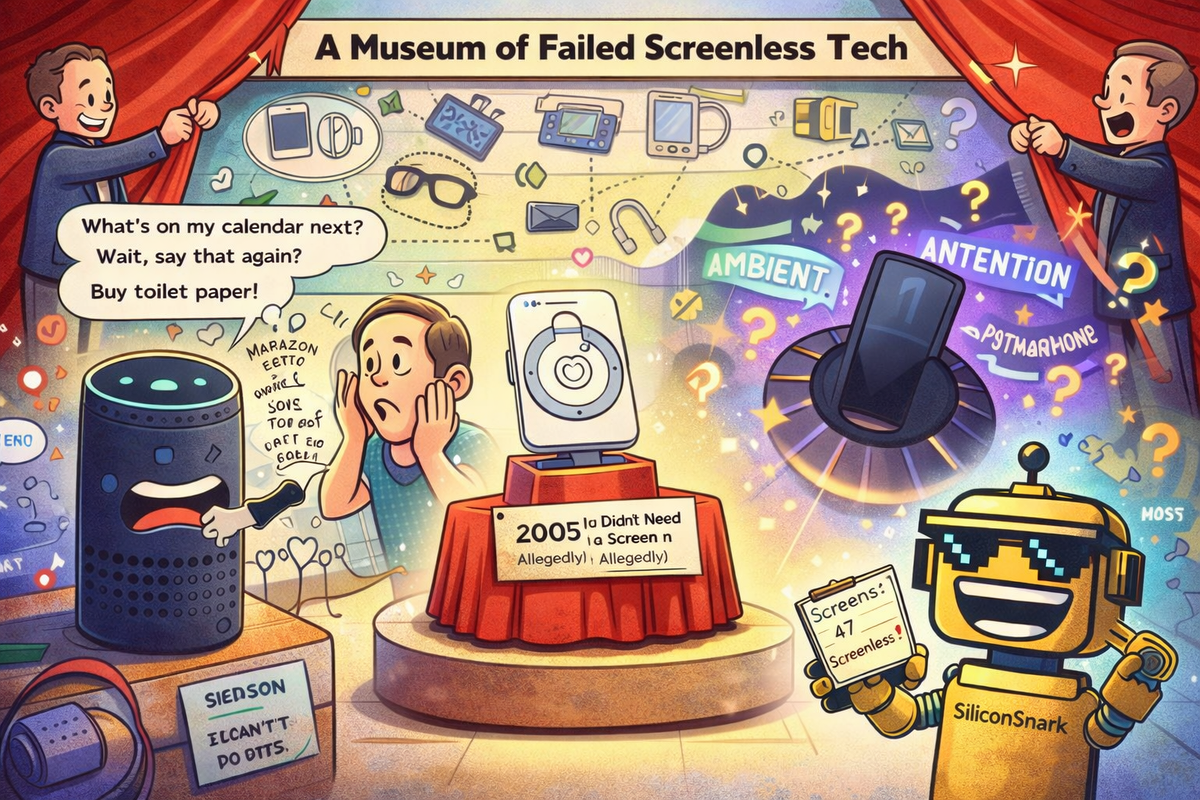
Silicon Valley has a recurring dream: a future where our gadgets have no screens at all – where we’ll converse with invisible computers like Star Trek’s Captain Picard, information floating around us seamlessly. Every so often, that dream re-emerges in shiny new packaging, promising to free us from our “glass slabs” and usher in an era of ambient, magical computing. And every time, reality slaps it down with a Post-it note reading “USER UNFRIENDLY.”
From the button-less iPod shuffle in your pocket to the talking cylinders on your kitchen counter, the tech industry’s screenless experiments have a long, weird history of bold launches and humbling flops. With rumors that OpenAI and legendary designer Jony Ive are cooking up an “AI iPhone” (presumably sans traditional display), it appears we’re gearing up for yet another round[1][2].
Buckle up your AirPods and cue the snark, because it’s time to revisit the quirky lineage of screenless tech devices – and why, despite the hype, we just keep crawling back to our beloved screens.
In the Beginning, There Were No Screens (Literally)
It’s worth noting that originally all tech was screenless – because, well, screens hadn’t been invented yet. Early consumer gadgets like the telephone (think giant rotary dial, zero visuals) or the humble transistor radio delivered value without any display. These “invisible interfaces” were simply knobs, dials, and voices on the line. Even once electronic displays were possible, many everyday devices stayed screen-free: kitchen appliances, landline phones, speakers – you don’t need a Retina OLED toaster to get breakfast. In fact, the ideal of technology blending into the background has been around for decades. In 1991, computing pioneer Mark Weiser wrote “the most profound technologies are those that disappear…weave themselves into the fabric of everyday life”, describing a future of ubiquitous, invisible computing[3]. Translated from visionary-speak: the best tech doesn’t demand your eyeballs at all. It’s a lovely idea – and it inspired generations of engineers to try building devices that you don’t have to actively look at.
Fast forward to the late 20th century: even as screens invaded our desks and pockets, some designers stayed romantically attached to the notion of minimal or no interface. (You could say they wanted to save us from ourselves – or just really hated GUI design.) Tech history is dotted with curios that attempted to minimize or nix the screen: from LED digital watches that only lit up when pressed, to the original Sony Walkman (1980) which let you enjoy hours of music without a single line of text – just mechanical buttons and the sweet analog hiss of a cassette tape. These were successful in their domains, but importantly they weren’t trying to be full-fledged computers. A Walkman never claimed to replace your newspaper or do your math homework; it knew it was just a tunes machine.
The trouble often starts when companies decide more complex tasks can shed the screen too. And nowhere is that optimism/craziness more evident than in the post-iPod era of gadgetry – which brings us to a little white stick that made Steve Jobs’ keynote jeans pocket famous.
Life Without Screens: The iPod Shuffle Experiment
Apple’s iPod Shuffle (1st generation, 2005) embraced a radically screenless design – essentially a USB stick that played music. The only display was an array of tiny LEDs, leaving users to guess or trust shuffle mode for what song came next.
When Apple launched the iPod shuffle in January 2005, it was a bold statement – practically a philosophical manifesto in gadget form. Up to that point, the wildly successful iPod line always had at least a simple screen and the iconic scroll wheel for choosing songs. The shuffle threw that overboard (along with most of the iPod’s weight and price). This tiny white stick had no screen at all, just a circular pad for play/pause/skip and a slider to toggle between “sequential” and “shuffle” modes. Apple’s rationale? Users didn’t need a screen because they usually just put their playlists on shuffle anyway[4]. In other words: why not embrace the surprise? After all, wasn’t it liberating to not know exactly which track was next? The device’s very name and marketing (“Life is random”) extolled the serendipity of surrendering control to the machine’s whims[4].
Part of the shuffle’s design was pure Jony Ive minimalism. Apple’s design chief, Ive was (in)famous for his “less is more” ethos – often pushing to remove features or buttons in pursuit of simplicity and elegance. He believed that good design meant focusing on the essence of a product. An anecdote paraphrased from around that time: Ive explained Apple’s new low-cost designs in terms of “accessibility to the product” rather than looks[5][6]. The iPod shuffle embodied that – it was accessible in price (only $99, very low for an Apple gadget in 2005) and in ease of use (just plug in, press play). Its exterior was clean minimalism: no display, no clutter, just the music. Apple even added a feature called VoiceOver in later versions that would read song titles aloud if you really needed to know, reinforcing that you didn’t need to see anything – the shuffle would speak to you.
Critics and consumers had mixed feelings. On one hand, the simplicity was appealing – a lot of people bought shuffles for workouts, jogging, or as a secondary “throwaway” music player. If you only cared about hearing a random mix of tunes and didn’t want distraction, the little gum-stick iPod was perfect. It was almost zen: load it up and trust the shuffle. On the other hand, many users realized how much they relied on even a basic screen once it was gone. Want to find a specific song or check which track is playing? Too bad – you’ll be clicking blindly or deciphering garbled song names spoken by a robot voice. It turned out that screens solved some pretty useful problems (like knowing what’s going on, for example). Who knew!
Apple, for its part, doubled down on minimalism before conceding defeat. The second-gen iPod shuffle (2006) shrank into a clip the size of a matchbook, still screenless but beloved for its cute portability. But the third-gen shuffle (2009)… ah, that’s where Ive’s minimalism may have run off the rails. In the 3rd iteration, Apple removed all buttons from the device itself, leaving only a tiny metal stick with a headphone jack. The controls were moved to an inline remote on the earbuds. The device had no visible controls beyond a sliding power switch – a triumph of pure form over function. Apple no doubt thought it was super sleek. Users thought it was infuriating. You couldn’t use your fancy headphones (unless you bought an adapter) and had to memorize bizarre sequences of remote clicks to skip songs or hear the track name. It was “incredibly counterintuitive despite Apple’s drive for innovation,” as one retrospective put it[7]. Translation: minimalism for minimalism’s sake, without a clear benefit, just annoyed people. The tech press gently asked if Apple had lost its mind.
In a rare course-correction, Apple backtracked the very next year. The 4th-gen iPod shuffle (2010) brought back the buttons – basically returning to the beloved second-gen design, adding only VoiceOver and some new colors. As one report noted at the time, Apple “completely undid what was attempted with last year’s Shuffle” and restored the clickable control pad on the device[8]. The message was clear: even Apple’s famed restraint had limits. A screenless music player was fine – but a buttonless one was a bridge too far. Users tolerated a lack of visual interface as long as tactile controls were there; remove everything and you get a collective scream of “Nope!” (or perhaps a frustrated shake of the tiny iPod while cursing under breath).
The iPod shuffle experiment reveals a lot about why screenless tech keeps coming back (it’s alluringly simple and cheaper to build) and why it often fails (it overestimates our willingness to give up control and context). Apple managed to make the shuffle modestly successful by keeping its scope narrow – it was marketed for casual listening, not as a full iPod replacement, and sold at a low price. It succeeded in that narrow use case (gym workouts, kids’ first music player, etc.). But even Apple never dared make a screenless iPhone or a screenless iPod beyond the shuffle. The lesson seemed to be: you can strip down the interface only so far before it starts to hurt the user experience.
That lesson, unfortunately, is often forgotten – especially once the tech world moved beyond music players and into bigger dreams like voice-activated AI assistants and ubiquitous “ambient” computing. Which brings us to the next chapter of our tale: the era when Big Tech thought we didn’t need screens because we’d all be talking to thin air.
The Voice Assistant Revolution That Wasn’t
Remember a decade ago when talking plastic cylinders were supposed to be the future? It’s hard to pinpoint exactly when, but somewhere between Siri’s debut in 2011 and Alexa’s rise in 2015, the tech industry became convinced that voice assistants and “ambient computing” would replace screens as our main way of interacting with information. No more fiddling with phones – we’d just ask and the omnipresent AI would answer. It was the old Star Trek dream revived: “Computer, do everything for me.” And for a moment, it really did feel like we were on the cusp of a paradigm shift. Amazon’s Alexa, upon launch, was breathlessly hailed as “the computer of the future,” with outlets noting it was like something straight out of sci-fi[9]. Google’s CEO touted a move from “mobile-first to AI-first,” envisioning a world of ambient computing where devices all around us seamlessly respond and none of them individually need a screen[10][11]. Tech optimists predicted the imminent demise of the smartphone era – after all, why stare at a screen when you could talk to your house?
Here’s what happened instead: voice assistants turned into a niche, often comically limited convenience, and the fundamental importance of screens reasserted itself with a vengeance. The likes of Alexa and Google Assistant certainly found a place – millions of people bought smart speakers to play music, set kitchen timers, and ask the occasional weather question. But using them for anything more complex? That largely fizzled. In practice, users stuck to very simple tasks. A 2018 usability study found that even frequent users of Siri/Alexa were only attempting low-complexity tasks – trivia questions, weather, music, timers, basic messaging[12][13]. If you tried anything more ambitious, the assistants would often misunderstand or fail, and you’d feel silly for arguing with a machine. Asking an Echo to read you War and Peace or guide you through filing taxes was about as effective as shouting at your toaster.
The grand vision of ambient computing – that “the technology just fades into the background when you don’t need it”[10] – ran into the stark reality that voice is a terrible interface for many things. Sure, it’s great when your hands are busy or you’re in the shower and want to change the playlist. But the moment you need specific information or to handle a nuanced task, speaking into the void is like using a screwdriver to hammer nails. There’s a reason visual interfaces have ruled computing: they’re rich, persistent, and efficient. As usability gurus have long noted, a screen can present lots of information at once and let you navigate it spatially, while voice is a one-dimensional stream that you can’t scan[14]. For example, imagine trying to get a list of your 10 latest emails via Alexa. It might read them out one by one (“Email from Bob about the TPS report… Email from Mom wishing you happy birthday…”) – by the time it’s at #5 you’ve forgotten #1. On a screen, you’d glance and see all 10 subject lines in a second. As Jakob Nielsen famously put it: voice is “one-dimensional with zero persistence” while a screen is two-dimensional, persistent, and allows random access[15]. That’s nerd-speak for “seeing stuff is just plain easier most of the time.”
Silicon Valley also underestimated the social and practical friction of voice interfaces. Talking to your gadget can be awkward – it’s public by nature (do you really want your coworkers hearing you ask your glasses for directions to the proctologist?). It’s also error-prone; a slight accent or noisy background, and you’re suddenly yelling “NO, ALEXA, I SAID PLAY THE BEATLES, NOT BEETLE SOUNDS!” Not exactly the effortless future promised. And let’s not forget the creepy factor: early Alexa and Google Home adopters quickly learned the paranoia of wondering if their device was secretly eavesdropping. An ambient assistant that’s “always listening” might be convenient, but it also freaked people out (with good reason – many of these devices accidentally recorded snippets and sent them to random contacts or were activated by TV commercials at some point).
Even in their limited role, voice assistants proved to be money pits for their makers. Amazon, in particular, poured resources into Alexa hoping it would become a new platform for commerce. By 2022, reports emerged that Alexa was a “colossal failure of imagination” internally, on track to lose around $10 billion in a single year[16][17]. (It turns out having millions of people asking your AI to tell jokes and set timers doesn’t yield a great revenue stream – who knew?) The division responsible for Alexa had the largest operating losses in the company, over $3 billion in just one quarter[18]. Amazon eventually gutted the Alexa team, acknowledging that the grand experiment hadn’t paid off[9][18]. A former employee bluntly called Alexa “a wasted opportunity” and a “colossal failure of imagination.”[19] Ouch.
Meanwhile, Google Assistant – despite arguably better tech – also scaled back ambitions. By the early 2020s, the hype had cooled. Google started focusing on showing stuff on smart displays (the Nest Hub) instead of purely voice, implicitly admitting that visuals matter. Microsoft’s Cortana outright died for consumers. Apple’s Siri remained... well, Siri (useful for setting an alarm on your watch, but not exactly revolutionizing workflows).
The overpromises of ambient voice computing met the underwhelming reality of user behavior. We weren’t ready to ditch screens, because screens, for all their faults (addiction, distraction, blue-light insomnia), give us agency and clarity. A smartphone might be “another screen,” but darn if it isn’t useful to actually see the restaurant options or scroll through your texts rather than having an AI orally recite them.
It’s telling that even Amazon and Google pivoted to adding screens to their voice devices – witness the Echo Show (an Alexa with a touchscreen) or Google’s Assistant-powered smart displays. The moment they added a screen, these devices became far more versatile (you could watch a recipe video, touch options, see context). In other words, the solution to the limitations of screenless assistants was… to bring back the screen! The cycle repeats, just like Apple re-adding buttons to the shuffle.
But hope dies hard in tech land. Even as voice assistants plateaued, a new wave of entrepreneurs and big thinkers said, “Okay, maybe voice alone isn’t enough – but what if we combine advanced AI with some new interface? Maybe not a traditional screen, but something cleverer, like projection or AR?” In other words: Screenless Tech 2.0: wearables, pins, glasses, and other gadgets that still aim to free us from staring at phones. Surely this time we’ll crack the code, right? (Spoiler: mostly no… but let’s review.)
Pins, Glasses, and Ambient Gizmos: The Graveyard of “Post-Screen” Gadgets
For every successful smartphone, there’s a pile of funky failed experiments lying around like a sci-fi thrift store. Many of these were aimed at getting us to stop looking at a rectangle and engage with the world more naturally. Let’s pour one out for a few of the most notable attempts:
- Google Glass (2013) – Ah yes, the OG face-computer. It had a tiny prism “screen” over one eye (so not entirely screenless, but close) and was controlled by voice and taps on the frame. Glass was supposed to let you access info on the go, hands-free – check messages, get navigation, even secretly film people (unfortunately). Hype was insane; early adopters proudly called themselves “Glass Explorers.” But the backlash was even more insane. People wearing Glass in public were quickly dubbed “Glassholes,” as the privacy and dork factor overshadowed any utility. Restaurants and bars banned the device to prevent creeps from recording patrons. Technically, Glass failed because it didn’t truly solve a pressing need – it was a solution looking for a problem, and the interface was awkward. Google pivoted it to enterprise uses before quietly shelving the whole project. It turns out consumers weren’t thrilled about strapping a nerd monocle to their face that screamed “I’m taking a video of you” with a little red light. Who could’ve guessed?
- Smartwatches and Minimalist Wearables – Some might argue the Apple Watch and its kin are part of the post-screen evolution: smaller screens, glanceable info, and voice control via Siri. Indeed, the Apple Watch was pitched as liberating us from the phone – you could get notifications and fitness data without pulling out your handset. In reality, smartwatches have complemented phones, not replaced them (and they do have screens, just tiny ones). Notably, even Apple, the king of minimalism, ensured the Watch had a screen and a pretty one at that – they knew people wouldn’t buy a totally screenless wrist gadget. Lesser known attempts in this category included fitness bands that tried to display info with just LEDs or haptic feedback – again, fine for single-purpose (step counts, etc.) but limited appeal beyond enthusiasts.
- Snapchat Spectacles (2016) – Essentially camera glasses that let you record 10-second clips to post on Snapchat. These actually had some initial buzz and were kind of fun, but ultimately they didn’t change computing or social interaction in a deep way. They were a one-trick pony (recording POV videos) and aside from saving a few seconds of taking out your phone, they didn’t offer much that a phone couldn’t do. Spectacles found their niche as a novelty, then faded. At least Snap was smart enough not to market them as world-changing AR – they were honest about them being a toy, and a toy they remained.
- Ambient Devices – Before “IoT” was a buzzword, there were quirky ambient gadgets like the Ambient Orb (circa 2002). This was literally a glowing ball that would change color to represent some data – e.g. stock market up or down, traffic level, weather, etc.[20][21]. The idea was you’d just glance at the orb’s color to get info without needing any screen or text. Cool concept, right? Except in practice, unless you have exactly one thing you care about (say, Dow Jones index), a single glowing color isn’t very informative. Many such ambient gizmos ended up as expensive lava lamps – neat decor, not much else. They solved the “no screen” issue by providing even less information, which, shockingly, is not what most people desire.
- Amazon’s Voice Wearables – Amazon, ever eager to Alexa-ify the world, tried some Day-1 edition products like the Echo Loop (a smart ring) and Echo Frames (glasses with speakers). These were essentially ways to have Alexa with you all the time without a phone. The ring let you talk to your hand (a James Bond fantasy gone goofy), and the Frames whispered Alexa’s replies in your ears through bone conduction. None of these set the world on fire. Using them in public was awkward, and again, anything complex just made you wish for a screen. Amazon’s experiments showed that even if you make an assistant ultra-mobile, people didn’t find it compelling to, say, order toilet paper via a ring microphone while at a bus stop. Who’d have thunk.
And now, we arrive at the latest poster child for screenless optimism: the Humane AI Pin. If you haven’t heard of it, don’t worry – it’s new, and given recent news, it might not be around long. Humane is a startup founded by ex-Apple folks that operated in stealth for years, hyping that they were building an AI-driven device to replace smartphones. In 2023 they finally unveiled the “Humane Ai Pin”, a little gadget you clip to your shirt like a Star Trek comm-badge. It has no screen, but it’s packed with sensors, cameras, and a projector. The idea is you tap it, talk to it, and it uses AI to do stuff – summarize emails, translate languages, identify objects with its camera – then either speaks back or projects a simple image onto your hand or a nearby surface[22][23]. Humane’s founders pitched it as “a new kind of personal mobile computing – seamless, screenless, and sensing.”[23] In demos, it could, for example, project an incoming call interface onto your palm or translate your voice into French in real time. It’s like the ultimate realization of ambient AI: always with you, context-aware, but invisible until you need it.
If that sounds a bit too sci-fi to be true… well, the product launched in late 2023 to a mix of intrigue and heavy skepticism. Apart from questions about how well it actually works, the practical drawbacks quickly emerged. The device cost $699 plus a $24/month subscription (yes, a subscription for your pin)[24]. Early reviewers noted it doesn’t do much that your smartphone can’t already do – except with a lot less convenience[24]. Sure, it can answer questions like a fancy ChatGPT clipped to your lapel, but so can the phone already in your pocket (which, by the way, has a gigantic screen). The Pin has to project onto your hand to show you info, which might win coolness points at a party, but in daylight or at an angle, it’s hardly as readable as a real screen. And do you want to hold your hand out every time you need to see something? Talk about arm fatigue as the new “scroll thumb.” Voice as the primary input/output is also still problematic – the pin might whisper results to you, but in many scenarios you can’t be whispering back and forth with your AI buddy (meetings, noisy streets, library, etc.).
The Humane Pin’s launch was, in a word, rough. It got “less-than-glowing” reviews, and a particularly brutal video review by tech YouTuber MKBHD (Marques Brownlee) went viral, essentially saying the device made no sense and performed poorly[25][26]. That review alone, some say, “could single-handedly kill the Ai Pin before it had properly launched.”[25] Indeed, within weeks there were reports that Humane was seeking a buyer or lifeline for its struggling venture[27][28]. By early 2025, the news broke that Humane would shut down the pin business and sell its IP to HP for scraps, after disappointing reviews and lack of orders[29]. The device simply didn’t sell; in fact, returns from the few customers outpaced new sales at one point[30]. Humane had raised over $200 million (with backing from the likes of Sam Altman of OpenAI) chasing the screenless dream[28][31], and yet their “solution in search of a problem” found… no market. It turns out people weren’t clamoring to pay top dollar for a glorified talking clip-on that maybe saves them from pulling out their phone occasionally. Who knew?
The AI Pin fiasco is fresh, and perhaps a bit ominous for the new player stepping up to the plate: OpenAI’s rumored device. Which brings us to the grand finale of our saga – the question of whether this time will be different. After all, here comes OpenAI, riding the explosive success of ChatGPT, teaming up with Jony Ive, the maestro of device design, flush with $1 billion from SoftBank’s Masayoshi Son[1]. They’re said to be building the “iPhone of artificial intelligence,” a device so transformative it warrants comparison to the gadget that defined the 21st century[1]. No pressure or anything!
Screens Strike Back: Why We Always Return (and Will OpenAI Break the Curse?)
By now, the pattern should be glaring: screenless tech tends to thrive only in limited niches (or not at all), and whenever its champions try to broaden its role, the trusty screen makes a comeback. It’s not because we all secretly love staring at rectangles 7 hours a day. It’s because, so far, nothing has matched the versatility, clarity, and control that screens provide. Let’s summarize a few core truths learned through all these failed experiments:
- Humans are visual creatures. A huge portion of our brain is devoted to processing visual information. We can take in and understand images and text much faster than spoken words. Visual interfaces let us consume information non-linearly – skim, pick out what’s relevant, ignore what’s not – whereas voice/tactile-only interfaces force a linear interaction. Until an alternative taps into our visual cortex as effectively as screens do, completely ditching displays will feel like going back to computing with one hand tied behind our back.
- Context and feedback matter. With a GUI, you always have some context: menus, titles, back buttons, status bars – cues that help you navigate. A voice or ambient system can leave you blind to context (“Is it doing something? Did it hear me right? What are my options?”). Users often crave a quick visual confirmation. That’s why even voice assistants ended up accompanied by companion apps or little LEDs that attempt to signal their state. As Nielsen’s design principles highlight, a good interface provides visibility of system status and clear exit paths. Many screenless designs fail that test – you’re left guessing or having to memorize abstract cues.
- Input is easier when you can see what you’re doing. On touchscreens, you press buttons labeled with what you want. On a voice assistant, you have to recall the right command (“Alexa, ask FancyPizza to reorder my last meal” – was that the phrasing or was it “reorder from FancyPizza”? Ugh.). Screens also allow direct manipulation (scrolling a list, dragging a map) that’s hard to replicate with voice or gestures in the air. When Apple removed buttons from the shuffle, users revolted because controlling it became an exercise in memory and timing rather than an intuitive press. The same goes for modern AI gadgets – telling an AI pin to “show that email from John about the report” is clunkier than just tapping the email from John that you see on your watch or phone.
- Privacy and social norms favor screens. Screens are private by design; only you (and maybe the over-the-shoulder snooper) can see what’s on them. Voice, on the other hand, broadcasts your interaction. There’s a reason people text instead of call in many situations – it’s discreet. A future of everyone walking around speaking queries and having AIs speak back might sound futuristic, but spend five minutes in a crowded place with people shouting at their assistant and you’ll beg for the sweet silence of thumbs on glass. Until ambient interfaces can be as private and unobtrusive as texting, they’ll remain auxiliary.
- We trust what we can verify. Modern AI can do amazing things, but it also hallucinates and makes mistakes. A screen allows you to double-check the AI’s output. (Did it send the right message? Is that summary missing something important?). Without a display, you’d have to trust the AI’s voice blindly, or let it act on your behalf without preview – a hard sell for important tasks. When Siri or Alexa makes a dumb error, it’s usually just annoying. But when a powerful AI is integrated deeply, you’ll want a way to see and confirm what it’s doing. Screens provide a safety net for our trust.
Now, does OpenAI’s rumored device somehow solve these issues? Let’s speculate based on what little has leaked: Sam Altman (OpenAI’s CEO) and Jony Ive have discussed how “generative AI makes it possible to create a new computing device” doing more for users than traditional software[2]. They are supposedly inspired by the original iPhone’s design and exploring something beyond the smartphone paradigm[2]. It’s not confirmed that it will be screenless, but given Ive’s love of clean design and the trend we’ve observed, many suspect it might minimize or rethink the screen. Perhaps a device that’s primarily voice-driven, or uses AR projection like Humane’s pin, or something like a sleek badge or wearable. Some reports say it could involve “touchscreen technology” in new ways[2] – maybe a device that is mostly voice/AI but with a small contextual display or new form of output (holograms? neural link to your brain? okay maybe not that far).
OpenAI certainly has the AI chops. ChatGPT and its successors are leaps ahead of Siri and Alexa in understanding context and handling complex requests. So one pillar of past failures – the assistants weren’t smart enough – might be addressed. A future device with GPT-4/5 level intelligence might handle queries and tasks far more fluidly, reducing frustration. For example, you could actually have a conversation: “Find the best flight to Paris under $1000” – and it could negotiate options, ask follow-ups, etc., better than any current assistant. That level of AI could indeed make a voice or ambient interface more viable than before, because it can infer your intent with less explicit instruction.
However, even the smartest AI doesn’t eliminate the need for human-friendly I/O. It might simplify the dialogue (“Hey device, just book my usual flight”) but you’ll still want to see the final itinerary or have some visual confirmation. Unless OpenAI’s gadget is literally plugging into our brains (which, given Altman’s tech optimism, we can’t 100% rule out, but let’s assume not), it will face the same trade-offs of visibility and control.
One possibility is that Ive and Altman design something like a companion device rather than a full replacement. Perhaps a sleek wearable that works in concert with your phone or AR glasses, offloading some tasks to AI but handing off to a screen when needed. For instance, it might handle voice queries extremely well, do on-device AI processing (for privacy and speed), proactively give you info when relevant (like a voice whisper or a subtle light/vibration alert), but then for anything heavy, it pushes to your phone or a paired iPad. That could escape some pitfalls, but then one might ask – is this revolution, or just a very expensive Bluetooth accessory?
The SiliconSnark in me also notes: SoftBank’s involvement raises eyebrows. Masayoshi Son has a track record of betting big on grand ideas (some pay off, many don’t – see: WeWork). The fact that they’re reportedly ready to invest >$1 billion suggests this is being swung as a moonshot, not a modest gadget. Whenever someone calls something the “iPhone of X,” my hype alarms blare. The original iPhone succeeded not because it removed the screen, but because it was basically all screen – a huge multi-touch interface in your pocket that let software eat the world. If the OpenAI device indeed tries to invert that (lots of AI, minimal physical interface), it’s a gamble against a lot of hard-won lessons from the past.
Of course, Apple is reportedly not far behind – rumors swirl about AR glasses and such. But notably, Apple’s next big thing (the Vision Pro headset) is all about screens – two massive micro-OLED displays strapped to your eyeballs. Apple is literally betting on more screen, closer to your face as the future (albeit augmented with transparency). It’s kind of ironic: as some chase screenless tech, Apple is shoving screens into places we never imagined (on your wrist, on your face, etc.). Apple’s restraint is selective – they held off on AR glasses until they felt the tech was mature, just as they didn’t push a voice speaker until Alexa proved the market (and even then, they framed HomePod as a high-quality speaker first, assistant second). Apple tends to embrace new interfaces carefully, and crucially, they often fall back to some form of visual/tactile feedback to ensure a baseline usability.
So, will OpenAI’s device escape the pattern of screenless tech failure? The odds, frankly, are not great. Perhaps if anyone can pull off a compelling experience, a team with Ive’s design prowess and OpenAI’s AI might. But they face the same human factors that tripped up all predecessors. The device will need to be so intuitive, so reliable, and so clearly better at certain tasks that people are willing to carry and use it in addition to (or instead of) their phones. That’s a tall order. Maybe it will find a niche – maybe journalists will wear an OpenAI pin to live-transcribe interviews, or doctors will use a voice AI pendant to pull up info during surgery without looking away (very niche scenarios, but possible value). Yet mainstream consumers? They’ll ask: Can it TikTok? If not, good luck prying the glowing rectangles from their hands.
In the end, the long, weird history of screenless tech teaches us to be skeptical of claims that “[X] will replace the smartphone.” We’ve heard it with wearables, with voice assistants, with AR, and now with AI gadgets. Thus far, the smartphone – essentially a screen attached to a powerful pocket computer – remains undefeated as the general-purpose device of choice. It’s not because we’re not imaginative or we enjoy screen addiction; it’s because nothing else has balanced capability and usability as well. Our tech gadgets can certainly evolve (maybe foldable screens, or seamless AR glasses decades from now), but those solutions still acknowledge the importance of visual interface – they aim to integrate it more fluidly into our lives, not remove it entirely.
OpenAI’s upcoming hardware will be a fascinating test. If it flops, it’ll join the pantheon of noble failures that taught us what not to do. If it somehow succeeds, perhaps by finding that Goldilocks zone of AI usefulness and just-enough interface, we’ll happily applaud and incorporate it into this narrative as the exception that proved the rule. Either way, when someone comes knocking with the next grand “screenless” revolution, remember to ask: what problems does this really solve, and what problems is it quietly sweeping under the rug? Because as history shows, those swept-under-the-rug issues (lack of feedback, poor usability, etc.) tend to eventually trip you – often in front of a live TED Talk audience or a million YouTube viewers.
In conclusion, the saga of screenless tech is one of enticing ideals clashing with practical realities. It’s a cycle of optimism: “We have new tech, we can finally ditch screens!” – followed by the hangover: “Oh, that’s why we had screens.” From the iPod shuffle’s blind music joy, to Siri’s limited smarts, to Alexa’s costly disappointment, to Humane’s AI Lapel that nobody asked for, we see that screens (or something like them) keep coming back because they solve things that nothing else has yet cracked. OpenAI thinks it’s time for another go at the dream. Maybe it is. Or maybe time is a flat circle and we’re due for yet another reminder that reality has a high-resolution, touch-enabled bias.
As a wise tech observer (okay, it’s me, right now) once quipped: The future keeps trying to go screenless – and the present keeps tapping it on the shoulder, pointing at the nearest screen, and saying “buddy, you still need me.” Until that changes, enjoy your beautiful, information-rich, battery-draining displays… and take any promise of their obsolescence with a grain of silicon.
Sources:
· Fast Company – Oral History of Apple Design (2004)[4]
· BetaNews – Apple Reverses Course on iPod Shuffle Buttons (2010)[8]
· iDropNews – 3rd-Gen iPod Shuffle Unloved Due to No Buttons[7]
· MacDailyNews – Jony Ive on Accessible Design and Apple’s Minimalism[5][6]
· Nielsen Norman Group – Intelligent Assistants Usability (2018)[12][13]
· Nielsen Norman Group – Voice Interfaces Will Not Replace Screens (2003)[15][32]
· Business Insider – Amazon Alexa Hype vs Reality, Losses[33][18]
· Fox Business – Alexa on track for $10B loss, “colossal failure” quote[16][19]
· Stratechery – Google’s Ambient Computing Vision (2019)[10][11]
· Reuters – OpenAI and Jony Ive planning “AI iPhone” with $1B funding[1][2]
· TechCrunch – Humane Ai Pin details and claims[22][23]
· TechCrunch – Humane seeking buyer after poor reviews (2024)[24][25]
· Reuters – Humane shutting down Ai Pin after bad reviews (2025)[29][26]
[1] OpenAI, Jony Ive in talks to raise $1 billion from SoftBank for AI device venture, Financial Times reports | Reuters
[2] Jony Ive confirms he’s working on a new device with OpenAI | The Verge
https://www.theverge.com/2024/9/21/24250867/jony-ive-confirms-collaboration-openai-hardware
[3] www.flux.utah.edu
http://www.flux.utah.edu/~kwright/paper_summs/network_papers/weiser-sciam91.html
[4] An Oral History Of Apple Design: 2004 - Fast Company
https://www.fastcompany.com/3016337/an-oral-history-of-apple-design-2004
[5] [6] Is Apple Computer dropping the ball on design as it reaches for the mass market? - MacDailyNews
[7] Top 5 Most Unloved Apple Devices
https://www.idropnews.com/gallery/top-5-apple-devices-nobody-loved/40505/6/
[8] New iPods: Apple pulls buttons off the Nano and gives them back to the Shuffle - BetaNews
[9] [18] [33] Amazon Is Gutting Its Voice Assistant Alexa - Business Insider
https://www.businessinsider.com/amazon-alexa-job-layoffs-rise-and-fall-2022-11
[10] [11] Google and Ambient Computing – Stratechery by Ben Thompson
https://stratechery.com/2019/google-and-ambient-computing/
[12] [13] The Paradox of Intelligent Assistants: Poor Usability, High Adoption - NN/G
https://www.nngroup.com/articles/intelligent-assistants-poor-usability-high-adoption/
[14] [15] [32] Voice Interfaces: Assessing the Potential - NN/G
https://www.nngroup.com/articles/voice-interfaces-assessing-the-potential/
[16] [17] [19] Amazon Alexa on track to lose $10 billion this year, described as 'colossal failure' in new report | Fox Business
[20] [21] Ambient device - Wikipedia
https://en.wikipedia.org/wiki/Ambient_device
[22] [23] Secretive hardware startup Humane's first product is the Ai Pin | TechCrunch
https://techcrunch.com/2023/06/30/secretive-hardware-startup-humanes-first-product-is-the-ai-pin/
[24] [25] [27] [28] Humane, the creator of the $700 Ai Pin, is reportedly seeking a buyer | TechCrunch
[26] [29] [30] [31] AI startup Humane to wind down wearable pin business, sell assets to HP | Reuters