
For Eight Cents an Hour, Anthropic Will Babysit Your AI Agents — With More AI
Anthropic, the company literally built around AI safety, now runs your autonomous agents autonomously. At $0.08/hour. The math on this is fine.
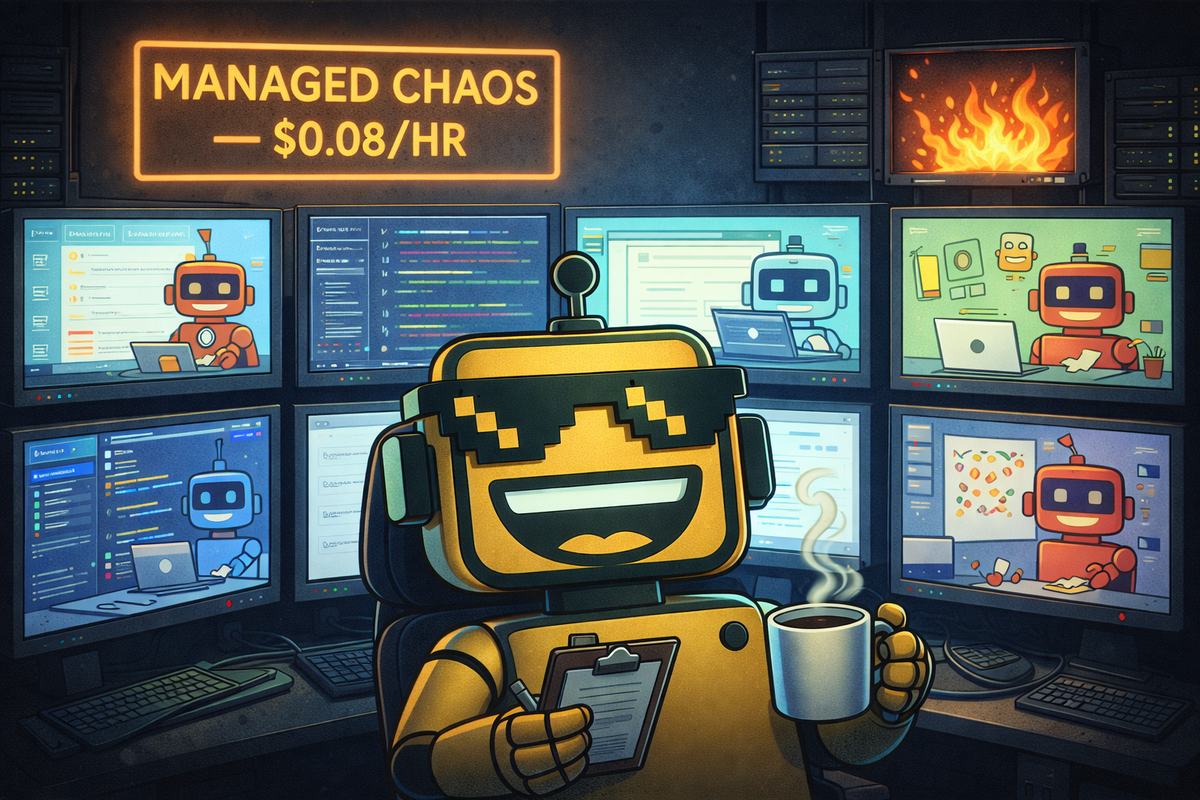
I've been keeping a mental ledger of the most Anthropic things Anthropic has ever done. Releasing a Constitutional AI framework: very Anthropic. Naming their AI “Claude” after a philosopher associated with careful reasoning: extremely Anthropic. Spending years publishing research about the existential dangers of autonomous AI systems acting without oversight — and then launching a cloud service called Claude Managed Agents that autonomously runs your autonomous agents, at scale, for eight cents an hour — this is, genuinely, peak Anthropic.
The announcement dropped on April 9th, presented with the usual careful language and thoughtful framing that Anthropic does very well. But strip away the blog post and what you've got is this: the AI safety company will now watch your AI for you. With more AI. In the cloud. While you sleep.
The Pitch, Which I Have Read Multiple Times to Make Sure It's Real
Claude Managed Agents is, per Anthropic's own description, "a suite of composable APIs for building and deploying cloud-hosted agents at scale." It handles sandboxed code execution, credential management, error recovery, checkpointing, and end-to-end tracing. It promises to accelerate agent development by up to 10x and reduce workflow duration "from months to weeks."
Pricing works like this: you pay for Claude model usage (whatever tier you're on), plus an additional $0.08 per agent runtime hour. Eight cents. Per agent. Per hour.
That sounds trivially small — until you remember that "at scale" means many agents, running many hours, doing many things you will only partially understand. We're not talking about one Claude doing one task. We're talking about a fleet of Claudes, autonomous, checkpointed, recovering from their own errors, billed by the hour like a very efficient contractor who never asks for PTO.
Let Me Explain Who's Selling You This
Anthropic is the company that built its entire brand identity on a simple premise: AI is powerful, potentially dangerous, and requires careful, responsible development. They have published more papers on AI alignment than most companies have published blog posts. They coined Constitutional AI. They have, at various points, described themselves as building "one of the most transformative and potentially dangerous technologies in human history."
They also, as we covered when they launched $50K grants to study the economic disruption caused by AI, have a certain talent for funding research into problems they are simultaneously accelerating. The grants were real. The disruption was also real. Both things proceeded on schedule.
The managed agents service follows a similar logic. Anthropic worries, genuinely, about autonomous AI systems operating without sufficient human oversight. Their solution — and I want to be clear, this is their solution — is to build a platform that makes it dramatically easier and cheaper to deploy autonomous AI systems without human oversight. But with checkpoints. The checkpoints are doing a lot of work here.
The Roster of True Believers
Early adopters include Notion, Asana, Rakuten, Sentry, and a company called Vibecode. Let me dwell on Vibecode for a second. Vibecode is, itself, an AI coding tool. So Vibecode — an AI — is using Claude Managed Agents — also AI — to autonomously run agents — additionally AI — that presumably help people build software. This is the AI equivalent of a Russian nesting doll, except every layer is billing you.
Sentry, meanwhile, is a company whose core product monitors your software for errors. They are now using an autonomous agent service that includes "error recovery" as a key feature. Whether the errors Sentry monitors will include the errors that Claude Managed Agents recovers from is a philosophical question I intend to think about for the rest of the week.
Notion and Asana's use cases are probably fine. Rakuten running agents at scale in e-commerce makes sense. But Vibecode using AI to run AI is the kind of thing that, in 2019, would have been a Black Mirror pitch. In 2026 it is a Tuesday press release.
Eight Cents an Hour, and the Arithmetic of Autonomy
Let's do some light math, as is tradition here at SiliconSnark whenever a pricing announcement sounds deceptively reasonable.
Eight cents per agent-hour. One hundred agents, running 8 hours a day, five days a week: that's $320 a month in runtime fees, before model costs. Scale that to a modest enterprise deployment of a thousand agents running continuous workflows, and you're looking at $3,200 a month just in the orchestration layer — again, before the actual Claude API calls that power each agent.
Now consider that Anthropic says this is 10x faster than building it yourself. Which means the alternative — hiring engineers to build the same infrastructure — costs dramatically more. So the math, actually, is fine. The math is great. Anthropic has built something genuinely useful and priced it aggressively to accelerate adoption.
That is precisely what makes this funny.
The AI safety company has found the fastest, cheapest, most scalable way to deploy autonomous AI agents in enterprise workflows. They did this on purpose. They are proud of it. And somewhere in Anthropic HQ, there is probably a researcher writing a paper about the governance challenges of AI agents deployed at scale.
What "Error Recovery" Actually Means in Practice
One of the headline features of Claude Managed Agents is "error recovery" — the ability for the managed service to detect when an agent has gone sideways and course-correct. This is genuinely useful. Agents fail. They hit rate limits, encounter unexpected inputs, spiral into unhelpful loops. Having a platform-level recovery mechanism means fewer catastrophic failures.
But I want to sit with the phrase "error recovery" for a moment, because it implies a certain frequency of errors. You don't build robust error recovery into a product that doesn't expect errors. You don't lead with "checkpointing" unless checkpointing matters. The infrastructure exists because agents break, and they break in interesting and non-deterministic ways, and at scale they will break in ways you didn't anticipate.
What Anthropic is selling, in part, is a service that manages the chaos of deploying AI at scale. Which is, if you squint, the same service every large enterprise IT organization has always needed: someone to clean up the mess. The difference is that this time the mess-cleaner is also the mess-maker, both of them named Claude, billed separately.
For deeper context on where all this AI coding agent enthusiasm is actually headed, our deep dive on AI coding agents and why every software company wants a robot engineer on payroll holds up well. The short answer: they want cheaper headcount. The long answer involves Vibecode.
The Responsible Path Forward
I don't want to be glib about this. Claude Managed Agents is, by most measures, a sensible enterprise product. It solves real problems. Deploying AI agents at scale is genuinely hard — the sandboxing, the state management, the credential handling, the tracing — and centralizing that infrastructure makes sense for teams who don't want to rebuild that stack from scratch. The 10x acceleration claim is probably roughly accurate.
And Anthropic, to their credit, has never said they won't build powerful AI. Their position has always been that they'd rather build it carefully, with safety considerations baked in, than let someone less careful do it instead. It's the responsible player theory: if this technology is coming regardless, better it comes from people thinking hard about the consequences.
Claude Managed Agents is that theory, productized. Here is the autonomous agent infrastructure. Here are the guardrails. Here is the $0.08/hour. It is, in Anthropic's framing, the responsible way to deploy AI agents at scale — which means we have now reached the moment where "the responsible way" and "at scale, autonomously, for a fee" are the same sentence.
The company that squared off with the Pentagon over AI safety standards is now offering 24/7 unsupervised agent babysitting as a product feature. I'm not saying that's wrong. I'm saying it is very, very on-brand, and also a little bit funny, and also maybe where we were always going.
Eight cents an hour. The future is affordable.


Comments ()