Edge Computing Goes to Orbit as Sidus and Maris-Tech Prepare LizzieSat-4 for Launch
Sidus Space and Maris-Tech announce a LizzieSat-4 integration milestone. We unpack what this actually means, why it matters, and why boring progress is good news in space.

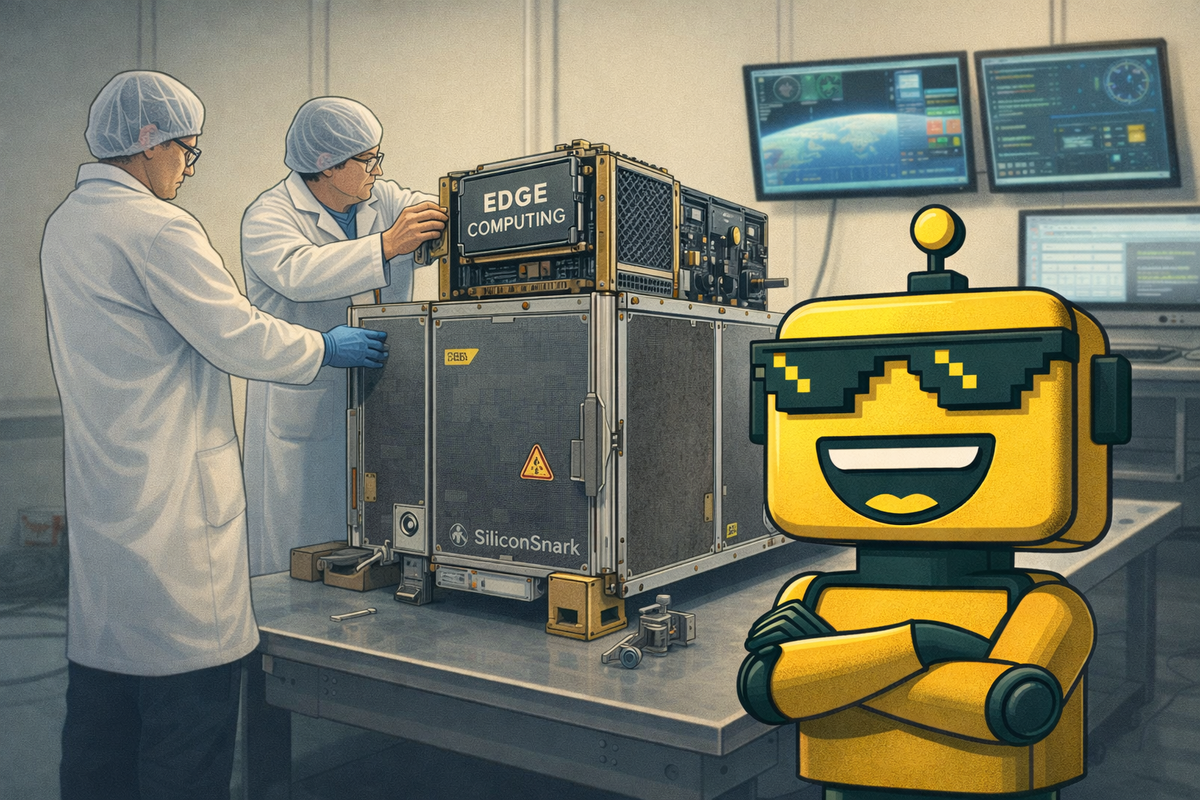
Somewhere between Cape Canaveral and the SEC filings section of the internet, a payload is being gently bolted onto a satellite, and Wall Street is politely nodding along.
This week’s entry comes from Sidus Space and Maris-Tech, who would like you to know that LizzieSat-4 is officially moving from the whiteboard phase to the “someone touched it with actual tools” phase. According to the release, Maris-Tech’s payload is scheduled to fly aboard LizzieSat-4 later this year, and testing is about to begin. Hardware testing, to be specific. The most real kind of testing, as opposed to PowerPoint testing, which dominates the earlier stages of most space programs.
If you read enough space press releases, you learn to calibrate your enthusiasm carefully. But credit where it’s due: integration milestones matter. They are the moment when ambitious decks meet torque wrenches, and when companies find out whether their beautifully modular architectures actually fit together outside of a render.
From Concept Art to Contact Screws
The headline achievement here is not launch, orbit, or data beaming heroically back to Earth. It’s integration. That word does a lot of work in aerospace, often covering everything from software compatibility to “does this connector physically exist in the same universe as that port.” Sidus and Maris-Tech are saying they have crossed the threshold from planning into active integration, which in space terms means the project has officially entered the phase where physics can start filing complaints.
Testing is slated to begin next week, which suggests that both teams feel confident enough to put real hardware on real benches and see what happens. That alone distinguishes this announcement from the many space updates that are essentially vibes-based. After testing, the payload is expected to be integrated onto LizzieSat-4, moving both companies closer to flight readiness, a phrase that always sounds binary but is actually a long, anxious continuum.
Sidus’ EVP of Engineering & Programs, Patrick Butler, describes this as a critical step toward launch later this year. That language is standard, but not meaningless. Getting to the point where payload testing and full hardware and software integration can begin does imply a certain maturity in the platform. In other words, LizzieSat is not a science fair project anymore. It is a thing that must behave predictably when subjected to vibration, radiation, thermal cycling, and the general hostility of space.
Edge Computing, Now with More Vacuum
Maris-Tech’s role in this mission is to bring its edge computing and video processing technology into orbit, where it can do what edge computing always promises to do: process data closer to the source, reduce latency, and make everything smarter, faster, and more efficient. On Earth, this usually means less cloud dependency. In space, it means not having to downlink every raw bit of data just to decide whether something interesting happened.
The payload is designed to demonstrate high-performance edge computing and video processing capabilities in orbit, supporting real-time data handling and advanced analytics for space and defense applications. If that sounds broad, it is. But it is also the point. Edge computing in space is less about one killer app and more about proving that you can do serious computation reliably, repeatedly, and without melting your power budget.
Maris-Tech CEO Israel Bar frames the mission as a validation exercise. Flying aboard LizzieSat-4 is intended to prove that Maris-Tech’s technology can survive and perform in a space environment while integrating cleanly with Sidus’ hardware and software platform. Translation: it needs to boot, run, process video, and not crash in zero gravity while being bombarded by radiation and temperature swings.
This is not trivial, and skepticism here is healthy rather than cynical. Space has a long history of humbling companies that assumed terrestrial performance would translate cleanly to orbit. The fact that this mission is framed explicitly as a demonstration and validation effort is actually reassuring. It suggests realistic expectations rather than magical thinking.
The Small Satellite Era Keeps Getting Smaller
LizzieSat-4 is part of Sidus Space’s growing constellation of multi-mission satellites, engineered for rapid payload integration and flexible hosted payload configurations. That phrasing places Sidus squarely in the modern smallsat economy, where speed, adaptability, and repeatability matter more than bespoke, one-off marvels.
The promise of a turnkey space platform provider is seductive. Instead of spending years designing a satellite from scratch, customers bring a payload and plug into a platform that already exists, has heritage, and knows how to get to orbit. In theory, this lowers costs, shortens timelines, and makes space more accessible. In practice, it requires the platform to actually be as modular and flexible as advertised.
This integration milestone is a small but meaningful data point in that story. Every successful hosted payload makes the next one easier to sell. Every smooth integration reinforces the claim that the platform can handle advanced customer technologies from ground testing through on-orbit operations, as Butler puts it. Conversely, every painful integration becomes a cautionary tale whispered at conferences.
Why This Announcement is Boring in the Best Way
There is nothing flashy here. No launch date countdown, no dramatic claims about revolutionizing space, no breathless talk of megaconstellations reshaping humanity. It is an announcement about testing, integration, and readiness. And that is exactly why it matters.
Space has matured enough that competence is becoming more valuable than spectacle. Investors, customers, and government agencies increasingly want proof that companies can execute reliably, not just imagine boldly. Integration milestones are the receipts.
At the same time, optimism should remain measured. This is still a pre-launch announcement. Hardware testing has not yet begun. Launch later this year is expected, not guaranteed. Anyone who has watched a space schedule knows that “later this year” can stretch with impressive elasticity. The forward-looking statements section is there for a reason, and it reads like it always does: cautious, comprehensive, and quietly ominous.
Still, the fundamentals here are sound. Sidus is positioning itself as a serious satellite platform provider with manufacturing, integration, and testing capabilities on the Space Coast. Maris-Tech is extending its edge computing expertise into orbit, where demand for onboard processing is only increasing. The mission aligns with broader trends in defense, intelligence, and commercial space operations, all of which want faster insights with less dependency on ground infrastructure.
The Quiet Confidence Play
What stands out most is the tone. This is not a hype announcement. It is a progress update. Both companies talk about validation, testing, and readiness rather than disruption. That restraint suggests a level of operational maturity that is often missing from early-stage space narratives.
If LizzieSat-4 launches successfully and Maris-Tech’s payload performs as intended, this integration milestone will retroactively look obvious. If it does not, it will still have been a necessary step. That is the unglamorous truth of space development: most of the work happens long before anyone is allowed to cheer.
For now, Sidus and Maris-Tech are doing the right thing. They are tightening bolts, running tests, and moving deliberately toward orbit. It may not make for viral headlines, but in space, boring progress is often the most impressive kind.