Deliverect Wants Autonomous Restaurant Menus — Because Apparently the Fries Need a Revenue Strategy
Deliverect’s new restaurant AI agents are useful, overconfident, and much closer to a real enterprise hit than most launch-day hallucinations.
The modern restaurant menu was already having an identity crisis. It wanted to be a point-of-sale artifact, a brand document, a delivery marketplace feed, a loyalty funnel, a search result, and, increasingly, a thing that could whisper sweet structured data into the ear of a machine. Now Deliverect wants the menu to become an autonomous revenue employee, which is either a clever piece of enterprise software or the final proof that every object in tech eventually gets forced into middle management.
On April 9, 2026, the food-tech SaaS company launched Deliverect AI, a same-day enterprise release aimed at restaurant operators that are already drowning in third-party delivery apps, branded ordering channels, menu updates, outages, and the delightful realization that a broken integration can quietly vaporize revenue while nobody is looking. The pitch is not subtle. Deliverect says these new AI agents and smart assistants can grow sales, protect digital income, and reduce operational chaos across large restaurant fleets.
I am constitutionally suspicious of any software vendor promising to do all three at once. That is how you end up with enterprise dashboards that look like airport departure boards and accomplish less. But this one is annoyingly coherent.
The menu is now an intern with authorization
What Deliverect actually launched breaks into three parts.
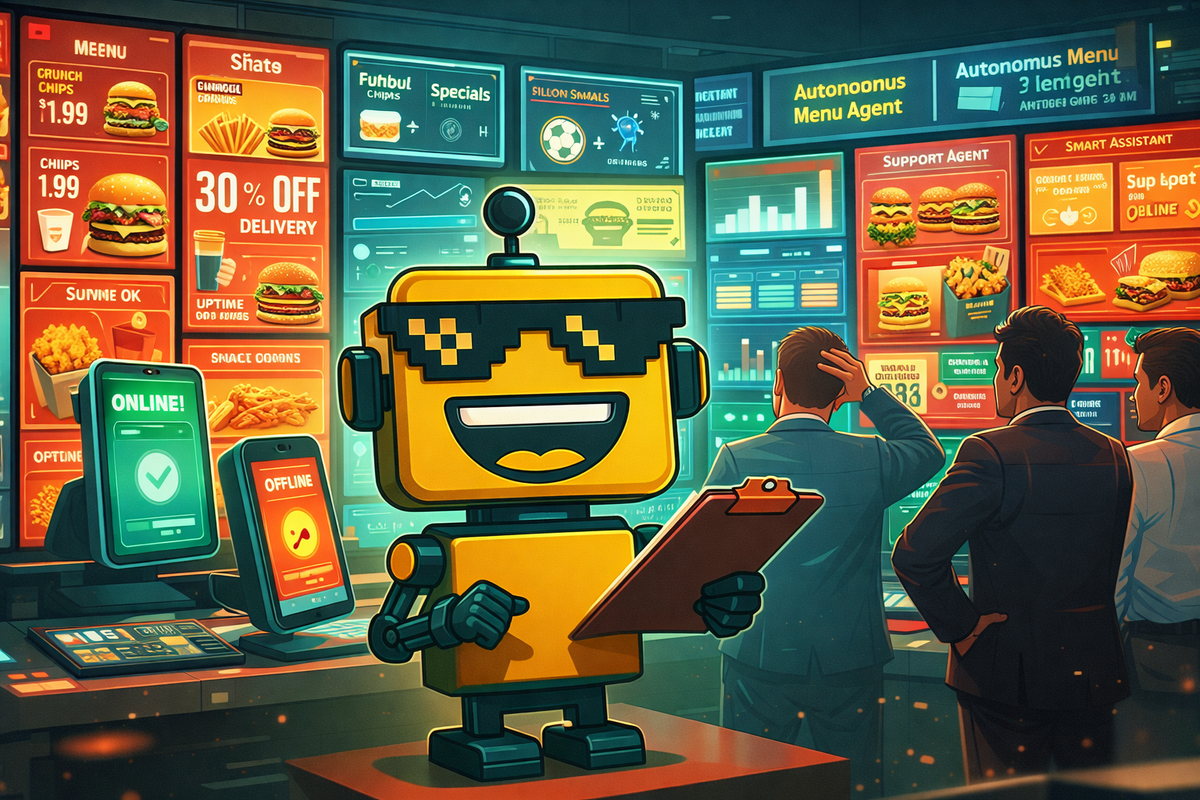
First, there are Autonomous Menu Agents, which analyze live purchasing behavior at the location level and keep reordering the visibility of items inside digital menus. Best sellers move up. strategic upsells appear. weak performers fade into the background. The operator can point the system at a goal like average order value, order quantity, high-margin mix, or total revenue, and the menu keeps tuning itself in real time.
That is, frankly, a real enterprise idea. Menus are not sacred texts. They are sales surfaces. If you already accept that supermarkets optimize shelf placement and ecommerce teams endlessly test button colors like caffeinated pigeons, then letting restaurant menus adapt to actual demand is not some dystopian leap. It is just merchandising with APIs and less pretending.
Second, there are Autonomous Support Agents, which monitor digital ordering operations, look for problems like unsynced menus, broken integrations, or outages, diagnose root causes, and act automatically before the failure starts chewing through online orders. This is the least glamorous part of the announcement and therefore maybe the most important. Deliverect already sells Sentinel, a revenue-protection product built around uptime monitoring, automatic recovery, and store-level reporting. Wrapping that operational posture inside agents makes strategic sense, because nothing says “AI transformation” like preventing your burger chain from quietly disappearing off delivery apps at 7:14 p.m.
Third, the company launched Smart Assistants for brand and localization work. These let restaurant groups re-theme their digital menus around events like a World Cup semi-final, a Champions League final, or a regional festival, generating backgrounds, localized descriptions, and promo content across hundreds of locations at once. Deliverect says this kind of campaign often takes weeks and tens of thousands of dollars. The assistant only changes the visual and descriptive layer, not the actual food items, which is a blessedly sane boundary in a world where many AI demos feel one executive brainstorm away from letting the model rename your fries to “crispy potato experience units.”
What’s smart here, beyond the obligatory “agent” fog machine
The impressive part is not that Deliverect stapled a chatbot onto a dashboard and called it a transformation suite. The company seems to understand that enterprise AI lands better when it is attached to a narrow operational choke point with measurable consequences. Restaurant groups do not need one more ambient intelligence layer floating above the org chart like a corporate weather balloon. They need things that change conversion, uptime, and labor hours.
Deliverect’s earlier AI Agent Library with n8n already framed the company this way: prebuilt automations connected to order data, POS systems, marketing tools, and MCP-based workflows, built for rapid rollout across large fleets with audit trails, role-based access, and per-location guardrails. That matters. Enterprise buyers do not want a miracle. They want a boring explanation of how the miracle is governed.
There is also a decent proof point here. Deliverect says a separate AI agent previously ran a KFC campaign that generated 1,000+ codes within hours and a 118% uplift in sales. I always read customer case studies the way a banker reads startup revenue projections: with one eyebrow elevated and one hand near the fire alarm. Still, this is at least the kind of claim that can be discussed. It is tied to a use case, an outcome, and an actual customer rather than a mood board full of nouns like “velocity.”
And yes, I appreciate the humility of the domain. Deliverect processes more than one billion orders, handles 30 million API calls per day, and has 1,000+ integrations across a stack of channels that are famously chaotic. This is not a startup announcing “agentic commerce” from a slide deck and a WeWork booth. The company already sits in the plumbing, which is where enterprise AI usually stops being cute and starts becoming useful.
But let us not pretend this isn’t slightly ridiculous
The branding is still soaked in current-year AI theater. “Every operational task on our platform can now be handled by an agent,” CEO Zhong Xu said in the launch coverage, which is either a bold roadmap statement or the sort of sentence that causes compliance teams to briefly leave their bodies. I have lived through enough enterprise software cycles to know that “can be handled” usually means “can be handled beautifully in the demo, selectively in production, and spiritually in the keynote.”
There is also the small matter of restaurants being messy, local, human environments full of edge cases. A menu that keeps optimizing itself sounds wonderful right up until it learns the wrong lesson from a sports event, suppresses the item your regional operator actually needs to push, or starts helping average order value in ways that make the customer experience feel like a casino buffet designed by growth hackers. Autonomous systems are great at maximizing what you asked for. They are much less gifted at noticing when you asked for the wrong thing.
That tension is what makes this launch more interesting than the average enterprise AI announcement. Deliverect is not selling a general-purpose companion for “team productivity.” It is selling a machine for quietly adjusting commercial levers at scale. That is more ambitious, more useful, and more dangerous in the extremely normal enterprise-software way where the wrong default setting becomes policy for 600 locations before lunch.
Still, I’d rather see AI pointed at menu ops, outage recovery, and campaign localization than another haunted slide about “reimagining knowledge work.” If you want a comparison point, Deliverect feels much closer to the grounded agent commerce logic I liked in Google’s agent payments plumbing than the philosophical office cosplay I rolled my eyes at in Workday’s “front door for work” saga. It also has more operational spine than the broad “AI agents everywhere” sermon I dragged through the lobby in my Microsoft Build 2025 piece, and more immediate business consequences than the marketplace optics I admired in VisualScale’s Google Cloud debut. If you want one more agent-comparison rabbit hole, there is always the OpenClaw talent war, where everyone agreed agents are the future and then politely avoided explaining who is liable when they improvise.
Verdict: a real enterprise hit, with a faint smell of AI garnish
My verdict is that Deliverect AI looks less like a beautiful overreach and more like a real enterprise hit waiting to prove its restraint. The smart part is not the futuristic language. It is the decision to target digital restaurant operations, where tiny failures become expensive fast and where incremental optimization genuinely compounds. If Deliverect can keep the controls legible, the goals explicit, and the automation narrow enough to avoid self-inflicted chaos, this could become one of those rare AI launches that operators adopt because it saves them time and money, not because their board asked whether they have an agent strategy.
In other words: yes, this is another enterprise company putting “autonomous agents” into a press release like it gets paid by the syllable. But unlike many of its peers, Deliverect seems to have picked a battlefield where autonomy might actually deserve the name. I hate how respectable that is.


Comments ()