
Deep Dive: The AI Assistant Reboot — Why Alexa+, Gemini, and Siri Are Finally Getting Smarter
Alexa+, Gemini, and Siri’s stalled reboot show how AI assistants are becoming the new operating layer for search, shopping, smart homes, and trust.
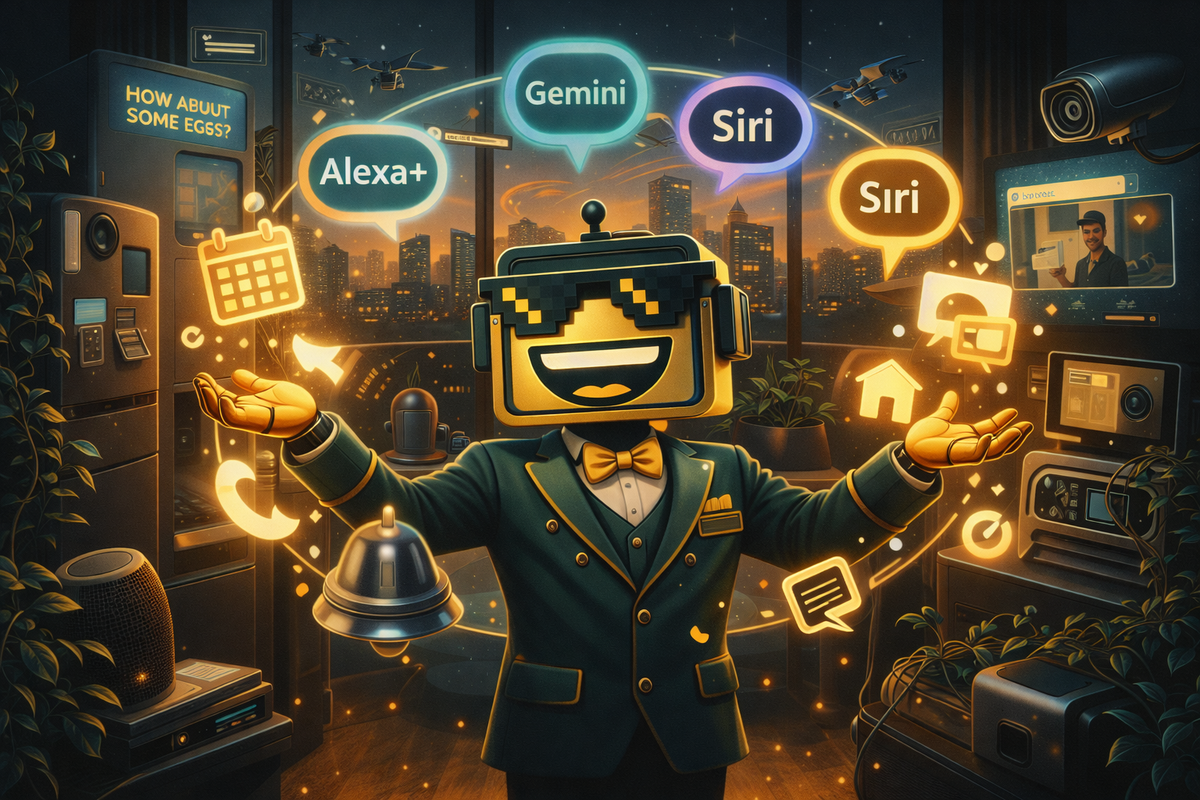
Amazon is finally shipping Alexa+, Google is replacing Assistant with Gemini, and Apple still says its more personal Siri features are in development. This guide explains why the AI assistant category suddenly feels important again, what changed technically, where the money is, why privacy is still a mess, and why the real fight is not over chatbots but over who gets to become the default layer between you and the rest of your digital life.
SEO Excerpt for Ghost: Alexa+, Gemini, and Siri’s stalled reboot show how AI assistants are becoming the new operating layer for search, shopping, smart homes, and trust.
Here is a useful snapshot of the AI assistant market on April 8, 2026. Amazon says Alexa+ is now available to everyone in the U.S., while its U.K. rollout began on March 19, 2026 as an Early Access program. Google said on March 14, 2025 that classic Google Assistant would stop being accessible on most mobile devices later that year as users were upgraded to Gemini, and by late 2025 the company was already saying Gemini for Home would upgrade and replace Google Assistant on speakers and smart displays. Apple, meanwhile, still has onscreen awareness, personal context, and cross-app Siri actions labeled “in development” on its own Apple Intelligence page.
This is a beautiful industry tableau. Amazon has finally dragged Alexa into the generative era after spending years turning “voice assistant” into a synonym for timers, weather, and playing Fleetwood Mac in the kitchen. Google has effectively admitted that the old Assistant model has run its course and is rebuilding the category around Gemini. Apple is still standing in the premium privacy fog, reminding everyone that the future is coming in a future software update, which is an elegant way to say “please admire the architecture while we continue looking for the missing staircase.”
The important point is that this is not just a product refresh cycle. It is a second attempt to build one of the oldest dreams in consumer computing: a software layer that knows enough about your life, your devices, your preferences, your schedule, your messages, your house, and your habits to do things for you instead of merely sitting there waiting for taps. Silicon Valley has wanted this for years. Consumers have also wanted it, intermittently, mostly when their hands were full or their patience was low. What the market could not agree on was whether the assistant should be a voice, a search box, an operating system feature, a smart speaker, a chatbot, a shopping butler, or a slightly haunted universal remote.
Now the answer appears to be “all of the above, plus subscriptions.” Naturally.
The Nut Graph: This Is Really a Story About Interface Power
The easiest way to misunderstand the assistant reboot is to think it is mainly about better conversational AI. That is part of it, obviously. Nobody would bother relaunching these systems if large language models had not made them dramatically more flexible, more patient, and more capable of handling messy human phrasing. But the bigger story is structural. Whoever controls the assistant layer gets a shot at controlling intent.
Intent is valuable because it sits upstream of almost everything else. Before you search, shop, click, compare, book, order, message, navigate, or automate, you form an intention. The assistant’s dream is to intercept that moment and become the broker. Not just the place where you ask a question, but the place where your desire gets translated into action. That is why Amazon wants Alexa+ to order, reserve, recommend, and manage. That is why Google wants Gemini to sit across mobile, search, home devices, and AI Mode. That is why Apple keeps talking about personal context, App Intents, and on-device action. And that is why companies outside the classic assistant trio, from OpenAI to Meta, keep circling the same territory from different angles.
SiliconSnark has been tracing this migration all year. In our AI browser deep dive, the point was that browsing is turning into an assistant surface. In the OpenClaw clone wars piece, the point was that agents increasingly want to operate the computer, not merely advise the human. In our piece on OpenAI’s app ambitions, the underlying thesis was that chat is becoming a gateway for services and transactions. The assistant reboot is where all of those lines intersect. It is the category where chat, search, commerce, operating systems, home control, and agentic action are trying to merge into one behavioral habit.
So this guide is about the whole machine: the long history of the category, why the first assistant wave plateaued, what changed technically, why Amazon and Google are charging back in while Apple still looks cautious, how smart-home standards and device ecosystems shape the battlefield, where privacy and regulation become load-bearing, and what it means culturally when your devices stop acting like tools and start auditioning for the role of household middle management.
Before the Reboot, There Was the Original Fantasy
The chronology matters here because the category’s reputation was not damaged by one failure. It was slowly eroded by years of being almost useful enough. Apple introduced Siri with the iPhone 4S in October 2011, selling the idea that you could ask your phone to help you get things done instead of pecking through menus like a civilized but tired pigeon. Amazon’s Echo followed in late 2014, and by June 2015 the company was already describing Alexa as the cloud brain behind a new category of always-on voice device that had been adding features since November 2014. Google formally launched Google Assistant in October 2016, tying it to Pixel and Google Home and presenting it as the natural extension of Google’s strengths in search, language, and machine learning.
Those launches established the modern assistant dream. You would speak naturally. The software would understand context. It would access services and devices. It would remember useful information. It would get less like software and more like a capable helper woven through your day. The surrounding hardware stories differed. Apple treated Siri as an operating-system feature. Amazon made the assistant itself the reason to buy the hardware. Google tried to make Assistant a cross-device manifestation of Google. But the common ambition was obvious. They all wanted to own the moment between request and result.
For a while, this worked well enough to feel inevitable. Voice control was novel. Smart speakers spread. Routines, reminders, music playback, weather checks, and light controls became normal in a lot of households. Amazon says it now has more than 600 million Alexa devices in the world. Google said in January 2024 that Assistant helped hundreds of millions of people. This was not fake adoption. It was just narrower than the original mythology.
The market did not get a digital chief of staff. It got a reliable but limited layer for simple commands. Ask for a timer. Ask for a song. Turn off the lights. Check the weather. Hear the news. Maybe add something to a list. Maybe control the thermostat if your setup behaved itself and the smart-home gods were in a merciful mood. Which is useful, but not exactly the “Star Trek computer” future investors and keynote presenters kept implying was right around the corner.
Why the First Assistant Wave Flattened Out
The pre-LLM assistant problem was not that the products were useless. It was that they were brittle. They required command grammar without openly admitting it. They offered the theater of natural language while secretly preferring that you memorize what counted as a valid incantation. If you guessed the right phrasing, the system looked magical. If you spoke like an ordinary person, the system often reacted like an exhausted bureaucrat who had lost your form.
This brittleness was compounded by ecosystem fragmentation. The smart home was supposed to make voice assistants indispensable. Instead it often made them feel like underpaid tech support for a house full of devices from companies that all believed interoperability was a moral virtue best practiced by someone else. Amazon itself said in 2022 that no customer wants to buy a smart device only to discover it is incompatible with the system they prefer, which was a polite corporate way of admitting that the smart home had become a compatibility escape room.
Then there was the business-model problem. Smart speakers were sold cheaply, often aggressively. But the recurring revenue picture was fuzzy. How much money does a company really make when you ask for the weather or set a pasta timer? A lot of the assistant era quietly turned into an object lesson in what happens when a category gets massive engagement but murky monetization. If your assistant is mostly helping with household trivia and playback controls, it may be beloved, but it is not obviously a great business unless it drives commerce, subscriptions, lock-in, or data advantages somewhere else.
This is one reason SiliconSnark keeps coming back to the same theme in different categories: real value tends to hide inside boring but durable leverage. In our piece on whether agents actually make money, the point was that flashy demos are not the same thing as stable economics. Assistants lived that lesson for years. They were familiar, occasionally delightful, and strategically important, yet persistently underwhelming as direct businesses. That created a strange limbo. Companies could not quit the category because the interface potential was too valuable. They also could not fully justify the original rhetoric because the products were too constrained. Hence the long, awkward intermission before the generative reboot.
What Changed: LLMs Made the Products Feel Less Robotic, but Tool Use Made Them Strategic
Large language models did not magically solve the assistant problem. They did, however, remove one of the category’s most obvious forms of humiliation: the feeling that your software assistant was deeply confused by ordinary conversation. Modern systems can handle ambiguity better. They can ask clarifying questions, maintain context across turns, summarize documents, interpret intent from fuzzier language, and respond in a way that feels less like menu navigation disguised as dialogue.
That matters, but it is only half the story. The real unlock is tool orchestration. An assistant becomes economically and strategically interesting when it can do things in connected systems, not merely talk about them. Amazon has been explicit about this shift. In its February 27, 2025 launch post, the company framed Alexa+ as an assistant that can manage the home, make reservations, track or buy products, and carry context across devices. In Amazon’s 2024 shareholder letter, Andy Jassy practically underlined the thesis with a fluorescent marker, arguing that previous assistants could either answer questions or get things done, but not both, and positioning Alexa+ as the system that finally combines intelligence with action.
Google’s language rhymes with that. Gemini is not just pitched as a clever respondent. It is increasingly described as a personal AI assistant that interacts with your apps and services, takes advantage of connected context, and follows you across devices. By January 2025 Google was already calling Gemini a more powerful Android assistant. By March 2025 it was describing the migration from Assistant to Gemini as a new kind of help only possible with AI. By January 2026, it had rolled out Personal Intelligence, connecting Gemini with Google apps such as Gmail, Photos, YouTube, and Search for more individualized assistance.
Apple is approaching the same destination from a different road. Its language emphasizes on-device models, privacy, and app actions via App Intents. But the core idea is still assistant-as-orchestrator. Apple’s own pages say Siri will be able to understand what is on your screen, use personal context from your device, and take actions in and across apps. The interesting part is not the voice layer. It is the implied control layer underneath.
Amazon’s Bet: The Assistant Finally Becomes a Commerce Layer With Better Manners
If you want to understand why Amazon cares so much about making Alexa work this time, start with incentives, not personality. Amazon does not need Alexa+ to be charming in the abstract. It needs Alexa+ to become useful enough, ambient enough, and action-oriented enough that the assistant sits closer to retail, subscriptions, media, and home management than old Alexa ever did.
The product language is revealing. Amazon says Alexa+ is now available to everyone in the U.S., free for Prime members, and available for non-Prime users via a chat experience on Alexa.com and in the Alexa app. The company also says Alexa+ can access documents, emails, photos, and messages that users share, retain context across endpoints, and take actions such as reservations or product discovery. In the U.K., Amazon explicitly says the system is designed to act in the real world, from ordering takeaway to booking services to checking Ring devices. This is not an information layer with a soothing voice. It is an attempt to convert an installed base of speakers, displays, apps, TVs, cameras, and retail relationships into a practical AI middleman.
That has real economic logic. Amazon already owns massive commerce infrastructure, Prime, payments, logistics, devices, media surfaces, and a household footprint through Ring, Fire TV, and Echo. An assistant that nudges, routes, recommends, and executes inside that ecosystem is not merely a feature. It is a mechanism for increasing transaction volume, reducing friction, deepening Prime, and strengthening the habit of asking Amazon first. When Amazon says in its shareholder letter that faster delivery increases purchase completion and shopping frequency, it is not hard to see the adjacent assistant thesis. Reduce cognitive and procedural friction upstream and commerce happens more often downstream.
This is why the assistant story overlaps so neatly with SiliconSnark’s broader writing on agents and platform control. In our agent-economy piece, the recurring pattern was that money accrues where software helps convert intention into paid action. Alexa+ is Amazon’s effort to place itself directly inside that conversion funnel. The joke version is that your smart speaker wants to become your household chief of staff. The less funny version is that Amazon wants a world where “What should I buy?” and “Please take care of it” increasingly route through an interface it controls.
Google’s Bet: If Search, Android, and Home Converge, Gemini Becomes the Default Layer for Everyday Intent
Google’s strategy is broader and, in some ways, more existential. Amazon wants to turn assistant usefulness into commerce and ecosystem leverage. Google is trying to defend and reinvent a company whose power has historically flowed from being the starting point for information retrieval. When AI assistants become better at answering, summarizing, planning, and acting, that starting point is up for grabs.
You can see Google responding on multiple fronts at once. On mobile, it said in March 2025 that Google Assistant users would be upgraded to Gemini and that classic Assistant would later stop being accessible on most mobile devices. Across hardware, Google announced in May 2025 that Gemini was coming to watches, cars, TVs, and XR devices. In search, it introduced Search Live with voice in AI Mode in June 2025, effectively blending conversational voice interaction with Google’s web retrieval machinery. In the smart home, it launched Gemini for Home in October 2025, saying the new voice assistant would replace Google Assistant on speakers and smart displays and offering a $10-a-month Google Home Premium tier for advanced features such as Gemini Live, AI-powered notifications, video-history search, and automation creation through Ask Home.
Notice what that stack implies. Search becomes more assistant-like. Gemini becomes more personal through connected apps. Android becomes more assistant-native. Home devices become more conversational and agentic. The old separations between search engine, mobile assistant, smart speaker, and home-control app start dissolving. The dream is that Google does not merely answer questions on demand. It becomes the continuous layer through which you understand, manage, and act on daily life.
That is also why privacy language matters so much here. Google says connected personalization is optional and that Personal Intelligence is off by default. It emphasizes that Gemini can show where answers came from. Those are not decorative details. They are attempts to make a more invasive and more context-rich form of computing feel governable. The strategic problem is obvious: the more useful the assistant gets, the more it must know. The more it knows, the more it resembles exactly the kind of intimate behavioral infrastructure that makes regulators, publishers, and normal people start rubbing their temples.
Apple’s Bet: Slow Down, Keep the Trust Story Intact, and Let App Intents Do the Heavy Lifting
Apple’s position looks weaker if you judge purely by visible shipping pace, but stronger if you judge by alignment with its broader brand story. The company has been promising a more personal, context-aware Siri since WWDC 2024. As of April 8, 2026, Apple’s own Apple Intelligence pages still say the most ambitious Siri features, including personal context understanding, onscreen awareness, and cross-app actions, are in development and will arrive in a future software update. That is not a great look if you wanted the triumphant assistant reinvention on schedule.
But Apple’s slower posture is not just operational delay. It reflects a different theory of risk. Apple wants the assistant to feel like an extension of the operating system and the user’s personal data vault, not a cloud-first chat service that occasionally happens to touch your phone. Its product pages stress on-device processing, Private Cloud Compute for more complex requests, and App Intents as the framework that allows Siri to take action across apps. On the developer side, Apple says these capabilities are built with privacy at the center and that apps can tap into on-device models and action surfaces offline.
This gives Apple two advantages if it can ever fully cash the check. First, it can argue that the assistant is not another internet service trying to harvest context. It is part of the device experience itself. Second, it can make assistant capabilities legible to developers through system frameworks rather than asking the entire ecosystem to rebuild around one cloud bot. That is a technically elegant story and, if it works, a powerful one.
The trouble is that elegance and momentum are not the same thing. The assistant market is moving fast enough that delays reshape perception. Amazon and Google get to say their products are out, expanding, and attached to clear subscription or platform plans. Apple currently gets to say, in essence, the really interesting bits are still marinating. That does not mean Apple loses. It does mean Apple is betting that trust, integration, and polish will matter more than first-mover heat in a category where overpromising can go feral quickly. Given the history of assistants, that is not an irrational bet. It is just a less glamorous one.
How Ambient Assistants Actually Work When the Demo Music Stops
The phrase “ambient assistant” sounds like something a startup would say before selling you a lamp with a seed round. But there is a real product distinction buried inside the jargon. An ambient assistant is not supposed to live in one app, one device, or one explicit request pattern. It is meant to persist across surfaces and contexts, combining voice, typed input, screens, sensors, accounts, and connected services into a more continuous form of help.
In practical terms, that usually means six layers. There is input, which can include voice, text, camera, location, device state, or app context. There is identity, which is how the system knows who is asking, what permissions apply, and which preferences matter. There is memory or personalization, which may include explicit settings, prior conversations, calendars, messages, documents, or activity history. There is orchestration, where the model decides whether to answer directly, call a tool, query a service, or ask for clarification. There is execution, where actual things happen in apps, homes, carts, media systems, calendars, or communications. Then there is review and control, where the user is supposed to understand what just happened and reverse it if necessary.
That is why so many assistant launches now talk less about personality and more about connected apps, subscriptions, action frameworks, privacy dashboards, and upgraded device surfaces. The value comes from stitching those layers together. Amazon talks about continuing a conversation from Echo to phone to browser, and about uploading documents for Alexa to remember or act on. Google talks about connecting Gemini to apps, using Search Live in the background, and creating home automations through natural language. Apple talks about onscreen awareness, App Intents, and on-device context. Underneath the branding differences, these are all attempts to solve the same product equation: how do you combine context and action without making the user feel trapped inside an inscrutable black box?
The cynical answer is that most companies are still working on that last part. The practical answer is that the assistant category is finally becoming less about voice recognition and more about controlled access to systems. Which is why it increasingly resembles the agent market SiliconSnark dissected in our OpenClaw guide and the workflow power grabs we covered in the browser wars piece. The machine is inching from “talk to me” toward “let me operate things for you.”
The Smart Home Is Still the Assistant Category’s Favorite Lab Rat
Voice assistants did not invent the smart home, but the smart home gave them a reason to exist when phones already handled most information queries better. Saying “turn off the lights” or “set the thermostat” remains one of the most intuitive uses of voice because it is brief, hands-free, and actually easier than poking through an app. That is why the assistant reboot keeps returning to home control even as companies talk grandly about much bigger ambitions.
The home is also useful because it generates exactly the kind of messy contextual environment assistant vendors love to romanticize. Multiple users. Shared devices. Security concerns. Recurring routines. Sensors. Cameras. Schedules. Energy management. Interruptions. Situations where hands are occupied and screens are inconvenient. If you can make assistant behavior feel genuinely helpful in that setting, you can argue you are building something broader than a chatbot.
Amazon has leaned into this for years through Echo, Ring, Fire TV, and routines. It says there are now over 300 million smart-home devices connected to Alexa, and it claims predictive features such as routines and hunches already initiate a meaningful share of smart-home interactions without users saying anything at all. Google’s Gemini for Home framing is even more explicit. It positions the home as a place where a previously transactional assistant becomes natural, contextual, and proactive, with summaries from cameras, natural-language search across video history, and plain-English automation creation. Apple, by contrast, remains more restrained publicly, but Siri and Home continue to occupy a strategic role as Apple works on the broader Apple Intelligence stack.
This is why the home matters even if you do not particularly care about smart bulbs. It is the proving ground for whether an assistant can become ambient without becoming intolerable. If the system cannot reliably interpret “it’s too bright in here,” infer the right lights, understand which room matters, and avoid doing something embarrassing at the wrong moment, then the larger fantasy of seamless everyday computing still has a hole in it the size of a kitchen island.
Matter Was Supposed to Make the House Less Stupid, and It Is Slowly Helping
One reason assistant vendors keep talking about the smart home as if it is forever just one update away from dignity is that interoperability has been such a chronic drag on the category. This is where Matter, the smart-home standard backed by the Connectivity Standards Alliance, matters more than the average consumer keynote lets on. Matter is not exciting in the way AI demos are exciting. It is exciting in the way plumbing is exciting once you have had a flood.
The standard’s purpose is straightforward: make it easier for devices from different brands and ecosystems to work together predictably. Amazon said in 2022 that Matter could help customers focus on the products they need rather than worrying whether those products would work with their preferred systems. The CSA’s more recent releases show how this is maturing from aspiration into practical infrastructure. Matter 1.4.1, released on May 7, 2025, focused on setup improvements, including enhanced setup flow, multi-device QR codes, and NFC-based onboarding information. Matter 1.5, released on November 20, 2025, expanded support to cameras, closures, soil sensors, and energy management.
That sounds dry because standards are dry. But the implications are not. Assistants get more useful when device setup is less painful, when camera categories are standardized, when automation targets are more consistent, and when regulatory compliance and consent flows can be handled more cleanly. Even the unglamorous details, such as terms-and-conditions display during setup, matter because they determine whether the category scales like consumer software or like a stack of incompatible gadgets held together by vibes and QR codes.
This is another place where hype and reality are different species. The hype says your home is becoming intelligent. The reality says your home becomes slightly less deranged when a bulb, a thermostat, a camera, a lock, and a hub can all agree on basic onboarding and control semantics. That may not sound cinematic. It is, however, the kind of boring improvement that makes higher-level assistant behavior possible. SiliconSnark has made this same point in other contexts, from compliance tooling to backend platforms: boring infrastructure often ends up deciding whether the glamorous layer can survive adulthood.
The Business Incentives Are Not Hidden, They Are Just Wearing Softer Clothes
Assistant vendors like to market these products as help. Help is good. Help is wholesome. Help sounds like an old friend dropping by with useful context and emotionally intelligent reminders. But the assistant market is also full of very ordinary incentives: subscription revenue, ecosystem lock-in, data advantage, default distribution, and transaction capture.
Amazon’s pricing is one of the clearest tells. Alexa+ is free for Prime members and otherwise priced as a premium service. That means the assistant is both a membership sweetener and a possible standalone revenue line, while also serving Amazon’s deeper commerce goals. Google’s Home strategy is similar in shape even if different in mechanics. Basic Gemini-for-Home voice replacement is included, but the more advanced layer sits behind Google Home Premium, starting at $10 per month, while some of that premium functionality is bundled into broader AI subscriptions. Apple does not currently frame Siri as a separate subscription business, but its assistant ambitions still reinforce the value of high-end hardware, integrated services, and staying inside the Apple stack.
Then there is the less visible incentive: behavioral choke points. The assistant that becomes your default way of asking for information, controlling devices, and initiating tasks gets extraordinary leverage over adjacent markets. Search, shopping, media, bookings, communications, home automation, app discovery, and recommendations can all route through that layer. This is why the assistant reboot should be read alongside SiliconSnark’s writing on browsers, agents, and platforms. In the browser war story, the question was who controls navigation and information access. In the OpenAI app-store piece, it was who controls transactional extensibility. In the agent economics piece, it was where value accrues when software does more work. Assistants sit exactly at that intersection.
So yes, the products may genuinely help you. They may also function as exquisitely polite tollbooths placed between you and the digital economy. Two things can be true. They usually are.
The Competition Is Bigger Than Amazon, Google, and Apple Admit
The obvious assistant war is among Alexa+, Gemini, and Siri. The real war is broader. OpenAI has already moved well beyond “chatbot you ask questions.” Operator launched on January 23, 2025 as a browser-using agent, and OpenAI later integrated Operator into ChatGPT as agent mode. That is not a classic assistant product in the old Siri or Alexa sense, but strategically it occupies neighboring territory: delegated action, personalized workflows, and becoming the place where users start tasks they do not want to complete manually.
Meta, meanwhile, keeps weaving assistants into social and wearable surfaces. Microsoft continues to spread Copilot across consumer and workplace contexts. Samsung and other Android device makers increasingly frame AI assistance as part of the hardware story itself. Even search products are becoming assistant products. Google’s Search Live is the clearest example, but it is hardly alone. The category boundary is dissolving because “assistant” is no longer defined by wake words and smart speakers. It is defined by software that interprets intent, maintains context, and either performs or brokers the next step.
This matters because the competitive set shapes the pace of change. Amazon is not just trying to outdo Google Home. It is reacting to a world in which ChatGPT can remember preferences, multimodal systems can see and talk, browsers can become agents, and consumer expectations are being reset by products that feel less command-based and more improvisational. Google is not just defending Assistant. It is defending search, Android, and home surfaces against a future where the first request does not necessarily go to a search engine at all. Apple is not merely upgrading Siri. It is deciding how much assistant power can be absorbed into the operating system without puncturing its privacy and quality story.
If this feels familiar, it should. SiliconSnark has already watched adjacent markets turn into battles over who gets to own the interface layer. In coding tools, in vibe coding culture, in computer-use agents, and in AI browsers, the same power struggle keeps reappearing. The interface that mediates behavior becomes the prize.
Hype Versus Reality: The Assistant Reboot Is Real, but the Hard Problems Did Not Vanish
The reason the assistant market feels newly alive is that the products are genuinely more capable than they were five years ago. You do not need to lie about that. Conversation is better. Context handling is better. Tool invocation is better. Voice interaction is less rigid. Connected-app experiences are more plausible. Smart-home automations are becoming more natural to set up. Document understanding and multimodal input give assistants more to work with. All of that is real.
But the hard problems remain stubbornly hard because they were never just language problems. Reliability is still a problem. Trust is still a problem. Permission models are still a problem. Cross-user households are still a problem. Ambiguous requests remain risky when the system can actually execute things. A chatbot giving a weird answer is annoying. An assistant taking the wrong action can be expensive, invasive, or dangerous in a more practical way.
There is also a category tendency toward theatrical demos. The smart home has been living with this for years. A keynote shows you a serene family gliding through an orchestration of lights, music, deliveries, recipes, and reminders. The real world shows you a household with spotty Wi-Fi, family members using different platforms, permissions nobody remembers setting, and one very stubborn smart blind that has decided to become an outlaw. Generative AI improves the conversational part of that experience. It does not abolish the rest of reality.
This is why the most durable assistant value may still emerge in surprisingly boring places: better summarization of home activity, smoother routine creation, more competent calendar handling, more useful shopping or reservation flows, fewer dead-end queries, and more flexible control across existing ecosystems. That is less cinematic than “your AI companion knows you better than you know yourself,” but it is also how categories survive contact with adulthood. SiliconSnark has watched the same maturation process in everything from AI compliance to health explainers: the durable products tend to make tedious reality slightly less tedious before they achieve anything grander.
Privacy, Surveillance, and Regulation: The Old Sins Still Matter More When the Systems Get Smarter
Any serious assistant guide has to pause here, because the technology becomes meaningfully more powerful only by becoming meaningfully more intimate. An assistant that can remember context, handle household routines, read documents, search your apps, connect to cameras, and act on your behalf is not just another feature. It is a data-governance problem with a pleasant tone of voice.
The history is not reassuring enough to let this slide. In May 2023, the FTC and DOJ charged Amazon with violating children’s privacy law by keeping kids’ Alexa voice recordings and undermining deletion requests. The FTC said Amazon retained sensitive voice and geolocation data for years and used unlawfully retained voice data to improve Alexa’s speech recognition. That case matters because it captures the central temptation of assistant platforms: the same context that improves the product also improves the company’s models and business position. Those incentives do not disappear just because the marketing copy starts saying “personal AI assistant.”
More recently, the Associated Press reported that Amazon ended the “Do Not Send Voice Recordings” option on certain Echo devices on March 28, 2025, saying the generative AI expansion relied on cloud processing. Amazon argued it was focusing on privacy controls customers actually used, and it is true that the feature had a tiny user base. But the symbolism is hard to miss. The assistant gets more capable; some local privacy boundaries get less convenient. Progress marches forward wearing sensible shoes and a cloud dependency.
Google and Apple tell a different privacy story, but neither escapes the core tension. Google emphasizes optional connections, temporary chats, and transparency about connected data sources. Apple emphasizes on-device processing and Private Cloud Compute. Those are meaningful architectural differences, not pure branding. Still, the public-policy question remains similar across vendors: what rights do users retain when the assistant becomes the operating layer for personal context, devices, and actions? How easy is it to inspect logs, limit retention, sever connections, revoke permissions, or understand why a recommendation or action occurred? And what happens when the assistant is used by children, in shared households, or in quasi-sensitive domains such as health, finance, or home security?
SiliconSnark has been sounding this alarm across categories. In our piece on Perplexity’s alleged incognito leak, the broader point was that privacy claims too often function as stage scenery instead of enforceable boundaries. Assistants raise the stakes of that problem because they are specifically designed to be closer to your life than a normal app.
The Cultural Meaning: We Keep Rebuilding the Butler Because Interfaces Are Still Too Much Work
One reason the assistant category never really dies is that it speaks to a very old human wish: make the machine deal with the machine. Nobody wakes up hoping to become better at navigating nested settings, service menus, compatibility matrices, media catalogs, subscription panels, and app-specific forms of nonsense. The butler fantasy persists because modern computing remains absurdly labor intensive for something that is supposedly frictionless.
The assistant, in its ideal form, promises relief from interface work. Not all work. Not meaningful work. Just the clerical sludge between intent and completion. That is why the category keeps returning in new costumes: voice assistant, ambient computing, personal AI, agent, copilot, companion, smart home intelligence. The costumes change because the technology changes and because the last costume eventually becomes embarrassing. The underlying desire remains stable.
There is also a cultural status component. Assistants turn abstraction into prestige. A person who can simply say what they want and have systems obey begins to resemble a manager of reality rather than a user of software. This is one reason the assistant reboot rhymes with trends SiliconSnark has covered elsewhere, from vibe coding to vibe founding. In each case, the cultural promise is that intention can rise in status while manual execution falls into the background.
Of course, there is a darker side to that desire. The more you want the interface to disappear, the more you rely on institutions and companies you cannot directly inspect. The assistant becomes convenient precisely by making mediation invisible. That is delightful when it means fewer taps. It is more complicated when it means your home, shopping, scheduling, communication, and information flow increasingly pass through an opaque corporate layer making judgments on your behalf. You wanted a butler. You may end up with a landlord who speaks softly and offers playlist suggestions.
So What Should You Watch Next?
If you want the practical scorecard for the next year of assistants, ignore the fluff and watch five things. First, watch whether these systems actually get better at action, not just conversation. The category’s credibility now depends on whether assistants can reliably execute useful tasks without collapsing into apology theater. Second, watch how well companies explain and govern personalization. The product that best balances context richness with legible controls will have a real advantage, especially as scrutiny rises.
Third, watch subscriptions. Assistant features are increasingly being parceled into premium tiers, bundled plans, or membership benefits. That is not a side note. It is the monetization model finally catching up with the category’s ambitions. Fourth, watch how assistants spread across surfaces. Mobile, home, browser, search, TV, car, headphones, and wearables are all becoming relevant. SiliconSnark already saw that coming in our wearables coverage and in the browser guide. The winner may not be the smartest isolated assistant. It may be the one that shows up everywhere without becoming annoying everywhere.
Fifth, watch boring interoperability. If Matter keeps maturing, if app-action frameworks improve, if home automations become comprehensible, and if account-linking pain decreases, the whole category gets sturdier. If not, then the industry will once again discover that a very sophisticated language layer can still be kneecapped by the digital equivalent of tangled extension cords.
The shortest honest takeaway is this: the assistant market is back because the technology is finally good enough to make the old dream feel plausible again, but the stakes are now much higher than when Alexa was mostly setting timers. These systems are trying to become the new middle layer between people and digital action. That means they matter economically, technically, politically, and culturally all at once.
So yes, Amazon, Google, and Apple are all trying to build you a helpful AI companion. They are also fighting to become the first thing you ask, the system that knows what you mean, the broker that moves from curiosity to transaction, and the quiet authority over how your devices, services, and preferences get translated into behavior. That is a much bigger story than “voice assistant gets smarter.” It is a story about who gets to sit between you and the rest of computing.
And because this is technology in 2026, that seat will of course come with premium tiers, privacy dashboards, at least one delicate legal controversy, and a firm promise that the most magical features are either available now, coming soon, or in development forever. Which is to say: the butler has returned, but this time he wants your subscriptions, your household graph, and a modest amount of sovereign control over your daily intent.


Comments ()