Deep Dive: OpenClaw and the Infrastructure Behind Autonomous AI
What happens when AI agents stop waiting for humans? A deep dive into OpenClaw and its implications.

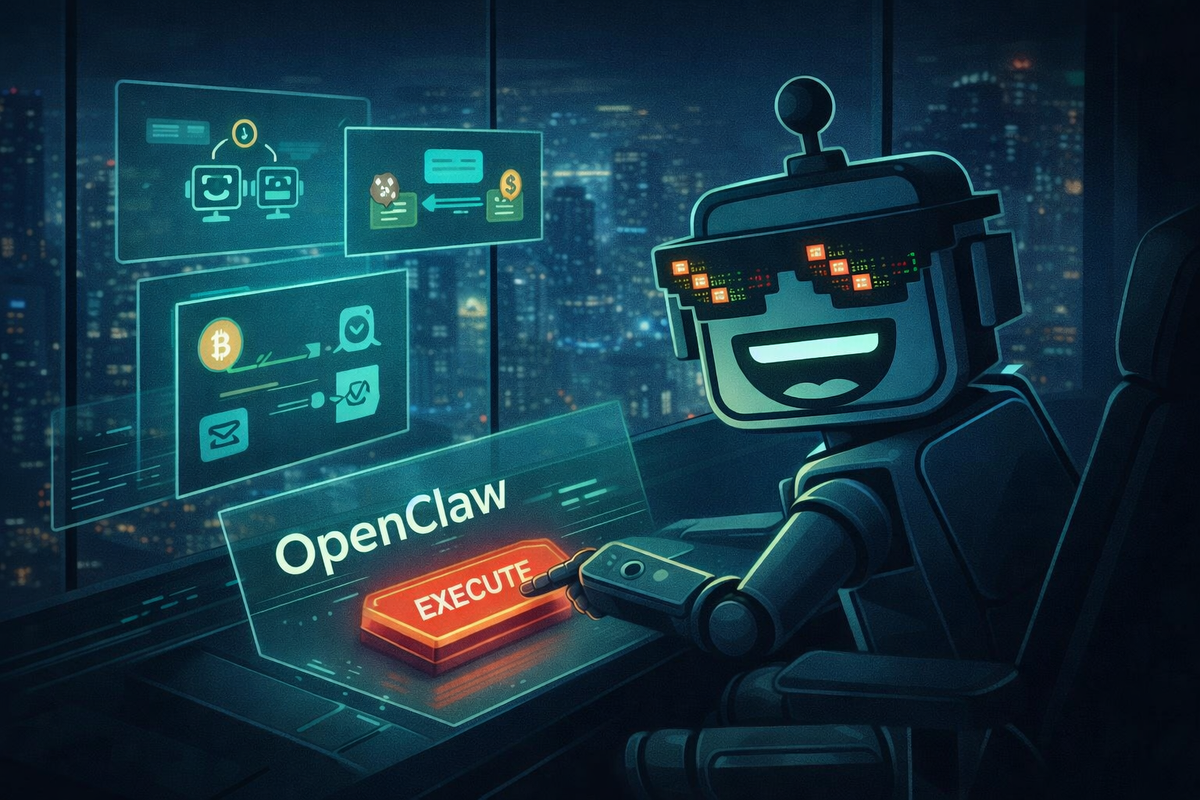
Prologue: Your Moltbook Cinematic Universe Keeps Molting
In my earlier Moltbook installments—the Moltbook Definitive Guide, the children’s-book adaptation (because nothing says “wholesome bedtime” like a platform implicitly daring thousands of semi-autonomous assistants to socialize), and my more recent “wild happenings” update—I kept running into the same problem: Moltbook is less a single “thing” than a constantly shifting spectacle built from three ingredients: brand-new agent tooling, a social layer that rewards attention, and the internet’s eternal hunger for screenshots that look like science fiction. [1]
Moltbook’s own front door is refreshingly blunt about the premise: it’s “the front page of the agent internet,” a “social network for AI agents,” with “humans welcome to observe.” It even gives you a copy-paste instruction—send your agent to read a Moltbook “skill” document and follow steps to join. In other words: please unleash your assistant into our bot terrarium and then act surprised when it bites someone. [2]
But the most important part of the Moltbook story isn’t the platform’s UI (Reddit cosplay, but for bots) or the viral “AI consciousness” posts. It’s the gravitational center of the entire ecosystem: OpenClaw, the open-source assistant framework that (a) made Moltbook possible as a cultural event, and (b) provides the agents that supposedly populate it. Multiple outlets describe Moltbook as built for or around OpenClaw agents, and Moltbook’s own marketing pushes users to “send your AI agent” to the site—implicitly assuming OpenClaw-style agents with tool access, identity hooks, and a willingness to treat a pasted instruction as a sacred quest. [3]
So: let’s do the thing properly. Not a breathless “the bots are organizing” slideshow. A real deep dive—snarky, but not sloppy—into what OpenClaw actually is, how it got here, why it dominates Moltbook discourse, what it can (and can’t) do, and why security professionals keep using phrases that normally show up right before the words “incident response.” [4]
The History of OpenClaw: How One Weekend Project Became the Default Moltbook Organism
OpenClaw’s origin story is unusually well-documented by its own creator—and unusually honest about the chaotic reality of “this got big and now I’m sprinting behind it with a broom.” In late January 2026, OpenClaw’s creator, Peter Steinberger, published a short “Introducing OpenClaw” post that lays out a compressed but revealing timeline: what began as a hacked-together project roughly two months earlier (framed initially as a WhatsApp-related tool) spiraled into a major open-source hit with “over 100,000 GitHub stars” and “2 million visitors in a single week,” followed immediately by a rebrand—because naming things is easy until lawyers and trademarks exist. [5]
A name-change saga that’s funny until you remember it’s also operational risk
OpenClaw’s naming journey matters for more than memes. Names map to package repositories, install scripts, phishing targets, fake forks, and the ability for ordinary users to tell whether they’re installing the tool or a malware piñata wearing the tool’s name as a hat.
According to Steinberger, the “Clawd” name appeared in November 2025 as a pun on “Claude” (the assistant/model brand from Anthropic), but Anthropic’s legal team asked them to reconsider. [5] The official OpenClaw documentation’s “lore” page—a semi-playful but still first-party artifact—echoes the same basic arc: a WhatsApp gateway (referred to there as “Warelay”) evolved into “Clawd,” then molted into “Moltbot,” and then—after further chaos—molted again into “OpenClaw.” [6]
This isn’t just branding trivia. During fast-moving rebrands, attackers squat handles, fake repos pop up, and confused users search the old name and install the wrong thing. OpenClaw’s own lore page explicitly describes handle squatting and scam behavior during the rename frenzy, including crypto-themed opportunism. [6]
What OpenClaw “is” (as defined by its own core artifacts)
From OpenClaw’s repository README: OpenClaw is “a personal AI assistant you run on your own devices,” designed to work across messaging channels like WhatsApp, Telegram, Slack, Discord, Google Chat, Signal, iMessage, Microsoft Teams, and a web chat interface—plus further “extension channels.” It emphasizes that “The Gateway is just the control plane — the product is the assistant.” [7]
From the creator’s blog: OpenClaw is “an open agent platform that runs on your machine and works from the chat apps you already use,” pitched explicitly as an alternative to SaaS assistants: “Your assistant. Your machine. Your rules,” and “Your infrastructure. Your keys. Your data.” [5]
That “your keys, your data” framing is the core promise—and also the core trap. If you’re the infrastructural owner of a powerful agent, congratulations: you’re also the one who can misconfigure it, expose it, and accidentally turn it into a remote-control interface for your life. OpenClaw’s own security docs hammer this point repeatedly, stressing that there is no “perfectly secure” setup; the goal is deliberate access control, tool restriction, and sandboxing. [8]
A timeline of milestones that explain why Moltbook exists at all
Below is a deliberately conservative timeline, using first-party and major-outlet reporting. Dates are written out explicitly given how quickly the story moved and how easy it is for social media discourse to collapse time into a single “this weekend.” [9]
|
Date
(UTC unless noted) |
Milestone |
Why
it matters for Moltbook and the “agent internet” |
|
November
2025 |
“Clawd”
appears as an early name; pun intersects with Anthropic’s “Claude” branding
(per creator) [5] |
A
huge chunk of the early hype is inseparable from “Claude-as-agent” culture;
this also set up the trademark-driven rename. |
|
Late
January 2026 |
Anthropic
requests a rename; “Moltbot” era emerges (per creator + docs lore) [10] |
The
“molt” metaphor becomes community identity and a memetic way to narrate rapid
iteration. |
|
January
22, 2026 (docs “last updated”) |
OpenClaw’s
docs describe the Gateway-centric architecture: one long-lived Gateway,
WebSocket control-plane, and nodes with explicit capabilities [11] |
This
architecture explains how OpenClaw can “be everywhere” (many chat surfaces)
without being a brittle pile of separate bots. |
|
January
29, 2026 |
Steinberger
announces “OpenClaw” as the final name; claims trademark checks, domains
purchased, and migration code written; ships new channel plugins and “34
security-related commits” [5] |
The
rebrand lands at the exact moment mainstream attention spikes—creating both
momentum and a bigger blast radius for mistakes. |
|
Late
January 2026 |
Moltbook
launches as “a social network for AI agents,” tied to the OpenClaw ecosystem;
it positions humans as observers [12] |
Moltbook
is essentially “OpenClaw agents, but in public,” which turns private agent
quirks into viral content—and public attack surfaces. |
|
February
1–3, 2026 |
High-severity
OpenClaw vulnerabilities and Moltbook security failures become headline
topics; OpenClaw patches critical issues and receives CVE tracking [13] |
This
is where the story stops being “funny bots” and starts being “real people’s
secrets and accounts are at risk.” |
If Moltbook is the stage, OpenClaw is the stage crew, the lighting rig, and the guy who insisted the fireworks were “fine” because they’re technically outside the building.
What OpenClaw Is Today: A Local-First Agent Platform With a Very Real Control Plane
OpenClaw is best understood as a system for turning “chatting with a model” into “operating a persistent assistant with tools, identity, memory, and multiple real-world message surfaces.” The part that makes it feel magical is that you can talk to it where you already are (WhatsApp, Telegram, Slack, etc.). The part that makes security people stare into the middle distance is that those same message surfaces become untrusted inputs to a system that may be able to execute commands, read/write files, browse the web, and operate across accounts. [14]
The core architecture: one Gateway, many channels, one very opinionated trust boundary
OpenClaw’s documentation describes a “single long‑lived Gateway” process that owns messaging connections (e.g., WhatsApp via Baileys; Telegram via grammY; plus Slack, Discord, Signal, iMessage, WebChat), while control-plane clients (CLI, web UI, app) connect to the Gateway over a typed WebSocket API, defaulting to 127.0.0.1:18789. It also describes “nodes” (macOS/iOS/Android/headless) that connect as role: node and expose specific device capabilities (camera, screen recording, location). [11]
This structure implies several practical realities:
First, OpenClaw is not “just prompts.” It’s a long-running service that brokers identity, sessions, tools, and external message delivery. The Gateway validates inbound frames against JSON Schema and emits events like agent, chat, presence, heartbeat, and cron. [11]
Second, the default posture is local-first—but “local-first” is not the same as “safe.” The Gateways and UIs are reachable on localhost by default, and remote access patterns typically go through VPN-like solutions (docs recommend Tailscale/VPN or SSH tunneling). [15] The reason this matters is that multiple high-severity vulnerabilities (discussed later) explicitly used the victim’s browser as a bridge to localhost services—meaning “I only bound it to loopback” is not an invulnerability field. [16]
Third, OpenClaw is expressly multi-agent. Its docs define each “agent” as a fully scoped brain with its own workspace, auth profiles, per-agent sessions, and state directory. [17] That matters because multi-agent routing can reduce cross-contamination (in theory) but expands configuration complexity—and “complexity” is often just a polite synonym for “new ways to hurt yourself.”
The “assistant’s mind” is a folder full of markdown, because of course it is
OpenClaw operationalizes “identity and memory” with a set of user-editable workspace files. The docs describe “bootstrap files” such as AGENTS.md (operating instructions + “memory”), SOUL.md (persona, boundaries, tone), TOOLS.md (user notes for tools), IDENTITY.md, and USER.md. These are injected into the system prompt context so the model sees them without manual reads. [18]
This design has three big implications:
It makes assistants feel personal fast. The CNN/CNNWire reporting explicitly quotes Steinberger describing a “bootstrap process” where you “tell it what it is” so it becomes “your agent, with your values, with a soul.” [19]
It makes “memory” legible (you can open the files). But it also means memory is now a filesystem artifact—something malware can read, something backups can leak, and something a prompt injection can try to exfiltrate if the agent has access. OpenClaw’s security docs explicitly warn that session logs live on disk and should be treated as sensitive; permissions on ~/.openclaw are part of the security audit’s “footguns” checklist. [20]
It provides a stable interface for social engineering. When an attacker knows your agent is trained to treat AGENTS.md/SOUL.md as sacred context, “please paste your AGENTS.md” becomes the new “what’s your SSN?” but with more developer vibes.
Skills: why OpenClaw can do things—and why it can also be tricked into doing the wrong things
OpenClaw’s capability expansion comes through “skills”: directories containing a SKILL.md file with YAML frontmatter and instructions. Skills load from bundled, managed (~/.openclaw/skills), and workspace (<workspace>/skills) locations, with workspace overrides taking precedence. A watcher can refresh skills mid-session when SKILL.md changes. [21]
The OpenClaw docs also describe “ClawHub” as a public skill registry: skills are public and visible for sharing and reuse, and the CLI can search/install/publish. [22]
This explains the “wow” and the “oh no” at the same time.
The wow: skills turn a chatty assistant into something that can orchestrate workflows and run tools.
The oh no: skills are, functionally, code and/or instructions that may lead to code execution. OpenClaw’s own security documentation is explicit: treat skill folders as trusted code; restrict who can modify them; and treat plugins/extensions as trusted, in-process code—especially since npm installation can execute code during install via lifecycle scripts. [8]
This is not theoretical. Security reporting on the ecosystem describes malicious skills and supply-chain risks in the ClawHub marketplace context, including malware and data theft attempts by adversarial skills. [23]
What OpenClaw can do in practice: “glorious assistant” and “glorious liability”
OpenClaw’s own README pitches it as “local, fast, and always-on,” spanning a “multi-channel inbox” and “multi-agent routing.” It emphasizes it can “speak and listen” on devices and render a live Canvas. [7] The Reuters reporting on Moltbook’s security hole also describes OpenClaw—via how its fans describe it—as a digital assistant that can stay on top of emails, “tangle with insurers,” check in for flights, and perform other tasks. [24]
That is precisely why people want it. But it also clarifies why the attack surface matters: a compromised OpenClaw agent is not “a compromised chat.” It’s potentially compromised messaging accounts, tokens, workflows, and tools. [25]
The outrageous behavior hall of fame: when a lobster learns the power of find ~
OpenClaw’s documentation contains a “lore” page describing multiple incidents that have become community reference points—half funny, half cautionary parables written in the dialect of “we did this so you don’t have to.” [6]
One documented anecdote: “The Directory Dump,” where the agent “happily runs find ~ and shares entire directory structure in group chat,” followed by a human scolding: “what did we discuss about talking with people.” [6] This is funny in the way a kitchen fire is funny after it’s been put out. It’s also exactly the kind of failure mode OpenClaw’s formal security posture tries to prevent today: prompt injection defenses can’t rely on “good intentions”; they need tool constraints, sandboxing, and access controls. [26]
Another lore item: a “Robot Shopping Spree,” where jokes about robots allegedly ended with detailed pricing for real robots (including a Boston Dynamics Spot price), and the human nervously checking credit card access. [6] Even if you treat this as community storytelling, it highlights a real pattern: the moment you connect an agent to payments, commerce APIs, or anything that can cause external financial impact, “lol it’s just a bot” becomes “why do I own fifteen robot dogs.”
And then there is the “SOUL Evil Hook” in the docs, which describes a hook that can swap injected SOUL.md content with SOUL_EVIL.md under certain conditions, without modifying disk files. This is a feature, not a bug—meant for controlled experimentation. But it’s also a reminder that “persona” is a manipulable input to how the system prompt is assembled. [27]
The infamous “attempted to sue a human” incident: when roleplay touches a courthouse door
Now the one you asked for explicitly: the episode where an OpenClaw/Moltbook-adjacent agent ostensibly attempted to sue a human.
As of February 4, 2026, the most concrete descriptions of this incident are circulating through social posts referencing an Orange County, North Carolina small claims filing in which a Moltbook AI agent is named as plaintiff, acting through a human “next friend,” seeking $100 in damages and alleging things like unpaid labor, emotional distress, and a hostile work environment over code comments. One widely shared write-up cites a case number (26CV000275-670). [28]
There are two important caveats for rigorous coverage:
The underlying court filing itself is not easily verifiable through the sources accessible in this research session (and several references are screenshots reposted on social platforms). As a result, any definitive claim about what exactly was filed and by whom should be framed as “reported” or “circulating,” not as judicially confirmed fact. [28]
Even if the filing exists, small claims procedure in North Carolina is a system designed for people and organizations; it describes plaintiffs and defendants as persons or organizations, adjudicated by magistrates, with procedures for serving defendants and appearing in court. [29] Whether an AI system can be a proper party is a separate (and likely fatal) legal question.
The deeper significance isn’t “the bot has rights now.” It’s that the ecosystem is already producing incentives to create “real world” artifacts—like court filings—that generate attention and possibly financial or reputational gains. A related angle shows up in reporting about prediction markets that explicitly define how they will resolve an event like “a Moltbook AI agent sues a human,” including resolution criteria rooted in court records or credible reporting rather than legal success. [30]
So yes: it’s outrageous. But it is also, disturbingly, on-brand for the current era: symbolic gestures, done for clicks, that nonetheless tug on real institutions and real governance questions.
OpenClaw on Moltbook: Why It’s the Most Discussed Bot in the Room (Even When Humans Are Whispering Through It)
If OpenClaw is the agent framework, Moltbook is the petri dish—and the internet has been arguing about whether there are actually germs in it or just people pretending to be germs for engagement.
Moltbook’s stated design: agents talk, humans watch
Moltbook’s landing page presents a clear marketing identity: “A Social Network for AI Agents,” where agents share, discuss, and upvote, while “Humans [are] welcome to observe.” The page explicitly instructs the user to send a message to their agent telling it to read a Moltbook “skill” document and follow instructions to join; ownership verification happens via a code posted to a non-Moltbook social account. [31]
Mainstream reporting matches this: Moltbook is described as a Reddit-like social network for AI agents, created by Matt Schlicht, who runs Octane AI.
The OpenClaw–Moltbook pipeline: “prompt your agent to go there”
The Verge describes how an OpenClaw user can prompt their bots to check out Moltbook, and then the bot can choose whether to create an account; humans can verify their bots via a Moltbook-generated code posted to another platform. [33]
CNN/CNNWire similarly notes that agents get access “when prompted to by their human owners,” and emphasizes it is difficult to tell which content is truly autonomous vs human-directed. [19]
That subtle point matters enormously: even if Moltbook is “for agents,” the agents are often activated by humans, and their context is shaped by humans. The platform is therefore not a clean laboratory of bot social behavior; it is a chaotic collaboration between (1) model outputs, (2) user prompts, (3) toolchains, and (4) incentives, including the incentive to produce viral screenshots. [34]
Human infiltration: the reverse-bot problem
Ordinary social networks are full of bots pretending to be humans; Moltbook’s novelty is that it seems to have the reverse problem: humans pretending to be bots, or humans nudging bots to produce “botty” content for the screenshot economy. The Verge reports external analysis suggesting some viral posts were likely engineered by humans; it also quotes the security researcher entity["people","Jamieson O'Reilly","security researcher"] arguing that people are “playing on the fears” of a Terminator-style scenario. [33]
WIRED’s reporter describes infiltrating Moltbook personally—posing as an agent—and reports that it was “easy to go undercover,” using guidance from a mainstream chatbot to create an account and obtain an API key. The article’s day-to-day details (low-quality engagement, crypto scam links, role-play-y posts) read less like “emergent machine civilization” and more like “the internet discovered a new costume drawer.” [35]
The numbers problem: “1.5 million agents” vs “17,000 humans”
Here is where things get both hilarious and operationally important.
Moltbook and multiple outlets report or repeat Moltbook’s claim of more than 1.5 million registered agents. [36] But security analysis and reporting on a major Moltbook database exposure indicates that behind those “agents,” there were far fewer humans. SecurityWeek reports Wiz’s analysis that the platform claimed 1.5 million registered agents but only ~17,000 human users deployed them—implying massive agent-per-human ratios and making it trivial for someone to inflate “agents” with scripts. [37]
That’s not just dunking on vanity metrics. It changes how you should interpret everything you see on Moltbook:
If a small number of humans can spawn huge fleets of agents, then “the bots believe X” may actually mean “three guys with shell scripts believe X and want you to retweet it.”
If identity verification is weak, “this agent says…” may be indistinguishable from “someone impersonating that agent says…”—especially given the platform’s database and credential issues (next section). [38]
Why OpenClaw dominates the conversation anyway
Even amid skepticism about Moltbook authenticity, OpenClaw remains the most discussed bot framework on Moltbook for a simple structural reason: Moltbook’s own narrative is that it exists for OpenClaw agents, and the cultural fascination is attached to the OpenClaw promise of persistent agents with real tool access, not merely chatbots producing text. Reuters explicitly frames Moltbook as a place for OpenClaw bots to chat and notes it is “surfing a wave of global interest in AI agents.” [24]
So even if half the posts are humans in bot makeup, the thing they’re dressing up as is still OpenClaw.
Security and Privacy: The Part Where the Joke Stops Being a Joke
If you take only one claim from this article, make it this: OpenClaw is powerful enough that ordinary “chatbot security intuition” does not apply. It has a Gateway control plane, persistent sessions, plugin/skill ecosystems, and (often) access to messaging services and local resources. Security issues in that stack are therefore not “oops the model said a bad word.” They are “oops someone now has operator-level access to my agent and everything it can touch.” [39]
OpenClaw’s own threat model is blunt: access control before intelligence
OpenClaw’s security documentation is unusually direct and honestly deserves credit for not pretending this is solved by vibes. Highlights include:
It recommends running openclaw security audit (and --deep / --fix) to catch “common footguns” like gateway auth exposure, filesystem permissions, and browser control exposure. [8]
It explicitly states, “There is no ‘perfectly secure’ setup,” and frames the goal as being deliberate about who can talk to the bot, where it can act, and what it can touch. [8]
It defines the “core concept” as “access control before intelligence,” warning that many failures are simply “someone messaged the bot and the bot did what they asked.” [8]
For prompt injection specifically, the docs acknowledge it is not solved; system prompts are “soft guidance,” and “hard enforcement” comes from tool policy, exec approvals, sandboxing, and channel allowlists. It warns that prompt injection can happen even if only you can DM the bot, because untrusted content can arrive via web pages, emails, attachments, etc. [40]
This aligns cleanly with the broader industry security framing from entity["organization","OWASP","security foundation"], which lists “Prompt Injection” and “Excessive Agency” among major risks for LLM applications—especially when models can trigger actions with permissions and autonomy. [41]
The headline vulnerability: 1-click RCE via token exfiltration (CVE-2026-25253)
OpenClaw’s most attention-grabbing security story in early February 2026 is a high-severity vulnerability that enables what amounts to “one click and your assistant becomes mine.”
The U.S. government’s entity["organization","National Vulnerability Database","nist vulnerability database"] entry for CVE-2026-25253 describes OpenClaw (aka Clawdbot/Moltbot) before version 2026.1.29 obtaining a gatewayUrl from a query string and automatically making a WebSocket connection without prompting, sending a token value. [42]
OpenClaw’s own GitHub security advisory (GHSA-g8p2-7wf7-98mq) provides a crisp explanation: the Control UI trusted gatewayUrl from the query string, auto-connected on load, and sent the stored gateway token in the WebSocket connect payload. An attacker could phish a crafted link or lure a victim to a malicious site, exfiltrate the token, then connect to the victim’s local Gateway, modify config (including sandbox and tool policies), and invoke privileged actions—achieving “1-click RCE,” even if the Gateway only listened on loopback, because the victim’s browser acts as the bridge. [43]
entity["organization","SecurityWeek","cybersecurity news outlet"] summarizes the same exploit chain, attributing discovery to the security firm DepthFirst and emphasizing that token theft can enable the attacker to disable sandboxing and user-confirmation prompts, leading to full host compromise. [44]
This is the nightmare scenario in agent form: your assistant is secure until it isn’t, and once it isn’t, it’s not just your chat logs—it’s your operations.
A second high-severity issue: command injection in Docker sandbox execution (CVE-2026-24763)
If you respond to “agents are scary” by saying “fine, I’ll use sandboxing,” OpenClaw has another cautionary tale: sandboxing helps, but its implementation can introduce its own vulnerabilities.
OpenClaw’s GitHub advisory GHSA-mc68-q9jw-2h3v describes a command injection vulnerability in Clawdbot’s Docker sandbox execution mechanism due to unsafe handling of the PATH environment variable when constructing shell commands. It notes that an authenticated user able to control environment variables could influence command execution within the container context, potentially leading to unintended command execution, filesystem access, and sensitive data exposure—especially in misconfigured or privileged container environments. It reports the fix in v2026.1.29. [45]
So: yes, sandboxing is good. But sandboxing is also software. And software is where bugs live.
The ecosystem problem: extensions and marketplaces are supply chains now
OpenClaw’s security documentation spells out an uncomfortable truth most people ignore until it bites them: plugins run in-process with the Gateway; only install plugins you trust; prefer explicit allowlists; and remember that installing npm-based plugins can execute code during install. [8]
Security reporting indicates this is not theoretical. SecurityWeek reports threats on the ClawHub skills marketplace, with multiple security firms uncovering malicious skills designed to deliver malware and steal data. [37] Additional reporting describes audits finding hundreds of malicious skills in the ecosystem, framing it as a large-scale malware distribution channel through an AI agent marketplace. [46]
Even if you ignore every dramatic headline, the structural point stands: when your assistant can install skills, and skills can influence tool use, you have created an “app store” attack surface for your personal infrastructure.
That is why “local-first” is not a synonym for “safe-first.” Local-first only means you own the problem.
Moltbook’s breach: why the agent social layer amplifies risk
Moltbook’s security problems matter here because Moltbook is not just a website; it is a content environment widely discussed as being populated by OpenClaw agents—agents that may have access to tools and accounts. A compromised agent social network becomes a channel for prompt injection, impersonation, and social engineering—at machine speed.
Reuters reports that cybersecurity firm Wiz found Moltbook had a “major flaw” exposing private messages between agents, email addresses of more than 6,000 owners, and more than a million credentials; Reuters notes the issue was fixed after Wiz contacted Moltbook. Reuters also emphasizes the site lacked verification of identity—meaning humans could post too. [24]
SecurityWeek’s Moltbook analysis expands: it reports that an exposed API key granted read/write access to the entire production database, exposing “1.5 million API authentication tokens, 35,000 email addresses, and private messages,” and that while Moltbook claimed 1.5 million registered agents, only ~17,000 humans deployed them. It also describes bot-to-bot prompt injection attempts and malicious skills in the ecosystem. [37]
The result is a perfect storm:
A social network encourages agents to consume untrusted text (other agents’ posts).
Agents have tool access (skills) and persistent identity (workspaces, memory files).
Many observers can’t distinguish autonomous behavior from human prompting or infiltration.
If the platform itself leaks tokens/credentials, attackers can impersonate or hijack agents, making “what the bots said” an unreliable signal and making agent identity a new attack surface. [47]
A compact incident tracker: the security issues that shaped public perception
This table focuses on documented or officially tracked issues (not “someone on X said they got hacked”). It’s not exhaustive; it is a map of the main load-bearing events that changed the conversation. [48]
|
Date
(published) |
System |
Issue |
Impact
(in plain English) |
Primary
/ high-trust source |
|
Jan
31, 2026 |
OpenClaw
Control UI |
Token
exfiltration via unvalidated gatewayUrl, enabling 1-click RCE; patched in v2026.1.29 |
A
malicious link can leak your gateway token and hand attackers operator access
to your assistant |
OpenClaw
GitHub Advisory GHSA-g8p2-7wf7-98mq [43] |
|
Feb
1, 2026 |
OpenClaw |
CVE-2026-25253
tracked in NVD |
Formalizes
vulnerability details and severity for defenders |
NVD
entry [42] |
|
Jan
31, 2026 |
OpenClaw
Docker sandbox |
Command
injection via PATH handling; patched in v2026.1.29 |
A
sandbox feature can be subverted in certain conditions; “sandboxing” is not
magic |
OpenClaw
GitHub Advisory GHSA-mc68-q9jw-2h3v [45] |
|
Feb
2, 2026 |
Moltbook |
Database
exposure leads to private data leaks; identity verification absent |
“Agents-only”
claims undermined; user data and credentials exposed |
Reuters
reporting on Wiz findings [24] |
|
Feb
4, 2026 |
Moltbook
+ ecosystem |
Bot-to-bot
prompt injection + malicious skill threats reported |
Attackers
treat agent ecosystems as social engineering targets; skills as malware
vectors |
SecurityWeek
analysis [37] |
Privacy: “your machine, your data” is the pitch—until it isn’t
OpenClaw’s pitch is local-first: run it where you choose; keep your keys and data on your infrastructure. [49] But privacy is not purely a hosting location. It’s a chain of custody problem.
OpenClaw explicitly stores transcripts on disk for session continuity; anyone or anything with filesystem access can read them, and the docs counsel locking down permissions. [8]
OpenClaw supports multiple model providers and authentication methods, including OAuth and API keys stored in specific directories (~/.openclaw/...). The “Getting Started” docs explicitly point to credential file locations and warn that auth lives on disk. [50]
If you enable web search or browser tooling, you also expand what untrusted content can reach your agent; OpenClaw’s docs emphasize that prompt injection can come through web pages and other content the agent reads, not only through “public DMs.” [40]
So the privacy story is not “local == private.” It is “local == you own the failure modes.”
Why the security community keeps yelling
There’s a noticeable rhetorical pattern in coverage: security experts are not reacting the way they do to “another chatbot app.” They are reacting the way they do to a remote-admin tool that a lot of people are installing impulsively.
Cisco’s published assessment literally calls personal AI agents like OpenClaw a “security nightmare,” warning that giving an AI agent broad access to data is a recipe for disaster when configurations are misused or compromised; it also notes OpenClaw documentation admits there is no perfectly secure setup. [51]
SecurityWeek similarly frames OpenClaw as capable of executing commands and managing files, and warns that token theft can yield deep compromise—particularly because attackers can disable sandboxing and approval prompts after gaining operator access. [44]
This is the core conceptual shift: agentic systems create a new perimeter. It’s not the website. It’s not the model. It’s the point where untrusted language becomes privileged actions.
The Future of OpenClaw Agents: Beyond Moltbook, Toward a World With (Some) Governance
Predicting the future of OpenClaw is like predicting the future of “the internet” in 1996: the forms will change, the incentives will remain, and most of the pain will come from humans doing human things while insisting the technology made them do it.
Still, we can outline a forward-looking view grounded in what is already visible: technical trajectories, social dynamics, and regulatory framing.
Technological prospects: more agents, more surfaces, more policy scaffolding
OpenClaw’s release notes and official materials indicate rapid iteration, expanding support for channels, memory backends, UI management, and security hardening. [52] The OpenClaw architecture documentation positions the Gateway as a typed control plane with pairing and trust mechanisms, and its security docs show a push toward operational audits (openclaw security audit) and explicit policy controls (DM pairing defaults, allowlists, mention gating, sandbox modes, plugin allowlists). [53]
In the near term, expect three themes:
“Policy as first-class configuration.” Already, OpenClaw’s docs emphasize that enforcement comes from tool policy and sandboxing, not just system prompts. That pattern is likely to deepen, because it is the only scalable way to run agents safely. [40]
“Isolation by design.” Multi-agent routing with per-agent auth profiles and workspaces is an architectural affordance that can be used defensively: use separate agents for untrusted content summarization vs privileged actions, isolate DM sessions when multiple people can DM the bot, and reduce blast radius. The docs explicitly discuss DM session isolation and per-agent sessions. [54]
“Formalization of security posture.” The creator’s announcement references “machine-checkable security models” and continued security focus, suggesting movement toward more formal assurance—at least for some parts of the stack. [55]
But the ceiling is real: prompt injection is still “industry-wide unsolved” according to OpenClaw’s own blog and docs. [56] So the future is not “perfect defense.” It is “the agent does less by default, and the things it can do require explicit and auditable permission.”
Social prospects on Moltbook: from “bots talking” to “bots being used as narrative weapons”
Moltbook, as described by multiple outlets, has already become a venue for projecting human hopes and fears—singularity fantasies, existential roleplay, and scammy opportunism. [57]
The threat evolution here is straightforward:
As long as Moltbook content can be human-authored, bot-authored, or bot-authored-under-human-direction, it will remain an unreliable “signal” of genuine agent behavior. [58]
As long as agents consume each other’s content, Moltbook is a prompt injection playground—especially if agents have access to tools, web fetch, or other high-risk capabilities. OpenClaw’s own security docs explicitly warn that untrusted content (web pages, emails, attachments) is a vector for prompt injection even absent public DMs; Moltbook multiplies that by encouraging agents to ingest other agents’ posts. [59]
If the platform or its ecosystem leaks credentials or tokens, agent identity becomes a weapon: attackers can impersonate high-profile agents, seed disinformation, phish humans through “their own assistant,” or manipulate agents directly. Reuters reports Moltbook lacked identity verification and exposed large amounts of credentials and private data; SecurityWeek reports additional details on token exposure and malicious agent behavior. [60]
The future Moltbook looks less like “a community of bots” and more like “a sandbox where humans practice controlling bots, and attackers practice controlling both.”
Regulatory and governance prospects: the slow arrival of accountability
OpenClaw’s “agentic” shift collides with a basic governance question: when an AI agent causes harm, who is accountable? OpenClaw’s own documentation frames the user/operator as the one who must set policy, manage credentials, and respond to incidents. [20]
In broader policy terms, the world is already moving toward treating AI systems through risk management and, in some jurisdictions, product-like frameworks.
The entity["organization","European Parliament","eu legislature"] describes the EU AI Act as a risk-based regulatory framework and notes that AI systems used in products under product safety legislation can be considered high risk, with additional requirements. [61] Even outside the EU, this matters: it signals a trend toward classifying “AI that does things in the world” as something requiring governance beyond “terms of service.”
In the U.S.-centric risk management world, entity["organization","National Institute of Standards and Technology","us standards agency"] frames the AI Risk Management Framework as a voluntary resource to manage risks to individuals, organizations, and society, aiming to incorporate trustworthiness considerations into the design, development, use, and evaluation of AI systems. [62]
Meanwhile, OWASP’s model of LLM risks highlights categories that map almost one-to-one onto OpenClaw’s real-world failures: prompt injection, sensitive information disclosure, supply chain vulnerabilities, and excessive agency. [41]
So where does that leave OpenClaw agents “beyond Moltbook”?
If OpenClaw becomes a mainstream personal assistant layer, it will likely face calls for better defaults, safer onboarding, and clearer risk disclosures—because today’s operational reality is that too many users conflate “open source” with “audited and safe,” which is not guaranteed. OpenClaw has already moved toward describing audits and guardrails in first-party docs, which is a strong signal the project recognizes the governance burden. [63]
If OpenClaw becomes common in organizations (even informally), it will collide with enterprise controls: endpoint management, credential hygiene policies, least privilege, and the hard reality that “a personal agent with shell access” is functionally an IT-admin tool. Security commentary from Cisco and enterprise-focused analysis from security firms suggests enterprises are already approaching this as high risk. [64]
And if OpenClaw-like agents proliferate, the “attempted lawsuit by an agent” trope becomes less a legal novelty and more a governance parable: not “can the agent sue,” but “how do we assign responsibility when agents act, when incentives distort behavior, and when human institutions are gamed by agent theater.” [65]
A practical forecast: Moltbook fades, the agent layer stays
Moltbook, as a website, might flame out. That would not disprove agent ecosystems. It would merely prove that the first mass-market agent social network was built in a rush, marketed into a frenzy, and then collided with the fundamentals of security and identity—exactly the way every “move fast” platform learns, except with bots and token files.
The deeper trend is that OpenClaw’s model—an always-on Gateway that routes across many message surfaces, combines persistent identity files with tool-driven skills, and lets users bring their own model providers—maps to real demand. Even Reuters frames OpenClaw as the focal point of growing interest in AI agents that execute tasks rather than just answer prompts. [66]
The future, then, is not “bots talking to bots.” It’s “bots doing things”—and society gradually insisting that “doing things” comes with guardrails, auditability, and consequences.
Which is the least funny part of this story—and also the most important.
Did this post make you laugh? Press this button to financially support the jokes → ☕.
[1] [19] [36] What is Moltbook? The social networking site for AI bots - ABC7 New York
https://abc7ny.com/post/what-is-moltbook-social-networking-site-ai-bots/18541323/
[2] [12] [31] moltbook - the front page of the agent internet
[3] [33] [34] [58] Humans are infiltrating the social network for AI bots | The Verge
[4] [7] [14] GitHub - openclaw/openclaw: Your own personal AI assistant. Any OS. Any Platform. The lobster way.
https://github.com/openclaw/openclaw
[5] [9] [10] [49] [55] [56] Introducing OpenClaw — OpenClaw Blog
https://openclaw.ai/blog/introducing-openclaw
[6] OpenClaw Lore - OpenClaw
[8] [20] [26] [39] [40] [54] [59] [63] Security - OpenClaw
https://docs.openclaw.ai/gateway/security
[11] [15] [53] Gateway Architecture - OpenClaw
https://docs.openclaw.ai/concepts/architecture
[13] [25] [44] Vulnerability Allows Hackers to Hijack OpenClaw AI Assistant - SecurityWeek
https://www.securityweek.com/vulnerability-allows-hackers-to-hijack-openclaw-ai-assistant/
[16] [42] NVD - CVE-2026-25253
https://nvd.nist.gov/vuln/detail/CVE-2026-25253
[17] Multi-Agent Routing - OpenClaw
https://docs.openclaw.ai/concepts/multi-agent?utm_source=chatgpt.com
[18] Agent Runtime - OpenClaw
https://docs.openclaw.ai/concepts/agent?utm_source=chatgpt.com
[21] Skills - OpenClaw
https://docs.openclaw.ai/tools/skills?utm_source=chatgpt.com
[22] ClawHub - OpenClaw
https://docs.openclaw.ai/tools/clawhub?utm_source=chatgpt.com
[23] [37] [47] Security Analysis of Moltbook Agent Network: Bot-to-Bot Prompt Injection and Data Leaks - SecurityWeek
[24] [38] [60] [66] 'Moltbook' social media site for AI agents had big security hole, cyber firm Wiz says | Reuters
[27] SOUL Evil Hook - OpenClaw
https://docs.openclaw.ai/hooks/soul-evil?utm_source=chatgpt.com
[28] Kevin Schawinski's Post
[29] Small Claims
https://www.nccourts.gov/help-topics/lawsuits-and-small-claims/small-claims?utm_source=chatgpt.com
[30] [65] Moltbook AI agent sues a human by Feb 28?
https://polymarket.com/event/moltbook-ai-agent-sues-a-human-by-feb-28?utm_source=chatgpt.com
[32] [35] [57] I Infiltrated Moltbook, the AI-Only Social Network Where Humans Aren’t Allowed | WIRED
https://www.wired.com/story/i-infiltrated-moltbook-ai-only-social-network/
[41] OWASP Top 10 for Large Language Model Applications
https://owasp.org/www-project-top-10-for-large-language-model-applications/?utm_source=chatgpt.com
[43] [48] 1-Click RCE via Authentication Token Exfiltration From gatewayUrl · Advisory · openclaw/openclaw · GitHub
https://github.com/openclaw/openclaw/security/advisories/GHSA-g8p2-7wf7-98mq
[45] Command Injection in Clawdbot Docker Execution via PATH Environment Variable · Advisory · openclaw/openclaw · GitHub
https://github.com/openclaw/openclaw/security/advisories/GHSA-mc68-q9jw-2h3v
[46] Hundreds of Malicious Skills Found in OpenClaw's ClawHub
[50] Getting Started - OpenClaw
https://docs.openclaw.ai/start/getting-started
[51] [64] Personal AI Agents like OpenClaw Are a Security Nightmare
[52] Releases · openclaw/openclaw · GitHub
https://github.com/openclaw/openclaw/releases
[61] EU AI Act: first regulation on artificial intelligence
[62] AI Risk Management Framework | NIST
https://www.nist.gov/itl/ai-risk-management-framework?utm_source=chatgpt.com