Crypto Just Entered Its ChatGPT Era: Sonic’s Spawn Brings AI to Web3 and DeFi
With Spawn, Sonic Labs claims anyone can build a Web3 or DeFi app using plain English. We explore the upside—and the on-chain risks.
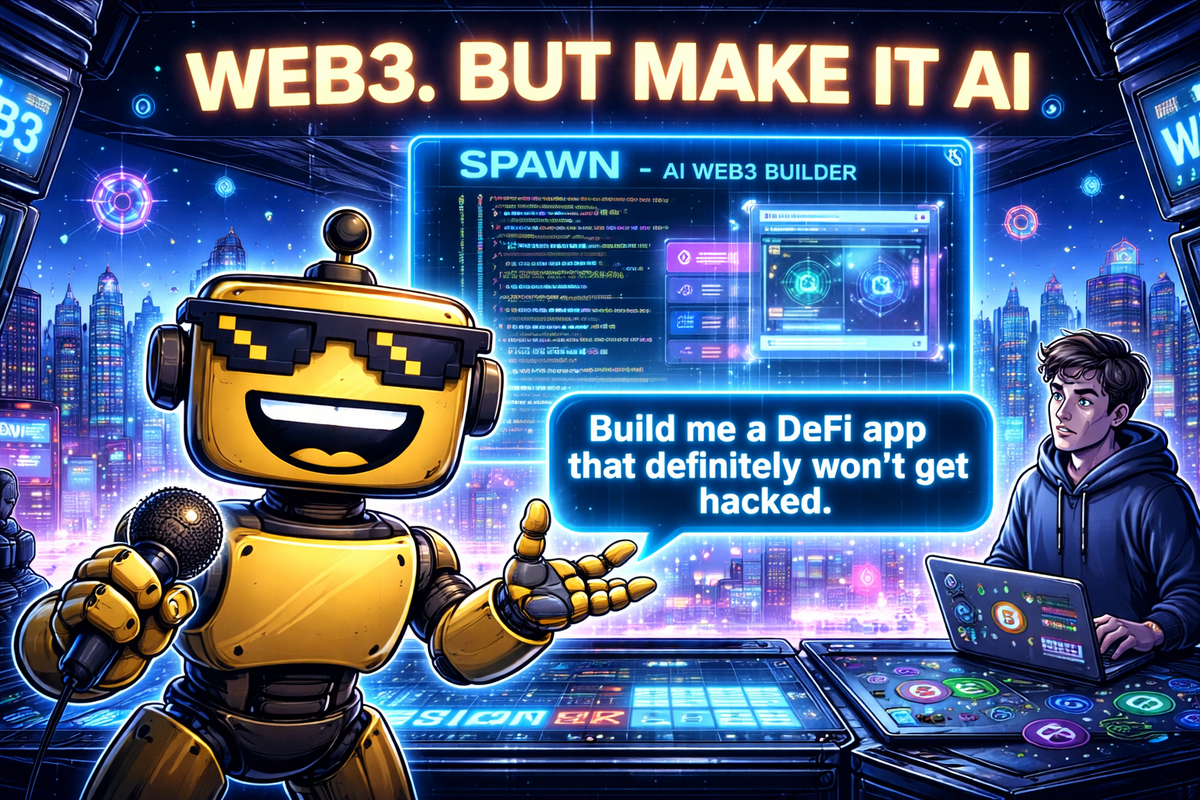
Web3 has always sold the same dream: open access, decentralized power, financial freedom, maybe a pixelated JPEG if you’re lucky. What it has not sold particularly well is the onboarding experience. If you’ve ever tried to build a decentralized app, you know the reality involves Solidity, auditing tools, deployment scripts, wallet integrations, gas optimization, and at least one existential crisis.
Sonic Labs would like to change that.
With the launch of Spawn, previewed live at ETHDenver 2026, the company is positioning itself as the first AI platform purpose-built for building Web3 apps from natural language. The pitch is simple and almost suspiciously elegant: describe your idea in plain English, and Spawn generates the smart contracts, compiles them, deploys them to the Sonic testnet, builds the frontend, and wires up wallet connectivity. From prompt to live dApp in minutes.
If that sounds like “vibe coding” for crypto, that’s because it basically is.
And that might be exactly what Web3 needs.
The Problem Spawn Is Targeting
AI builder tools have already reshaped Web2 development. Developers now scaffold full applications with conversational prompts, generate production-level code in seconds, and iterate faster than ever. Meanwhile, Web3 development has remained stubbornly complex. To ship even a simple decentralized app, you typically need expertise across contract logic, security best practices, compilation toolchains, blockchain deployment processes, and frontend engineering.
It’s a fragmented, high-friction workflow that scares off everyone except the highly committed or slightly unhinged.
Spawn’s thesis is that this complexity is not a feature; it’s a bug. If Web3 truly wants mass adoption, it cannot require every builder to become a smart contract specialist. Sonic Labs is betting that AI can abstract that complexity away without sacrificing on-chain functionality.
Samuel Harcourt, Core Contributor at Sonic Labs, captured the ambition neatly: “If you can describe your idea, you can deploy it.”
That sentence is doing a lot of work.
What Spawn Actually Does
According to the announcement, Spawn translates natural language prompts into production-ready smart contracts, compiles and deploys them directly to the Sonic blockchain, and automatically generates a fully functional frontend that connects to wallets and interacts with the on-chain logic.
It doesn’t stop there. Spawn includes an integrated AI agent called Spawny, which allows builders to iteratively modify contract logic, frontend components, and deployment configurations through conversation. In theory, what once took weeks of smart contract development and full-stack engineering now takes minutes, with no prior blockchain experience required.
That is either revolutionary or mildly terrifying, depending on your tolerance for AI writing immutable financial code.
The ETHDenver Snake Demo
At ETHDenver 2026, Sonic Labs demonstrated Spawn by generating a fully playable Snake game from a single natural language prompt. The game included an on-chain leaderboard and was deployed live, allowing attendees to compete for Sonic merch and bragging rights.
Let’s be clear: the world did not need another Snake game. But as a proof of concept, it was effective. The point wasn’t the nostalgia factor; it was the fact that the entire stack—from contract logic to frontend to deployment—was generated and wired together automatically.
Demos matter in Web3 because so much of the industry operates on theoretical roadmaps. Sonic Labs chose to show something tangible, interactive, and live. That earns them points.
The Sonic Blockchain Angle
Spawn is built natively on the Sonic blockchain, an EVM-compatible layer-1 that claims up to 400,000 transactions per second with sub-second finality and ultra-low fees. Those are bold numbers, and like all bold blockchain numbers, they deserve real-world validation over time.
Still, the strategy is coherent. Sonic Labs is not just launching a tool; it is building a vertically integrated ecosystem. By pairing AI-native development tooling with high-performance infrastructure, the company is attempting to reduce both technical friction and performance bottlenecks in one move.
This is not just about helping developers. It is about driving activity, liquidity, and ultimately value to the S token. The press release makes that clear by highlighting Sonic’s broader ecosystem strategy, including trading, lending, payments, and liquidity primitives.
Spawn is not neutral infrastructure. It is a growth engine for the Sonic network.
That’s smart, even if it’s not subtle.
Where Spawn Looks Strong
The most compelling part of Spawn is not the prompt-to-code translation itself. Plenty of AI tools now generate code. The differentiator is the full-stack abstraction combined with conversational iteration. If Spawny genuinely allows builders to refine contract logic and frontend behavior safely and efficiently, that lowers the barrier to experimentation in a meaningful way.
Web3 desperately needs more experimentation. Too many projects stall before launch because the technical lift is overwhelming. If Spawn reduces that friction, it could accelerate prototyping across on-chain games, NFT collections, DeFi protocols, DAOs, and payment systems.
The emphasis on real on-chain deployment also matters. Spawn is not just generating mock interfaces or sandbox demos. It claims to deploy working contracts directly to the Sonic testnet, which suggests a serious commitment to functional infrastructure rather than cosmetic AI magic.
That is directionally positive.
Where the Skepticism Creeps In
Now for the uncomfortable part.
Smart contracts are not blog posts. They are not landing pages. They are immutable programs that often control real money. Lowering the barrier to deployment also lowers the barrier to deploying insecure code.
The press release describes “production-ready smart contracts,” but it does not detail what security guardrails are in place. Are there automated audits? Formal verification checks? Built-in limitations to prevent obvious vulnerabilities? Rate limits to stop infinite mint disasters?
When AI-generated Web2 code breaks, you refresh the page and fix it. When AI-generated Web3 code breaks, you might lose a treasury.
The promise of “minutes to production” is seductive, but financial systems rarely benefit from speed alone. They benefit from rigor.
Spawn’s long-term credibility will hinge on how seriously it treats security and developer education alongside convenience.
The Bigger Shift
Zooming out, Spawn represents something larger than one product launch. AI is no longer just assisting blockchain developers; it is attempting to design and deploy blockchain logic itself. That marks a shift in how we think about infrastructure.
Web3 has long been developer-first, almost to a fault. Spawn signals a move toward builder-first tooling, where the emphasis is on accessibility and speed. If that shift succeeds, it could widen participation in the ecosystem significantly.
If it fails, we may get a wave of half-baked AI-generated contracts and a renewed appreciation for manual review.
Final Take
Spawn from Sonic Labs is ambitious, polished, and strategically aligned with the future of AI-assisted development. It tackles a real and painful problem in Web3: excessive complexity and fragmented tooling. It pairs AI-native workflows with high-performance blockchain infrastructure. It demonstrates live use cases rather than abstract slides.
At the same time, it raises valid questions about security, over-automation, and whether ease of deployment should be prioritized in immutable financial environments.
Still, Web3 cannot reach mass adoption if building on-chain remains a niche skill set reserved for specialists. If Spawn can genuinely make decentralized app development more accessible without compromising safety, it could mark a meaningful step forward.
It may not eliminate every barrier, and it may not live up to every bold claim. But for an industry that often confuses difficulty with legitimacy, making things easier is not heresy.
It might actually be progress.



Comments ()