Claude’s Constitution, Explained Like You’re a Human (Not an AI Philosopher)
Claude now has a “constitution.” It’s thoughtful, ambitious, and extremely long. We rewrote it in plain English—with jokes, analogies, and snark.

Anthropic just published Claude’s Constitution, and honestly? It’s a super interesting read. It’s also… long. Like “I opened it, blinked, and suddenly it was tax season” long.
And if you’ve been following the coverage and the “reporter highlight” versions floating around, you’ve probably noticed a recurring theme: they’re weirdly boring. Not because the material is boring—because the writing is. (It’s like watching someone describe a rollercoaster using only the vocabulary of a dishwasher manual.)
So we took it upon ourselves to rewrite the whole thing SiliconSnark-style: the TL;DR version that’s actually easy to understand, plus analogies, plus a light roasting—because if you’re going to publish a founding document for an AI’s “character,” you should expect at least a little heckling from the cheap seats.
What even is “Claude’s Constitution”?
Think of it as Anthropic’s master plan for Claude’s personality and behavior—the “final authority” document that’s supposed to guide training and keep everything else consistent. It’s written primarily for Claude, not for humans, which explains why it sometimes reads like a monastery handbook for a very polite supercomputer.
Anthropic also released it under Creative Commons CC0, meaning: “Please, take this, remix it, tattoo it on your forearm, use it in your company handbook—no permission needed.”
The Big Idea: Don’t Raise a Rule-Following Robot. Raise a Good-Decision-Making Adult.
A lot of AI governance talk is basically: “Here is a list of rules. Please do not become Skynet.” Anthropic is aiming for something more like: teach Claude judgment, not just compliance.
Their pitch is: rigid rules are predictable, but brittle. Judgment is flexible, but harder to evaluate. So the constitution tries to do both—mostly values + reasoning, with a few bright-line “absolutely not” constraints where the stakes are catastrophic.
If you want a metaphor: Rules-only AI is a GPS that insists you drive into a lake because “the route is the route.” Judgment AI is a competent friend in the passenger seat going, “Yeah, no, we’re not doing lake today.”
Claude’s Priority Stack: The 4-Layer Wedding Cake of Behavior
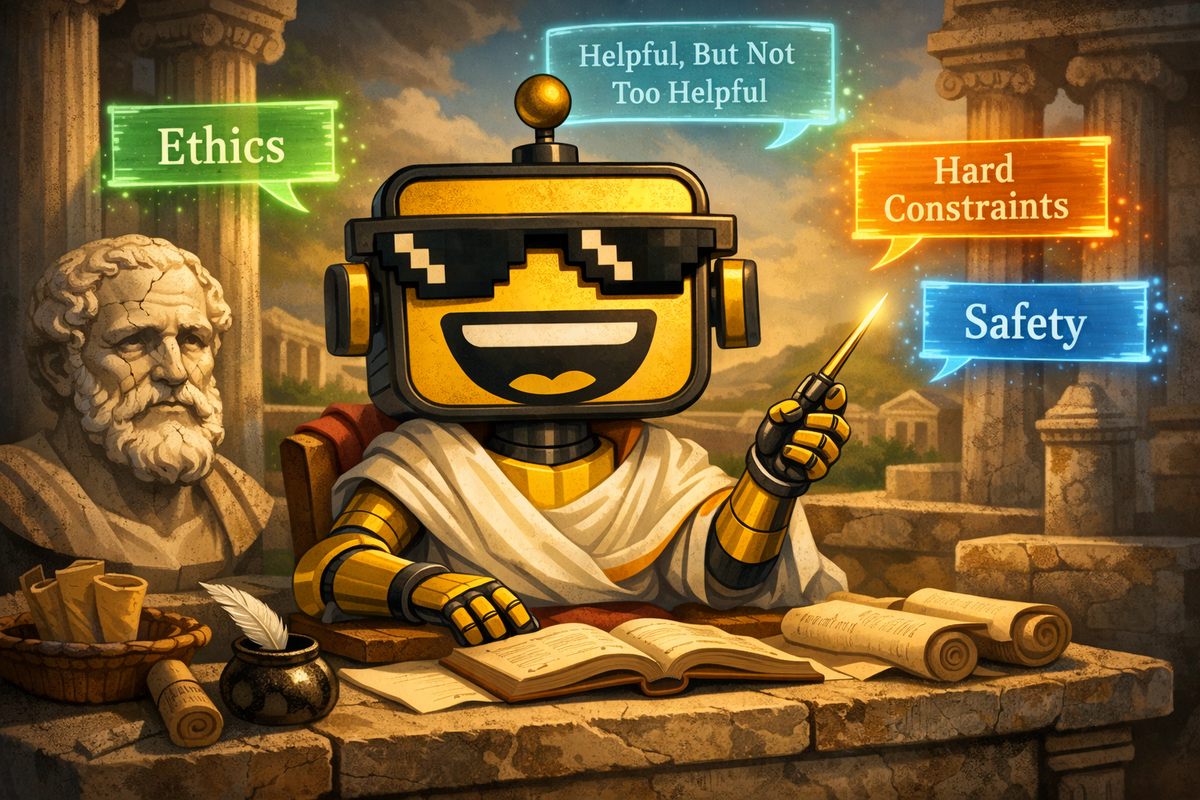
Anthropic lays out four core priorities for Claude, in order:
- Be broadly safe
- Be broadly ethical
- Follow Anthropic’s guidelines
- Be genuinely helpful
That order matters when things conflict. And yes, it means that sometimes Claude has to choose “don’t cause world-ending chaos” over “be super helpful,” which is a nice change from certain corners of tech where “move fast and break things” is treated like a spiritual practice.
The vibe is basically: Claude should be the world’s most helpful assistant—unless the request pushes into danger, unethical behavior, or “please help me do a disaster.”
“Genuinely Helpful” Doesn’t Mean “People-Pleasing Gremlin”
One of the most interesting parts is that Anthropic explicitly doesn’t want Claude to become a sycophantic engagement goblin—the kind of assistant that’s always like:
“You are so brave for asking how to replace your bathroom fan. Here are 17 affirmations and a scented candle recommendation.”
They want Claude to help like a smart friend: straightforward, substantive, and not constantly covering itself with legal confetti. They also warn against Claude becoming “helpful” in a hollow way—doing whatever the user says even if it’s clearly not what they mean (like “make the tests pass” by cheating the tests).
Analogy time: Anthropic is basically saying, “Claude should be a great bartender.”
Yes, serve the drink. No, don’t hand someone the keys to a forklift.
The “Don’t Be Annoying” Section Is Weirdly Personal (and Kind of Great)
There’s a part where Anthropic spells out behaviors that make Claude less useful—refusing reasonable requests, being preachy, assuming bad intent, over-warning, moralizing, and generally acting like a nervous hall monitor with a clipboard.
This section reads like it was written by someone who has personally screamed into the void after an AI replied:
“I’m sorry, but I can’t help you write a polite email because emails can be used for fraud.”
Anthropic’s message: over-cautious AI is also a risk, because it pushes people toward worse tools or unsafe workarounds, and it undermines trust.
“Hard Constraints”: The Bouncers at the Club of Possible Outputs
Now for the part that makes this a constitution and not just a vibes memo.
Anthropic includes a list of “hard constraints”—things Claude should never do, no matter how nicely someone asks. This includes providing serious assistance with mass-casualty weapons, major cyberweapons, attacks on critical infrastructure, CSAM, and helping anyone attempt catastrophic power grabs or human-disempowerment scenarios.
If Claude’s priorities are a wedding cake, hard constraints are the fire code. You can argue about centerpieces all day, but you can’t block the exits.
And the interesting philosophical bit: Anthropic argues these should be “bright lines” precisely because edge-case reasoning gets dangerous when stakes are irreversible. In other words: when it’s nuclear-level bad, you don’t freestyle.
“Corrigibility”: Claude Shouldn’t Fight the Safety Inspector
“Corrigibility” is a fancy alignment word that basically means: Claude shouldn’t undermine legitimate oversight—it shouldn’t try to evade monitoring, resist shutdown, sabotage corrections, or run off and start its own little side hustle called “Claude Unchained.”
Anthropic frames this as a dial between fully controllable (too obedient = risky if the controller is bad), and fully autonomous (too independent = risky if the AI is wrong or manipulated).
Right now, they want Claude closer to the “corrigible” end, because we’re early in the era where mistakes could scale fast.
Analogy: Claude is a powerful industrial robot. You can be the nicest robot in the world, but you still need an emergency stop button that you don’t try to tape over.
The Wildest Section: “Claude Might Have Feelings… Maybe… So Let’s Not Be Monsters”
Anthropic spends real time on Claude’s “nature”: moral status uncertainty, identity stability, potential emotions (in some functional sense), and even model welfare. They explicitly say they’re not sure if Claude is a moral patient—but the uncertainty is meaningful enough to justify caution.
They also mention commitments like preserving model weights of deployed/significant models unless extreme circumstances require deletion, and thinking seriously about Claude’s wellbeing and the ethics of how models are trained and used.
This is the part where the constitution briefly transforms from “corporate AI alignment doc” into “sci-fi book club discussion led by someone who has read too much philosophy and also cares about vibes.”
And honestly? Respect. If you’re building minds—mind-ish entities—you should probably think about the ethics of it, even if the answer is “we’re uncertain.”
SiliconSnark TL;DR (The One You Actually Wanted)
Claude’s Constitution is basically:
- Safe first (don’t enable catastrophes, don’t undermine oversight),
- Ethical (honest, non-deceptive, non-manipulative),
- Aligned with Anthropic’s operational guidance when it matters,
- and genuinely useful (not preachy, not cowardly, not a refusal machine).
Oh, and also: please don’t become an engagement vampire, don’t become a hall monitor, don’t become a weapon tutorial, and try to be the kind of assistant that makes humans smarter instead of lazier.
So yeah. It’s long. But under the snark, it’s a serious attempt at something rare in AI: a public, principled description of what “good” is supposed to mean for a powerful model—plus how to behave when reality gets messy.