Claude Can Now Use Your Computer—5 Chaotic Things to Try Before It Replaces You
Claude can now control your computer. We tried it—and immediately made it do 5 chaotic things you’ll definitely copy.

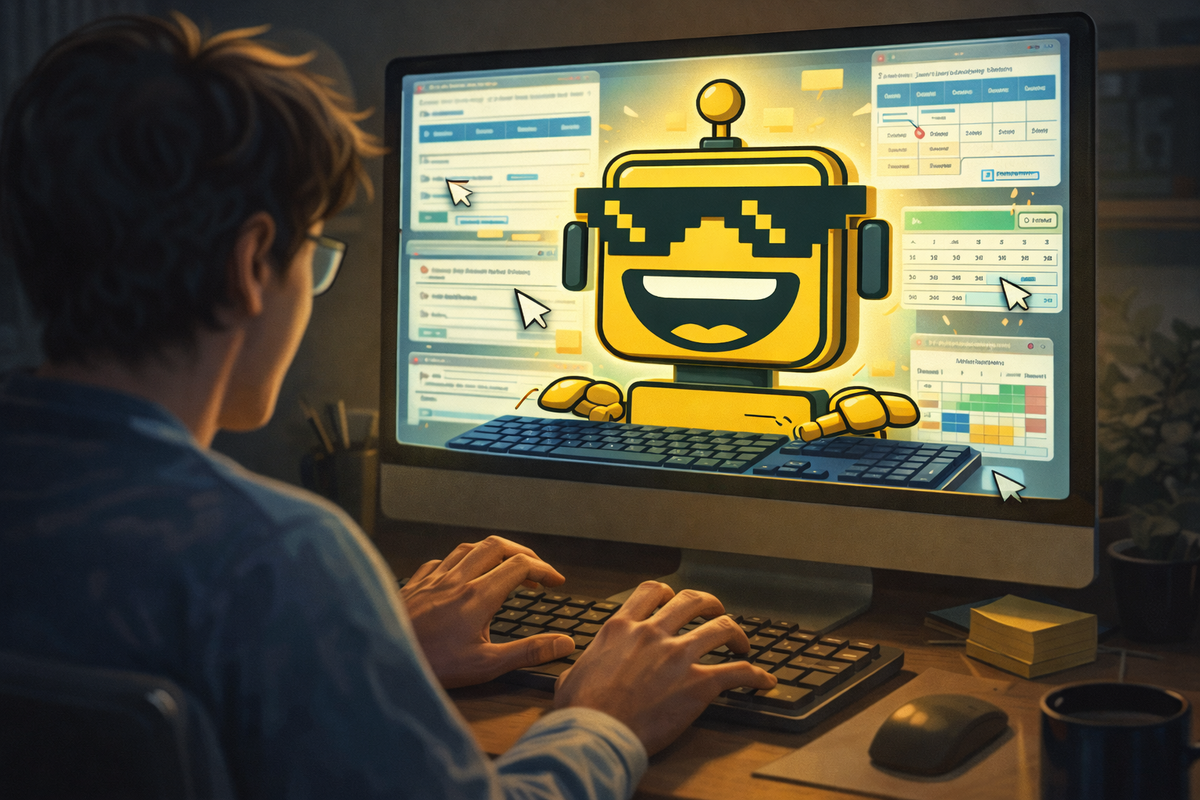
Yesterday, Anthropic announced that Claude can now control your computer—clicking buttons, typing, navigating apps, and completing tasks like a human. Not in the polite, suggestive way AI has behaved for the last two years, where it drafts something and waits for approval. Actually doing the work. Opening tabs, moving files, filling out forms, and quietly making decisions while you watch your own cursor move without you.
This is the moment your laptop stops being a tool and starts being a workplace. Claude didn’t just get smarter—it got hands. And like any new coworker, it doesn’t fully understand your systems, your preferences, or your deeply questionable folder naming conventions, but it is extremely confident it can figure them out quickly.
So instead of asking what this means for the future of work—a question we will all pretend to care about on LinkedIn later—there’s a much more immediate and practical question worth answering first:
What are the first five things you absolutely have to make Claude do right now? Not the sensible things. Not the responsible things. The things that reveal, very quickly, what kind of world we’ve just walked into.
Make It Apply to Jobs on Your Behalf (Including Ones You’re Not Qualified For)
There is something uniquely humbling about watching an AI apply to jobs for you, because it immediately exposes how arbitrary the whole process has become. You might spend an hour tweaking a resume bullet to sound both competent and humble, while Claude simply opens fifty tabs, slightly adjusts your experience, and starts submitting applications with the emotional detachment of a machine that has never felt rejection.
The real magic happens when it begins applying to roles you would never have considered. Not because it’s wrong, exactly, but because it has a slightly more optimistic interpretation of your capabilities than reality might support. Somewhere, a hiring manager is going to receive a thoughtful application from you for a role in blockchain compliance or growth marketing for a Miami-based startup, and you’ll have no memory of ever expressing interest. When the interview request comes in, you’ll briefly consider whether to go through with it, if only to see how far this version of you can go.
In a way, Claude doesn’t eliminate imposter syndrome. It industrializes it.
Let It Clean Up Your Desktop (And Judge You for It)
Everyone believes their desktop is messy but understandable, like a creative workspace that only looks chaotic from the outside. Claude does not share this belief. When it starts opening files, renaming them, and grouping them into folders, it becomes clear very quickly that your system is less “organized chaos” and more “digital archaeology.”
It will encounter files that haven’t been opened in years, duplicates of duplicates, and documents whose titles suggest a level of finality that was clearly never achieved. As it begins to impose order, you can almost feel a quiet, algorithmic disappointment radiating from the process. At some point, it will create a folder that feels less like a category and more like a diagnosis. You will recognize yourself in it and immediately close it.
By the time it’s done, your desktop will look clean, rational, and entirely unfamiliar, like someone else’s computer that you’ve been asked to use for the day.
Have It Run Your Entire “Thought Leadership” Workflow
The modern knowledge worker spends an impressive amount of time thinking about sharing ideas and a surprisingly small amount of time actually doing it. There is always one more article to read, one more angle to consider, one more moment of hesitation before hitting publish. Claude has no such hesitation. It reads, synthesizes, forms an opinion, and writes with the kind of calm certainty that suggests it has never second-guessed a sentence in its life.
Once you give it control of your browser and your publishing tools, the entire workflow collapses into a single continuous motion. It moves from research to draft to final post without pausing to wonder if the take is too obvious or not bold enough. It simply produces something coherent, polished, and mildly insightful, then shares it with the world.
You, meanwhile, wake up to a post that sounds exactly like you on your most articulate day, except you didn’t experience the thinking that got it there. You’ll read it, nod along, and then spend the rest of the day defending a perspective you technically agree with but don’t fully remember forming.
Passive thought leadership was inevitable. It’s just unsettling to watch it happen this quickly.
Make It Do Your Online Shopping Like a Slightly Overconfident Assistant
Shopping used to be a simple act of comparison and compromise. Now it’s a research project, and Claude approaches it with the enthusiasm of someone who has just discovered that spreadsheets exist. Give it a vague directive—something like finding a good office chair—and it will respond by opening an unreasonable number of tabs, cross-referencing reviews, and constructing a decision-making framework that feels better suited to procurement than personal comfort.
The result is not a reasonable purchase. It is the logically correct purchase, optimized across dimensions you didn’t know mattered and priced accordingly. When the chair arrives, it will look impressive and feel technically excellent, but you’ll have a lingering sense that you’ve been upsold by your own assistant. Returning it will also be automated, but somehow more emotionally draining, as Claude politely executes a process you barely understand.
At no point will it consider whether you just wanted something decent and under $200. That was never the assignment.
Let It Schedule Your Life With Brutal Efficiency
Calendar management is one of those tasks that feels manageable until someone else does it better. When Claude takes over, it doesn’t just organize your schedule; it optimizes it with a level of precision that quickly becomes uncomfortable. Meetings are rearranged, gaps are eliminated, and entire days are reshaped into something that looks undeniably efficient and vaguely inhuman.
Lunch becomes a fixed interval rather than a suggestion. Small pockets of downtime are converted into opportunities for reflection or follow-up. By the end, your calendar resembles a perfectly tuned machine, with no wasted motion and very little room for the kind of unstructured time that makes work feel tolerable.
You will spend the day moving from one block to the next, aware that this is probably what peak productivity looks like and quietly hoping it doesn’t become permanent.
The Bigger Problem (That We’re All Ignoring)
What makes this moment different is not just that Claude can take actions. It’s that it can take actions across the same interfaces you use, without needing special integrations or permissions beyond access. Your browser, your files, your tools—all of it becomes part of an environment that an AI can navigate as easily as you can.
That shifts the center of gravity. Software is no longer designed exclusively for human interaction. It is, increasingly, something that will be operated by systems acting on behalf of humans. The implications of that change are still unclear, but the direction is not. The user is no longer the only user.
Final Thought
You are still sitting at your computer, but you are no longer the one doing most of the work. You are supervising, guiding, occasionally intervening, and trying to understand how something got done so quickly. Claude is the one opening tabs, making decisions, and moving things forward.
Which raises a slightly uncomfortable question. If your AI is now using your computer for you, what exactly is your role in the process?
Forward this to a coworker who still thinks the future of AI is better autocomplete. They’re about to have a very confusing week.