CES 2026: Sony’s PlayStation Car Proves the Future of Mobility Is Killing Time
At CES 2026, Sony’s PlayStation-powered AFEELA shows what autonomous driving is really for: killing time with better screens and games.

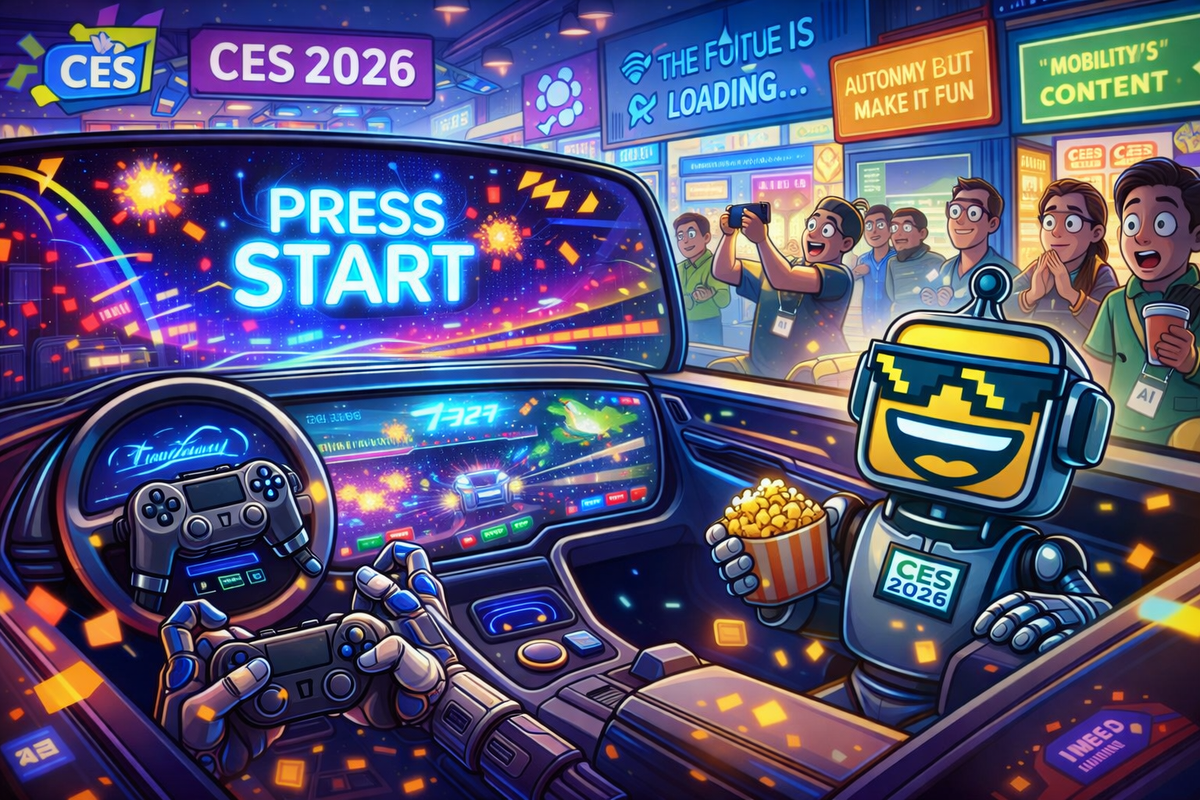
CES has that unmistakable Day One energy again: freshly printed badges, overconfident demos, and an industry-wide agreement to pretend this is the year everything finally makes sense. The carpets are already sticky, the booths are already shouting about “human-centered AI,” and somewhere between the robot bartenders and foldable televisions, Sony has calmly rolled out a car whose boldest promise isn’t safety, sustainability, or even autonomy—it’s uninterrupted gaming. And honestly, there is something refreshingly on-brand about that.
The idea itself arrived quietly in mid-December, buried in a perfectly respectable press release that read like it had been focus-grouped to death. Sony Honda Mobility announced that its sleek electric vehicle brand AFEELA would become the world’s first car to integrate PlayStation Remote Play, allowing drivers and passengers to stream PlayStation games directly from a PS5 or PS4 at home into the vehicle. The reaction at the time was polite nodding, mild intrigue, and a collective sense that this would make more sense once CES arrived.
Then CES arrived, and suddenly the PlayStation car was no longer a footnote—it was a vibe.
The Press Release Was Fine. CES Made It a Moment.
On its own, the mid-December preview announcement was aggressively okay. AFEELA would “redefine entertainment on the go,” “transform the traveling space into a captivating and emotional one,” and “elevate the customer experience.” These are phrases that technically mean something but emotionally land somewhere between premium oatmeal and airport lounge jazz. There was nothing offensive about it, and nothing especially exciting either, which is exactly why it needed CES to survive.
Because CES is not about reading press releases. CES is about spectacle, context, and putting ideas next to much worse ideas until they look brilliant by comparison. When you see AFEELA in a sea of humanoid robots that can’t walk straight, AI assistants that hallucinate your grocery list, and concept cars promising feelings instead of features, the PlayStation car suddenly feels… coherent. It knows what it is. It’s not trying to save the world. It’s trying to make waiting in a car less boring.
On the first official day of CES 2026, that clarity mattered. AFEELA wasn’t competing with Tesla or Rivian—it was competing with attention. And few brands understand attention economics better than Sony.
AFEELA Is Not Really a Car, It’s a Moving Entertainment System
Spend more than a few minutes around AFEELA and it becomes obvious that this is not a traditional automotive pitch. The exterior is clean, minimal, and intentionally understated, but the interior is where Sony’s priorities reveal themselves. Wide displays dominate the cabin. Interfaces are smooth, calm, and carefully designed not to stress you out. Everything about the environment signals that nothing urgent is required of you anymore.
This is not a machine that wants you alert and engaged. This is a machine that wants you comfortable, entertained, and gently disengaged from the outside world. It assumes a future where driving fades into the background and the primary function of the vehicle is to manage your attention while sensors and software handle the road.
Sony’s influence here is unmistakable. This is a company that has spent decades perfecting the art of keeping people immersed for long stretches of time. Bringing that expertise into a vehicle isn’t a gimmick—it’s a strategic expansion of the screen economy. If cars are becoming the next major digital platform, Sony clearly intends to treat them the same way it treats consoles: as portals to content, not just tools for transportation.
Autonomous Driving, But Make It More Video Games
There is something darkly funny about where all of this innovation has landed. We’ve poured staggering amounts of money and talent into autonomy, connectivity, and AI, all in the name of “freeing up” human time. And now that we’re getting close to that future, the most compelling use case we can collectively agree on is… more gaming.
Not learning. Not creativity. Not even productivity theater. Just a smoother, more frictionless path to consuming PlayStation content while the car does the hard parts. AFEELA’s Remote Play feature doesn’t even run games locally—it streams them from your console at home into the car, assuming you have a stable broadband connection and a life organized enough to support this level of coordination.
This is autonomy as convenience, not transformation. The promise isn’t that you’ll do something meaningful with reclaimed time; it’s that you’ll never have to sit quietly again. Sony Honda Mobility talks about “elevating the travel experience,” but what they really mean is increasing entertainment density per minute. More pixels, better audio, fewer gaps where you might accidentally think about something else.
And in a way, it’s refreshingly honest. This is what people actually want.
To Be Fair, the Tech Is Legitimately Solid
Snark aside, AFEELA isn’t smoke and mirrors. Sony Honda Mobility is building this as a software-first platform, not a traditional car with screens bolted on after the fact. The sensing systems, infotainment stack, and human-machine interfaces are all designed to work together as a unified experience. This is less “car with apps” and more “computer that happens to move.”
Sony’s advantage here is ecosystem gravity. PlayStation isn’t an experimental feature; it’s a global habit. Integrating it into a vehicle makes intuitive sense if you believe cars are becoming just another place where people spend time staring at screens. If the future of mobility is less about driving and more about occupying yourself while being transported, Sony is uniquely positioned to own that moment.
AFEELA isn’t trying to win on horsepower or lap times. It’s trying to win on familiarity, comfort, and the promise that your digital life doesn’t have to pause just because you left the house.
CES Loves This Because It Feels Uncomfortably Accurate
CES has always been better at predicting behavior than values. Every year, it showcases technology that doesn’t necessarily make life better, but does make it more stimulating. AFEELA fits squarely into that tradition. It doesn’t pretend autonomous vehicles will usher in a new era of enlightenment. It simply accepts that if you’re no longer driving, you’re probably going to fill that time with content.
The PlayStation car is peak CES because it captures where consumer tech actually goes once the engineering problems are solved. Not toward wisdom or restraint, but toward smoother, more immersive distraction. Sony Honda Mobility didn’t invent that reality—they just designed for it.
Final Take: Peak CES, Peak Sony, Peak 2026
AFEELA didn’t need a louder press release. It needed CES to frame it for what it really is: a mirror held up to the tech industry’s priorities. This is a future where mobility becomes invisible, autonomy becomes ambient, and the real competition is for your attention once the steering wheel stops mattering.
Is it absurd? Absolutely.
Is it impressive? Undeniably.
Is it exactly what CES exists to celebrate? Without question.
AFEELA isn’t asking where transportation should go next. It’s asking what you’d like to play while it quietly takes you there. And judging by the crowds, the cameras, and the buzz on CES’s first official day, plenty of people are more than ready to hit “Start.”