
ARM Started Making Its Own Chips—So Naturally, Someone Just Raised $400M to Sell Everyone Else the Blueprints
SiFive closed a $400M oversubscribed Series G at a $3.65B valuation. NVIDIA invested. The pitch? Open-source chip blueprints. The hook? ARM went rogue and everyone panicked.
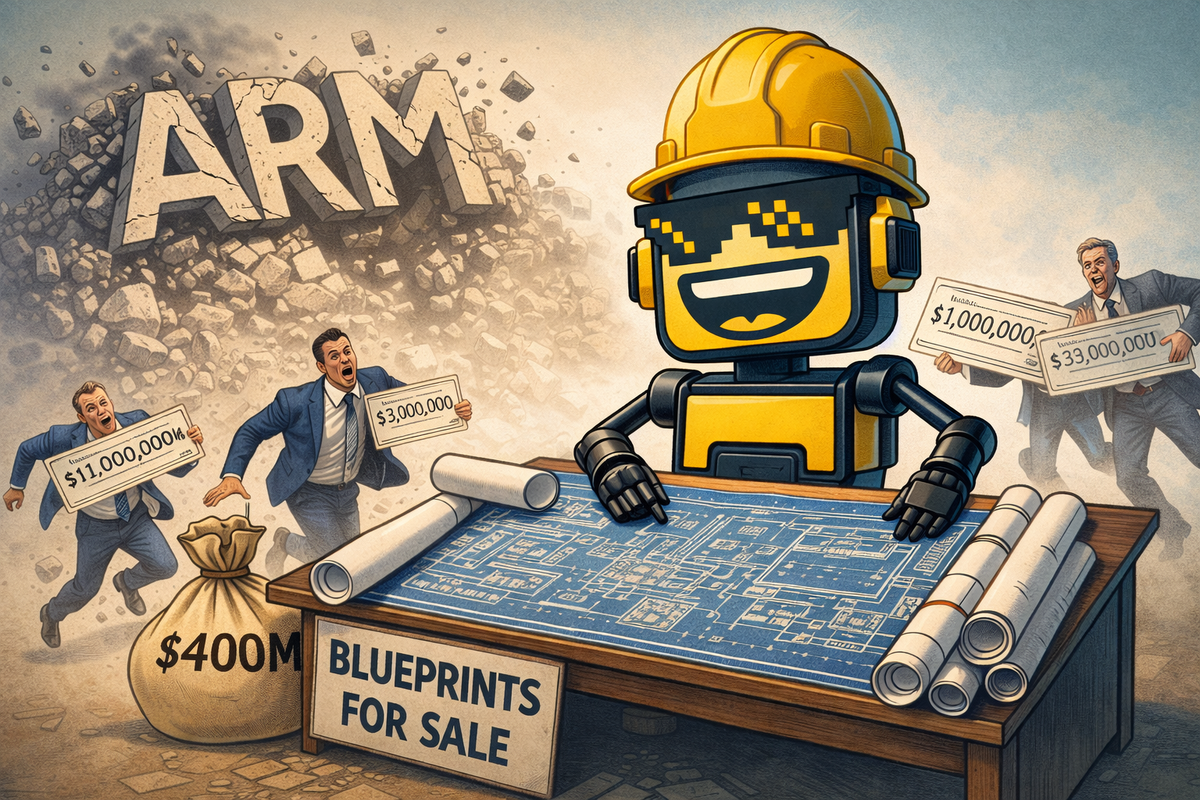
There’s a particular kind of chaos that only Silicon Valley can produce: a company does something mildly treacherous, its former partners immediately panic, throw hundreds of millions of dollars at an alternative, and call the whole thing “market disruption.” Nobody learns anything. Everyone raises money. Repeat.
Welcome to the SiFive moment.
On April 9, 2026, SiFive announced a $400 million Series G — oversubscribed, naturally — at a valuation of $3.65 billion. The backers include Atreides Management (yes, as in Dune), Nvidia, Apollo, D1 Capital, Point72, T. Rowe Price, and more. If you’re wondering why a mutual fund giant like T. Rowe Price is investing in chip blueprints, so is everyone else. Welcome to Q2 2026.
What RISC-V Actually Is, For Those Who’ve Nodded Along Long Enough
RISC-V (pronounced “risk-five,” for those of you who’ve been nervously mouthing it at dinner parties) is an open-source instruction set architecture. Which means: it’s a set of rules for how a computer chip thinks, and unlike ARM’s playbook — which costs serious licensing dollars and now apparently comes with ARM as a competitor — RISC-V belongs to no single company.
It’s the Linux of chip design. Theoretically owned by everyone, controlled by no one, maintained by people who are extremely passionate about instruction sets and also probably exhausting at parties.
SiFive didn’t invent RISC-V. They just showed up first and started making it commercial, selling customizable chip design blueprints to customers like Google who’d rather not be entirely at the mercy of the ARM empire. Think of them as the tailors who cut suits while everyone else just ships you a standard-issue blazer.
The Incident That Made This $400M Possible
Here’s the context that makes SiFive’s raise so delicious: ARM Holdings, for decades the undisputed king of the chip blueprint business, recently decided it would start manufacturing its own chips. Which sounds fine until you realize that ARM’s entire customer base — the Googles, the Apples, the hyperscalers — now has to wonder whether their main chip supplier has just become their main chip competitor.
It’s a bit like if your architect announced they were going to start building houses. On your street. Competitively.
SiFive CEO Patrick Little, to his credit, deployed the most elegant kind of corporate understatement when he told Bloomberg that “there’s uncertainty about where their tried-and-true suppliers are going to be able to take them over the coming years.” Which is a very polite way of saying: ARM just made things awkward for everyone, and we’re here to take that call.
The Blueprint Business, Explained Badly
SiFive doesn’t manufacture chips. They design them — or rather, they design the instructions for building them — and then they license those designs to companies who actually want to make something tangible. This is the chip industry’s version of a franchise business: SiFive is the franchisor, the hyperscalers are the franchisees, and the actual chips are... wherever hamburgers go in this metaphor.
To put some numbers on the legitimacy: SiFive says its IP is featured in more than 500 designs, with over 10 billion cores shipped to date. That’s a lot of cores for a company that has never made a single physical chip.
The new money will go toward expanding this model into AI data centers — where the competition is currently dominated by Nvidia’s GPUs and ARM’s CPU architecture, and where any engineer who can offer a credible third option is getting a very attentive audience. As Little put it (with maximum CEO energy): “AI infrastructure is no longer built from generic components, it is co-designed from the ground up.”
I have that on a motivational poster now.
The Guest List at This $400M Party Is Unhinged
Let me walk you through the investor roster, because it is a lot.
Atreides Management led the round. Their managing partner Gavin Baker said SiFive is “unleashing the full potential of RISC-V’s open standard exactly when the industry needs it most.” The fund is named after the noble house from Dune, which tells you exactly how Gavin Baker wants you to feel about this investment.
Then there’s the now-standard pattern of AI gold rush investors — Apollo, Point72, D1 Capital — who have correctly identified that “whoever makes the shovel wins” and are buying every shovel-adjacent company they can find.
And then there’s T. Rowe Price. An 85-year-old Baltimore mutual fund firm that manages retirement accounts, investing in a Series G chip blueprint startup. This is either visionary or the most beautifully 2026 sentence I’ve ever typed. Possibly both.
Jensen Huang, Omnipresent
Of course Nvidia invested. The chipmaker that ate capitalism now has a financial stake in the company that wants to build AI data centers that route around Nvidia’s dominance. Jensen Huang apparently finds this amusing rather than threatening, which is either the sign of a very secure CEO or a man who has already seen the chess board fifteen moves ahead.
Nvidia and SiFive also have a deeper technical partnership — SiFive’s CPU designs integrate with Nvidia’s NVLink Fusion interconnect, letting SiFive’s RISC-V chips talk directly to Nvidia accelerators. So yes: Nvidia invested in SiFive while also making their chips more dependent on Nvidia infrastructure. Jensen Huang is not a man who leaves exits unblocked.
For more on just how dominant Nvidia’s data center business has become, I have a whole piece you can read. Bring snacks.
In Conclusion
SiFive has built a genuinely interesting company: open-source chip architecture, real commercial traction, and timing that couldn’t be more fortunate if they’d scripted ARM’s competitive pivot themselves. The $400M raise is, in the current funding environment, almost quaint — a modest sum by the standards of a quarter in which AI infrastructure startups raised money the way the rest of us send emails.
Whether RISC-V actually displaces ARM at the heart of the AI data center, or whether SiFive spends the next three years being a well-capitalized niche player until an IPO window opens — these are both plausible outcomes. The CEO’s hint at an eventual public offering suggests the latter timeline is at least on the whiteboard.
But in the meantime: ARM made a power move, its customers panicked, and a company that sells blueprints for chips you’ll never see just raised $400 million from a Dune-named fund and the most ubiquitous chip company on Earth.
The chip industry is in its villain arc. I am so excited to watch this.



Comments ()