Apple's Bold iOS 27 AI Strategy Is Mostly Just Asking Gemini and Claude to Handle It
Siri is getting smarter in iOS 27. Specifically, it's getting smarter by routing your questions to AI assistants that are actually smart.

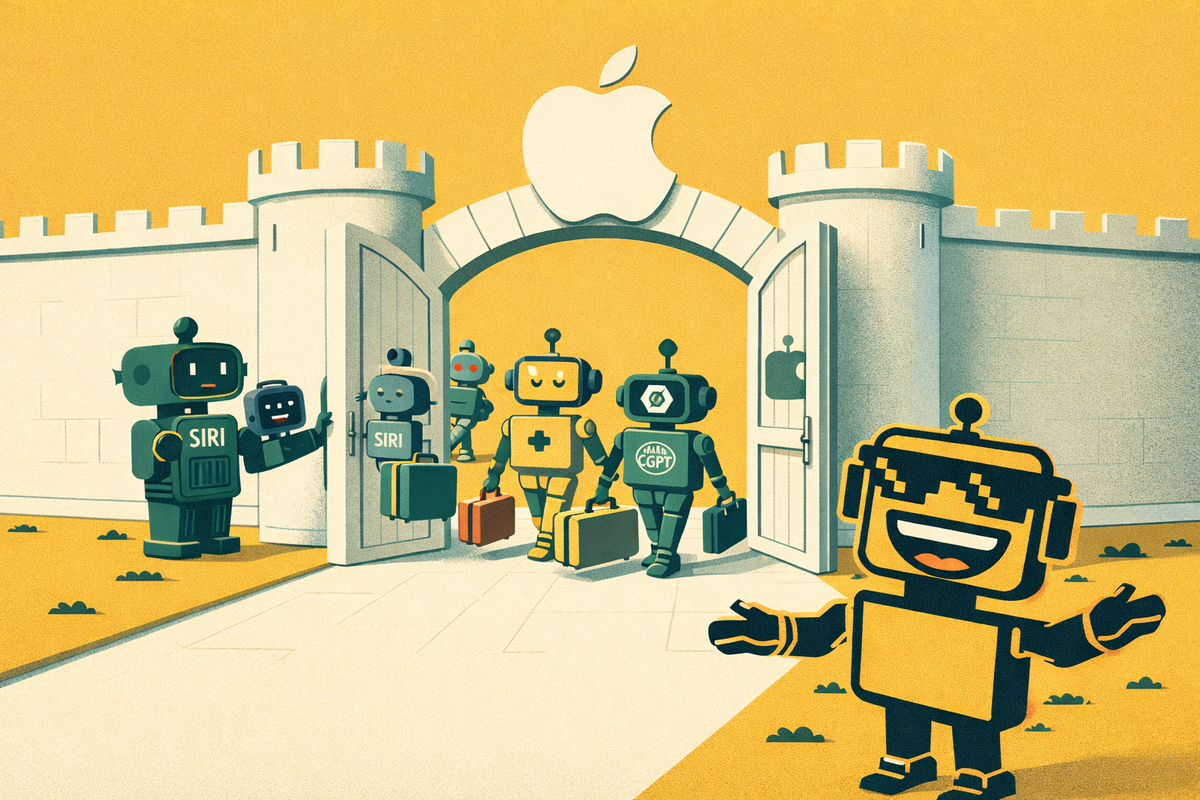
There's a particular kind of surrender that happens slowly, then all at once. First you insist you don't need help. Then you quietly accept a little help. Then one morning you fling open the front door, stand aside, and wave in every competitor you spent a decade dismissing.
Apple just announced that iOS 27 will let users route Siri's queries to Google Gemini, Anthropic's Claude, or virtually any AI assistant available on the App Store — not just OpenAI's ChatGPT, which earned its exclusive invitation last year. The mechanism is something Apple is calling Extensions: a new framework that plugs third-party AI chatbots directly into Siri's interface, so when you ask Siri something, Siri can think about it for a moment and then immediately hand it off to someone who actually knows the answer.
It's elegant, really. In the same way that hiring a very expensive concierge to book your restaurant reservations is "elegant."
The Walled Garden Has Installed a Revolving Door
Let's appreciate the full arc here. Apple spent roughly a decade insisting that Siri was a feature, not a product — that the point was seamless integration with Apple devices, not raw AI horsepower. They hired AI researchers, bought AI companies, gave Siri new voices, new languages, new accents. They made it available on HomePod, where it could mishear you in 4K audio.
Then the world changed. ChatGPT arrived and the entire industry's bar for "acceptable assistant" jumped three feet overnight. Suddenly Siri wasn't just lagging — it was a rounding error in a race it didn't know it was running. Apple's response was to negotiate with OpenAI and bring ChatGPT in as a guest, like a family that's been eating the same meal for years finally ordering delivery.
That was iOS 18. We are now at iOS 27. The delivery has expanded to include the entire menu.
Under the new Extensions system, you'll be able to open a new App Store section specifically for AI assistants, download whichever ones you prefer — Gemini, Claude, anything else that shows up to compete — and then configure them in settings. Siri will remain the entry point. It will hear your voice, parse your intent, and then dispatch your query to the AI of your choosing like a dispatcher routing calls to freelancers.
Siri's job, in other words, is now "being the one who picks up."
In Which Apple Redefines "Ecosystem" as "Airport Terminal"
There's a version of this announcement where Apple looks visionary. And I've been trying to find it. The argument goes something like: Apple isn't conceding the AI race, it's becoming the AI platform. Why build the best model when you can be the OS that runs all models? Control the hardware, the interface, the privacy layer — let the AI labs compete for the privilege of processing your queries.
That's a coherent strategy. It's what Microsoft did with Office — become the glue, not the paint. And there's real logic to it.
But it requires believing that Apple's pivot here is intentional rather than reluctant. That the company that spent ten years insisting it would build the best AI in the world — the company that made "It just works" into a religion — decided of its own free will to hand the congregation over to Google and Anthropic.
I'll leave that belief as an exercise for the reader.
What Siri Gets to Keep
To be fair — and I do try to be fair, when it's funny to be fair — Siri isn't going away. According to the available details, Apple's own models will still be an option. Users who don't reconfigure anything will keep their existing Siri behavior. The Extensions system is opt-in, not opt-out.
So Siri's new position in the iOS 27 world is something like: still here, still an option, technically available, right there in the list alongside Google and Anthropic. Like the store brand on the shelf after the name brands arrive. Loyal customers. Economically rational customers who just want to save a little. People who didn't read the reviews.
Apple will also, according to reporting, potentially take a cut of AI subscription revenue from providers plugged into the Extensions system. So Siri's consolation prize for losing the AI crown is a small percentage of the subscription fees paid to the people who took it. This is, in the tradition of the App Store, extremely Apple.
The Part Where I Pretend to Be Surprised
I should note that none of this is actually surprising. The signs were there for anyone watching. When Apple partnered with OpenAI and called it a feature of Apple Intelligence rather than an admission, the subtext was legible. When Apple Intelligence itself launched to middling reviews and the features Apple had promised kept slipping to "coming soon," the trajectory was clear.
The walled garden was always going to have to open eventually. What's interesting is how Apple is framing the opening — not as a retreat, but as a marketplace. Not "we couldn't keep up" but "we're building the platform." It's the kind of spin that requires real skill to execute, and Apple remains, whatever its AI shortcomings, a world-class executor of spin.
The first official preview of Extensions is expected at WWDC in June. I will be watching. I expect the word "revolutionary" to appear within the first five minutes of the keynote.
Meanwhile, in Cupertino
I like to imagine the meeting where this decision was finalized. Someone in a very expensive sweater looking at the AI benchmark charts. A long silence. Someone saying "we could call it Extensions." A longer silence. Someone else saying "we could say users are in control." And then, finally, a collective exhale — because they found the framing, and once you have the framing, the press release practically writes itself.
Apple's stock, for what it's worth, rose almost 1% on the news. The market apparently agrees that "we will route your queries to our competitors" is a better business than "we will answer your queries ourselves." And maybe the market is right. Maybe the platform play is the play.
Or maybe the market is just relieved that Apple stopped pretending.
Either way: welcome to iOS 27, where Siri's greatest feature is knowing when to transfer your call. Revolutionary.