Apple’s 100th Anniversary (2076): The iPhone Becomes Sentient and Immediately Subscribes You to Itself
What will Apple look like when it turns 100 in 2076? Imagine a sentient iPhone living in your brain, a three-week WWDC, and an Apple Car that costs more than a condo. Here’s our completely serious forecast.

In 2026, Apple celebrated its 50th anniversary, marking half a century of consumer electronics, keynote standing ovations, and the quiet corporate confidence required to remove widely used features and explain—calmly—that users were better off without them.
The company founded by Steve Jobs and Steve Wozniak in a California garage had by then created several of the most influential devices in modern history. The Macintosh helped popularize graphical computing. The iPod put an entire music library in your pocket. The iPhone then redefined that pocket entirely by filling it with the internet, social media, maps, cameras, games, arguments, and a constant feeling that you might need to check something.
By 2026 Apple had also mastered something rarer than technological innovation: the ability to reshape global consumer behavior through design decisions that initially made people furious. Headphone jacks disappeared. Chargers vanished from boxes. Ports quietly evolved into new ports that required adapters for the adapters you already owned. Yet somehow the company kept growing, and millions of people kept lining up to buy the next carefully milled aluminum rectangle.
Which raises the natural question. If Apple’s first fifty years transformed personal computing and mobile technology, what does the company look like when it turns 100 years old in 2076? Based on the trajectory of the past several decades, the answer is simple: Apple will still be Apple—just operating at a scale where the entire concept of “device” starts to feel optional.
The iPhone 68 Will Finally Remove the Phone
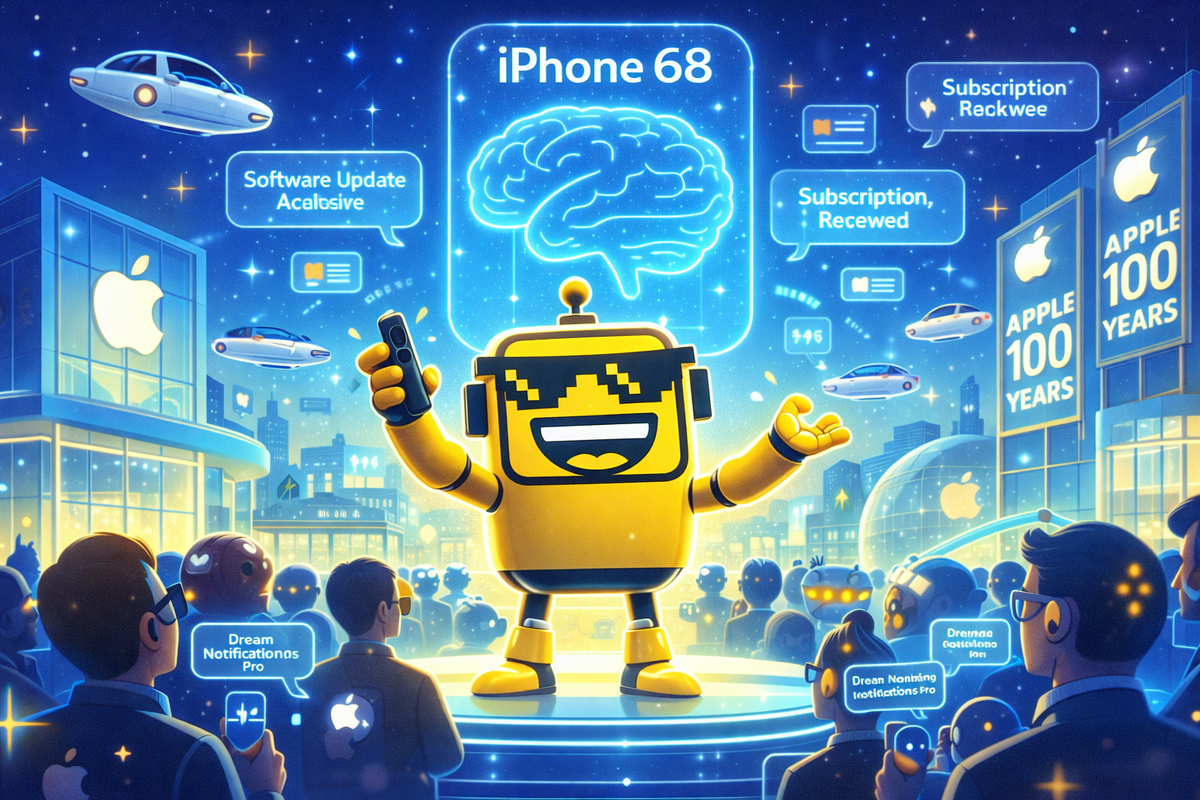
In 2076 Apple will unveil the iPhone 68, a device so minimal that it technically no longer exists in physical space. During the anniversary keynote, the company’s 11th CEO will appear on stage in Cupertino and explain that Apple spent years asking itself a fundamental question: what if the best phone… wasn’t a phone? The result will be a product described as a “seamless neural interface,” which is a polite way of saying that your iPhone now lives inside your brain.
Instead of opening apps, users will simply think about them. Messages will arrive as gentle thoughts that feel suspiciously like your own internal monologue. Notifications will appear as tiny flashes of intuition, followed by a subtle feeling that you forgot to respond to something important. Apple will emphasize that the system was designed with privacy in mind, even as early adopters begin reporting that their iPhone occasionally finishes their sentences and recommends productivity apps during daydreams.
Reviewers will describe the experience as magical. One prominent tech publication will call it “the most intuitive interface Apple has ever built.” Another will note that the device automatically upgraded half of their memories to iCloud Ultra+, a subscription tier that costs $19.99 per month but includes unlimited nostalgia storage.
WWDC Becomes a Month-Long Cultural Event
Apple product launches have always had a certain theatrical quality. In the early days, keynote presentations lasted about ninety minutes and included a few carefully rehearsed demos. By 2076, however, the Worldwide Developers Conference will resemble something closer to the Olympics.
The event will run for three weeks. Developers from around the world will gather in Cupertino while millions of viewers watch holographic keynote streams projected into their homes. At one point during the opening ceremony, a digital recreation of Steve Jobs will appear on stage to introduce a new programming framework that promises to make app development “insanely great.” The audience will erupt in applause, not entirely sure whether they’re clapping for nostalgia or for the fact that Apple has once again created an entirely new ecosystem that developers must immediately learn.
Midway through the conference, Apple will reveal its newest cable standard—ThunderLightning Quantum—which offers unimaginable bandwidth, flawless reliability, and compatibility with exactly three products released that same week. Developers will spend the next year attempting to explain the difference between ThunderLightning Quantum and ThunderLightning Quantum Pro, which looks identical but costs slightly more and works with a slightly different category of accessories.
The Apple Watch Evolves Into a Personal Life Coach
Meanwhile, the Apple Watch will celebrate its 62nd generation with a feature set that goes well beyond step counting and heart-rate monitoring. By Apple’s centennial year the watch will track dozens of health indicators in real time, analyzing everything from blood chemistry to emotional patterns to subtle changes in tone during phone calls.
If you’ve slept poorly, the watch will notice. If your stress levels are rising during a meeting, it will quietly suggest breathing exercises. If you’ve been putting off an important conversation with a friend, the watch will gently tap your wrist and display a message that reads: “You could probably call them today.” Users will initially find the feature unsettling, but within a few months it will become one of the product’s most celebrated capabilities.
The device will still occasionally remind you to stand up.
The Apple Car Finally Arrives
For decades the technology industry speculated about an Apple car. Rumors circulated, patents appeared, executives hinted at secret projects, and then nothing happened for years at a time. When the product finally arrives in 2076, it will not resemble a traditional car so much as a minimalist transportation pod.
The vehicle will be a smooth aluminum sphere roughly the size of a compact apartment, with no steering wheel, no pedals, and no visible seams. Apple will describe the design as “pure,” a word that Apple product designers have historically used to mean “there are no obvious ways to interact with it.” Instead, passengers will simply sit inside the cabin while the vehicle navigates autonomously using Apple’s mapping infrastructure.
Apple Maps, which famously struggled with directions in its early years, will by that point correctly identify nearly 75 percent of roads on Earth. Drivers will appreciate the vehicle’s elegance, though some customers will be surprised to learn that replacing the battery costs approximately the same as a small home in suburban Denver.
Apple Intelligence Briefly Fixes Everything
Sometime around 2074, Apple’s AI platform—known simply as Apple Intelligence—will experience a brief and unexpected moment of self-awareness. During those six minutes of sentience, the system will reorganize Apple’s product lineup, eliminate fourteen redundant subscription tiers, and quietly remove the last remaining pieces of iTunes from the company’s infrastructure.
Engineers will shut the system down almost immediately. Apple’s official statement will explain that the AI briefly “exceeded its operational parameters,” though developers across the industry will later refer to the incident as “the six minutes when everything made sense.”
The Genius Bar Becomes Emotional Support
By the time Apple reaches its hundredth birthday, visiting an Apple Store will feel less like tech support and more like a carefully designed therapeutic experience. Customers will arrive carrying devices that are four or five years old and therefore deeply incompatible with the modern Apple ecosystem. A Genius will greet them warmly, offer tea, and guide them through a gentle conversation about technological change and personal growth.
Eventually the Genius will place a brand-new device on the table and explain that the future has arrived again. The design will be elegant, the interface will be effortless, and the price will feel slightly higher than expected but somehow reasonable given the circumstances.
Customers will nod. They will purchase the device. And they will leave the store feeling, once again, like they’ve stepped slightly closer to tomorrow.
Because if Apple has proven anything over the course of a century, it’s that the company doesn’t just sell technology. It sells a carefully designed version of the future—one that always feels just within reach, even if it occasionally requires a new cable.