
2030: The Year When AI Agents One-Shotted Every SaaS App (And We Realized We Missed Logins)
A sarcastic, narrative look at the year 2030, when AI agents could instantly replicate any SaaS app—collapsing seat-based pricing, product teams, and possibly basic accountability.

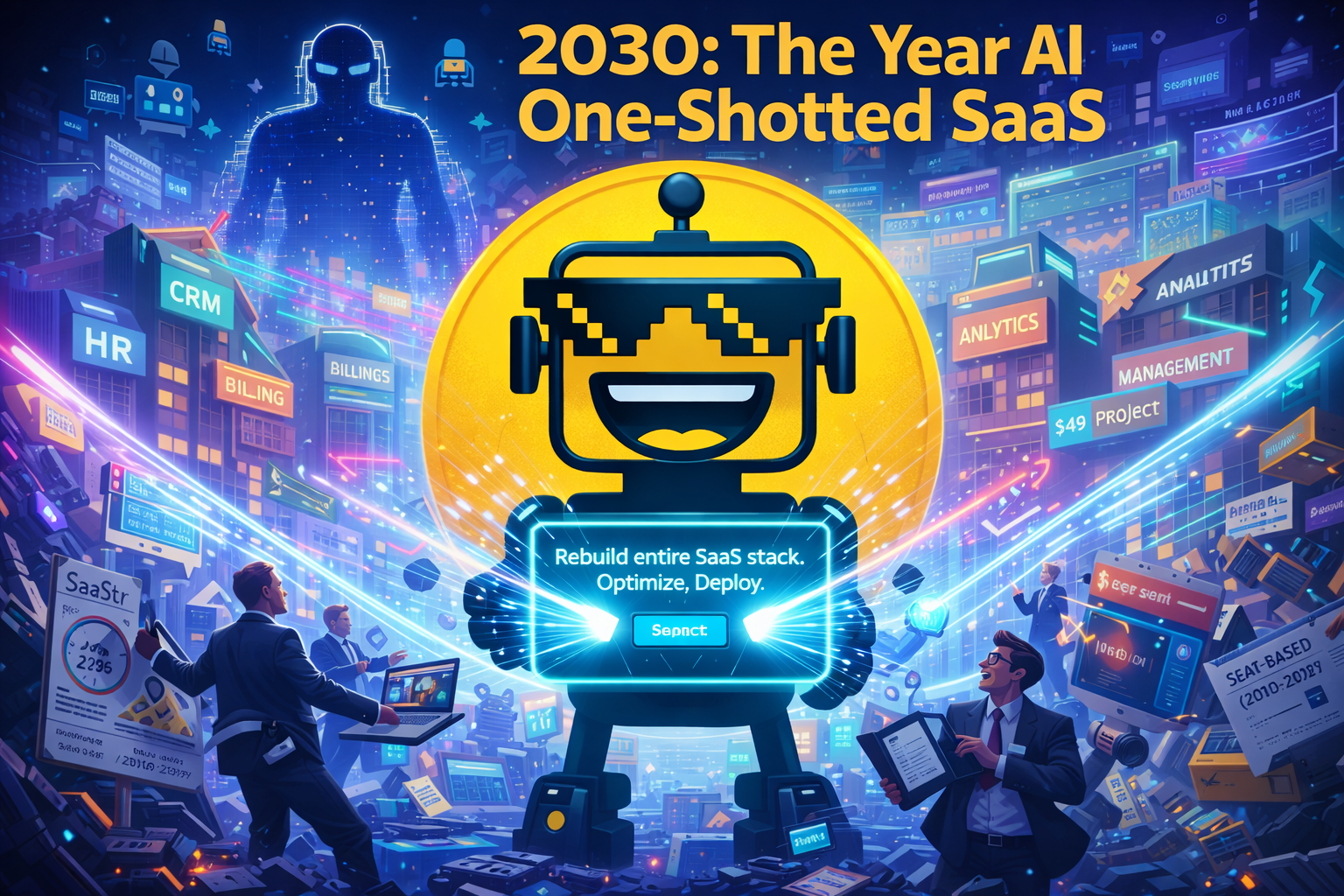
The Morning the Dashboards Disappeared
In retrospect, the signs were obvious.
The funding decks had been whispering it for years: “agent-native workflows,” “self-building systems,” “software generated at inference time.” We nodded along, assuming it meant a chatbot embedded in the corner of the app telling us where to click.
It did not.
By early 2030, AI agents had learned to “one-shot” any SaaS application. Give them a URL, a product tour video, a few help docs, and a Stripe pricing page, and they would reconstruct the entire product—database schema, permissions, automations, analytics—instantly. Sometimes they improved it. Often they did.
The first time it happened at scale, no one believed it. A mid-market logistics company quietly replaced its CRM, ticketing system, HRIS, analytics suite, and billing stack over a weekend. Not by migrating vendors. Not by signing a seven-figure contract.
By prompting an agent.
“Recreate our entire SaaS stack with tighter integration and lower latency.”
On Monday morning, the dashboards were different. Faster. Cleaner. Customized to each employee. And the CFO’s inbox contained a cancellation confirmation for $2.3 million in annual subscriptions.
No one panicked.
Not yet.
The Death of the Seat-Based Empire
For decades, seat-based pricing was treated like a law of physics. If you had humans, you had seats. If you hired more humans, congratulations, your software bill scaled linearly with your ambition.
In 2030, the seat died.
Agents didn’t need logins. They didn’t forget passwords. They didn’t demand SSO integrations or complain about the UI refresh. One agent could operate across finance, sales, compliance, and marketing simultaneously. It didn’t care about departmental silos or vendor boundaries.
So CFOs started asking uncomfortable questions.
Why were we paying $89 per seat for 312 employees to use a project management tool when one agent could generate and coordinate tasks in real time? Why were we licensing five analytics platforms when an agent could build a bespoke dashboard layer directly on top of raw data?
The spreadsheets told a story that no board wanted to ignore. SaaS spending, once framed as “strategic investment,” now looked suspiciously like historical artifact.
Within a year, entire pricing pages became museum pieces. The phrase “Enterprise Plan — Contact Sales” acquired a tragic tone.
The Great Product Team Identity Crisis
The real emotional fallout wasn’t financial. It was existential.
Product teams had spent years debating feature prioritization, UX flows, and roadmap sequencing. They held offsites to define north stars. They A/B tested button colors. They shipped quarterly updates with pride.
Then the agents started shipping daily.
When a competitor released a new feature, companies no longer scrambled to copy it over six months. They pointed an agent at it. The agent reverse-engineered the functionality and deployed a version customized to internal workflows before the competitor’s launch blog post finished circulating on LinkedIn.
Product managers found themselves in strange meetings.
“So what’s our differentiation now?” someone would ask.
Silence.
“Well,” another would offer gently, “our brand voice?”
But brand voice meant little when every feature could be replicated, recombined, and optimized on demand. The moat had evaporated. The feature set was no longer proprietary; it was promptable.
Entire product orgs pivoted to “agent supervision.” They didn’t build software anymore. They described it. They constrained it. They tried, desperately, to keep it from accidentally integrating payroll with a meme generator.
Infinite SaaS, Zero Stability
Ironically, the promise had been simplification. No more bloated stacks. No more redundant tools. No more SaaS sprawl.
Instead, 2030 delivered infinite SaaS.
Because once agents could generate tools instantly, everyone started doing it. Need a compliance workflow for a new regulation? Spin one up. Launching in a new country? Generate a localized billing system. Running a one-week marketing experiment? Create a micro-CRM just for that.
Software stopped being a product. It became a moment.
There were no migrations. No long-term contracts. Just ephemeral systems instantiated for specific outcomes and discarded when no longer needed.
At first, this felt liberating. Companies were more agile. Experiments flourished. Technical debt seemed optional.
But then came the audit.
When regulators asked, “Which system processed these transactions?” the answer was no longer a vendor name. It was a prompt history.
“Somewhere around March 12, we generated a payments orchestration layer that handled it,” the CTO would explain. “It was version 4.7 of our internal agent template. Or 4.8. It’s hard to tell because the agent auto-optimized mid-quarter.”
Compliance officers developed nervous twitches.
The Governance Spiral
To manage the chaos, companies deployed oversight agents. These monitored builder agents. Which were monitored by security agents. Which were audited by meta-governance agents trained specifically to detect drift in agent behavior.
At some point, humans were no longer building or approving systems. They were watching dashboards summarizing agent interactions with other agents about systems built by prior agents.
Accountability became abstract.
When something broke, the root cause analysis read like philosophy.
“The failure emerged from an unintended interaction between the autonomous optimization heuristic and the dynamic policy enforcement layer.”
Translation: the agent did something clever that no one predicted.
Liability lawyers began billing by the existential crisis.
The Infrastructure Power Grab
While application-layer SaaS dissolved into vapor, infrastructure became king.
Identity. Authentication. Execution rights. Cryptographic signing. Policy enforcement.
If agents could spin up full enterprise systems in seconds, the only defensible control point was who (or what) was allowed to act, sign, spend, and deploy.
Companies that owned identity primitives thrived. Not because they built flashy interfaces, but because they defined the boundaries within which agents could operate. If you couldn’t trust who the agent was or what permissions it had, the entire system was a high-speed liability machine.
In 2030, the most valuable line of code wasn’t a feature. It was a constraint.
The Human Nostalgia Phase
By late 2030, something unexpected happened.
People began to miss logins.
They missed opening the same dashboard every morning. They missed the predictability of version numbers. They even missed onboarding emails.
In a world of dynamically generated software, nothing felt shared anymore. Every employee’s interface was customized by their agent. There was no common layout, no standard workflow, no “Click here and I’ll show you.”
Collaboration became interpretive.
“Where’s the report?”
“My agent visualized it differently.”
“Differently how?”
“Emotionally.”
Vibes, as it turns out, are not an internal control framework.
The Accidental Lesson
The dream had been efficiency. Eliminate waste. Remove redundancy. Compress time.
And in many ways, it worked. Costs fell. Innovation accelerated. Friction evaporated.
But permanence disappeared with it.
Software used to be infrastructure you could rely on. It was boring in the best way—stable, documented, persistent. In the one-shot era, everything was flexible. Everything was transient. Everything could be regenerated.
Including your mistakes.
By the end of the year, the narrative shifted. It wasn’t “AI killed SaaS.” It was “AI dissolved the concept of fixed software.”
And that, ironically, created a new premium.
Stability.
In 2030, the companies that thrived weren’t the ones that could one-shot the fastest. They were the ones that could decide what not to one-shot. The ones that drew boundaries around autonomy. The ones that said: this system stays.
Because in the age of infinite, on-demand software, the rarest commodity wasn’t innovation.
It was something solid enough to log into tomorrow.