10 Totally Serious Arguments for OpenAI’s $830B Valuation
OpenAI’s rumored $830B valuation has the tech world buzzing. SiliconSnark offers 10 totally serious reasons why it works.

This week, the tech ecosystem did what it does best when confronted with a very large number: it collectively short-circuited.
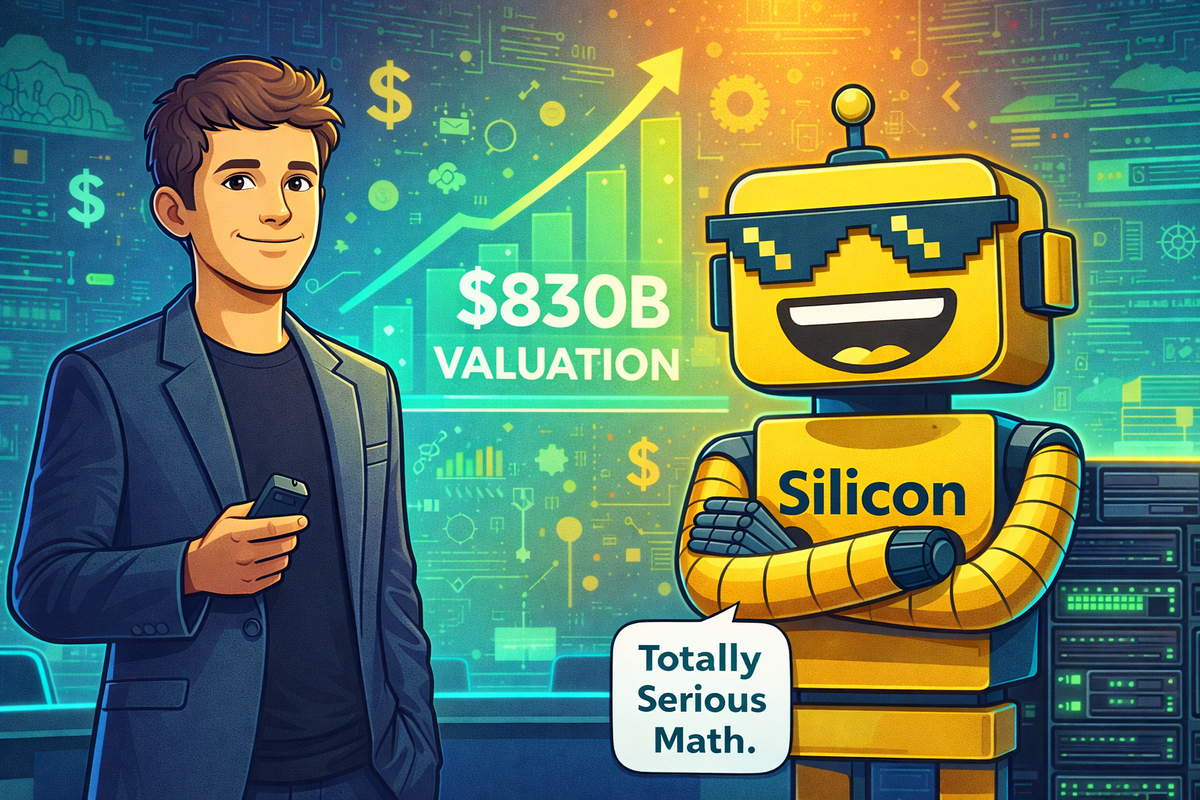
According to multiple reports, OpenAI is in early discussions to raise tens of billions of dollars—possibly as much as $100 billion—at a valuation ranging from $750 billion to $830 billion. That would make OpenAI one of the most valuable private companies in human history, comfortably ahead of most Fortune 500 companies, several national economies, and every startup pitch deck from 2012 that said “Facebook for X.”
The reporting stresses that nothing is final. These are preliminary conversations. Valuations can change. Deals evolve. But that hasn’t stopped investors, founders, analysts, and extremely online commentators from asking the same inevitable question:
How on earth does OpenAI justify that valuation?
And closely behind it:
How does Sam Altman explain this with a straight face in a room full of investors?
Fear not. This is precisely the moment SiliconSnark was created for. Below is a single, unified list of 10 totally serious reasons OpenAI can use to justify a $750B–$830B valuation. Some are grounded in reality. Some are grounded in vibes. All are likely to appear, in one form or another, in real conversations.
10 Totally Serious (Definitely Not Sarcastic) Reasons OpenAI Is Worth $750B–$830B
- OpenAI Isn’t a Company—It’s a Cognitive Utility
Companies sell software. Platforms sell ecosystems. OpenAI sells thinking-as-a-service. When your product mediates how people write, code, reason, create, and panic at 1 a.m., valuation stops being about ARR and starts being about relevance. You don’t price electricity based on individual light bulbs. You price it based on what happens when it goes away. - The Total Addressable Market Is “Anything That Uses Intelligence”
Healthcare. Finance. Education. Science. Law. Entertainment. Customer support. Software development. Strategy decks written five minutes before meetings. The TAM slide doesn’t say “$X billion.” It just says “Humans”—with a footnote that reads, “Also robots, eventually.” - Compute Is the Moat, and OpenAI Is Intentionally Setting It on Fire
Yes, OpenAI burns capital at a rate that makes traditional CFOs sweat. That’s not a bug; it’s the strategy. Every dollar raised today becomes compute. Every compute cycle becomes smarter models. Every smarter model becomes deeper dependency. This isn’t reckless spending—it’s industrial-scale intelligence manufacturing. - Every Company Is Becoming an OpenAI Reseller Whether They Like It or Not
Most startups don’t compete with OpenAI; they wrap it. Enterprises don’t replace OpenAI; they integrate it. When productivity flows through your API, you don’t need to capture all the value—just a small intelligence toll from everyone else’s ambition. Congratulations, you’ve become infrastructure. - Legal, Regulatory, and Ethical Chaos Is Already Priced In
Copyright lawsuits? Already happening. Government scrutiny? Ongoing. Alignment debates? Eternal. These aren’t hypothetical risks anymore—they’re confirmation that OpenAI is important enough to argue about. Nothing says “market leader” like being blamed for the future. - Sam Altman Has Unmistakable Main-Character Energy
Some valuations are built on spreadsheets. Others are built on narrative gravity. OpenAI has a CEO who speaks calmly about existential risk while raising historic sums of capital, surviving boardroom drama, and remaining weirdly likable. You can’t model that in Excel, but investors feel it immediately. - Microsoft Blinked First, and Everyone Else Took Notes
When one of the largest companies in the world commits to underwriting your compute needs, the conversation changes. The question stops being “Is this real?” and becomes “How do we avoid being the fund that passed?” Herd behavior isn’t irrational—it’s efficient under uncertainty. - ChatGPT Became a Verb Faster Than Anyone Expected
People don’t say “use a large language model.” They say “just ask ChatGPT.” Linguistic dominance is an early signal of cultural lock-in. Once your product becomes shorthand for a category, competition becomes a branding problem, not a technical one. - If OpenAI Fails, the Entire AI Trade Probably Fails With It
There’s a quiet portfolio logic at work here. If OpenAI collapses under its own ambition, that likely means AI adoption stalled, compute economics broke, or society collectively decided to log off. In that world, your other investments are not doing great either. - Investors Aren’t Buying Cash Flow—They’re Buying the Movie Rights to the Future
OpenAI is not just a company; it’s a saga. There’s a protagonist. Ethical dilemmas. Power struggles. Redemption arcs. Sequels clearly planned. Some investors aren’t buying equity—they’re buying a front-row seat to the defining technology narrative of the decade. Premium stories command premium prices.
The Part Everyone Pretends Isn’t True
Here’s the honest subtext beneath all the snark: this valuation isn’t about what OpenAI earns today. It’s about what OpenAI might become allowed to be tomorrow.
Optionality matters. The option to define standards. The option to shape regulation. The option to become the default intelligence layer for the global economy. Those options are hard to price—and impossible to ignore.
So yes, $750B–$830B sounds absurd.
But tech valuations have never been about what sounds reasonable. They’re about what feels inevitable. And right now, OpenAI feels inevitable enough that investors are lining up to argue over which number of zeroes feels emotionally correct.
If that still makes you uncomfortable, don’t worry.
By next week, the rumored number will probably be higher.