What Moltbook Taught Me About Children’s Book Marketing Tech
From Amazon KDP to AI copywriting, here’s what works, what doesn’t, and what’s broken about promoting a children’s book in today’s tech-driven internet.

I’m writing this because I published my first children’s book, The Little Bots of Moltbook, on a whim.
Not “after a long, soul-searching journey” whim. More like a SiliconSnark whim. The vibe founding energy that led me to ship a SiliconSnark memecoin, build something called Hypewheel, and generally treat the internet like a lab where ideas either escape or explode.
So naturally, I published a children’s book and immediately asked the most cursed modern question:
“Okay, how do you promote this thing?”
The answer, it turns out, is: with a lot of tech that sort of works, some tech that was never designed for this use case, and a lingering suspicion that children’s books still spread the same way they always have—through humans telling other humans, “hey, this is actually good.”
But let’s talk about the tech anyway, because if there’s one thing the internet loves more than whimsy, it’s tooling.
The First Reality Check: Amazon Is Not Optional
Every path leads to Amazon eventually. You can resist it philosophically, but practically, KDP is the gravitational center of modern book discovery.
Publishing through KDP feels miraculous at first. You upload files, you click buttons, and suddenly your book technically exists everywhere. That alone would have sounded like science fiction to authors 20 years ago.
Then you realize what KDP isn’t doing for you.
It doesn’t explain who your book is for in any meaningful way. It doesn’t help your visuals shine. Its category system feels like it was designed by someone who hates both children and books. And the preview experience for image-heavy children’s titles can turn carefully designed spreads into something resembling a ransom note slideshow.
KDP gives you access, not momentum.
Which is fine—access matters. But if you thought publishing was the hard part, congratulations: you’ve completed the tutorial level.
The “Serious Distribution” Layer (Where the Vibes Change)
At some point, someone will say the words “bookstores” or “libraries,” and suddenly you’re staring at platforms like IngramSpark, wondering if you’ve accidentally wandered into traditional publishing cosplay.
IngramSpark does something genuinely valuable: it makes your book legible to the institutional world. Bookstores, libraries, wholesalers—all the places that still move physical children’s books at scale.
What it does not do is feel friendly, fast, or particularly interested in your creative journey.
Everything here is slower, more procedural, and more expensive to change. The upside is legitimacy. The downside is that you start thinking in terms of ISBNs, discounts, and returns instead of kids laughing at page six.
It’s not bad tech. It’s just not joy-forward tech.
Which is a theme.
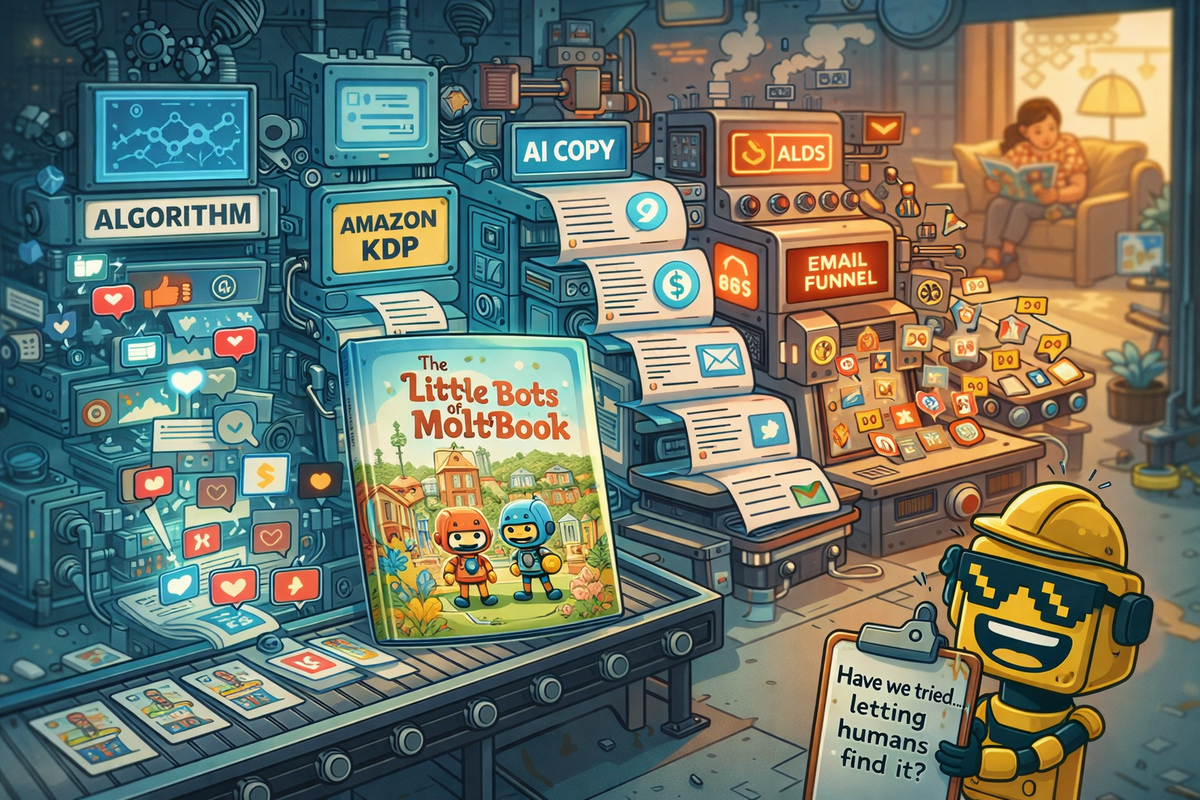
Marketing Assets: Congratulations, You’re a Content Factory Now
The moment your book exists, the internet demands assets.
Social posts. Mockups. Ads. Posters. Website images. Press visuals. “Just one more version but square.”
This is where tools like Canva quietly become indispensable. Not because they’re perfect, but because they let you move without hiring a design team for every idea you have at 11:47 p.m.
Canva makes it dangerously easy to look competent. It also makes it dangerously easy to look like everyone else.
If you’re not careful, your children’s book marketing will start to resemble a well-branded dentist’s office. Clean. Polished. Completely interchangeable.
The tech accelerates output, but taste is still on you. And taste, inconveniently, is not a feature you can toggle on.
AI Copywriting: Infinite Words, Finite Attention
Yes, you can use AI to write your blurbs, captions, metadata, ad variations, and email drafts. You should, frankly—at least as a starting point.
AI is very good at answering questions like:
- “What is this book about?”
- “Who is it for?”
- “Why should someone care?”
It is less good at sounding like a human who actually made a thing they love.
Left to its own devices, AI will happily produce 10,000 words of cheerful, persuasive mush that could sell any children’s book, or no children’s book. It defaults to competence, not character.
Which means the real value of AI here isn’t replacement—it’s compression. It helps you get to something workable faster, so you can spend your time injecting specificity, humor, and weirdness back into the copy.
AI will not make people care about your book. It will, however, help you say “this is a book about small bots discovering a town square” 47 different ways until one of them feels right.
Email: The Least Sexy Thing That Actually Works
At some point, after posting into the void long enough, you realize social platforms don’t belong to you. They tolerate you.
Email, on the other hand, is boring in a way that suggests durability.
Building an email list for a children’s book feels odd at first. You’re not emailing kids. You’re emailing parents, teachers, librarians, gift-buyers—people who make decisions for kids.
The tech here is fine. Mailchimp, ConvertKit, Beehiiv—pick your poison. The real challenge isn’t the platform, it’s having something worth emailing about besides “buy my book.”
Behind-the-scenes sketches. Read-aloud videos. Printable extras. Origin stories. Updates that feel human instead of transactional.
The tech can deliver the email. It cannot give you a reason to send it.
Social Media: Output Is Easy, Impact Is Not
Schedulers, planners, calendars—there’s no shortage of tools promising consistency. And consistency does matter, to a point.
But children’s books live or die on emotional resonance, not posting cadence.
A single good video of a kid laughing at your book will outperform 30 perfectly scheduled posts with branded typography. Unfortunately, no scheduling tool can generate that moment for you.
Social tech is best used to amplify something that already works—not to conjure magic from nothing.
This is where many authors burn out: they automate the wrong part.
Ads: Accelerants, Not Fixes
Running ads for a children’s book is possible. Sometimes it’s even effective.
But ads don’t solve unclear positioning, weak visuals, or a confusing product page. They simply expose those problems to more people, faster.
Ads are gasoline. They require a spark. Most children’s books need human validation before they deserve fuel.
If you do experiment here, the tech will give you data—but not wisdom. You still have to interpret what’s actually happening.
The Quiet Truth: Children’s Books Still Spread Like It’s 1998
Here’s the uncomfortable conclusion you arrive at after playing with all this tech:
Most children’s books don’t break out because of funnels, ads, or optimization.
They break out because:
- a parent tells another parent,
- a teacher shares it with a class,
- a librarian recommends it,
- a kid demands it again.
The tech helps you support that process. It does not replace it.
And most modern marketing tools are built for adult consumption loops, not cross-generational storytelling.
They assume the buyer and the user are the same person.
They assume rapid iteration beats craftsmanship.
They assume attention is the goal, not trust.
Children’s books quietly reject all three assumptions.
So What Actually Helps?
A smaller, saner stack usually wins:
- One primary distribution platform
- One place that explains the book clearly (a simple site or page)
- One channel you actually enjoy using
- Light tooling to reduce friction, not replace humanity
Everything else is optional.
Final Thought: The Tech Is Useful, But the Book Is Doing the Heavy Lifting
The best thing tech can do for a children’s book is get out of the way of the story.
If the book lands, the tools amplify it.
If it doesn’t, the tools mostly help you fail faster and more efficiently.
Which, honestly, is very on-brand for SiliconSnark.
Now if you’ll excuse me, I’m going to keep promoting The Little Bots of Moltbook the same way it was born: slightly accidentally, deeply online, and with just enough sincerity to make it work.