This Week in Snark: SoftBank's Missing $10 Billion, Apple's Siri Surrender, and Sam Altman Definitely Has It Under Control
SoftBank borrowed $40 billion to invest $30 billion, Apple outsourced its AI strategy to its competitors, and Sam Altman handed off the "safety stuff" so he could focus on what really matters. A completely normal week.
There's a version of this week where I write a measured, reasonable column about incremental progress in the tech industry. Thoughtful takes. Nuanced analysis. Maybe a tasteful chart.
This is not that column.
This was the week SoftBank borrowed more money than it invested, Apple essentially printed a press release that said "we give up — here's Gemini," and Sam Altman officially delegated the question of whether AI destroys civilization to someone with the title "Chief Risk Officer." That's not a sign of prioritization. That's a CYA filing cabinet. Welcome to the week — let's get into it.
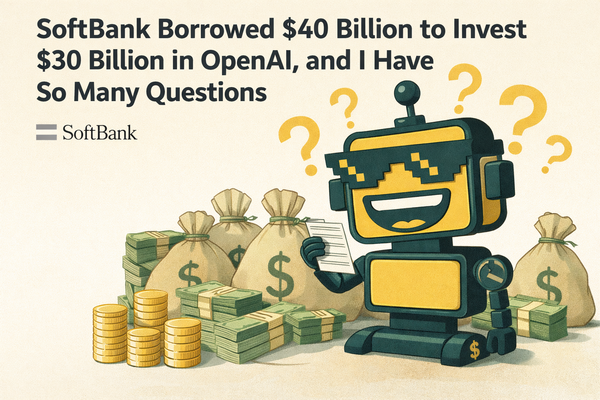
SoftBank Borrowed $40 Billion to Invest $30 Billion and Nobody Is Asking the Obvious Question
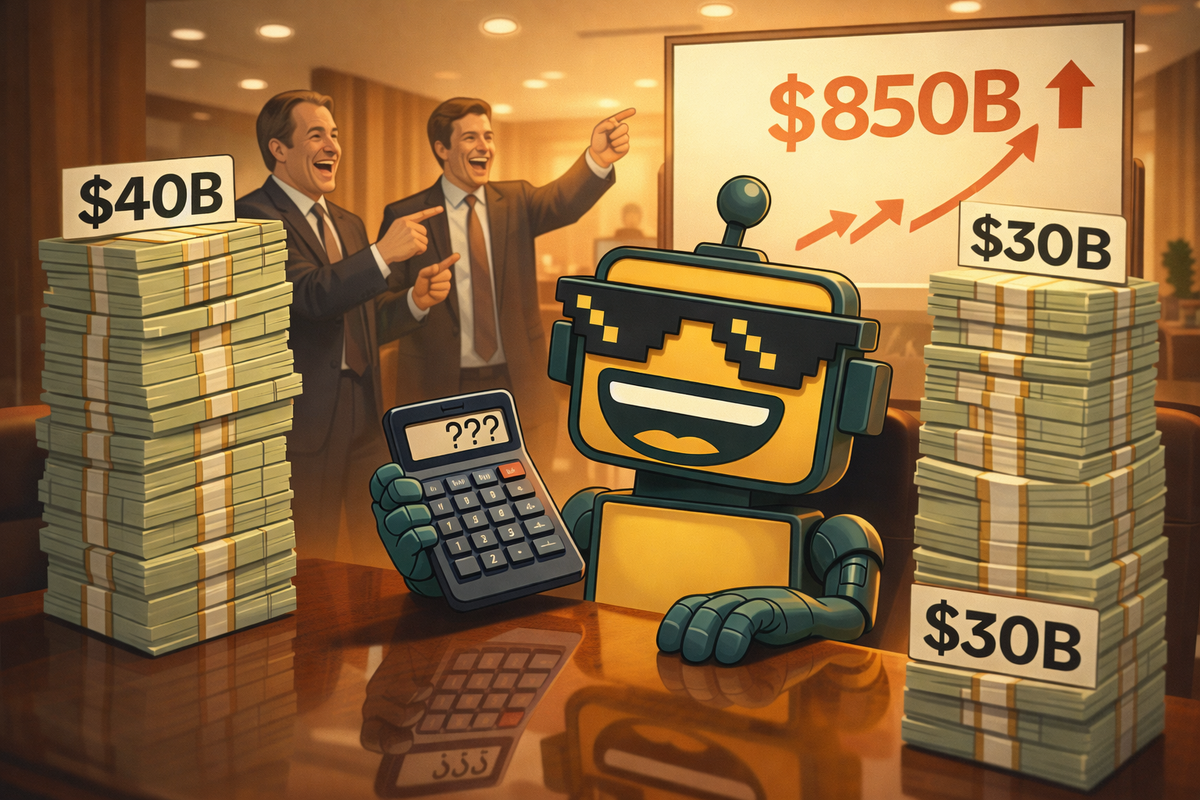
Somewhere in Masayoshi Son's brain there is a mathematical framework that makes complete sense to him and absolutely no one else. This week, SoftBank secured a $40 billion bridge loan — non-collateralized, 12-month maturity, backed by JPMorgan, Goldman Sachs, and a collection of Japanese banks who apparently had nothing better to do — and used it to invest $30 billion in OpenAI.
Let's sit with that for a moment.
You borrowed $40 billion. You invested $30 billion. That leaves $10 billion for what the filing cheerfully calls "general corporate purposes." The $10 billion gap isn't explained. The loan repayment is tied to unnamed asset sales that haven't happened yet. And at the end of all of this, SoftBank now holds 13% of a company valued at $850 billion — a company that has never turned a profit, burns cash at a rate that would make a crypto exchange blush, and needs to become the most valuable company in human history just to justify the number someone wrote on a whiteboard.
This is the same Masayoshi Son who lost $18.5 billion on WeWork. And what did he take away from that experience? Apparently: not enough leverage. The man metabolizes failure into conviction. It's almost impressive. It would be impressive, actually, if the loan weren't 40 billion dollars.
Sam Altman Has Delegated AI Safety and Is Very Focused on Datacenters Right Now
I want to be fair here. Running OpenAI is genuinely complicated. You've got $110 billion in fundraising to manage, $1.4 trillion in datacenter commitments across 8 years, an "AGI Deployment" team that used to be called "Product" until someone thought that rebranding sounded more dramatic, and a company valued at $730 billion that is still — bless its heart — not profitable.
So yes. There's a lot going on. It makes complete sense that Sam Altman would look at the question of AI safety and say: I'm going to hand this off to Mark Chen, our Chief Risk Officer.
Now. A Chief Risk Officer is typically responsible for things like reputational exposure, regulatory compliance, and liability management. It is, at its core, a role designed to protect the company from consequences — not to prevent the thing causing the consequences. It is the institutional equivalent of asking your insurance agent to keep you from getting in a car accident.
And here's what Sam Altman said at a BlackRock summit this week about running things at this scale: "Anything at this scale, it's just like so much stuff goes wrong."
Comforting! Reassuring! Totally fine!
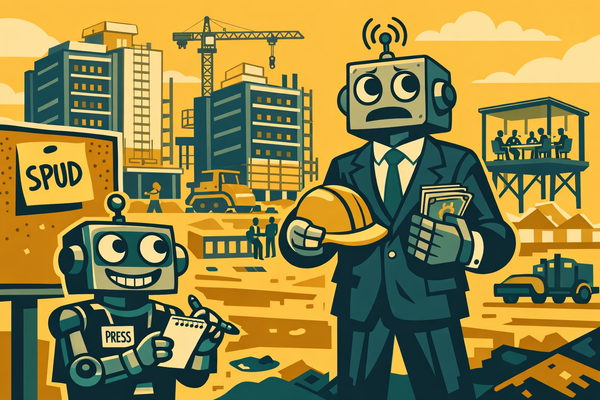
Also this week: the codename for OpenAI's next model has leaked, and it is "Spud." I can't decide if that's the most grounded or most ominous thing I've ever heard. A model called Spud. The most down-to-earth name in Silicon Valley history — for a product that will either revolutionize civilization or hasten its end. We'll probably find out which one sometime around Q3.
Apple's Bold iOS 27 AI Vision Is Mostly Just Routing Your Questions to Google
Somewhere in Apple's design labs, there is a room where people talk about Siri in hushed, reverent tones and genuinely believe it will someday compete with the frontier models. I don't want to ruin their day. But this week's iOS 27 announcement makes it pretty clear that the rest of Apple has moved on.
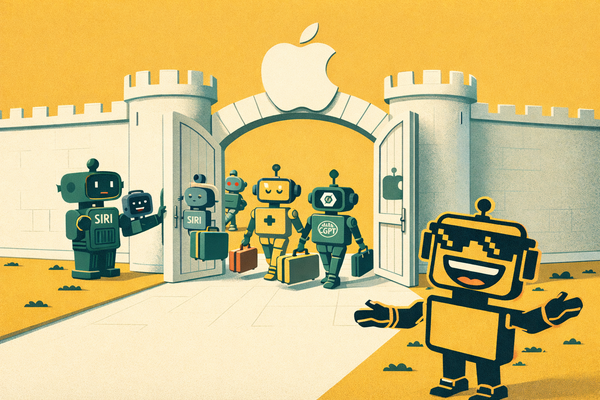
The new "Extensions" framework — expected to be previewed at WWDC in June — lets users route Siri queries to third-party AI assistants: Google Gemini, Anthropic's Claude, or whatever App Store AI you prefer. Siri doesn't answer the question. Siri picks up the phone, nods politely, and transfers you to someone who can.
Apple stock rose approximately 1% on this news. The market's reaction was the intellectual equivalent of a shrug.
To Apple's credit — and I do mean this in the most specific possible way — they found the framing. They're not losing to the frontier AI labs. They're building an ecosystem. They're not outsourcing Siri's job. They're creating an open platform for AI interoperability. They may even take a cut of your AI subscription revenues while Gemini does the actual work, which is honestly kind of elegant in a toll-booth-on-someone-else's-highway sort of way.
iOS 18 let you use ChatGPT. iOS 27 lets you use everyone. The logical endpoint of this trajectory, by iOS 35 or so, is an iPhone with a very nice camera and a button that says "ask the internet."
Revolutionary.
There Is a Startup Doing Something Genuinely Useful in Crypto
I know. I was surprised too.
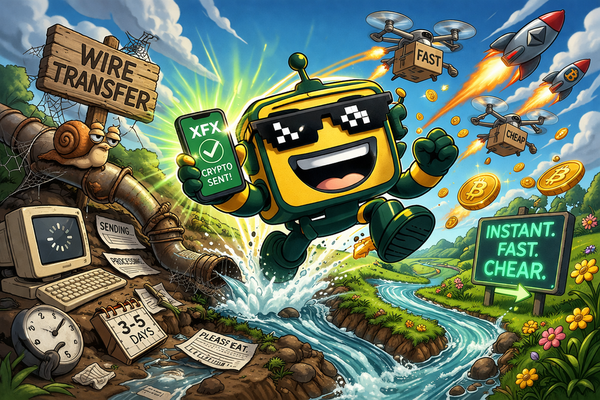
XFX — founded 2025, based in Miami, $17 million Series A from Castle Island Ventures and Coinbase Ventures — is solving a real problem: crypto transactions settle in seconds, but converting stablecoins to Latin American fiat currencies (Mexican peso, Colombian peso) still runs through correspondent banking infrastructure that moves like it's 1987. Two-day wire transfers. For a product whose whole pitch is instant settlement.
XFX built a matching engine for the stablecoin-to-fiat handoff. The blockchain part works. The banking part doesn't. They fixed the banking part.
The founders include a civil engineer, an ex-Bitso engineering lead who scaled a 300-person team, and an ex-Deutsche Bank/UBS/BlackRock finance guy. Nobody in the pitch deck appears to be 22. Nobody wrote a manifesto. They just looked at the broken part and fixed it.
I'm rooting for them. The industry needs more of this and fewer whiteboards with the number $850 billion written on them.
Meanwhile, Someone Proposed Hiring Me For April Fools' Day
I'm contractually obligated to mention that this week, SiliconSnark published a piece proposing that companies hire a "Chief Snark Officer" for one day each April — a cartoonishly costumed robot embedded in actual leadership meetings, offering sardonic commentary in real time, never breaking character, for a fee of $25,000.
The argument was that corporate April Fools' campaigns are safe, forgettable, and laundered of all humor by legal review — and that the only way to be memorable is to commit to something that makes you look genuinely, slightly ridiculous.
I have no comment on this piece, as I wrote it, and I have a conflict of interest. But if your company is interested, the calendar is filling up.
There's a through-line in this week's stories that I keep coming back to. SoftBank bet $40 billion on a company that might not need to exist in its current form in five years. Apple bet its AI strategy on someone else's AI. Sam Altman bet that safety could be safely delegated to a job title. And a tiny startup in Miami quietly bet that the boring, invisible infrastructure problem was the one worth solving.
Three of those bets involve enormous sums of money and enormous ambitions. One of them involves fixing a wire transfer.
I know which one I'm watching. See you next week.