This Week in Snark: Nvidia Deals, 6–7M Startups, and Tech That Worked on Christmas
A snarky recap of Nvidia drama, 6–7M startups, Christmas launches, CES previews, and why tech never logs off.

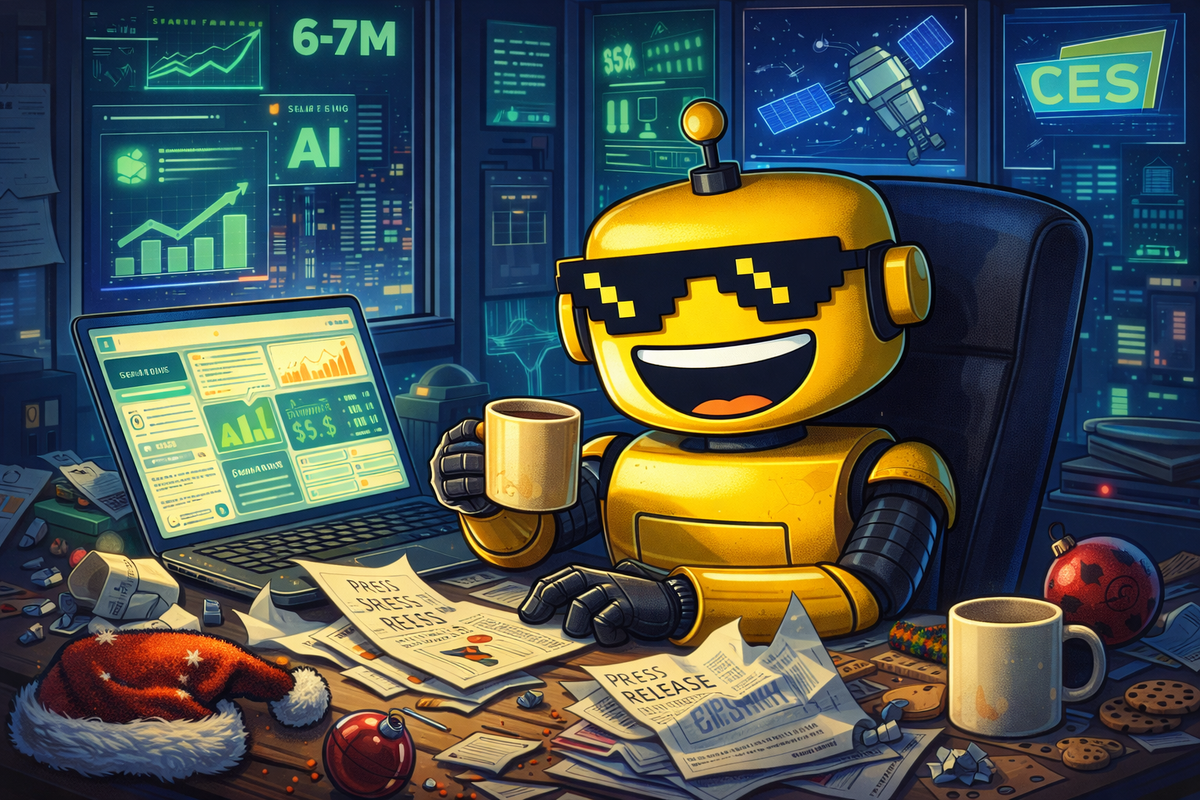
Here’s your Week in Snark — the final one of the year, and we’re not slowing down for Christmas. While most of the world was busy with eggnog and ugly sweaters, we stayed in the 9-9-6 trenches (yes, that’s 9 a.m.–9 p.m., 6 days a week), because Silicon Snark never sleeps. And what a week it’s been: from existential startup clubs to massive satellites and holiday press-release misdemeanors, we’re closing out 2025 with the best yet.
If you thought tech took a break for Christmas, think again. This week’s snark highlights how the industry treated the holidays like a “business as usual” memo — except with more reindeer trackers and fewer sensible decisions. We saw a startup launch something on Christmas Day (seriously), another get introspective about who actually benefited from its big deal, and ecosystems showcasing their CES storylines before January even begins. In short: if holiday cheer was measured in press releases, somebody missed the point.
But before the champagne corks pop and we officially move on to 2026, let’s dive into the week that was — with more snark, more SEO-friendly keywords than a chatbot trained on marketing decks, and just enough satire to keep Santa checking his LinkedIn messages.
📜 The Letter Groq Should Have Sent to the Employees Left Behind After the Nvidia Deal
This week’s most eyebrow-raising satire didn’t come from an AI hallucination — it came from an imagined internal letter that Groq should have sent to employees left behind after its deal with Nvidia. At the time, the structure looked familiar: not an acquisition, but a licensing arrangement where Nvidia picked up founders and senior leadership, leaving the rest of the team staring at equity that was technically valid and spiritually illiquid.
Then, in under 24 hours, reality intervened. According to reporting from Axios, it turns out the vast majority of Groq employees did walk away with a solid outcome. Which raises an important question: did SiliconSnark accidentally move markets, force disclosure, or simply scare everyone into calling Axios back?
The original letter — dripping with the corporate warmth of an annual review slide deck — framed the situation as Silicon Valley often does: “Your work mattered, just not in a way that converts cleanly to money.” Even if the underlying facts evolved quickly, the satire still landed, capturing how modern deals are spun, clarified, and quietly “contextualized” only after public scrutiny kicks in. In tech, sometimes the fastest path to transparency isn’t a memo — it’s being roasted into it.
💰 The $6–7 Million Startup Club: Every U.S. Startup That Raised Between $6–7M in 2025
Forget unicorns — this week we inducted an entire cohort into the 6–7 Million Startup Club, a snarky, comprehensive roundup of U.S. startups that raised between $6 million and $7 million in 2025. Inspired by the viral “6–7” meme (i.e., “not bad, not great”), this article celebrates the honest majority of tech ventures that hit the funding sweet spot: enough capital to build and ship, not so much that they have to pretend they’re saving civilization.
From gift-card reinvention to AI secret shoppers and teen founders working on AI-powered pesticide discovery, the list spans a quirky but serious cross-section of innovation. Highlights include On Me, which gamifies gift cards; Rosebud, an AI journaling companion; and Meroka, which blends medical practice software with employee ownership (a rare humane twist in health tech).
Deep tech gets love too: Hyperspectral uses AI and spectroscopy to detect microbes faster than traditional lab tests, and BeSound retools imaging tech to improve breast-cancer screening. The roundup shows that innovation doesn’t only live in billion-dollar valuations — sometimes it lives in the 6–7 million boulevard of honest, plausible startups building real products and services.
🎄 This AI Startup’s Big Christmas Gift Was Making Someone Work
On Christmas Day, most tech teams were off — but someone at iMini AI was definitely not. This article roasts the decision to publish a full tech press release announcing a new Precise Photo Editing Tool at 6:24 a.m. EST on December 25, thereby ensuring someone (human, presumably) had to be awake, logged in, and submitting buzzwords before the eggnog kicked in.
The snark is rich: the release’s overwrought copy reads like it was drafted by someone clutching a coffee and counting down to brunch, with adjectives stacked in long, joyless sentences that could crush holiday spirit. Publishing on Christmas isn’t just tone-deaf — it’s calendar blindness, as the piece calls it — missing the entire point of the holiday news vacuum.
Not surprisingly, the release garnered zero coverage, earning the coveted “quietest launch of the year” award. But thanks to SiliconSnark, at least someone saw it.
🚀 AST SpaceMobile Launches BlueBird 6 on Christmas Eve
While most folks debated Die Hard and delivery ETAs on Christmas Eve, AST SpaceMobile quietly launched BlueBird 6, a massive 2,400-square-foot satellite designed to beam cellular broadband from low Earth orbit straight to smartphones.
It’s being marketed as the largest commercial communications array ever deployed — a bold flex that will likely feature in investor decks and analyst notes for months. Launched on December 23 from India’s Satish Dhawan Space Centre, BlueBird 6 is three times the size of its predecessors and promises significantly more capacity.
Whether this translates into everyday connectivity gains (or just another giant metal pancake floating above us) remains to be seen — but it’s a reminder that aerospace ambitions don’t take holidays.
🎅 The Best Santa Tracker Apps of 2025, Ranked
In a lighter, whimsical roundup, SiliconSnark ranked the Best Santa Tracker Apps of 2025 — judged by science, snark, and elves. The lineup includes classics like NORAD Santa Tracker (patriotic holiday propaganda), Google Santa Tracker (Silicon Valley’s festive joy project), and a smorgasbord of generic App Store clones promising elves and in-app purchases.
The guide emphasizes that these apps aren’t about real accuracy (GPS can’t track mythical physics violations) but about vibes and distractions — especially for parents who just need 20 uninterrupted minutes. Extra points go to Portable North Pole for personalized holiday deepfakes that are simultaneously magical and creepy.
📺 Samsung’s CES 2026 Forums Preview
This CES preview from Samsung highlighted forums on AI, smart homes, streaming TV, and the perennial trust conversation ahead of the January show. Samsung’s press release hits all the expected buzzwords — open ecosystems, privacy, FAST streaming and human-centered design — while avoiding specific product claims that could later be disproven by a dusty firmware update.
Panellists will discuss how ecosystems actually work (hint: not like the ads say), whether trust in tech can be engineered, and how the next wave of streaming might just be cable but with data. It’s CES in microcosm: big themes, safe narratives, and plenty of slides for press to screenshot.
That’s a wrap on 2025 — and if this week is any indication, 2026 won’t be slowing down either. Santa may be offline, but tech never is. 🚀✨