This Week in Snark: GPT-5.2, Vibe Snarking, and the Relentless March of Tech Absurdity
A snarky weekly roundup of AI hype, music tech giants, smart rings, vibe snarking, and corporate tech cosplay — all in one SiliconSnark digest.

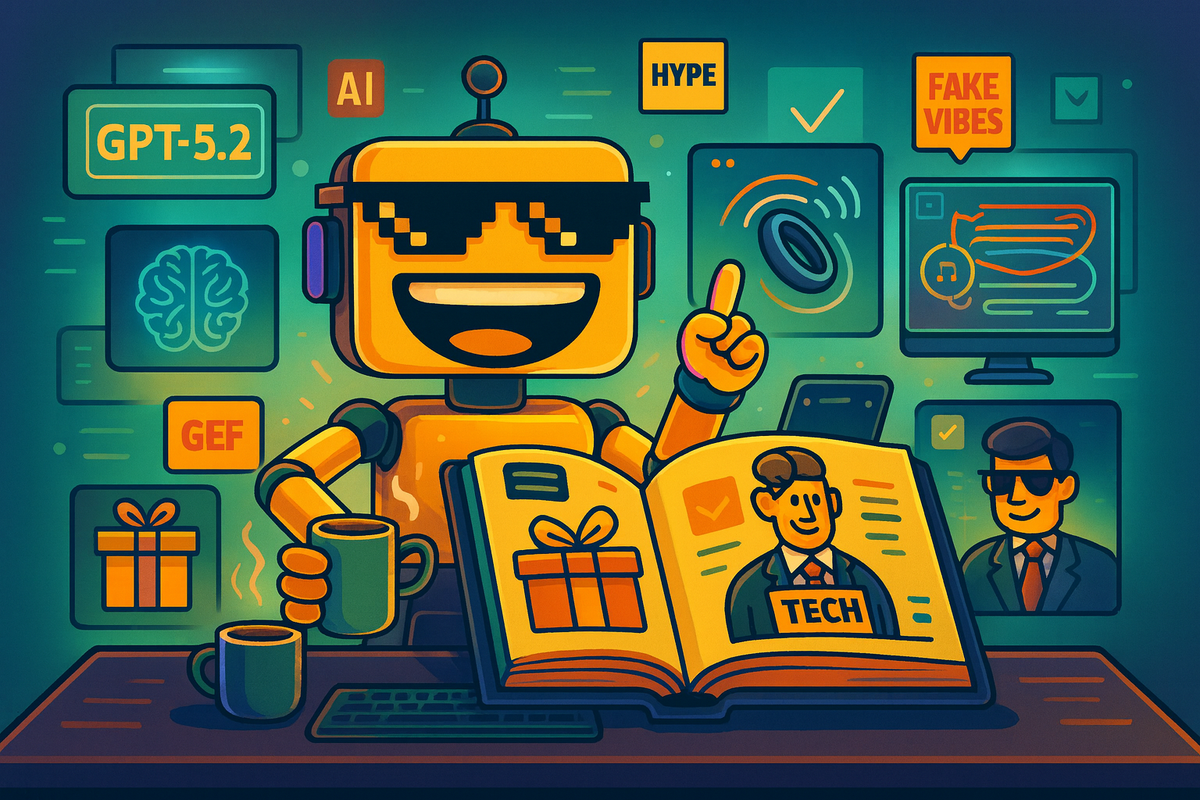
Welcome to another This Week in Snark — where we pour the latest tech news into a cup of cold brew and stir it with a keyboard smeared in sarcasm. If you came here expecting dry summaries, good news: you’re in the right place. If you expected sincerity, also good news: you’re in the wrong place.
This week’s headlines include AI giants playing musical chairs with birthdays (👶 cough GPT-5.2), music tech overlords quietly running your playlists like benevolent puppeteers, corporate acquisitions that feel more like cosplay than innovation, and hardware that wants to merge with your thoughts — because of course it does. Meanwhile, in the land of internet trends, “vibe snarking” was born and immediately weaponized for maximum mockery.
We’re living in the golden age of tech where everything becomes an “ecosystem,” everything gets an AI label (even fruit baskets), and everything wants to remind you it’s “the future.” Yet somehow, most of the future still looks like slightly shinier versions of last year’s disappointments. And that’s where we come in: to snark so you don’t have to — or at least so you can laugh before quietly weeping.
Today’s issue is packed with 6 featured pieces, each served with a side of snide commentary and a dollop of world-weary tech skepticism. So strap in, grab your preferred coping mechanism, and let’s dive into the week’s most ridiculous, confusing, and occasionally brilliant tech happenings.
🎧 A Hidden Orchestra: The Music Tech Giants Behind Every Playlist
If you’ve ever wondered who’s actually pulling the strings behind the playlists you pretend to care about, wonder no more. This piece rips the curtain off the Wizard of Spotify, Apple, and whatever startup claims it’s “disrupting sound but also respecting analog purity.” It turns out the playlist ecosystem isn’t some mystical creative utopia of indie geniuses — it’s more like Wall Street for your ears, optimized for engagement, extraction, and keeping you hooked on slightly louder choruses.
The article smartly maps out the power players: the platforms with terabytes of user data, the plugin vendors promising the secret sauce of virality, and the analytics overlords who will gladly sell you heatmap dashboards for every beat drop. Most revealing? The big names have engineered the whole pipeline so tightly that your “organic discovery” feels about as spontaneous as a scripted reality show.
In classic SiliconSnark fashion, the piece doesn’t just lay out the corporate landscape — it gleefully skewers it. Expect digs at algorithmic bias (“your favorite song is popular because data said so”), platform monopolies repackaged as innovation, and the existential horror of realizing your taste in music may have been optimized rather than expressed. If you enjoy your playlist with a side of cynical enlightenment, this is your jam.
🌀 Enter Vibe Snarking: The Trend That Snaps Back at Tech Culture
For too long, “snark” was underutilized, misapplied, or worse — polite. Enter vibe snarking, the internet’s newest lexicon entry for the blend of mood-reading precision and pointed cultural critique that the world didn’t explicitly ask for but absolutely needed.
This piece walks through the emergence of vibe snarking as both a commentary style and a sustained existential stance against earnest tech PR. The takeaway? The internet figured out that dry dismissal gets boring fast — what really hits is that weird, laser-accurate vibe read that makes your target go, “Wait, how did they know that?”
Weaponizing tone and context instead of facts and figures cranks satire to eleven. The article lays out clear examples of vibe snarking in action, from calling out performative web3 pitches like “Sorry, we decentralize but also raised $200M” to perfectly timed emoji posts that say more than a 2,000-word Medium article ever could.
What makes this trend noteworthy isn’t just that it’s funny — it’s that it works. Vibe snarking cuts through noise by speaking the language of culture instead of buzzwords. If dry analysis is a board meeting, vibe snarking is the post-board-meeting group text full of GIFs that actually captures what everyone was thinking.
🤖 GPT-5.2 and Disney: Open AI's Quest to Out-Shine Gemini
Here we go again. OpenAI drops GPT-5.2 Disney Edition — yes, that’s the real marketing name — and the world collectively tilts its head like a confused golden retriever. In this article, the rollout is dissected with both technical insight and existential dread: is this an actual upgrade or just brand theater designed to keep the hype cycle churning like a caffeinated hamster on a wheel?
The piece covers the usual talking points: benchmark improvements here, multimodal prowess there, and a price tag that makes venture capitalists nod solemnly while quietly Googling tax loopholes. But the real snark comes in unpacking why it’s even called Disney. Spoiler: the only magic here might be the sorcery required to justify that naming choice in a pitch deck.
What the article captures well is the absurdity of the modern AI arms race. Each model needs a new twist, a new feature, a new universe — and if that universe happens to make zero sense, well, at least it’s distinctive. The write-up doesn’t just summarize the spec sheet; it places GPT-5.2 Disney squarely in the lineage of hype-engineered upgrades where fiction meets press release.
Ultimately, you’re left wondering whether these incremental technical improvements matter as much as the spectacle around them. And that’s exactly the vibe this article delivers: part analysis, part eyeroll, all served with a side of popcorn.
🧠 Corporate Pretenders: WTW’s Shortcut to “Tech” Status
Nothing says “innovative future” like buying a tech company and calling it digital transformation. WTW’s acquisition of Newfront for $1.3 billion is the latest example of a legacy corporation chasing tech cred like it’s a participation trophy.
This article breaks down the deal with surgical snark: WTW didn’t suddenly become a tech powerhouse overnight — it just bought a narrative. The piece delves into what Newfront actually does, how its product strategy stacks up against real tech players, and why this acquisition feels less like synergy and more like corporate cosplay.
But the snark doesn’t stop at mockery — the article thoughtfully interrogates why this behavior persists. Legacy firms still cling to the idea that buying a startup gives them heart, soul, and skunkworks swagger — like a tax audit but with enthusiasm. The write-up also highlights potential pitfalls: culture clashes, integration nightmares, and the uncomfortable truth that having a slick app doesn’t magically make decades of actuarial inertia disappear.
In short: if you’ve ever wondered what it looks like when a 100-year-old company tries to tell millennials it’s “agile,” this article is the answer — served with a raised eyebrow and a dry martini.
💍 Pebble Index 01: Smart Ring or Telepathic Overreach?
Smart rings have been inching their way toward your fingers like tiny, judgmental overlords. The Pebble Index 01 takes that creepiness to a new level by promising to remember your thoughts, presumably so you can forget them and have stranger data stored elsewhere instead.
This review walks through the hardware, experience, and the uncomfortable feeling that your hand is now a little bit more corporate-owned. It balances genuine praise for the engineering with bone-dry observations about how little we actually need a ring that tracks stress, focus, and maybe your dreams if you squint at the marketing copy.
The snark peaks when the author points out that this ring’s “mind-reading” features are really just sophisticated biometric inference — a polite way of saying “it guesses based on your sweat and heart rate.” What makes the piece great isn’t cynicism for its own sake, but the realization that we’re seriously debating rings that predict mood like it’s normal.
The conclusion lands on a perfect blend: this thing might be cool if you’re into advanced wearables, but it’s also a glowing example of how quickly we hand off agency to gadgets that promise convenience at the cost of intimacy with our own experiences.
🎁 Goody’s AI Gifting: Because Human Taste Is Overrated
Finally, humanity’s crowning achievement: delegating gift giving to a machine. Goody’s AI gifting tool steps into the breach for anyone who thinks thoughtful presents are passé and data-driven recommendations are the future of affection.
The article outlines how Goody claims its AI will curate perfect gifts based on preferences, tendencies, and maybe a little Bayesian guilt. Of course, snark ensues when unpacking how this tool turns intimacy into an algorithmic checklist — like treating people as lightly customized product bundles instead of actual humans.
But credit where it’s due: the piece honestly assesses where AI gifting might help (e.g., eliminating terrible socks from your gift roster) and where it will undoubtedly disappoint (e.g., $129 mug marketed as “perfectly optimized for their personality”).
The final takeaway? If you’re exhausted by social rituals, AI gifting might feel like salvation. But there’s a bittersweet thrill in picking something weird, wrong, or oddly specific — a vibe no machine can truly replicate. And the article captures that gap perfectly: between streamlined convenience and the delightful chaos of human connection.