This Week in Snark: Age Gates, AI Newsrooms, 300,000 Litter Boxes, and Other Signs of Progress
This week in tech snark: Roblox safety theater, AI in the newsroom, Meta’s metaverse flop, and why simplicity keeps beating hype.


If this week in tech had a unifying theme, it would be this: everyone is trying very hard to look serious while doing things that are, on closer inspection, extremely funny. Not intentionally funny, of course. That’s the best part. The tech industry’s most earnest attempts to solve real problems keep producing outcomes that feel like performance art, and SiliconSnark is, once again, here to document the spectacle.
We saw platforms roll out “safety” features that immediately spawned black markets. We watched AI march confidently into newsrooms while journalists wondered whether this was the end of their profession or the first time management had actually invested in tools that work. We learned that you can, in fact, sell a litter box for the price of a luxury car if you wrap it in enough AI language. And we were reminded that if you spend enough billions loudly enough, eventually people will politely stop asking what you were trying to accomplish.
At the same time, the week delivered a masterclass in contrasts. Some companies overexplained themselves into oblivion, while others issued minimalist announcements so short they felt like subtle insults to everyone else still writing 1,200-word blog posts about “journeys” and “visions.” It was a week where restraint looked smarter than ambition, simplicity outperformed spectacle, and silence somehow communicated more confidence than a room full of executives with microphones.
Here’s what SiliconSnark covered this week, and why it all fits together a little too well.
A Deep Dive Into Roblox’s Age Verification Fiasco
Roblox’s latest attempt at age verification arrived with all the seriousness of a platform that has been under sustained scrutiny for how it handles kids, safety, and monetization. The promise was simple: better controls, more protection, and a clearer separation between children and adults. The execution, however, followed a familiar Silicon Valley pattern of creating new problems faster than it solved old ones.
The rollout immediately sparked confusion among users, parents, and developers alike. Face scans, verification flows that felt both invasive and flimsy, and a system that seemed to misunderstand the difference between friction and security combined into a perfect storm. Almost instantly, reports began circulating that verified accounts were being sold, turning the entire safety mechanism into a tradable commodity. Nothing says “robust child protection” quite like a gray market.
What makes the situation especially snark-worthy is that none of this feels surprising if you’ve paid attention to Roblox’s past. The platform’s public messaging leans heavily on trust and community, while its underlying incentives consistently favor growth, engagement, and spending. Age verification becomes less about protecting users and more about protecting the company from regulators, even if the result is a system that looks secure mostly from a distance.
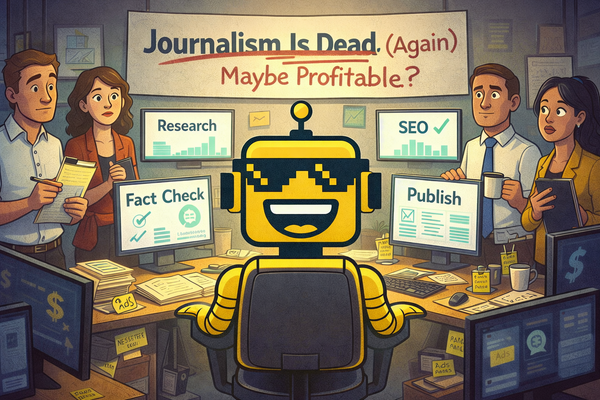
AI Just Moved Into the Newsroom. Is This the End of Journalism—or Its Only Hope?
Few topics trigger more immediate existential dread than AI entering journalism, and this week’s coverage leaned fully into that tension. On one hand, the idea of machines writing, researching, or assisting with news feels like a betrayal of everything the profession stands for. On the other, many newsrooms are already stretched thin, underfunded, and expected to do more with less every quarter.
The article explores how AI tools are being framed as assistants rather than replacements, quietly handling research, summarization, and background work so journalists can focus on reporting. In theory, this is the optimistic version of automation, where technology amplifies human judgment instead of erasing it. In practice, it depends entirely on whether executives view AI as a way to empower reporters or an excuse to reduce headcount.
What makes this moment particularly fascinating is that journalism might be one of the rare fields where AI could actually help restore quality if used responsibly. Better reporting could lead to more engaged audiences, more sustainable revenue models, and fewer listicles pretending to be news. Or it could accelerate the race to the bottom. The technology itself doesn’t decide. Management does, which is somehow both comforting and deeply alarming.
What a 300,000-Unit Litter Box Teaches Us About AI and Simplicity
Every once in a while, a product becomes a parable, and this week’s unlikely star was a very expensive, very successful litter box. Despite lacking flashy AI features, it managed to sell hundreds of thousands of units by doing something radical: solving a real problem simply and reliably.
The contrast with much of the AI market couldn’t be sharper. While startups race to add intelligence to everything from toothbrushes to toasters, this product succeeded by focusing on user experience, reliability, and trust. It didn’t promise to “learn” your cat. It just worked, consistently, without requiring a software update or a philosophical debate about the future of pet ownership.
The lesson here is uncomfortable for AI evangelists but obvious to users. Intelligence is only valuable when it makes things easier, not more complicated. The litter box didn’t need a roadmap, a manifesto, or a demo day. It needed to do the one thing it promised, and do it better than the alternatives. That, it turns out, is still a viable strategy.
Radius Tech Debuts, Making the Case That ChatGPT Isn’t a Strategy Team
Radius Tech entered the conversation with a refreshingly blunt message: generative AI is powerful, but it does not replace actual strategy. In a moment when many organizations are quietly hoping a subscription can stand in for thinking, that stance feels almost rebellious.
The article breaks down how AI excels at synthesis, speed, and surface-level analysis, but struggles with context, judgment, and long-term decision-making. Treating ChatGPT as a strategy team doesn’t just produce mediocre outcomes; it creates a false sense of confidence that can be worse than not knowing what you’re doing at all.
What makes this launch notable is its timing. As companies rush to signal AI adoption to boards and investors, Radius Tech is betting there’s still demand for human insight layered with technology, not replaced by it. It’s a subtle critique of the current hype cycle, and one that will age either very well or very awkwardly depending on how the next year unfolds.
The Rise and Fall of Reality Labs: How Meta Spent Billions to Invent a Metaverse Nobody Wanted
Reality Labs remains one of the most impressive examples of commitment without traction in modern tech history. Billions were spent, headcount ballooned, and executives spoke with total confidence about a future that stubbornly refused to arrive.
The piece traces how Meta’s metaverse ambitions collided with basic user preferences. Headsets were bulky, experiences were underwhelming, and the value proposition never quite materialized. While leadership framed the effort as visionary, users mostly saw it as optional at best and irrelevant at worst.
What lingers is the question of whether Reality Labs was ahead of its time or simply misaligned with reality itself. The answer may be both, but the lesson is clear: belief does not create demand. Even infinite resources can’t force people to want something they didn’t ask for.
Apple and Google’s Minimalist AI Announcement Is a Flex
While everyone else was publishing essays disguised as press releases, Apple and Google opted for near silence. Their joint AI announcement was short, restrained, and conspicuously lacking in grand claims. And that restraint was the message.
In an industry addicted to overpromising, minimalism reads as confidence. Apple and Google didn’t need to explain why their AI mattered. They assumed you already knew. The subtext was clear: when you control platforms, distribution, and ecosystems, you don’t need hype. You need timing.
The contrast with the rest of the market couldn’t be sharper. While startups scramble to justify relevance, incumbents remind everyone that power often speaks most clearly when it doesn’t speak much at all.
Taken together, this week’s stories form a familiar pattern. Technology keeps advancing, but judgment remains optional. The most successful ideas are still the ones that respect users, solve real problems, and resist the urge to explain themselves into oblivion. The rest? They give us plenty to snark about next week.