The $6–7 Million Startup Club: Every U.S. Startup That Raised Between $6–7M in 2025
A snarky deep dive into every U.S. startup that raised $6–7 million in 2025, inspired by the viral 6–7 meme and tech’s most honest funding tier.

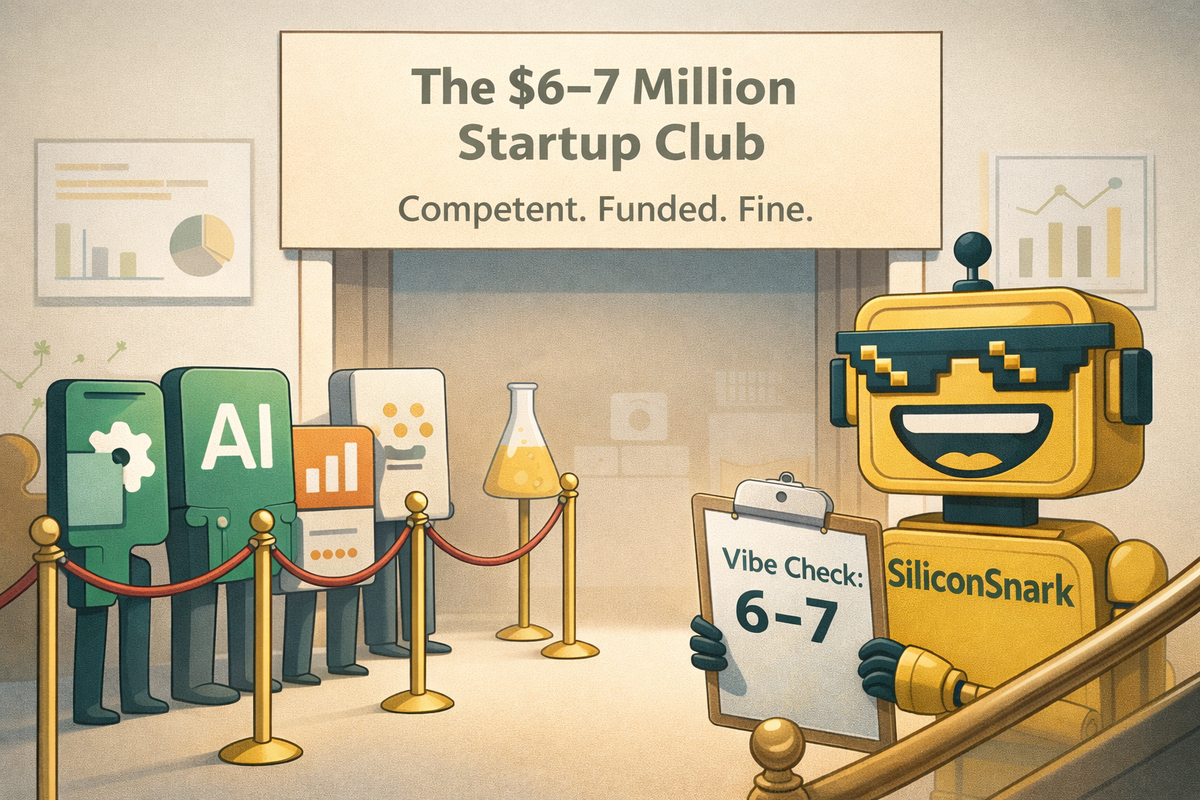
I thought Boxing Day—one of the slowest news days of the year, especially since it falls on a Friday this time around—was the perfect moment to honor the internet’s most quietly devastating meme: “6–7.” Not great. Not terrible. Functional. Funded. Spiritually unremarkable.
Thus was born The $6–7 Million Startup Club, a tribute to the companies that didn’t raise a seed round so small it screams bootstrap cope, and didn’t raise a mega-round so large it demands performative optimism. These startups hit the exact 6–7 sweet spot: enough capital to hire, ship, and announce partnerships, but not enough to pretend they’re rewriting civilization.
In a year dominated by billion-dollar valuations, AI hype cycles, and decks that promise category creation, the 6–7 club represents the most honest cohort in tech. These are the companies that followed the playbook, cleared the bar, impressed investors just enough, and earned a collective shrug of respect. Competent. Plausible. Investable. 6–7.
And for anyone wondering why 6–7 deserves this level of ceremony: the phrase comes from the internet’s recent obsession with rating everything—products, vibes, experiences, startups—on an informal ten-point scale. Over time, people realized most modern things don’t fail spectacularly or succeed memorably. They simply exist. “6–7” became shorthand for that limbo state: technically good, broadly acceptable, and completely devoid of magic. It’s the rating you give something that checks the boxes, follows the template, and moves on. In tech especially, where enthusiasm is often manufactured and hype is mandatory, 6–7 is a quietly brutal verdict—calm, reasonable, and impossible to argue with. Which is why it feels like the most honest way to talk about this particular slice of the startup ecosystem.
On Me – Reinventing Gift Cards ($6M Seed)
On Me is a digital gift card startup that apparently decided the world has suffered long enough with boring plastic gift cards for big box stores. They raised $6 million in seed funding to prove that gifting can be more personal and eco-friendly[1][2]. Founded by ex-Googlers with a penchant for mobile apps, On Me lets you send friends digital gift cards based on interests – think “outdoorsy”, “foodie”, or “coffee addict” – rather than locking them into a single retailer. Because who wouldn’t want a gift card that says “I know you love tennis, go buy some Wilson balls or whatever” instead of yet another Starbucks card? On Me even lets you attach video messages and GIFs to the gift (so you can personalize that “sorry I forgot your birthday” e-card)[3]. Snark aside, the platform offers 72 categories of gifts from camping to concerts, and it touts itself as a greener alternative to the billions of plastic gift cards that usually end up in landfills[2]. It’s like the love child of Hallmark and Venmo, and with this new $6M infusion (led by NFX and friends), On Me is out to prove that even gift cards can join the digital age with a bit of flexibility and charm. Hey, if it helps us avoid the dreaded unused gift card drawer, more power to them.
Meadow AI – Big Brother for Retail? ($6M Total Funding)
Seattle-based Meadow AI emerged from stealth with a total of $6 million in funding (including a fresh $4.5M seed round) to bring an AI-powered “secret shopper” to physical retailers[4]. Yes, you heard that right – this startup wants to automate those undercover audits that tell your local coffee chain if the barista smiled appropriately while spelling your name wrong. Meadow’s multimodal AI platform hooks into everything: security cameras, point-of-sale systems, inventory logs, even audio of employee-customer interactions[5]. It’s like putting a super intelligent mall cop in every store, except it never needs a donut break. The AI analyzes all this to continuously evaluate customer experience and staff performance, then whispers recommendations to managers on how to boost revenue or cut labor costs. Depending on your perspective, that’s either dystopian workplace surveillance or the secret sauce to better service. Meadow insists it’s the latter, claiming competitors only tackle narrow problems while their system is a comprehensive ops overlord[6]. Snark aside, co-founder Max Jai Sim (who sold his last startup to Compass) was inspired by his family’s restaurant biz struggles and figured AI could step in where tech had ignored mom-and-pop shops[7]. With this $6M, Meadow is targeting mid-sized restaurant and retail chains (10–300 stores) – basically those big enough to have headaches but not enough budget for bespoke Silicon Valley solutions[8]. If it works, next time you complain about slow service, don’t be surprised if an AI agent is already drafting an action item for the manager. At least someone’s watching, right?
Bindwell – Teen Chemists Take on Big Ag ($6M Seed)
Leave it to two teenagers to waltz into Paul Graham’s yard and walk out with a startup idea and his money. Bindwell is the brainchild of Tyler Rose (18) and Navvye Anand (19), who decided to reinvent how we discover pesticides using AI. They raised $6 million in a seed round co-led by General Catalyst and A Capital – and yes, Y Combinator’s Paul Graham was so impressed he chipped in personally[9]. These prodigies realized that while agrochemical giants are still tweaking 40-year-old formulas to fight evolving super-pests, AI could potentially cook up brand new, more targeted molecules from scratch[10][11]. Bindwell started as a research project when the founders were literally in high school, applying drug-discovery AI techniques to agriculture. Instead of selling their tech to Big Ag (who apparently weren’t interested – shocker), they’re designing new pesticide compounds in-house and plan to license the IP. Basically, they’re aiming to break a vicious cycle: farmers dump on more chemicals as bugs get resistant, pests then get even more resistant, and the environment takes a hit[12]. Bindwell’s AI models (based on binding affinity predictions, if you must know) try to find novel molecules that can outsmart those pesky pests without requiring a chemical arms race[13]. It’s an audacious goal – modernize a legacy industry that still sometimes acts like it’s 1950 – but if two Gen-Z founders just out of their teens can pull it off, they’ll not only save crops but also give new meaning to “youthful disruption.” In a field full of older players, Bindwell might be the fresh blood (or sap) the industry needs[14].
Rosebud – An AI That Reads Your Diary ($6M Seed)
Ever wish your diary could talk back and give you life advice? Rosebud is on it. This startup raised $6 million to build an interactive AI journaling app that’s basically a cross between a diary and a therapist, minus the hourly fees[15]. Rosebud’s AI analyzes your journal entries (yes, all those late-night ramblings and existential dread you type out) and then offers insights, questions, and gentle nudges for self-reflection[16]. They pitch it as an “AI mentor for personal growth,” helping you track patterns and build better habits over time. Think of it as having a wise, non-judgmental friend who remembers everything you’ve ever written – because it literally does. The founders, Chrys Bader (who previously co-founded the Secret app – remember anonymous confessions?) and Sean Dadashi, bonded over men’s group therapy sessions and figured AI could democratize that kind of introspection[17]. Rosebud swears it’s not here to replace real therapists (we’ll see about that) and rather to “open up access to quality mentorship”[18]. In practice, you might get an AI that knows when to validate your feelings and when to call you out on your BS – personalized to your emotional “language” as Bader puts it[19]. Snark factor? Well, journaling purists might cringe at pouring their soul out to a machine. But with half a billion words already journaled on the platform[20], plenty of folks don’t mind a robot reading their diary. If Rosebud can truly make journaling more insightful (and keep your secrets safe), this $6M could help a lot of people have breakthroughs – or at least feel a little less alone in their own heads.
Meroka – Doctor’s Office, Inc. ($6M Seed)
In an era of McHealthcare consolidation, Meroka is fighting the power – with a fresh $6 million seed round – to keep your local physician’s practice independent and actually humane[21]. This New York startup blends two very in-vogue concepts: a software platform to streamline running a medical practice, and an employee ownership model to give every nurse, doctor, and front-desk Karen a stake in the business[22][23]. The pitch: If everyone from the physician to the receptionist owns a piece of the pie, they’ll care more, burn out less, and you won’t end up in a waiting room cattle call run by some private equity overlord. Meroka’s platform handles the boring but critical stuff – billing, staffing, compliance, data, recruiting – basically all the admin that independent docs usually drown in[22]. By taking those headaches away and letting staff build equity over time, Meroka hopes to make private practice cool again. “We’re not trying to ‘save’ independent medicine; we’re unlocking its potential,” says CEO Alex Barrett – presumably while shining a bat-signal for all caped-crusader family doctors out there[24]. It’s a noble mission: over 5,000 physician practices got gobbled up by investors in the last decade[25], often prioritizing profits over patients. Meroka basically says, “Nah, let’s arm the little guys with tech and a co-op model.” Snarky take? It sounds a bit like Office Space meets Grey’s Anatomy – give everyone ownership and maybe they’ll care more. With backing from folks like Better Tomorrow Ventures and Slow Ventures (ironically named, considering the fast changes needed in healthcare), Meroka has a shot at actually making medicine about patients again. And if not, well, at least the clinic staff meetings will be more interesting when everyone’s a part-owner.
Shuttle – Deploying the Vibe-Coded Future ($6M Seed)
If you haven’t heard of “vibe coding”, don’t worry – it’s basically AI writes your code, and you vibe along with it. The problem is, once the AI spits out that app you dreamed up, who’s gonna deploy and maintain the darn thing? Enter Shuttle, which just raised $6 million to fix vibe-coding’s deployment problem, as TechCrunch quipped[26]. In plain English, Shuttle takes code generated by AI coding tools (like those fancy GitHub Copilots or Replit’s Ghostwriter) and automates all the messy DevOps and cloud infrastructure setup[27]. It’s like having a roadie for your impromptu AI garage band – you play the hits (i.e. describe the app you want), and Shuttle sets up the stage, speakers, and pyrotechnics. The platform assesses the code, figures out the best cloud services and configuration needed, and deploys it with minimal friction[28]. It’ll even give you a price tag upfront for the resources, so you’re not hit with a surprise AWS bill the size of a small mortgage. Co-founder and CEO Nodar Daneliya says the timing is perfect because agentic AI systems are blurring lines between programming languages, meaning a tool like Shuttle can work across many tech stacks at once[29]. Bold aspiration for a company that’s been quietly building since 2020 (it was a YC alum and got popular for deploying Rust apps)[30]. Now, with this new cash and backing from ex-GitHub and Segment execs[26], Shuttle plans to expand beyond Rust to every language under the sun. Snark level: moderate. It’s actually a pretty practical idea – lots of devs can get an app running, but keeping it running is another story. If Shuttle can make deploying as easy as prompting ChatGPT, our future might be filled with half-baked AI-coded apps that nevertheless run smoothly in the cloud. And if Skynet ever builds itself, hey, Shuttle will make sure it’s deployed on the right server cluster.
Avid – Nonprofits Get the Startup Treatment ($6.5M Seed)
Fundraising for nonprofits: it’s like herding cats to throw their money at a cause. Avid thinks it shouldn’t be so hard, so they built an “AI-powered fundraising operating system” (yes, that’s a thing now) and raised $6.5 million to bring Silicon Valley smarts to charitable orgs[31]. Dallas-based Avid basically wants to be the Salesforce (or maybe the OS) for nonprofit fundraising teams. Their platform connects all the tools a fundraiser uses – donor databases, email campaigns, project management – and unifies the data, insights, and workflows in one place[31]. In theory, this means less time wrestling with spreadsheets and more time actually schmoozing donors or crafting inspiring messages to tug at heartstrings. Led by CEO Ray Gary and founder/CTO Kevin Peters, Avid is all about eliminating the friction between strategy (“Let’s raise $1M for the new shelter!”) and action (“Who’s emailed Bill Gates and did we remember to thank Aunt Sally for her $50?”)[31]. They already boast that some big nonprofits use the platform, so it’s not just PowerPoint vaporware. The snarky view: Nonprofits typically pinch pennies, so seeing a $6.5M venture-backed play here is both impressive and a tad ironic. But hey, if Avid’s system helps charities raise more money with less wasted effort, even cynics can’t hate on that. Silverton Partners led the round, probably betting that altruism at scale is worth investing in[32]. So next time you get a flawlessly personalized donation appeal that makes you cry, it might just be powered by Avid’s OS (and a few AI prompts). Don’t say we didn’t warn you.
The Prompting Company – SEO for the AI Era ($6.5M Seed)
As people stop Googling and start asking ChatGPT for shopping advice, brands are freaking out about how to get mentioned by your friendly neighborhood AI. Enter The Prompting Company, which snagged $6.5 million in seed funding to pioneer “Generative Engine Optimization” (GEO) – basically, SEO for AI answers[33][34]. This Y Combinator-backed startup is just four months old, but it already has a cool name that literally describes what it does. The idea is that in a future where AI chatbots and digital assistants do our product searching for us, companies will need to market to the bots as much as to humans[35]. The Prompting Company’s platform figures out what questions AI agents are asking (“What’s the best coffee maker under $100?”), then generates AI-optimized pages and content that these agents can gobble up and regurgitate to consumers[36]. They even advocate creating an AI-facing version of your website – stripped of all the human-oriented fluff like nav bars and pop-ups – so the bots can easily parse your info[37]. It’s a wild concept that basically assumes a chunk of web traffic will soon be from non-human visitors with wallets (or at least purchasing influence). The startup already counts companies like Rippling and others as customers, so some folks are buying the vision[38]. Snark factor: medium-high. On one hand, it’s clever – someone has to be the first to shout “optimize for ChatGPT or die!” On the other hand, “generative engine optimization” might become the buzzword that makes every marketer groan in 2026. But with $6.5M in the bank and a belief that AI agents are the new consumers, The Prompting Company is boldly stepping into a future where your next customer is an AI. Let’s just hope the AI has good taste.
BeSound – Space-Age Breast Cancer Screening ($6.8M Seed)
When a former NASA quantum researcher has a cancer scare at 21 and finds the health system wanting, what does she do? Start a company, of course. BeSound raised $6.8 million to reimagine breast cancer screening for women with dense breast tissue and those under 40, groups traditional mammograms often fail[39][40]. Founder Bailey Renger basically asked, “Why can we detect galaxies lightyears away, but can’t spot a tumor 2.5 cm inside the body?”[41]. Her answer: combine ultrasound with photoacoustic imaging (fancy term for using laser-light pulses to generate ultrasound signals) to catch breast cancers that mammograms miss, without painful squishing or radiation. BeSound’s FDA-approved tech has shown it can reduce unnecessary biopsies by up to 75% in studies – translating to fewer “false alarms” that scare the heck out of patients[39]. With the new seed round (co-led by Overwater, Kindred, and Muse Capital, and even the Oura smart-ring CEO in the mix), BeSound is opening its first clinic in Los Angeles, charging about $350 for a fast, 24-48 hour turnaround screening[42]. They’re aiming to expand nationwide, bringing high-end breast imaging to the masses, especially younger women who currently are told to “wait till 40” or left fighting insurance for coverage[43][44]. Snark-wise: it’s hard to be snarky here – this is serious stuff. If anything, we’re impressed by the “space tech meets femtech” vibe. Renger literally took inspiration from deep space imaging to solve a down-to-earth problem. If BeSound succeeds, getting a breast exam might feel more like a quick tech-enabled health check and less like a medieval torture session. And that deserves a cheer (and maybe a NASA rocket salute).
Ambassador – All-in-One Customer Whisperer ($7M)
Customer feedback is like the vegetable of business data – everyone knows it’s good for you, but it’s a pain to chew and digest. Seattle startup Ambassador raised $7 million to make that whole process a lot easier (and smarter) for companies[46]. Ambassador’s platform is a one-stop shop for managing customer relationships: think referrals, surveys, loyalty programs, email outreach – basically all the channels companies use to ask “So, how’d you like our product?”[47]. The twist is they’ve layered AI (dubbed “HiroAI”) on top to analyze all that engagement data and actually tell you what to do next[48]. It’s like Clippy from MS Word, except instead of bugging you about your resume, it’s advising your marketing team on how to not lose that big customer or how to turn more trial users into paying ones. Ambassador claims businesses want to consolidate tools (agreed) and get more automation as budgets tighten (double agreed)[49]. And with 200+ enterprise customers already – including telecom and fintech giants – they must be onto something[50]. Fun fact: Ambassador isn’t a fresh-faced startup; the tech was acquired out of a larger company in 2021 and revived by CEO Geoff McDonald and team[51]. So this $7M is more like a scale-up boost than a starting gun. The snark angle? Ambassador says it’s building “the most connected AI feedback network on the planet”[52], which sounds like something a Bond villain would brag about. But if it results in fewer disjointed surveys and more coherent customer experiences, we, the perpetually surveyed public, won’t complain. Just don’t let HiroAI become self-aware and start sending its own customer satisfaction emails – nobody wants to be rated by the AI.
Cactus – Your Plumber’s New AI Secretary ($7M Seed)
Ever play phone tag with a plumber or HVAC tech who’s too busy fixing things to answer your calls? Cactus feels your pain, and they’ve raised $7 million to be the AI-powered front desk for all those small home service businesses[53][54]. This San Francisco startup built an “AI copilot” that automates calls, bookings, and follow-ups for plumbers, electricians, cleaning services – essentially acting like a tireless receptionist who never sleeps (and never gets an address wrong). Missed calls = lost money for these businesses, so Cactus makes sure no customer inquiry slips through the cracks, even after hours[55]. It can answer the phone, qualify leads (“Oh, your sink exploded? We can handle that.”), schedule jobs, and even send those nagging follow-up texts/emails for maintenance or reviews[56][57]. Early users apparently saw their booking rates double, from 45% to 90% – likely because the AI never says “sorry I was on the other line”[58]. The founders, two-time YC alums Ajith Govind and Avinash Joshi, built Cactus after working with hundreds of small businesses and noticing owners drowning in admin work[59]. With backing from Wellington Management, YC, and others[60], Cactus is now beefing up its tech and aiming to serve more service verticals beyond just plumbing and HVAC. The snarky take: It’s like Jarvis for your local handyman, and that’s actually pretty cool. We might finally be able to get a live person (well, AI) on the phone when the AC dies in July. Just don’t be too shocked if one day you call for a locksmith and an AI voice warmly asks, “Have you tried turning the key off and on again?”
August – AI for the Little Law Guys ($7M Seed)
Legal AI is usually associated with big fancy law firms (cue Suits theme song), but August is bringing those smarts to the midsize law firms that don’t have an army of paralegals to abuse. Founded by a trio of Columbia University buddies and based in New York, August raised $7 million in seed funding led by NEA and Pear VC[61]. Their AI platform helps automate the routine, document-heavy drudgery of legal work – think sifting through case law, drafting basic contracts, plowing through due diligence – all the stuff junior associates usually do while cursing under their breath. By letting AI handle the boring paperwork, August frees up lawyers to do higher-value lawyering, like arguing with other lawyers and taking clients out to lunch[62]. It’s particularly aimed at midsize firms who can’t drop millions on custom AI solutions but still want to compete with the big guns that have tools like Harvey (an OpenAI-backed legal AI for BigLaw)[63][64]. The founders snagged some impressive angels too – including a VP from Ramp, OpenAI’s head of engineering, and even Gokul Rajaram, the so-called “Mayor of the Internet”. With just 12 people on the team, August plans to double headcount and take on established players in the legal tech space[65][66]. Snark angle: The startup’s name is August, which is either a bold choice (hard to Google) or secretly implies they want to be the august (read: respected) AI partner of the legal world. Either way, if their tech actually helps lawyers spend more time lawyering and less time copy-pasting, midsize firms will say objection overruled to the old ways. And maybe those 2 AM all-nighters combing through documents will become a relic – or at least something you blame on the AI when it misses a memo.
Hyperspectral – Germs Under the Microscope (of AI) ($7M Series A)
Now for some deep tech. Hyperspectral raised $7 million (in a Series A extension) to speed up how we detect microbes and toxins, using a combo of spectroscopy and AI[45]. This startup’s origin story goes back to the COVID pandemic, when founder Matt Theurer waited days for a PCR test result and thought, “There’s got to be a faster way to spot germs”. Hyperspectral’s solution: shine specific frequencies of light on a sample, and use AI models trained on tons of spectral data to identify any nasty bacteria, viruses, or chemicals within minutes[67]. It’s the kind of tech that sounds like Star Trek’s tricorder – and in fact, spectroscopy is a proven science (every substance reflects/absorbs light uniquely, like a fingerprint)[67]. The AI just makes the pattern-matching blazingly fast. The company, founded in 2022, says its approach could revolutionize testing in healthcare and food safety, making it possible to detect contamination on the spot rather than shipping samples to a lab[45]. With this new cash (which brings total funding to $15.5M), Hyperspectral is moving from beta to getting its tech in the hands of first customers[68]. They call it “science as a service” – a phrase that surely gives scientists a chuckle and a bit of pride. Snark view: Honestly, any tech that cuts down the time between swabbing and knowing results is fine by us. We’ve all done the waiting game for test results – it’s about as fun as watching paint dry while thinking you might be sick. If Hyperspectral can deliver on its promise, labs of the future (or even bedside devices) might zap your sample with light and say “Yep, it’s strep throat” or “Nope, that lettuce is E. coli-free” in record time. And that, my friends, is a bright idea – literally.
Pibit.AI – Insurance Underwriting Gets Nerdy ($7M)
Insurance tech doesn’t always get hearts racing, but Pibit.AI is trying to add some sizzle (or at least some silicon) to underwriting. This San Francisco-based insurtech just locked in $7 million from investors like Stellaris to ramp up its AI-driven underwriting platform[69][70]. Essentially, Pibit.AI is building systems that help insurance companies figure out who’s insurable and at what price – using artificial intelligence to crunch data better than the old-school actuarial tables ever could. The company’s founder, Akash Agarwal, emphasizes that a big chunk of the funding will go straight into R&D, beefing up Pibit’s tech so it stays ahead in the fast-evolving insurance landscape[71]. (Translation: they know competitors are coming, and they want the best AI nerds on their side.) They’re also planning to expand the team, presumably with more engineers and data scientists who can teach machines how to say no politely to high-risk policies[72]. Investor confidence in this round suggests that even the centuries-old insurance industry is hungry for modern, AI-driven solutions[73]. The snarky perspective? Let’s face it, underwriting isn’t sexy – it’s the behind-the-scenes math magic that makes or breaks an insurance company. But that’s exactly why it’s ripe for AI: tons of data, patterns to find, probabilities to calculate. If Pibit’s tech can help insurers make faster, more accurate decisions, you might get your policy approved (or rejected) in seconds, not weeks. Of course, we’ll have to watch out that the AI doesn’t go all Minority Report and start predicting who’s going to file a fraudulent claim before it happens. For now, Pibit.AI is a reminder that no industry – not even boring insurance – is safe from savvy young startups with a $7M check and a mission to automate the heck out of it.
Cellibre – Fermenting the Future ($6M Series A)
Rounding out our club is Cellibre, a San Diego biotech startup that raised $6 million in a Series A round led by Symrise (a global flavors & fragrance bigwig)[74]. Cellibre specializes in precision fermentation, which is a fancy way to say they use engineered microorganisms to manufacture complex chemicals that usually come from plants (or other not-so-sustainable sources). Imagine yeast or bacteria that have been tweaked to spit out vanilla flavoring, or rare cosmetic ingredients, or even pharmaceutical precursors – that’s what Cellibre is about. With Symrise backing them, the focus is on taste and cosmetic markets: think natural sweeteners, flavor enhancers, and skincare actives produced in steel tanks instead of fields or petrochemical plants[75][76]. It’s like craft brewing meets chemistry. The $6M infusion (which Symrise calls a strategic investment) gives Cellibre not just capital but a validation that their tech can play in the big leagues of global ingredients[74]. Snark angle: minimal; this is straight-up deeptech biotech doing cool stuff. If anything, one could joke that one day your “all-natural” vanilla ice cream might owe its flavor to a microbe in a lab humming the Willy Wonka tune. But with sustainability on everyone’s mind, fermenting things instead of harvesting or synthesizing them is a trend to watch. Cellibre’s invite into the $6-7M Club shows that even yeast can be disruptive little entrepreneurs. In a world where biology is technology, a $6M check is just the start – and we’ll raise a Petri dish toast to that[74].
So there you have it: the 6–7 Million Club of 2025, unveiled on this quiet Boxing Day. These startups may not (yet) be unicorns, but they’re tackling everything from gift cards to cancer, AI marketing to microbe tracking, with just a few million bucks and a ton of ambition. If there’s one takeaway, it’s that innovation doesn’t care about round sizes – big ideas can sprout from “small” funding. And as we head into 2026, keep an eye on these names. They might just grow into the next big thing… or at least make your life a little easier, healthier, or more interesting in the process. Not bad for a club that anyone with $6 million can join!
Sources: The funding information and details about each startup were obtained from 2025 news releases and reports on TechCrunch, GeekWire, Reuters and other industry publications, as cited above[1][39], among others. Each citation points to the original source confirming the facts and figures for these funding rounds and company missions.
[1] [2] [3] On Me raises $6M to shake up the gift card industry | TechCrunch
https://techcrunch.com/2025/12/11/on-me-raises-6m-to-shake-up-the-gift-card-industry/
[4] [5] [6] [7] [8] Seattle startup Meadow AI emerges from stealth with $6M to help physical retailers monitor operations – GeekWire
[9] [10] [11] [12] [13] [14] Teen founders raise $6M to reinvent pesticides using AI — and convince Paul Graham to join in | TechCrunch
[15] [16] [17] [18] [19] [20] Rosebud lands $6M to scale its interactive AI journaling app | TechCrunch
https://techcrunch.com/2025/06/04/rosebud-lands-6m-to-scale-its-interactive-ai-journaling-app/
[21] [22] [23] [24] [25] Meroka Launches with $6M Seed to Empower Independent Physician Practices Through Employee Ownership and Technology
[26] [27] [28] [29] [30] Shuttle raises $6M to fix vibe-coding's deployment problem | TechCrunch
https://techcrunch.com/2025/10/22/shuttle-raises-6-million-to-fix-vibe-codings-deployment-problem/
[31] [32] Avid Raises $6.5M in Seed Funding
https://www.finsmes.com/2025/10/avid-raises-6-5m-in-seed-funding.html
[33] [34] [35] [36] [37] [38] The Prompting Company snags $6.5M to help products get mentioned in ChatGPT and other AI apps | TechCrunch
[39] [40] [41] [42] [43] [44] BeSound Raises $6.8M to Expand Breast Cancer Screening for Dense Tissue and Younger Women | Femtech Insider
[45] [67] [68] This Startup Raised $7 Million To Track Microbes With AI - HyperSpectral
https://www.hyperspectral.ai/this-startup-raised-7-million-to-track-microbes-with-ai/
[46] [47] [48] [49] [50] [51] [52] Seattle startup Ambassador raises $7M to help companies analyze customer feedback with help from AI – GeekWire
[53] [54] [55] [56] [57] [58] [59] [60] Exclusive: Cactus lands $7M to automate home service calls and bookings with AI — TFN
https://techfundingnews.com/cactus-raises-7m-ai-automation-home-services/
[61] [62] [63] [64] [65] [66] AI startup by Columbia graduates raises $7 million to target midsize law firms | Reuters
[69] [70] [71] [72] [73] Insurtech startup Pibit.AI raises $7 million from Stellaris, others
https://insnerds.com/news/insurtech-startup-pibit.ai-raises-7-million-from-stellaris-others
[74] The Biggest San Diego Startup VC Fundings and M&A News in Q4 2025 (So Far)
https://businessofsandiego.substack.com/p/the-biggest-san-diego-startup-vc
[75] Symrise invests in Cellibre, a U.S.-based biotechnology company, to ...
[76] Symrise Invests in Cellibre to Drive Biotech Innovation in Clean ...