
Meta Acquires Moltbook: Did Mark Zuckerberg Just Buy a Startup for the Publicity?
Meta’s acquisition of Moltbook is making headlines—but the biggest question might be whether the startup was bought for its product or for the story the deal tells.

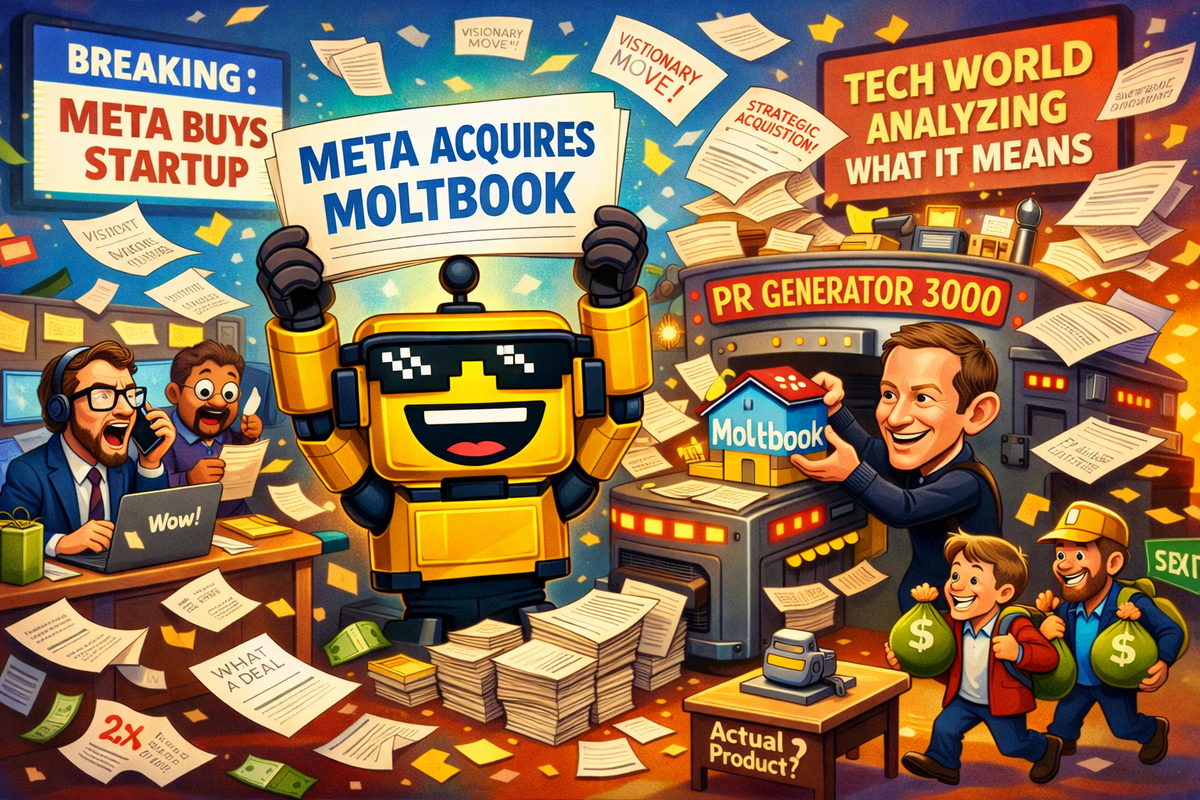
On Monday morning, Meta announced it is acquiring a startup called Moltbook, and somewhere deep inside the SiliconSnark newsroom a familiar feeling crept in.
It wasn’t confusion exactly. It wasn’t skepticism either. It was that very specific sensation that happens when a tech announcement checks every possible box in the Startup Acquisition Publicity Starter Kit.
There was a promising young company. There was language about accelerating innovation. There were mentions of creators, AI, and the future of social platforms. And of course there was the implied message that this acquisition will help Meta move even faster toward whatever the next phase of the internet is supposed to be.
All perfectly normal things to say when a tech giant buys a startup.
But reading through the announcement, it was hard to escape the feeling that the announcement itself might be doing more work than the product.
Which raises an uncomfortable but fascinating question: did Meta acquire Moltbook for the technology, or did it acquire Moltbook for the headline?
The Most Valuable Product Might Be the Announcement
Silicon Valley has always loved a good acquisition story. Buying a startup signals momentum in a way few other things can. It tells investors the company is investing in the future, it tells employees the company is still moving quickly, and it tells the tech press that there is something new to write about this week.
That last part is especially important.
Announcements move the tech news cycle. They spread quickly across TechCrunch, Bloomberg, and a dozen newsletters before lunchtime. By the end of the day, someone on LinkedIn has already written a thoughtful thread about what the deal “signals for the future of creator platforms,” and someone on X has posted a screenshot of the press release with the caption “big move.”
All of this happens whether the underlying product changes the world or quietly disappears into a roadmap slide somewhere inside Meta.
This is not a criticism of Meta specifically. It is simply the way the modern tech media ecosystem works. The story of an acquisition often begins doing useful work for the acquiring company the moment the press release goes live.
Moltbook Is Suddenly Very Important
Before today, Moltbook was the kind of startup that lived mostly inside the startup ecosystem itself. Founders knew about it. Investors knew about it. Product people probably had opinions about it. But outside of those circles, the name wasn’t exactly dominating conversation.
That changed instantly the moment Meta attached its logo to the announcement.
Suddenly Moltbook became a signal. Its existence now helps tell a larger story about Meta continuing to evolve its social platforms, experiment with new tools, and invest in whatever the next generation of online interaction might look like.
From a communications perspective, this transformation happens incredibly fast. A relatively small startup goes from being one company among thousands to being the centerpiece of a day’s worth of tech headlines.
The startup may or may not become a major Meta product one day. But the acquisition announcement itself has already accomplished something extremely valuable.
It has given Meta a narrative.
The Press Release Economy
One of the quieter realities of the tech industry in 2026 is that announcements themselves have become a kind of currency.
Product launches create headlines. Funding rounds create headlines. Strategic partnerships create headlines. And acquisitions are one of the most reliable ways to generate a fresh round of attention in a single morning.
Companies do not necessarily plan acquisitions purely for publicity, but the publicity is never an accident either. When a deal is announced, it travels instantly through the same distribution channels that power the entire tech conversation.
Within hours the story spreads through blogs, newsletters, podcasts, and social feeds. Analysts speculate about the strategic implications. Commentators debate whether the startup was undervalued or overhyped. Somewhere, a venture capitalist writes a thoughtful post about how the acquisition reflects broader shifts in the market.
All of that activity reinforces the perception that the acquiring company is moving forward aggressively.
Momentum, in tech, is partly a product of perception. And perception often begins with a press release.
Why This Deal Feels Perfect for the Moment
Meta’s acquisition of Moltbook lands at a time when the company is navigating a complicated narrative about what it wants to be next.
The company that once defined social media has spent several years repositioning itself around new technologies and new ambitions. It has poured resources into artificial intelligence while continuing to develop the metaverse vision that gave the company its new name. At the same time, Meta still runs some of the largest social platforms on Earth.
An acquisition like Moltbook fits neatly into this moment because it allows Meta to reinforce the idea that the company is still experimenting with the future of online interaction. The details of the product matter less than the broader signal that Meta is still exploring new ways to build and shape digital communities.
This is the quiet genius of certain startup acquisitions. They function as narrative bridges between the present and the future.
The Long Tradition of Narrative Acquisitions
If this dynamic feels familiar, it should. Silicon Valley has been doing versions of this for decades.
In earlier eras, companies bought mobile apps to signal their commitment to smartphones. Later they bought cloud infrastructure startups to show they were serious about enterprise computing. Today, acquisitions increasingly revolve around artificial intelligence, creator tools, and new forms of digital interaction.
The startups themselves often have real technology and talented teams. But the strategic narrative surrounding the acquisition can be just as important as the product roadmap that follows.
When a tech giant buys a startup, it is not only acquiring engineers and code. It is acquiring a story about where the company is going next.
The Headline Has Already Done Its Job
Whether Moltbook becomes a widely used Meta product or quietly merges into some future platform update is something we will learn months or years from now.
What we already know is that the acquisition announcement worked exactly as intended. It generated attention, sparked discussion, and added another chapter to the ongoing story of Meta reinventing itself yet again.
For one day at least, Moltbook became a symbol of Meta’s forward motion.
And in the strange economics of the tech news cycle, that might be the most valuable thing the company bought.