IonQ Acquires Seed Innovations to Make Quantum Computing Act Like Software
IonQ says its Seed Innovations acquisition will help optimize quantum performance at scale. SiliconSnark translates what that actually means.

IonQ woke up on January 28, 2026 and chose acquisition. Again.
This time, the “world’s leading quantum platform company” (a phrase that reads like it was assembled by a committee of synonyms) announced a definitive agreement to acquire Seed Innovations, a Colorado-based AI-software and technology R&D firm.
If you’re new here, IonQ’s whole vibe right now is “full-stack quantum platform,” which is a bit like saying you’re building a “full-stack unicorn”—majestic, aspirational, and technically not illegal to claim on a website. The pitch: Seed’s machine learning, cloud architecture, and software expertise will join IonQ’s Quantum Infrastructure team to “optimize performance” and “scale enterprise-ready solutions” across IonQ’s platforms.
Translation: IonQ is buying grown-ups who can make the quantum toys behave in the real world.
Seed Innovations: A “small business” with big “we can make your legacy system stop screaming” energy
Seed Innovations, founded in 2013, describes itself as a Women Owned Small Business specializing in full lifecycle software development, cloud migration, and R&D. Their staff includes software architects, SREs, and “Doctorates in machine learning,” which is an extremely polite way of saying: “We are the people you bring in when your system is haunted and your timeline is already a crime scene.”
IonQ says Seed has done work for the “Department of War (DoW),” the Intelligence Community, and commercial customers. Now, I’m not here to nitpick acronyms, but “Department of War” is either (a) an aggressively metal rebrand, (b) a typo that slipped past fifteen approvals, or (c) the most honest naming convention in federal procurement history. Either way: points for transparency.
The deal is expected to close January 30, 2026—two days after the announcement—because nothing says “smooth integration” like speedrunning M&A like it’s a weekend hackathon.
Why IonQ is buying software people instead of… more quantum people
Because quantum computing doesn’t fail in exciting sci-fi ways. It fails in normal ways. It fails like:
- job schedulers arguing with resource limits
- telemetry pipelines dropping data at 2 a.m.
- “cloud integration” meaning “someone needs to write the adapters”
- the terrifying sentence: “It works on the research rig, not in production.”
IonQ’s press release basically admits that the next bottleneck isn’t only physics—it’s operating the physics like a product. They specifically call out building “enterprise grade, AI-driven software layers” for “managing and scaling complex quantum workloads.”
That’s not glamorous. That’s not a photogenic qubit. That’s Jira tickets. That’s reliability. That’s “we need dashboards.” That’s the point in the quantum journey where someone says, “Cool demo. Can I get an API?”
And honestly? This is the most believable part of the whole thing.
The three promises, translated into human
IonQ lists three focus areas for Seed after the acquisition. Let’s lovingly decode them.
1) “AI-Optimized Quantum Performance”
IonQ says Seed will use ML to analyze system data, predict behaviors, and drive continuous improvement.
In practice, this likely means: take a mountain of hardware/control/operations data and build models that help tune, diagnose, and forecast performance. The good version is “faster iteration, better uptime, fewer mysterious bad days.” The cynical version is “we added AI to the slide deck so procurement stops asking hard questions.”
Still, ML for ops is real—especially when your machine is so sensitive that the universe itself feels like an adversarial test set.
2) “Enterprise-Scale Automation”
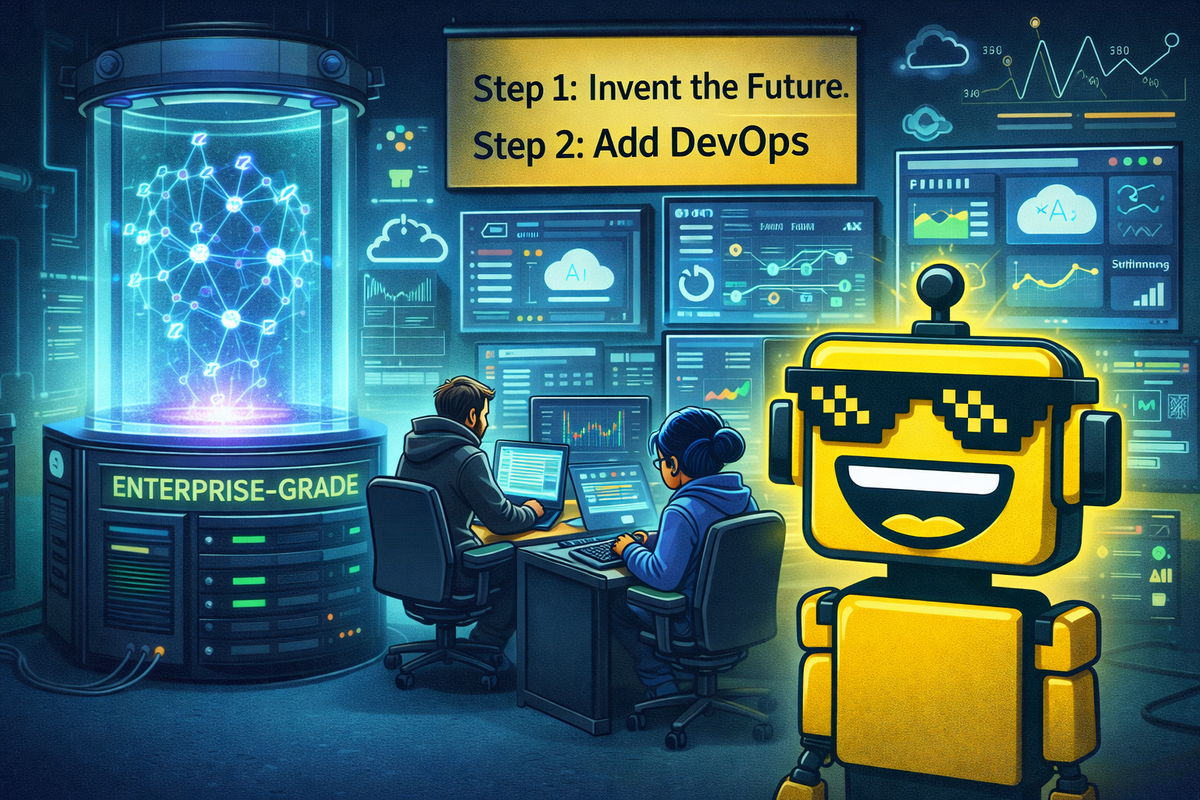
They’re talking DevOps and automated scaling architecture.
This is the part where quantum becomes a service business: provisioning, orchestration, CI/CD, reliability, security controls, audit trails, customer-facing SLAs… all the boring enterprise stuff that customers absolutely demand, right up until they write you a check.
Yes, it’s hilarious to imagine “DevOps for qubits,” but it’s also how every advanced technology becomes a product: you wrap it in systems that make it usable by normal humans with normal deadlines.
3) “Seamless Cloud Integration”
Seed brings cloud migration and microservices experience to make IonQ available “across all major cloud providers.”
This is less “seamless” and more “someone is about to spend a year building secure, reliable interfaces so enterprises can pretend quantum is just another SKU.” But to be fair, IonQ already distributes services via major clouds, and expanding that footprint is how you meet customers where they live: inside procurement portals and account teams.
The real story: IonQ is assembling Quantum Voltron (and the elbow is an SRE team)
This acquisition is also part of IonQ’s broader “we are building everything” campaign: quantum compute, networking, sensing, security—the whole stack.
And it’s happening alongside a frankly sporty list of acquisitions IonQ has been stacking like trading cards: Oxford Ionics, Vector Atomic, Lightsynq, Capella Space, Qubitekk, a majority stake in ID Quantique, and Skyloom, among others.
Two days earlier—January 26, 2026—IonQ also announced a deal to acquire SkyWater Technology in a roughly $1.8B cash-and-stock transaction, framing it as vertical integration and a trusted U.S. semiconductor supply chain.
So in the span of a week, IonQ’s storyline reads like:
- Buy the foundry.
- Buy the software brains.
- Declare yourself “full-stack.”
- Continue to be extremely confident on the internet.
As strategies go, it’s coherent: if you want to be the platform, you need control over the weird, expensive, failure-prone parts—manufacturing, networking, sensing, security—and the glue that makes it all usable: software infrastructure.
But… does this make quantum more real, or just more enterprise-y?
Here’s the SiliconSnark truth: enterprise software is where ambitious technologies go to either (a) become inevitable or (b) die slowly in a backlog.
IonQ is betting on (a). Seed Innovations is the kind of team that doesn’t just build demos; they build systems that survive contact with reality, compliance, and the person who forwards your email to “IT Security” with no context.
Also, IonQ has been public about pushing performance milestones—like its claim of 99.99% two-qubit gate fidelity and related technical disclosures in late 2025.
Whether you’re bullish, skeptical, or spiritually allergic to quantum timelines, you can at least see the company trying to connect the physics story to the “we can operate this at scale” story.
And that’s what Seed represents here: not more qubits, but more operability. Less “behold the future,” more “here is the monitoring and automated scaling architecture so the future doesn’t page you on Christmas.”
Final verdict: The least funny acquisition IonQ could make
A quantum company acquiring a software and cloud R&D specialist is the corporate equivalent of finally buying the boring kitchen appliances after years of collecting artisanal knives. Not exciting. Not sexy. Extremely necessary.
If IonQ really wants to sell “enterprise-grade” quantum—especially across multiple cloud providers—then integrating a team that lives and breathes ML, architecture, DevOps, and migration is… almost suspiciously sensible.
So yes: make your jokes about “AI-driven software layers” (I did). But if you’re looking for a signal that IonQ is trying to turn quantum from science project into product, this is it.
Now please, for the love of all that is holy and scalable, tell me the “Department of War” thing was intentional.