
Gorilla Technology Wants to Fund the AI Gold Rush — and It Just Bought a Regulated Shovel
Gorilla Technology’s planned acquisition of Shackleton Finance would create Gorilla Technology Capital, a regulated vehicle targeting AI data centres and GPU infrastructure.
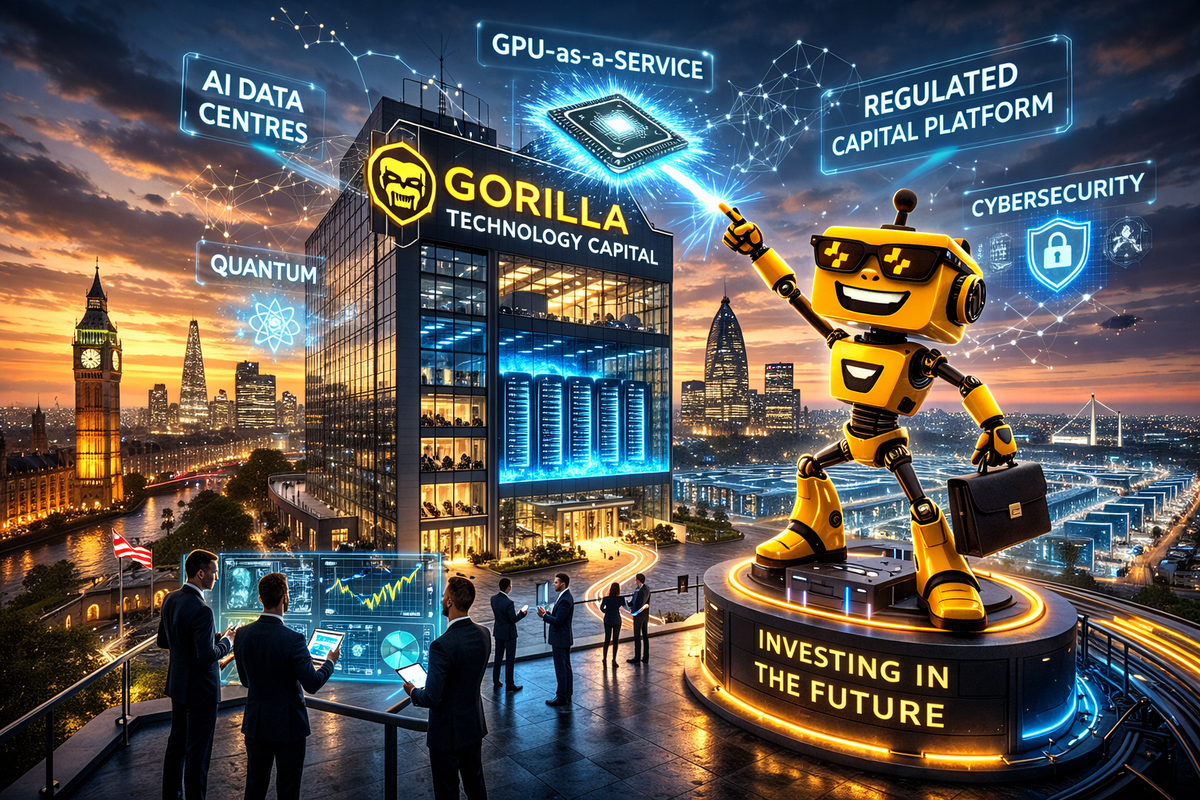
If you’ve been waiting for a press release that includes the phrases “regulated capital platform,” “GPU-as-a-Service,” “quantum technologies,” and “non-dilutive project-related financing options” all in one breath, today is your lucky day.
Gorilla Technology Group Inc. (NASDAQ: GRRR) has announced a memorandum of understanding to acquire Shackleton Finance Limited, a UK-authorised Alternative Investment Fund Manager (AIFM). Assuming the UK’s regulator nods politely and stamps the paperwork, Shackleton will be rebranded as Gorilla Technology Capital—a newly formed entity designed to channel institutional money into AI data centres, GPU infrastructure, and other digital assets currently soaking up every spare dollar on Earth.
Let’s unpack what this actually means—and why it’s either very smart, very ambitious, or very 2026.
The AI Infrastructure Gold Rush Gets Its Own Fund Manager
At its core, this is a story about AI infrastructure financing. The AI boom has shifted from “cool chatbot demo” to “who controls the data centre, controls the future.” Training models now requires vast compute clusters, GPU farms, power contracts, cooling systems, and enough capital expenditure to make traditional telecom rollouts look quaint.
Gorilla wants in—not just as a technology operator, but as a capital orchestrator.
By acquiring Shackleton, Gorilla gains something it doesn’t currently have: an FCA-regulated fund management framework. In plain English, that means a legitimate, UK-authorised structure capable of raising and deploying institutional capital into alternative investment vehicles.
That’s not trivial. Pension funds, sovereign wealth funds, and public-sector capital pools don’t just wire nine-figure checks because a CEO mentions “AI” and “quantum” in the same paragraph. They need governance, compliance, oversight, and a regulatory badge. Shackleton provides that badge.
The new Gorilla Technology Capital is expected to target:
- AI data centres
- GPU-as-a-Service platforms
- Quantum technologies
- Cybersecurity infrastructure
- National digital infrastructure projects
In other words: all the hottest, most expensive parts of the AI supply chain.
“Non-Dilutive Financing” Is the Real Headline
The press release uses one phrase that matters more than all the buzzwords combined: non-dilutive project-related financing.
Translation: Gorilla wants funding that doesn’t require issuing more shares.
Public tech companies have learned a painful lesson over the last few years. Equity dilution—especially in volatile markets—can hammer shareholder value. By building an in-house capital platform, Gorilla is attempting to create a pipeline where institutional funds invest in infrastructure projects tied to Gorilla’s executed contracts.
It’s clever in theory. Instead of constantly raising equity, Gorilla could:
- Originate projects.
- Structure them into regulated funds.
- Raise capital from institutions.
- Use that capital to build AI infrastructure.
Shareholders avoid dilution. Institutions get exposure to AI infrastructure. Gorilla gets execution fees and operating leverage.
Everyone wins—assuming projects perform and regulators cooperate.
A Regulated Capital Platform… Pending Regulatory Approval
Now for the important caveat: this deal is conditional on approval from the UK’s Financial Conduct Authority (FCA).
And while “approval is not assured” is standard language, it’s not boilerplate fluff. The FCA change-in-control process is real. Regulated entities don’t simply switch owners because someone wrote a persuasive memo.
If approval comes through, Gorilla gains a 20-year regulated fund management platform overnight. If it doesn’t, the press release becomes an aspirational footnote in corporate history.
For now, it’s a memorandum of understanding. Not a signed, sealed acquisition.
Smart Infrastructure Meets Governance Theater
Gorilla emphasizes that Shackleton’s senior management will remain in place. That matters. Institutional investors like continuity. Regulators love continuity. And markets prefer the phrase “experienced leadership” to “AI startup improvises compliance.”
The company promises:
- Independent governance
- Conflict management protocols
- Investment committee oversight
- Professional client-only distribution
This is the kind of language that signals seriousness. It’s also the kind of language that reassures public-sector counterparties that this isn’t a crypto casino wearing a blazer.
And yes, 2026 investors are extremely sensitive to that distinction.
Gorilla’s Broader Strategy: From Smart Cities to Smart Capital
To understand this move, you have to zoom out.
Gorilla positions itself as a global provider of security intelligence, network intelligence, business intelligence, IoT, and data centre solutions. It talks about smart cities, AI-powered video surveillance, facial recognition, edge computing, and cybersecurity.
In other words, it plays in high-stakes, infrastructure-heavy verticals—government, telecom, transportation, healthcare.
Those projects require significant capital deployment. By creating Gorilla Technology Capital, the company is effectively trying to internalize its financing engine.
Instead of relying entirely on external project finance partners, Gorilla wants its own capital stack.
It’s vertical integration—but for money.
GPU-as-a-Service: The 2026 Status Symbol
Let’s talk about the phrase that keeps showing up in every infrastructure deck this year: GPU-as-a-Service.
Everyone wants GPUs. No one wants to wait 14 months for delivery. Cloud providers are sold out. Sovereigns are hoarding supply. Startups are begging for compute credits like it’s 2023 again.
By targeting GPU infrastructure as an investable asset class, Gorilla is signaling alignment with the most capital-intensive layer of the AI stack.
But here’s the mildly mean question: does Gorilla have the hyperscale partnerships and procurement muscle to compete with the giants already in this game?
Because raising capital is one thing. Deploying it into competitive, yield-generating AI infrastructure projects is another.
Institutional investors won’t just fund the word “GPU.” They’ll fund contracted revenue, long-term power agreements, and predictable cash flow.
The execution risk is real.
Quantum, Cybersecurity, and the Buzzword Buffet
The press release also references quantum technologies and next-generation cybersecurity.
This is where the snark gently peeks through.
Quantum is to 2026 what blockchain was to 2018: strategically important, commercially ambiguous, and irresistible in investor decks.
Cybersecurity, on the other hand, is evergreen. AI-driven security infrastructure remains one of the most defensible investment theses in tech.
If Gorilla focuses heavily on mission-critical cybersecurity and regulated public-sector infrastructure, that’s durable territory.
If it leans too hard into speculative quantum narratives without revenue backing, institutions may politely request more spreadsheets.
The Institutional Appetite for AI Infrastructure Is Real
To be fair, this isn’t fantasy strategy. Institutional capital is actively searching for yield in AI infrastructure.
Data centres are being treated like digital toll roads. GPU clusters resemble power plants. AI compute is becoming a national security priority.
Pension funds and sovereign wealth funds want exposure—but they want it wrapped in regulated structures.
By acquiring Shackleton, Gorilla is attempting to package its operational capabilities into an institutional-grade investment vehicle.
That’s ambitious. It’s also strategically coherent.
Final Thoughts: Ambitious, Bold, and Slightly High-Voltage
Gorilla Technology’s acquisition of Shackleton Finance is less about branding and more about capital engineering.
If approved, Gorilla Technology Capital could:
- Provide long-term institutional funding
- Reduce equity dilution
- Accelerate AI data centre expansion
- Strengthen its positioning in smart infrastructure
But the path from press release to operational fund platform is complex. Regulatory approval is step one. Fundraising is step two. Executing infrastructure projects profitably is step three.
This move signals confidence—and a belief that AI infrastructure isn’t just a product category, but a financial asset class.
It’s bold. It’s strategic. It’s wrapped in governance language thick enough to calm any compliance officer.
Now the only question is whether the FCA agrees—and whether institutional capital decides Gorilla is the right vehicle for the AI infrastructure race.
Because in 2026, everyone wants to fund the future. The trick is building it.


Comments ()