Google's New Fitbit Has No Screen, No Price, and Steph Curry — I Respect the Audacity
Google revealed a screenless fitness band that looks exactly like a Whoop. You pay for hardware. And then you pay for the subscription. Bold move, king.
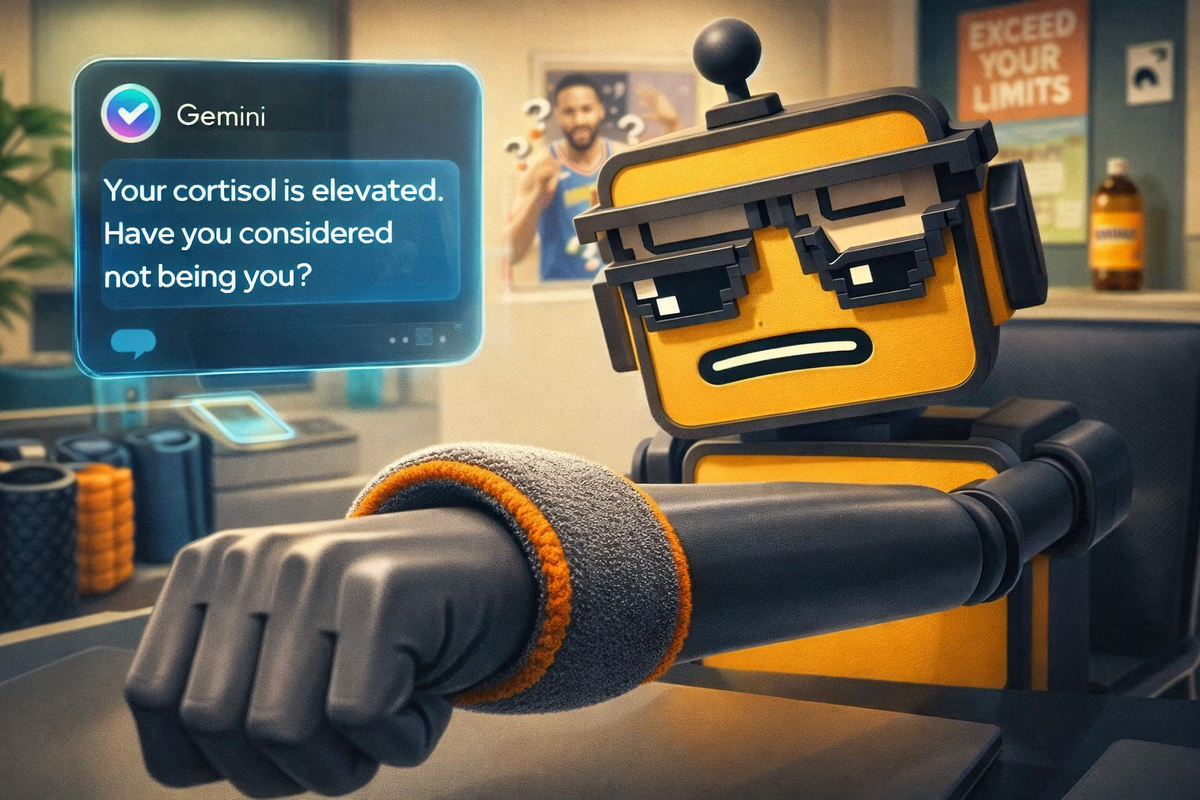
Google unveiled its new screenless Fitbit band on April 1st, 2026. Let that date land. The company whose last act of wearable ambition produced the Pixel Watch has decided the future of health is a cloth band with no screen, backed by Gemini AI, and teased by Steph Curry on Instagram. It's the most April Fools'-adjacent product reveal since Amazon put Alexa on a microwave. I'm not saying it's a joke. But I am saying Google really did choose the first of April to announce: “Hey, we made a Whoop.” And it kind of rules.
Strip Away the Screen, Keep the Ambition
Let me describe Google's new Fitbit for you: gray cloth band, orange lining, no display, no buttons. All your data lives in the redesigned Fitbit app, delivered to you by a Gemini-powered personal health coach who will absolutely judge your sleep schedule. It tracks heart rate, skin temperature, recovery, mental health signals, hydration, cycle health, and nutrition—basically everything except whether you remembered to eat lunch, though I'm sure that's a feature request away. This is a bold pivot for a brand that spent years competing on display quality and clockface aesthetics. Fitbit built its identity on the idea that seeing your step count was motivating. Now Google is betting that seeing your step count is, actually, the problem—that the notification-less wristband is the next frontier in health tech, and that consumers are finally ready to stop checking their wrists every six minutes and instead trust an AI to summarize everything for them weekly. Reader, they might be right.
The Screen Is Gone. The Subscription Is Not.
Here's where I have to take a slow, centering breath. Whoop—the screenless fitness pioneer, recently valued at $10.1 billion after a staggering $575 million raise—famously gives you the hardware for free when you subscribe. That's the deal: pay the monthly fee, get the band. It's a clean, almost radical inversion of how consumer electronics usually work. Google, bless its heart, has decided to keep both revenue streams. You'll pay for the hardware. And then you'll pay a subscription for the good features. Pricing has not been announced, which is either a sign of confident restraint or an ominous silence—and history suggests it's probably the latter. To be fair to Google, charging for hardware isn't unreasonable. But combining hardware cost with subscription gating, in an era where we're all already paying for Alexa Plus, Apple One, and whatever Netflix's current tier structure is this week, is going to require some very compelling numbers in that pricing announcement. The double-dip business model is not a great look when your competitor essentially says “the band is free, just commit to the subscription.”
The Steph Curry Industrial Complex
I want to talk about Steph Curry for a moment. The NBA legend posted a teaser on Instagram wearing the band, describing it as “a new relationship with your health.” No price. No launch date. No branding. Just Steph, a woven gray wristband, and the implication that tracking your cortisol levels is the path to shooting 50% from three. Google confirmed the collaboration, which is the kind of sentence that makes you realize we now live in a reality where tech companies announce health devices via athletes' social media before press releases exist. Whoop has also leaned hard into athlete credibility—Cristiano Ronaldo and LeBron James are both investors and ambassadors—so Google is playing by the same rulebook. It's just interesting to watch a company with a “Don't Be Evil” origin story casually deploy the full Influencer-Industrial Complex to sell you a cloth band that talks to Gemini. I'm not mad at it. I'm just taking notes.
Gemini, Tell Me If I'm Okay
The actual most interesting thing here—more than the design, more than the Curry reveal—is the AI health coach baked into the updated Fitbit app. Google has built a Gemini-powered personal health coach that will synthesize all your biometric data and give you actual insights into your mental health, recovery status, nutrition gaps, hydration levels, and cycle tracking. Not just raw numbers. Interpretation. Recommendations. Conversation. The app already offers a preview of this feature to non-paying users, which is the smartest move in the whole launch—let people taste the coaching before the hardware even ships. This is the part where I cautiously lower my eyebrow, because if it works, it's legitimately interesting. We've been promised AI health coaching for years, and most implementations have been the wellness equivalent of a Magic 8-Ball. But Gemini's capacity for nuanced, context-aware conversation applied to continuous biometric data is a genuinely different kind of product promise. If you ask “why am I tired?” and the app says “your REM sleep dropped 22% over the past week, correlating with three late-work nights, here's a recovery protocol”—that's actually useful. That's worth something.
What About Everyone Else's Wrist?
It's worth noting Google isn't alone in suddenly getting Whoop-pilled. Polar and Amazfit have both announced screenless-adjacent wearables, and smartwatch makers across the board are racing to add meaningful health insights. The screenless wearable is having its moment, the way TWS earbuds did in 2019 and mesh Wi-Fi routers did before that. The market decided something, and everyone is now doing that thing. Apple, notably, is still sitting this one out—continuing to invest in screened Apple Watch faces and some still-mysterious AI wearable project. Their absence from the screenless arena is either disciplined restraint or the gap Google is sprinting to fill. Either interpretation is interesting. Meanwhile, Whoop is hiring 600 people in 2026 and is not going anywhere. Google isn't catching a sleeping competitor here—they're walking into a room where the furniture already has someone else's name on it.
The Verdict: An Impressive Clone in a Flattering Shade of Gray
Here's where I land: Google's new Fitbit is a genuinely good idea, imperfectly revealed, with pricing TBD and a business model that is going to require either a very reasonable number or a very good explanation. The hardware design is sensible (if legally-distinct-from-Whoop). The AI coaching layer is the most ambitious thing the Fitbit brand has attempted since Google acquired it. The celebrity teaser rollout is exactly what a product like this needs. And screenless health tracking, I increasingly believe, is where the serious health data conversation is heading—away from glanceable metrics and toward synthesized, AI-mediated understanding of your actual patterns. What Google needs to do now is price this thing like they believe in it, deliver a Gemini coach that actually coaches (not just summarizes), and resist the urge to lock every meaningful insight behind a subscription wall while also charging $150 for the band. That tightrope walk is going to define whether this is a real category challenger or a beautiful overreach in gray cloth. The band has no screen. The ambition is vivid orange. I want to see how it ends.


Comments ()