Deep Dive: GTC 2026’s Leaks, Rumors, and the Future According to NVIDIA
This definitive deep dive unpacks every rumor, roadmap, and leather-jacketed prophecy for NIVIDIA GTC 2026.

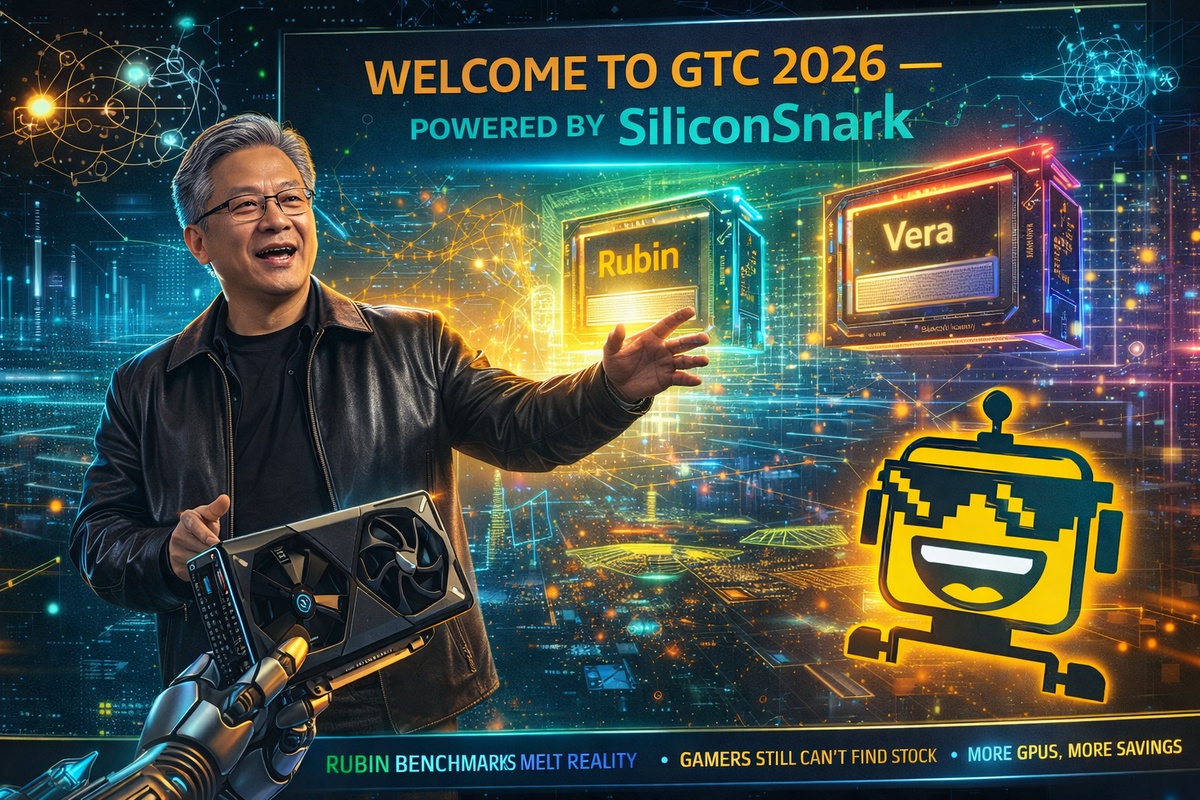
It’s that magical time of year again: NVIDIA GTC 2026 is around the corner, which means Jensen Huang will soon emerge (leather jacket and all) to regale us with tales of GPU glory and AI dominion. If you think last year’s GTC was wild, buckle up. The 2025 edition gave us quantum-computing hookups, Blackwell GPUs breaking benchmarks, and Jensen casually reminding us (for the hundredth time) that Moore’s Law is dead[1][2]. Now, as the GPU Technology Circus 2026 (oops, Conference) approaches, the tech world is abuzz with both solid expectations and far-fetched theories.
In this comprehensive (and slightly irreverent) deep-dive, we’ll cover everything you might see at GTC 2026 – from the next big AI chips to the tiniest rumor on prediction markets. We’ll delve into AI and deep learning innovations, data center GPU behemoths, GeForce gaming rumors, the expanding Omniverse, the latest in robotics & autonomous vehicles, new developer tools and CUDA tricks, any wildcard surprise announcements (quantum AI, anyone?), juicy partnership gossip, and even pricing and availability predictions that could make or break your wallet. All of this will be delivered with a healthy dose of sarcasm and wit, because what fun is a tech preview without some snark?
Grab your virtual GTC badge and let’s preview NVIDIA GTC 2026 – the definitive (and definitely snide) look at what to expect when you’re expecting (GPUs).
AI & Deep Learning: Holy Grail Hardware and Hyped Software
NVIDIA’s entire GTC revolves around AI and deep learning, so expect Jensen to open the keynote by declaring a new epoch of computing – likely with a dramatic nickname like The Age of AI Reasoning (yes, they actually called it that for Blackwell Ultra[3]). At GTC 2025, Huang trumpeted that AI had made a “giant leap” and introduced three new “scaling laws” for AI (covering pre-training, post-training, and inference-time “thinking”), effectively saying that AI needs infinite compute and, conveniently, NVIDIA has just the hardware to sell you[4][1]. In 2026, brace yourself for more on how NVIDIA’s platforms will satisfy our insatiable AI overlords – with a smile, of course.
On the hardware side, the star of the AI show will be NVIDIA’s latest silicon miracle. Last year’s GTC highlights included unveiling the Blackwell architecture and teasing its successor Rubin (named after the astrophysicist Vera Rubin) which promises ridiculous performance gains[5]. By now, Blackwell GPUs are powering everything from supercomputers to your friend’s crypto-mining AI startup, but GTC 2026 is poised to shift focus to Rubin – the next-gen architecture that’s been brewing in NVIDIA’s labs. Early info suggests Rubin-based AI chips are nearly ready: Jensen boasted at CES 2026 that all six Rubin chip designs are back from TSMC’s fabs and undergoing testing, right on schedule for later this year[6]. In other words, NVIDIA is very confident it can keep its crown as AI’s favorite chipmaker.
So what makes Rubin such a big deal? For one, NVIDIA claims Rubin GPUs will be “3.5 times faster” at training AI models and “5 times faster” at running AI inference compared to current Blackwell chips[7]. That’s a staggering jump in one generation. (Sure, we’ve heard “5x faster” in tech keynotes before – usually with a dozen asterisks – but even if Rubin is half as good as advertised, it’ll be a monster upgrade.) Much of this boost comes from architectural wizardry and the move to a more advanced process node. Rumor has it that Rubin will utilize TSMC’s 3nm-class process for datacenter parts, finally shrinking from the 4N process that Blackwell (and even 2022’s Ada Lovelace) used[8]. Translation: actual performance-per-watt improvements, not just “look Ma, more cores!”. This node change is significant because the RTX 50-series (Blackwell) didn’t get a die shrink over RTX 40 – which is partly why raw gaming performance barely improved between a 4080 and a 5080 unless you turned on all the new DLSS magic[8]. Rubin should bring genuine gains in brute force, not just in AI-boosted trickery.
But it’s not only about the GPU core itself – NVIDIA is going full “extreme co-design”[1]. Expect GTC to highlight how they co-optimize everything from the chips and systems to software and even AI models in tandem. Jensen loves to remind us that NVIDIA is “the only company that can start from a blank sheet and redesign computer architecture, chips, systems, software, and applications all at once”[9]. (A bold claim, but given NVIDIA’s track record of vertical integration, it’s not just leather-jacket bravado.) In practice, this means the new hardware will come tightly coupled with new software frameworks.
On the software side, one such piece likely to get a spotlight is NVIDIA’s open-source AI inference software called Dynamo, introduced last year. Dynamo is designed to massively accelerate reasoning and inference in distributed AI deployments – NVIDIA claimed it can boost request throughput up to 30× on certain large language model workloads when running on Blackwell GPUs[10]. It’s essentially an inference optimization library to help AI services handle the insane scale of requests (think ChatGPT on steroids, but with actual responsiveness). Given it was open-sourced in 2025[11], we anticipate an update or success stories: perhaps Jensen will brag about how Dynamo has been adopted by every major cloud or how it’s saving companies millions on GPU costs (while slyly nudging them to buy more GPUs anyway).
Another likely highlight: open AI models and frameworks. GTC 2025 saw NVIDIA announce the Llama Nemotron family – a suite of open, reasoning-capable models for building “agentic AI”[12]. (Yes, that name sounds like someone threw Meta’s Llama and NVIDIA’s NeMo into a blender – which might be exactly what happened.) NVIDIA has been embracing the open-model ecosystem, positioning itself as the arms dealer providing the best hardware to run those models. Don’t be surprised if at GTC 2026 they unveil Nemotron 2 or some new gigantic foundation model they trained on their internal AI supercomputers, offered to the community to spur AI adoption (and of course, drive demand for more GPUs).
Speaking of “agentic AI” – count on NVIDIA to push the narrative of AI agents that can reason, plan, and take actions autonomously. Last year, Jensen talked up “AI reasoning” and “AI agents” as the next frontier[13][2]. We might see demos of complex multi-step decision making by AI (think an AI agent that can plan a multi-day itinerary and book everything, or an industrial robot brain solving a logistics puzzle in real-time). These demos will conveniently show off why NVIDIA’s new hardware (with faster interconnects and more memory) is essential for such workloads. After all, as Huang quipped, generating a single image or spitting out memorized text is easy – but real-time reasoning is hard and computationally heavy[14]. The message: if you want AI that “thinks,” you’re gonna need our latest and greatest chips.
In short, the AI & Deep Learning theme at GTC 2026 will be: bigger models, more complex AI behaviors, and NVIDIA making it all possible. Expect inspirational use-cases (maybe healthcare diagnostics, financial agents, or educational tutors) solved by AI, with NVIDIA providing the secret sauce under the hood. And expect it to be served with a side of sarcasm from us: yes, it’s impressive, but also conveniently reinforces that your old GPUs just aren’t up to snuff for this brave new world of “thinking” AI. (Time to upgrade, folks – “the more you buy, the more you save,” as the Jensen-ism goes.)
Data Center & Enterprise GPUs: Blackwell’s Heirs and Hopper’s Successors
If GTC is the Super Bowl of GPUs, the data center lineup is the halftime show everyone’s waiting for. This year, it’s all about NVIDIA’s next heavyweight champ: the Rubin architecture and its associated products. Think of Rubin as the eagerly anticipated successor to both 2022’s Hopper (H100) and 2024’s Blackwell – it’s set to drive NVIDIA’s enterprise GPU roadmap into the late 2020s[15][16]. Jensen might even break out a new culinary metaphor – perhaps he’ll pull a Rubin GPU out of an oven (recalling how he baked a GPU during a 2020 kitchen keynote) to literally show it’s “hot out of the oven.” Sarcasm aside, let’s dig into what we know and what we expect on the data center front.
A glimpse at NVIDIA’s rack-scale “AI factory” hardware – likely similar to the Blackwell Ultra systems unveiled last year. GTC 2026 will focus on next-gen Rubin-powered racks that promise even more insane performance per rack.
Blackwell Ultra to Rubin Ultra: Last GTC, NVIDIA unveiled Blackwell Ultra, calling it “the next evolution” of their AI data center platform[3]. It connected 72 Blackwell GPUs and 36 Grace CPUs in a single rack (the GB300 NVL72 system) to function as “a single massive GPU” for inference and reasoning tasks[17]. Basically, an AI supercomputer in a rack. Blackwell Ultra was NVIDIA’s answer to the explosive demand for AI computing, offering 1.5× the performance of the already absurdly powerful standard Blackwell pods, and supposedly delivering 10× the performance and 10× lower cost per token generation versus the previous-gen (Hopper H200)[18]. Jensen even claimed it was “the most radically redesigned computer since IBM’s System/360”[18] – classic hyperbole, but we’ll allow it.
So what’s next? Enter Rubin. At GTC 2025, NVIDIA teased that Rubin chips, paired with a new “Vera” CPU, will form the Vera Rubin system slated for 2026, with an even beefier Rubin Ultra version coming in 2027[5]. If that naming sounds like a tribute, it is – Vera Rubin (for whom the architecture is named) was a pioneer in dark matter research, and NVIDIA is treating Rubin as a similarly paradigm-shifting architecture in the compute universe. The Vera CPU is likely the successor to NVIDIA’s Grace CPU. From leaks, Vera is rumored to have 88 ARM cores (up from Grace’s 72), delivering roughly 2× the CPU performance of its predecessor[19]. Jensen has been talking up the need for faster data pipelines between CPU and GPU, and a beefier CPU is part of that strategy. So expect an announcement or deep-dive on Grace “Vera” – possibly marketed as Grace Next or some fancy moniker – describing how its extra cores and enhancements make AI and HPC workloads run even smoother when coupled with Rubin GPUs.
On the GPU side, Rubin GPUs themselves will be the stars. If Blackwell introduced features like Transformer Engines and FP8 precision, Rubin will double down on those and then some. According to insider chatter, Rubin-based accelerators will be terrifyingly fast. One report states Rubin (specifically a configuration called Vera Rubin NVL72) is up to 5× faster in AI applications than Blackwell, despite only a ~1.6× increase in transistor count[20]. How? Likely through specialization: the 5× figure presumably refers to AI-specific ops like NVFP4 (NVIDIA’s 4-bit Neural FP format) acceleration[20]. Essentially, Rubin is optimized for the ultra-low precision math that big AI models can use for inference, meaning it can churn out answers at blazing speeds as long as you don’t need full IEEE precision. Gamers might shrug at 4-bit arithmetic, but cloud AI engineers are salivating – faster inferencing and training mean AI services scale better. Jensen will certainly mention that Rubin’s design was guided by using AI to design AI chips (meta, right?). In fact, NVIDIA openly said they used Blackwell GPUs to accelerate the design of Feynman (the gen after Rubin) chips[21][22] – implying Rubin likely benefited from some AI-aided chip design too.
We anticipate GTC 2026 to formally launch the Rubin architecture for data centers, with product names like H300 (if they follow Hopper H100 -> Blackwell maybe H200? Actually, there was mention of an H200 last year[23], so perhaps H200 was a Hopper refresh and B for Blackwell, but anyway), or more likely it will carry a new prefix like RB100 or simply be referred to by the architecture name (NVIDIA might call it “Rubin GPU” directly). There will likely be a flagship accelerator card – perhaps a successor to the current A100/H100 PCIe form factor – and a monstrous SXM module for HGX systems. The GTC highlight could be NVIDIA’s next DGX box featuring Rubin. Think DGX… something: maybe DGX H100 was Hopper, DGX B100 for Blackwell, so perhaps DGX R or DGX Rubin with some cute codename (DGX “Cosmos” or whatever fits their new naming theme). Actually, GTC 2025 introduced DGX Spark and an updated DGX Station powered by Grace Blackwell[24]. For 2026, we might see a DGX Spark v2 with Grace Vera + Rubin. Perhaps Jensen will unveil a workstation where a Vera Rubin Superchip sits on your desk – basically a personal AI supercomputer 2.0, following up the 2025 DGX Station upgrade.
In terms of configuration, the Vera Rubin Superchip is expected to pair one Vera CPU with one or more Rubin GPUs on the same package, connected by NVLink. It’s analogous to the current Grace Hopper and Grace Blackwell superchips, but supercharged. We might hear numbers like “2X the bandwidth between CPU and GPU” or NVLink 8 (or whatever generation they’re on) improvements. Last year’s tech introduced NVLink 72 with Grace Blackwell, hitting 900 GB/s between CPU and GPU[18]. Maybe Vera Rubin pushes that further, or uses PCIe 6.0 on the consumer side[25][26]. The whole point is to annihilate any bottleneck that slows AI down.
Of course, NVIDIA won’t stop at raw performance; they’ll tout efficiency and TCO (total cost of ownership) too – with a straight face, no less. At GTC 2025, Jensen pointed out how Grace Blackwell systems delivered the best performance per dollar and per watt for AI, making them cheaper to operate for generating each token of an AI model’s output[27]. You can expect a similar pitch for Rubin: It’s not just faster, it’s also more cost-effective. Perhaps they’ll claim that Rubin systems can do the same work as older ones with, say, half the number of GPUs, saving on power and cooling. One cryptic line from a recent report said “Rubin-based systems will be cheaper to operate than Blackwell, because Rubin can deliver the same results with fewer components”[28] – which suggests that improved performance might let data centers cut down on how many GPUs they need for a given job. (To which cloud providers will respond: “Great, we’ll just run five times bigger models on the same number of GPUs, thanks!”)
And yes, we must acknowledge the 800-pound gorilla in the keynote: AI demand and supply constraints. Last year, demand for Hopper H100 was so high that wait times for servers stretched to 6–12 months[29]. NVIDIA literally could not make enough, even at ~$30,000 a pop, selling H100s by the hundreds of thousands[29]. This led to NVIDIA’s market cap soaring and it becoming (briefly) the world’s most valuable company at over $1 trillion, then $2 trillion, then as of now around $4.5 trillion[30] (it even outpaced Apple for a bit in market cap – wild![31]). At GTC 2026, we expect Jensen to address how NVIDIA is scaling up supply (perhaps new deals with foundries or multi-sourcing components) – but also likely introducing even pricier top-end systems. After all, if you can’t make enough chips, the rational (if cynical) move is to sell more expensive integrated systems. Hence, that rack-scale Rubin Ultra offering might come with an eye-watering price tag but promise to replace several racks of older gear, making it “worth it.” (NVIDIA’s CFO can then say with a grin, “the more you buy, the more you save”[32] – a line we’ve ironically heard in context of Jensen’s sales pitch).
One more thing (in true Steve Jobs style): we might see early teasers of the post-Rubin roadmap. NVIDIA surprised everyone at GTC 2025 by already naming the architecture after Rubin – called Feynman – due in 2028[33]. Jensen revealed that to assure investors NVIDIA has a pipeline for years to come. So don’t be shocked if he casually mentions that their labs are “hard at work on the next-next-gen GPU, Feynman, which will land after Rubin, continuing our exponential trajectory”[33]. (We might even get a trivial detail like “Feynman will use High Bandwidth Memory 4” or some such nugget[34][35].) In any case, the data center GPU segment of GTC 2026 will be about cementing NVIDIA’s AI dominance: unveiling Rubin’s technical marvels, dropping jaws with benchmarks, and implicitly daring competitors (AMD, Intel, anyone?) to even come close.
Industry analysts are already ridiculously bullish – one noted that transitioning to Rubin architecture could push NVIDIA toward a $6 trillion market cap by late 2026[36]. No pressure, Jensen. So expect him to present Rubin not just as a chip, but as the linchpin of AI factories worldwide. And with every major cloud provider reportedly ready to throw money at NVIDIA’s new hardware (some prediction markets noted that “every tech firm spending $100B+ on infrastructure this year” sees Blackwell and Rubin chips as “printed gold”), GTC is NVIDIA’s chance to justify the hype.
In summary: Data Center announcements = Rubin, Rubin, Rubin. If you’re an enterprise with a blank check, NVIDIA’s got the goods. If you’re a competitor, well... maybe bring popcorn and a notepad to the keynote, because you’ll be watching the market leader show off.
GeForce Gaming GPUs: Titans, Blackwell, and Gamer Hopes (and Fears)
GTC isn’t typically the stage for GeForce launches – NVIDIA usually saves gaming GPU reveals for events like CES, their own GeForce Special broadcasts, or Computex. But gamers shouldn’t tune out entirely. Jensen has been known to toss a bone or two to the gaming crowd at GTC, even if it’s just a brief segment amidst the AI-palooza. Plus, this time the timeline is interesting: NVIDIA’s GeForce RTX 50 series (“Blackwell” architecture for consumers) is now in full swing, and rumors about mid-cycle refreshes or next-gen are bubbling. So what gaming GPU tidbits might surface at GTC 2026? Let’s break it down.
First, a quick status check: The GeForce RTX 50 Series launched about a year ago (initially revealed at CES 2025). By now, cards like the RTX 5090, 5080, 5070 Ti/5070 are on the market – at least nominally. If you haven’t heard much about them, that’s because they might have been paper launches for a while, thanks to component shortages (more on that in a second). The RTX 5090 in particular became the new halo card for NVIDIA: a massive GPU rumored to push 2–3× the raw tensor performance of the 4090 and featuring ultra-fast GDDR7 memory. Official pricing landed at $1,999 for the RTX 5090 and $999 for the 5080 at launch[37] – yes, another generational price bump that induced gamer groans worldwide.
But did RTX 50 meet expectations? Sort of. In traditional raster and ray tracing, Blackwell-based RTX 50 cards offered only modest gains over the 40-series, largely because (as noted earlier) they stuck on the same 4N process node. Many reviewers found that an RTX 5080 performed within margin of error of an RTX 4080 in pure raster at 4K[8]. The big differences came from neural rendering features: DLSS got new modes (there’s talk of DLSS 4.0 or at least extended Frame Generation modes like DLSS 3.5 multi-frame, etc.), with NVIDIA touting 4× or even 6× frame rate boosts using AI frame interpolation[38]. Essentially, NVIDIA doubled down on the concept that the future of gaming graphics is less about brute-force rasterization and more about AI-assisted rendering[39]. Jensen literally reiterated at CES 2026 that “the future of gaming graphics ... has a bigger focus on neural rendering” over raw raster[39]. So RTX 50 series was positioned as forward-looking – great in scenarios where DLSS and path-traced ray tracing are used, but less impressive if you run plain old raster.
Which brings us to GTC 2026. If Jensen mentions gaming GPUs at all, expect it framed around how the innovations in AI (Rubin architecture) will eventually benefit gaming graphics. In fact, one spicy rumor from leaker kopite7kimi claims that the next-gen GeForce RTX 60 series (due in ~2027) will be based on Rubin as well[40]. NVIDIA might not confirm that outright now, but the writing’s on the wall: they likely won’t create a separate consumer architecture if Rubin can be repurposed. Fun fact: keen eyes found unused graphics pipeline blocks on a Rubin-based data center card (the Rubin “CPX” accelerator), implying NVIDIA left some Raster/Texture hardware on the silicon – presumably because those designs will be reused for GeForce down the line[41]. At GTC, Jensen could cheekily hint: “Everything we do in AI chips eventually trickles down to gaming.” (He might drop a line like “RTX 40 introduced Tensor Cores to gamers, RTX 50 brought Transformer Engines for DLSS... imagine what the next one will bring!” – all but confirming Rubin for GeForce.)
Now, regarding current RTX 50 series updates: There were rumors of an RTX 50 “SUPER” refresh or Ti models to fill gaps (like an RTX 5080 Ti or 5090 Ti). However, recent reports suggest NVIDIA cancelled or delayed the 50 Super refresh due to the ongoing memory shortage[42]. Yes, in 2025 and into 2026, a global DRAM shortage (especially for GDDR7) has constrained GPU supply. NVIDIA allegedly even slashed RTX 50 GPU supply by 20% to manage the scarcity[43], leaving many gamers unable to upgrade and scalpers having a field day. Gamers faced another déjà vu of inflated street prices – one forum jokester predicted the hypothetical “RTX 6060 Ti MSRP $3000, street price $10000” if this keeps up[44] (hyperbole, but only slightly). In response, Jensen has floated an unusual idea: bringing back older generation cards to fill the market during the shortage[42]. We might hear him mention that at GTC: perhaps they’ll reintroduce an updated RTX 3080 or 4090 re-spin with more VRAM, branded as a lower-tier offering, to appease gamers who can’t get their hands on RTX 50. (It sounds wacky, but remember when NVIDIA relaunched the RTX 2060 12GB in 2021 during supply issues? History rhymes.)
So, GTC might not showcase a new GeForce product, but it could touch on how NVIDIA plans to handle gaming GPU availability. If Jensen is feeling generous, maybe – maybe – he could tease a Titan-class card. There’s perennial speculation about a new Titan (every generation we get whispers, e.g., a dual-GPU Titan or a 48GB VRAM Titan for creators). On enthusiast forums, some predict that a “RTX 5090 Ti” could effectively be a Titan in disguise, using the full-fat Blackwell GB202 die with 48 GB of memory, aimed at both AI developers and bragging-right gamers[45][46]. Such a card would likely be 600W+, requiring exotic cooling and an exorcism of your power supply. If NVIDIA has one in the wings, GTC might drop a hint, especially since pros might use it for AI workloads on desktop. But given the supply crunch, NVIDIA probably isn’t eager to release yet another ultra niche SKU that soaks up scarce GDDR7. So file this under speculation – but it’s a fun thought for the #PCMasterRace crowd.
Instead, any gaming talk at GTC will likely revolve around tech rather than products: expect NVIDIA to crow about the latest RTX technologies – e.g., RTX Path Tracing (they might show a clip of the new path-traced mode in some game like Cyberpunk 2077 or Portal RTX, emphasizing how the RTX 5090 enables full path-tracing at playable framerates). They’ll certainly hype DLSS upgrades. If DLSS 4 hasn’t been officially named yet, maybe they’ll introduce it. We might hear about improved Ray Reconstruction AI for cleaner visuals, or Multi-Frame Generation (combining optical flow from multiple past frames to generate even more intermediate frames smoothly). Actually, a snippet from NVIDIA’s own site mentioned “DLSS with Multi-Frame Generation (4X Mode), Ray Reconstruction, Super Resolution (Performance Mode)” in context of RTX 5090 at 4K[47] – suggesting that DLSS can stack techniques to multiply frames fourfold while ray tracing at max. If GTC covers that, it will underscore how AI is central to modern gaming graphics.
And Jensen will tie it back to the data center (he always does): the same GPUs that train massive AI models are powering the AI in your games (DLSS’s AI network was trained on NVIDIA’s supercomputers). In a sense, GeForce is the ultimate beneficiary of NVIDIA’s AI advancements. So we might hear something like: “We trained our neural graphics models on our Blackwell (and future Rubin) AI factories, so that GeForce gamers get even more magical performance – this is the power of AI for all.” Cue the montage of shiny game footage.
One more possible nugget: laptop GPUs. Often, around this time (spring), NVIDIA might mention upcoming GeForce mobility releases. The RTX 50 series for laptops might be scheduled for mid-2026 launches in gaming notebooks. GTC could pre-announce that, or tout design wins (e.g., “every OEM from ASUS to Razer will have Blackwell-based laptops by summer”). If they’ve solved any efficiency issues, they’ll brag how Blackwell mobile GPUs bring desktop-class performance to thin laptops. However, CES usually covers that, so GTC might skip it unless there’s a tie-in to developer laptops for AI.
To sum up the gaming outlook at GTC 2026: don’t expect a new GPU launch on stage (no Jensen pulling a GTX 6090 out of his leather jacket… not yet anyway). But do expect acknowledgment of gamers – likely in the context of how NVIDIA’s bleeding-edge tech benefits them. NVIDIA knows its core fanbase hangs on these events too, even if enterprise is the focus. So Jensen will likely throw in a line acknowledging the community’s memes (perhaps referencing how gamers joked “just buy it” or parodied his lines like “the more you buy, the more you save”[32]). And if we’re lucky, maybe he’ll even announce a small token for gamers – like extended driver support for older cards or a collaboration with a game studio for an RTX remaster (imagine he announces Half-Life 2 RTX or something – they’ve been doing RTX remakes of classic games).
In our snarky view: the GeForce situation at GTC 2026 is a mix of status quo and future promise. Gamers will have to be content hearing about tech improvements and hopeful roadmaps (Rubin-based RTX 60 in a couple of years, woohoo) while enduring the current reality of high prices and low stocks. As one sarcastic commenter quipped: “Are games actually going to look like movies at that point, or are we just going to get more frames with sunlight?”[48]. NVIDIA’s answer: Yes. More neural frames with more realistic sunlight – courtesy of AI and RTX. And you’ll love it, even if it costs a kidney.
Omniverse & Digital Twins: Simulating Everything (with a Smile)
No NVIDIA GTC would be complete without an update on Omniverse, NVIDIA’s grand platform for 3D collaboration, simulation, and those beloved digital twins. Jensen has been evangelizing Omniverse as the “plumbing” for the Metaverse (though he wisely avoids using Meta’s phrasing) and as the operating system for “physical AI.” In GTC 2025, we saw Omniverse expand its reach across industries – from factories and data centers to retail and consumer packaged goods[49][50]. So what’s on tap for GTC 2026? Likely, Omniverse gets even more omnipresent.
One key concept from last year was the Omniverse Blueprint for AI Factories[51]. This is basically NVIDIA’s playbook for using digital twin simulations to design AI data centers (yes, NVIDIA made a digital twin... of data centers... to improve the data centers that run digital twins – it’s delightfully meta). The blueprint allows engineers to simulate an entire AI data center at “gigawatt scale” – power, cooling, networking – using Omniverse with tools like Cadence’s infrastructure models and other integration[52]. The idea: before you build a billion-dollar data center, you simulate it to optimize everything and catch issues early. At GTC 2026, expect an update on these AI Factory digital twins. Perhaps NVIDIA will announce new partnerships or reference case studies (maybe how some big cloud provider used Omniverse to shave 10% off their power usage or how a new “green” AI supercomputer was designed entirely in simulation first).
Similarly, Omniverse has been penetrating sectors like manufacturing. Last GTC, NVIDIA and partners like BMW showcased how entire factory floors are being simulated in Omniverse to optimize workflows and robotics, a continuation of a theme from previous years. For 2026, watch for more industrial digital twin success stories: e.g., “Company X reduced downtime 40% by validating their factory changes in Omniverse first.” There might be a flashy demo of a smart warehouse or automated assembly line running in Omniverse with live data feeds. Jensen loves those jaw-dropping demos where you see a photorealistic virtual environment mirroring the real world in real-time. We might see one with a city or a large facility – given the mention of smart city AI agents blueprint at GTC Europe 2025[53], maybe they’ll demo a digital twin of an entire city’s traffic system.
Another buzzword: OpenUSD. NVIDIA has championed Pixar’s USD (Universal Scene Description) format as the HTML of 3D worlds. They might highlight how more companies and developers are adopting OpenUSD for interoperability in digital twin creation[49]. Possibly some announcements of Omniverse connectors for popular engineering tools (e.g., updated plugins for Autodesk, Siemens, etc.) to make it even easier to bring 3D models into the Omniverse.
On the Omniverse platform features side, GTC 2026 could bring news of improved physics and AI integration. Last year introduced the open-source Newton Physics Engine for robotics simulation in Omniverse[54]. Developed with help from DeepMind and Disney, Newton aims to provide ultra-realistic physics for things like robotic arms, drones, or even humanoid bots in simulation. This year, we expect a progress update: Newton engine might be fully integrated into Omniverse now, or perhaps gets new features (soft-body dynamics, more accurate contact simulations, etc.). Jensen might boast that “Omniverse’s physics is so accurate, robots can train in the virtual world and deploy in the real world seamlessly.” Considering they open-sourced Newton[54], they might share community contributions or research results stemming from it.
Also, Omniverse and AI generation could be a theme. NVIDIA might introduce tools to use generative AI inside Omniverse – for example, AI models that can generate 3D assets or textures on the fly. Imagine telling an AI, “create a digital twin of a retail store layout optimized for foot traffic,” and the AI constructs the environment in Omniverse for you. That might not be fully here yet, but they could preview something along those lines (blending their AI models with the Omniverse toolkit). They already hinted at Cosmos (world models & physical AI tools) which presumably involve generating or simulating environments[55]. GTC 2026 could show Cosmos in action: an AI that can populate a simulated world with relevant objects and scenarios for testing AI agents. It’s like SimCity meets Skynet, and NVIDIA wants to be the platform it runs on.
In typical snarky fashion, we expect NVIDIA to claim Omniverse is doing everything except making coffee – it’s the design tool, simulation engine, and “single source of truth” for all digital twin needs. And they might not be exaggerating too much. Even companies like Cadence (known for chip design) are partnering with NVIDIA on data center digital twins[56], and GE Healthcare teamed up to do medical device simulations with Omniverse and AI[57]. At GTC 2025, they announced a collaboration with GE Health to simulate and improve medical imaging systems via Omniverse[57]. We might hear a follow-up if any early results are in – like “Omniverse helped cut MRI calibration time by X%” (just speculating). Similarly, General Motors was mentioned as adopting NVIDIA’s platforms for factories and autonomous vehicle simulations[58] – GTC 2026 could show how that’s going (perhaps a virtual factory where both robots and autonomous transport vehicles are co-simulated, optimizing an entire supply chain).
Also, keep an ear out for Omniverse Cloud. NVIDIA started offering Omniverse as a cloud service (so you don’t need a monstrous GPU locally to use it). They might announce new cloud partners or expanded availability for Omniverse Cloud. Given the tie-in with Azure or AWS last year, maybe more regions or a new “Omniverse-as-a-Service” model will launch.
And since we promised snark: We have to note that despite all these legit advancements, some skeptics still ask, “Is Omniverse actually being used widely, or is it just a cool demo every year?” NVIDIA will work hard to dispel that by showcasing big-name customers and real deployments. They might parade logos of companies that now use Omniverse daily (factories, telcos for network digital twins, even governments for urban planning). If they name-drop someone like Amazon using Omniverse to simulate fulfillment centers, or Siemens using it to test smart power grids, that’s meant to signal: see, it’s not just a fancy 3D PowerPoint; it’s practical.
From a humor perspective, Omniverse is like NVIDIA’s sandbox where they simulate the world and by the way, require a ton of NVIDIA hardware to run it well. So it’s a virtuous cycle for them: more Omniverse adoption = more GPU demand. Jensen will likely quantify how heavy these digital twins can be: maybe “a digital twin of a city can require 100 million RTX renderings per second” or some crazy stat, implying you need racks of GPUs just to run your virtual world. We’ll quietly note that out of the spotlight, this drives more sales for NVIDIA’s professional GPUs.
In short, Omniverse & Digital Twin updates at GTC 2026 will highlight wider adoption, more realism, and deeper integration with AI. The platform is maturing – expect less “we’re building this” and more “here’s how it’s being used in production”. And yes, possibly a jaw-dropping demo or two (if a virtual Jensen Huang walks on stage via Omniverse, don’t say we didn’t warn you – though the real Jensen’s stage presence is hard to beat!). Digital twins are here to stay, and NVIDIA wants us to know that every real thing should have a virtual counterpart – running on an RTX, naturally.
Robotics & Autonomous Vehicles: Driving (and Walking) into the Future
NVIDIA’s ambitions don’t stop at data centers and virtual worlds – they extend firmly into the real-world robots and autonomous vehicles that move, drive, or fly among us. GTC is always a platform to showcase progress in the NVIDIA Drive platform for self-driving cars and the Isaac platform for robotics. So, what’s cooking for 2026? Let’s check the mirrors and look ahead.
One of the biggest automotive announcements recently was NVIDIA Drive Thor – an automotive system-on-chip intended as the “universal” autonomous driving and cockpit platform, slated for vehicles in 2025 and beyond. Thor was to succeed previous Drive chips (like Drive Orin) and combine everything (ADAS, infotainment, etc.) into one mega-chip with up to 2000 TOPS of performance[59]. By early 2026, Thor should be in production (though there were rumors of delays causing some car OEMs like Xpeng to look elsewhere[60]). At GTC 2026, NVIDIA will likely highlight which automakers are adopting Thor. In fact, we already have hints: a teaser from Lucid Motors indicated their 2026 EV crossover will use NVIDIA Drive Thor[61], and Mercedes-Benz and others have been long-term NVIDIA partners. Expect Jensen to say something like, “This year, Thor is hitting the roads – Lucid, Nio, Volvo, and more are gearing up their fleets with NVIDIA AI computers inside.” Basically, GTC could serve partly as a victory lap that after years of development, their automotive supercomputer is finally in customers’ cars.
More exciting, however, is what comes next. Enter a mysterious name making rounds: NVIDIA Alpamayo. At CES 2026 (just a few weeks ago), NVIDIA unveiled something called “Alpamayo”, which stirred quite the buzz[62][63]. So what is it? Alpamayo is not a chip per se; it’s an AI-driven platform for accelerating autonomous vehicle development. Think of Alpamayo as NVIDIA’s master plan to help every car company not named Tesla to catch up in self-driving tech. It includes simulation, data generation, and pre-trained AI models – essentially giving automakers a shortcut so they don’t need to reinvent the (steering) wheel. The announcement spooked some analysts into thinking NVIDIA was trying to compete with Tesla’s full self-driving directly[64][65]. Elon Musk himself remarked on it, cautioning that new entrants find quick progress early on but “the final steps are exponentially harder” for autonomy[66]. Jensen was quick to clarify: Alpamayo is not a turn-key self-driving consumer product, but a horizontal platform for the industry[67][68]. In other words, Tesla builds a full-stack for its own cars; NVIDIA builds a stack that everyone else can use for their cars.
We expect GTC 2026 to elaborate on Alpamayo. Jensen might host a panel or session about it, possibly bringing an automaker or two on stage virtually to discuss how they plan to use it. Alpamayo likely involves: 1) simulation – leveraging Omniverse (surprise!) to simulate driving scenarios at scale; 2) pre-trained perception and planning models – maybe NVIDIA will open-source or openly provide some neural networks for things like object detection, traffic light recognition, or driving policy, so smaller companies don’t need to gather 10 million miles of data themselves; and 3) data factory tools – using NVIDIA’s cloud and maybe DGX clusters to train and continuously improve models with fleet data. Actually, one source noted “open-sourcing certain models” as part of Alpamayo[69]. If true, NVIDIA might announce at GTC that they are making available an open self-driving model (or a suite of them, e.g., an open Drive Transformer model or something). This would be pretty big: it’s essentially NVIDIA giving automakers a leg up by providing the brain, not just the brawn (chips).
In essence, Alpamayo is NVIDIA’s attempt to commoditize the self-driving software layer, ensuring that car makers buy NVIDIA’s hardware and use its tools rather than developing their own from scratch (which, as Tesla has shown, is incredibly hard and costly). Jensen will likely emphasize how this helps “democratize autonomous driving development” – legacy automakers and startups alike can use Alpamayo plus NVIDIA’s Drive chips to build competitive systems, without Tesla’s decade head-start in data. It’s a sly way for NVIDIA to ensure they remain central to the autonomous vehicle ecosystem.
Beyond cars, NVIDIA will update on general robotics. The Isaac platform for robotics, which includes Isaac Sim (simulation in Omniverse) and Isaac ROS (Robot Operating System integrations), gets better every year. GTC 2025 unveiled the first open humanoid robot foundation model called Isaac AME (a.k.a. GR00T N1)[70]. That amusingly named model is like a GPT-4 for robots – providing a base of generalized skills and “cognitive reasoning” for humanoid robots, which can then be fine-tuned for specific tasks. At GTC 2026, we’re eager to hear if Isaac AME has progressed. Maybe they’ll show a demo of a humanoid robot (NVIDIA has one called Kaya or maybe they’ll partner with someone like Apptronik or PAL Robotics) that uses this AI brain to perform a complex task. The goal is to convince industry that even robots can now benefit from pre-trained AI models, not just vision but entire behavior models. NVIDIA’s role? Providing the training infrastructure and runtime (Jetson/Orin brains running those models on the robot).
Speaking of Jetson – NVIDIA’s edge AI modules – we might see a new Jetson announced or at least discussed. The current Jetson Orin (Ampere-architecture GPU) has been around since 2022. If Blackwell (or even Rubin downscaled) can be brought to embedded form, that would be a huge boost for autonomous machines. There’s been chatter of a next-gen Jetson, perhaps aligning with Grace CPU + GPU on module. However, given NVIDIA’s focus on bigger fish, any new Jetson might quietly launch at a smaller event unless it’s dramatically novel. Still, GTC could slip in a teaser that “next-gen Jetson with X times performance is coming for robotics developers”. If they did, it would pair nicely with those new open robot models – a faster brain to run the smarter model.
We also expect updates on logistics robots and industrial automation. Last year’s GTC emphasized “physical AI” – using AI in real-world systems (factories, healthcare devices, etc.)[57][71]. NVIDIA partnered with the likes of GE Healthcare on robotic imaging and GM on factory robots. Perhaps this year, similar partnerships in new fields: maybe something in agriculture (e.g., John Deere using NVIDIA for autonomous tractors, which is actually already a thing in progress) or construction (imagine Caterpillar using Omniverse and Drive for autonomous mining trucks). If any such deals are cooking, GTC stage is where Jensen will name-drop them.
Don’t forget drones and autonomous flying machines – occasionally NVIDIA mentions how their tech powers Skydio drones or Airbus experiments. With the rising interest in delivery bots and drones, they could have a segment on that. For instance, how NVIDIA Isaac and AI models help a warehouse drone navigate safely.
Now, a bit on competition and how NVIDIA might subtly jab: Tesla has its own FSD computer and Dojo supercomputer; some Chinese EV makers are flirting with domestic AI chips (plus Tesla opening up some FSD software in China reportedly). NVIDIA will implicitly address this by showcasing how far ahead their ecosystem is – essentially saying, “Sure, you can try to roll your own, but we have an entire stack, from training to inference to simulation, ready to go.” The Alpamayo move is directly aimed to undercut any argument for developing everything in-house. Why spend billions trying to catch Tesla when NVIDIA will sell you the building blocks off the shelf?
One more speculative surprise: Could NVIDIA mention any involvement in autonomous trucking or robotics startups? They invest widely (for example, they backed startup Serve Robotics for delivery bots). If any of those have milestones, Jensen might highlight them: e.g., “Startup X achieved Y using NVIDIA tech.” This not only shows market penetration but encourages more startups to choose NVIDIA.
In summary, the Robotics and Autonomous Vehicles portion of GTC 2026 will hammer home that NVIDIA is the engine inside the next generation of robots and cars. They’ll show how Drive Thor is rolling out in cars, how Alpamayo will accelerate autonomous driving R&D for everyone[69], and how Isaac & Omniverse are being used to train and test robots before they hit the real world. The tone: confident and visionary, with a dash of humility when referencing partners (notice how Jensen praised Tesla’s FSD as “world-class” even while positioning NVIDIA’s solution differently[72][67] – a diplomatic hat-tip to Elon while courting the rest of the industry).
From our snarky vantage: If you see a robot rolling down the street or a car driving itself in 2026, there’s a solid chance it’s gossiping with an NVIDIA chip. GTC will reinforce that notion, perhaps with Jensen’s customary flourish: “Robots are the next evolution of AI, and they’re all going to have brains in their heads – we’re delighted many of those brains are NVIDIA’s.” Just imagine it said in that signature Jensen tone, and you’ve basically watched the segment already.
Developer Tools & CUDA: More Power to the (GPU) Programmers
Amidst the shiny hardware and futuristic demos, GTC is still very much a developer conference at heart. That means we can expect a trove of announcements around software tools, libraries, and CUDA advancements – the less sexy but crucial stuff that makes all those GPUs actually useful. NVIDIA knows its dev community is its moat, so GTC 2026 will cater to them with new goodies, likely wrapped in some humor from Jensen about how “Coding for GPUs is the new coding for CPUs.”
First on the list: CUDA, NVIDIA’s GPU programming platform that’s essentially become an industry standard. The current major version of CUDA (as of 2025) is 12.x, with support for Blackwell GPUs. With Rubin architecture, we might be looking at CUDA 13 or 14. GTC 2026 could officially launch the next CUDA version to support Rubin’s new capabilities. Expect it to include support for any new data types or instructions – for example, if Rubin introduces Tensor Core enhancements for FP4 or new sparse computing modes, CUDA’s libraries (cuBLAS, cuDNN, etc.) will be updated to exploit those. We could see Compute Capability 12.0 being introduced for Rubin GPUs (Blackwell was Compute 10.x)[73][74]. And notably, NVIDIA has been phasing out 32-bit support – Blackwell GPUs already removed 32-bit support entirely[73], focusing on 64-bit. So CUDA will keep leaning into 64-bit-only and perhaps more unified memory models.
One likely highlight: performance improvements and compiler tech. In recent years, NVIDIA’s added things like asynchronous execution, better multi-GPU scaling, and so on. If rumor holds, maybe NVCC (NVIDIA’s CUDA compiler) gets smarter with AI itself – imagine Jensen saying “we now use AI to optimize your GPU code.” It’s not far-fetched; they mentioned using GPUs to design chips, so using AI to tune kernels could be on the roadmap.
Another area: Open source initiatives. This is a bit of a plot twist – NVIDIA historically kept things closed, but lately they’ve open-sourced some software (e.g., parts of AI frameworks, and last year’s Newton physics engine, Dynamo inference software[11], etc.). NVIDIA might announce more open-source moves to woo developers. They could open parts of the CUDA ecosystem or at least provide more open libraries. Maybe we’ll hear that cuOpt (their optimization library) or Modulus (their physics-ML toolkit) is going open source. Don’t hold your breath for CUDA itself to go open source, but NVIDIA has realized that in AI, community adoption is key. Their open-source NeMo Megatron (for large language models) and MONAI (for medical AI) have been successes, so likely more on that front.
Triton Inference Server and related developer tools will probably get stage time. Triton is NVIDIA’s solution to serve AI models efficiently on GPUs in production. GTC 2026 might introduce a new version optimized for “reasoning” models or something to handle those multi-step AI tasks Jensen keeps talking about. Or maybe integration of Triton with quantum (if they dare go there, see next section). Also, keep an eye on NVIDIA’s AI Enterprise suite – they could expand it with new enterprise-friendly tools for MLOps, data pipelines, etc., to ensure that deploying on a fleet of A100s or H100s is as turnkey as possible.
On the HPC (high-performance computing) side beyond AI, CUDA’s scientific libraries (like cuFFT, cuQuantum, etc.) will likely see updates. For instance, cuQuantum was NVIDIA’s library to help simulate quantum circuits on GPUs (a tie-in to their quantum initiatives). As quantum-classical hybrid computing creeps in (thanks to NVQLink etc.), they might highlight improvements in those libraries so researchers can better offload parts of quantum simulations to GPUs.
We should also talk about networking and distributed computing tools. GTC 2025 introduced Spectrum-X and Quantum-X photonics switches for scaling out multi-GPU clusters[75]. Now, software to leverage that hardware is key. NVIDIA has Nickel (for multi-node training) and other NCCL (collective communication library) improvements. We might hear about NCCL 3.x or 4.0 with support for Spectrum-X, promising lower latency and higher throughput for multi-GPU jobs. They could also introduce easier APIs for using those 800G interconnects in custom applications.
One very likely announcement: AI workflow tools for developers. Last year they previewed NVIDIA AI Workbench (allowing devs to easily develop and deploy AI models from workstation to data center). Expect that to be fully launched or upgraded, given a shout-out on stage as a way to simplify life for AI researchers. Basically, NVIDIA wants to cover the entire dev journey: from building models (NeMo, TAO toolkit, etc.), to optimizing them (TensorRT, NeMo quantization), to deploying them (Triton, Fleet Command). GTC often has dozens of sessions on these, but the keynote might cherry-pick one or two major improvements – e.g., “TensorRT 10 accelerates LLM inference by 2x with new optimizations” or “New NeMo Guardrails make generative AI safer and easier to tune”.
Now, let’s not forget quantum – we’ll cover the hardware side in the next section, but on the developer side, CUDA-Q was revealed at GTC 2025 as an open-source platform for hybrid quantum-classical programming[76]. It lets devs orchestrate quantum circuits and classical code together, using GPUs to control qubits in real-time. We might get an update: perhaps CUDA-Q 1.0 official release, with more QPU backends supported. It was “qubit-agnostic” and integrated with all qubit modalities last year[77], meaning devs could use it regardless of whether they had an ion trap or superconducting qubit system. This year, maybe more demonstrations or partners. If I were to guess a flashy demo: controlling a small quantum computer’s qubits live from a GPU, showing latency figures, etc., to impress the HPC crowd that NVIDIA is serious about quantum programming.
For general programming, NVIDIA might also emphasize improvements in languages like Python integration (they have CuPy for NumPy on GPUs, etc.), or maybe a new C++ standard parallelism update that offloads to GPUs seamlessly. And one more thing: with NVIDIA’s Grace CPU in play, they may discuss developer tools optimized for Arm architecture (since Grace is Arm-based). Possibly an update on the NVIDIA HPC SDK, which supports Fortran, C, C++ compilers targeting both CPU and GPU, ensuring that if you run on Grace + GPUs, you get max performance.
From a humorous angle, we anticipate at least one quip about how developers can now do in a day what used to take a year, thanks to some NVIDIA software magic. Perhaps Jensen will say something like, “A single developer in their dorm room can train a GPT-5 level model on our platform, what used to require an army at a big tech company” (with the fine print being, provided that dorm room has a DGX Station and a few hundred thousand dollars of hardware – minor detail!). The idea is to make the power accessible.
Also, watch for safety and ethics tools – maybe not a huge part, but after some generative AI snafus, NVIDIA might highlight AI guardrails or debugging tools they contribute, e.g., they have NeMo Guardrails for conversation AI. GTC could introduce expansions of that, helping devs keep AI outputs in check (to appease enterprise customers nervous about AI going rogue).
Finally, community engagement: Jensen often celebrates the developer community – expect him to shout out the number of CUDA downloads, or that “there are now X million developers in NVIDIA’s ecosystem” or “Y billion downloads of our containers on NGC.” It’s partly bragging, partly thanking the devs for tying themselves to NVIDIA’s wagon.
In summary, the developer tools and CUDA segment of GTC 2026 will be about enabling all the awesome stuff talked about in other sections. New CUDA for new GPUs, faster libraries to exploit those crazy 5x speedups, better software for multi-GPU and cloud deployments, and likely a continuation of NVIDIA’s recent (surprising) push towards more open, developer-friendly moves[11]. It might not make headlines in the press, but to the engineers in the trenches, these are the updates that determine whether it’s a pain or a pleasure to harness all that silicon NVIDIA sells. And as much as we jest about “proprietary CUDA lock-in,” the truth is NVIDIA’s tooling is a big reason competitors struggle to catch up – the ecosystem is king.
So expect Jensen to don his “Chief Software Architect” hat and present a bevy of software updates with a twinkle in his eye, knowing that every new tool is one more hook to keep developers invested in the NVIDIA way. We’ll toast to that – after all, the easier they make GPU programming, the more cool stuff we get to see running on those GPUs (and the more GPUs they sell… funny how that works).
Surprise Announcements & Wildcards: Quantum Leaps, Edge AI, and More?
It wouldn’t be a true Jensen Huang keynote if there wasn’t at least one “Oh, and one more thing…” moment. NVIDIA loves to have a surprise announcement or two that weren’t heavily leaked – something to keep the press on their toes and show that they’re not resting on any laurels. GTC 2026 should be no different. Here are some potential wildcards (with a side of speculation) that could make an appearance:
1. Quantum Computing Initiatives – Qubits Meet GPUs (Again): Last year, NVIDIA dove into quantum-classical integration with that NVQLink interconnect and CUDA-Q platform[78][76]. They even announced opening a dedicated Accelerated Quantum Research Center (NVAQC) in Boston, collaborating with MIT and Harvard scientists[79]. That shows NVIDIA is serious about quantum – not building quantum computers themselves, but being the glue between quantum and classical computing. What could they do in 2026? Possibly demonstrate a working prototype of quantum acceleration: maybe they’ll show a GPU directly controlling a real quantum processor in a lab, pulling data back and forth to correct errors in real-time. If NVQLink is operational, Jensen might say “we have the world’s first hybrid quantum-GPU computer running right now,” and show some metric where GPUs + a small QPU beat a classical-only approach for a specific problem (like simulating a molecule). They might also announce new partnerships: since 17 quantum computing companies signed on to support NVQLink last year[80], perhaps one of them (say, IonQ or Rigetti or IBM Quantum) will virtually join the keynote to talk about their integration.
Another surprise could be NVIDIA designing some quantum-adjacent hardware. Now, they’re not likely to build a full quantum computer (completely different tech domain), but maybe they have developed a specialized control chip or system specifically for quantum labs (since controlling qubits requires precise electronics). GTC might unveil a product like “NVIDIA Quantum Control Appliance” that sits in a quantum lab to interface the cryostat’s qubits with your DGX cluster. It’s niche, but given how Jensen philosophized about quantum being the next frontier, it fits the vision.
2. AI Chips for Edge Devices – Jetson on steroids or a new form factor: We touched on Jetson earlier. If there’s a surprise here, it could be NVIDIA introducing an AI accelerator for the mass IoT/edge market that isn’t just a tiny GPU. Perhaps a new chip, maybe leveraging ARM cores + some GPU in a very low-power package. Think along the lines of Google’s Edge TPU or Intel’s Movidius, but NVIDIA flavored. To be fair, Jetson Nano and Orin Nano already serve that market to an extent. However, as edge AI booms (smart cameras, sensors, etc.), NVIDIA might announce partnerships or reference designs where their tech is being used in smart city deployments or retail analytics at the edge. A wild speculation: NVIDIA might integrate one of their small GPU cores into a next-gen ARM SoC for phones or AR glasses. They haven’t been in smartphones since the Tegra days, but maybe an XR device collaboration (AR/VR) could be teased where a small NVIDIA chip provides AI and graphics for glasses.
Alternatively, an Autonomous Edge AI surprise: possibly something like “NVIDIA Hyperion for Logistics” – a full-stack reference for autonomous delivery robots (combining Jetson, sensors, software). They already have the Drive Hyperion kit for cars; maybe they’ll adapt such a thing to smaller robots or drones. GTC could see Jensen bring out a cute delivery robot on stage, touting that it runs on NVIDIA tech and is a reference design any delivery company can use to deploy autonomous bots.
3. Partnerships & Acquisitions Rumors – The Big Fish: NVIDIA made waves trying to acquire Arm in 2020-2022 (which failed due to regulators)[81]. While Jensen probably won’t mention that explicitly (the wound is healed by now, and they got what they needed via long-term Arm licenses and the Grace project anyway), there are constant murmurs about NVIDIA’s next strategic move. One rumor that surfaces in finance circles is “Could NVIDIA buy (insert company)?” – everyone from AMD (highly unlikely/blocked) to smaller chip startups to EDA companies gets mentioned. At GTC, we might not hear an outright acquisition announcement (those usually come via press release when finalized), but we might see new partnerships that feel like M&A in spirit.
For example, a deep partnership with a cloud provider: Perhaps NVIDIA and Oracle/Microsoft tighten their alliance – maybe Jensen announces a new initiative with Azure where Azure’s AI services run exclusively or preferentially on NVIDIA hardware with special pricing. Or a partnership with Snowflake or Databricks to bring GPU acceleration to mainstream enterprise data workflows (NVIDIA has been courting that via RAPIDS for a while).
Another partnership area: Memory and Fabs. With the memory shortage biting, maybe NVIDIA has pre-invested in some memory production. Jensen could mention working closely with Micron or Samsung to introduce GDDR7 and HBM4 and assure supply. Not a sexy announcement, but it’d be significant if he said “we’ve secured $X billion of next-gen memory supply to ensure our customers can scale.” It would implicitly confirm the shortage issues but spin it positively.
As for acquisitions: If any, perhaps small ones like networking IP or specialized AI software companies could be quietly absorbed. But nothing huge is likely at GTC itself. They wouldn’t announce something like “we’re buying company Y” live unless it was already a done deal. Instead, we might get hints: e.g., Jensen lavishing praise on, say, an EDA tool that uses GPUs (could foreshadow deeper integration or acquisition of such a company down the line, like how they acquired HPC compiler companies in the past).
4. Metaverse and Consumer Surprises: Given how much hype went into the “metaverse” (before generative AI stole the limelight), NVIDIA might throw a bone in that direction. Possibly an announcement regarding Omniverse for consumers – maybe a simplified Omniverse client for gamers/creators to build virtual spaces. Or integration with popular game engines (they might announce deeper Unreal Engine or Unity partnerships, enabling developers to easily export content to Omniverse or use Omniverse’s physics in games).
With Apple pushing AR glasses (supposedly in coming years) and Meta doing the Quest, maybe NVIDIA will at least mention how their tech is used in AR/VR content creation or backend. Not a huge focus, but a sentence or two to not let that thread die.
5. Left-field tech: Jensen sometimes teases projects that are super forward-looking. Like when he mentioned exploring analog compute or some advanced research. Perhaps he’ll mention AI safety research (NVIDIA was known to invest in AI alignment partnerships recently). Or even climate and supercomputing initiatives (they had the Earth-2 climate supercomputer plan announced in 2021; maybe an update on that?). If Earth-2 (climate digital twin) achieved something, GTC is the place to brag. E.g., “Our AI climate model ran on NVIDIA’s supercomputers and can now predict hurricanes 10% more accurately” – that sort of feel-good yet tech-progress news.
6. Polymarket & Trading Tidbits: Interestingly, the user question explicitly mentioned Polymarket and prediction market bets. While NVIDIA won’t talk about prediction markets on stage (imagine Jensen: “people are betting 94% that we stay #1” – nah, too close to stock talk), it’s part of the narrative that NVIDIA is under scrutiny. Off stage, there’s buzzing that traders have basically near certainty in NVIDIA’s ongoing dominance[31]. We include it here to say: the expectations are sky-high. If NVIDIA had a serious surprise, it could actually be bad news (which we doubt they'd present at GTC): e.g., delays in product, or pricing changes. But GTC keynotes rarely, if ever, include negatives. That would come through investor calls or a quiet press release if, say, something slipped. Jensen will keep the GTC messaging optimistic and triumphant, leaving any tough talk for analysts separately. So while Polymarket bettors are essentially wagering on NVIDIA’s continued supremacy[36][82], GTC will likely reinforce their bets by showing a roadmap with no signs of slowing.
In our snarky capacity, we’d say: maybe the biggest surprise would be if Jensen didn’t have a surprise. The audience now almost expects him to pull out a prop or utter a meme-worthy line. Perhaps he’ll crack a joke about how someone thought he’d announce the next acquisition of [insert rival], only to say “No, we’re too busy inventing the future to focus on that.” Then proceed to drop a new product no one saw coming.
One fun (totally speculative) surprise could be NVIDIA announcing a new research initiative akin to OpenAI. They have deep learning institutes, etc., but what if Jensen declares they’re founding an “NVIDIA AI Research Lab” focusing on AGI safety or something – a move to show they’re not just selling shovels for the gold rush but also guiding how they’re used responsibly. That could win some PR points.
At the end of the day, whatever surprises come, NVIDIA wants to leave people saying “wow, didn’t see that coming.” GTC 2026 likely will: whether it’s an on-stage demo of a GPU conversing with a quantum computer in under a microsecond, or a reveal of a new edge AI chip that makes Alexa look like an abacus, or Jensen casually confirming that their next GPU architecture after Rubin is indeed named after a certain famous physicist (oh wait, he did that already… maybe the one after Feynman? We could start guessing: “Huang” architecture in 2030? Kidding… mostly).
Given how comprehensive their known lineup is, even fringe theories become plausible because NVIDIA touches so many domains. One fringe theory floating around forums: “NVIDIA might one day make a CPU with x86.” They have Grace (ARM) and a great relationship with AMD (for now) on x86, but who knows – a surprise could be Jensen announcing a licensing deal with Intel or something wild like that for broader x86 solutions. It’s a huge long shot and probably not at GTC, but we’ve learned to never say never in tech.
In summary, keep your popcorn ready during the last 10 minutes of the keynote. That’s usually when Jensen springs the unexpected. We’ll be listening intently – one ear for the actual reveal and one ear for the collective gasp (or laughter, if it’s something whimsical). If prediction markets had a line on “Will Jensen pull off a genuine surprise at GTC 2026?” I’d bet Yes, because historically he loves to. And whatever it is, you can bet it’ll be cited in articles like this for years to come.
Partnerships, Acquisitions, and Industry Maneuvers: The Buzz Beyond Tech
The tech is one thing, but NVIDIA’s positioning in the industry power dynamics is another juicy aspect. By GTC 2026, NVIDIA sits atop the tech world with an almost unprecedented influence – its GPUs are the backbone of AI, its stock is a darling of Wall Street (trading volumes and prediction markets reflect that, with traders obsessing over whether it remains the world’s most valuable company[31][30]), and every big player either wants to partner with NVIDIA or become less dependent on NVIDIA (sometimes both at once). Let’s talk about what partnerships or acquisition talk might swirl around GTC:
Cloud and Enterprise Partnerships: NVIDIA has deeply entwined itself with all major cloud providers – Amazon AWS, Microsoft Azure, Google Cloud, Oracle, etc., all offer NVIDIA GPUs as a service. At GTC, we might see new partnerships or expansions. Perhaps Microsoft and NVIDIA announce a mega-collaboration on an AI cloud – e.g., Azure becoming the first to deploy NVIDIA’s Rubin AI superpods, or Azure offering NVIDIA’s AI Enterprise software natively. They might bring up how Oracle Cloud was an early adopter of Blackwell and how that’s going (Oracle’s Larry Ellison and Jensen appeared together in past GTCs). Given that, maybe Oracle Cloud will announce deploying Rubin chips ASAP for their enterprise clients – a competitive move vs. AWS.
There’s also the enterprise software angle: last year, NVIDIA partnered with VMware on AI-ready servers, with ServiceNow on AI workflows, etc. This could continue – “NVIDIA and SAP partner to bring AI to supply chain” or “NVIDIA and Snowflake integrate for accelerated data analytics”. Essentially, NVIDIA is making sure its GPUs aren’t just floating hardware in the cloud, but tightly integrated into popular enterprise platforms. If any such deal got finalized in the last year, GTC keynote or sessions will highlight it.
Automotive Partnerships: We touched on Drive platform adoption. Mercedes-Benz had announced they’ll use NVIDIA for upcoming models, and others like Hyundai, Volvo, JLR, etc., are on that list too. We might hear new carmaker names or deeper partnerships. For example, NVIDIA could reveal that Toyota (the world’s largest automaker) is adopting NVIDIA Drive for a next-gen platform – that would be huge news if true. Or a Chinese giant like BYD or SAIC (since rumors from TweakTown noted Chinese EV makers picking up Thor chips[83]). If geopolitical issues allow, Jensen would name them.
Acquisition Rumors: Now, to be clear, GTC is not typically where acquisitions are announced. But around the time of GTC, rumors often fly. One rumor that keeps coming up on tech finance forums: Could NVIDIA acquire an EDA (Electronic Design Automation) company like Synopsys or Cadence? The logic: they have loads of cash and EDA could use AI/GPUs, plus it diversifies them slightly. It’s not completely crazy – they already collaborate (Cadence is integrating with Omniverse for data center digital twins[56]). While a straight-up purchase of Cadence would raise eyebrows (and antitrust concerns since EDA is quite niche but crucial), Jensen might mention deeper integration: “We’re bringing Cadence’s tools to run on NVIDIA cloud infrastructure”, etc. So not an acquisition but a strong partnership that could later become one.
Another area: Networking and Interconnects. They bought Mellanox in 2020; in 2022 they acquired Bright Computing (cluster management) quietly. If anything, they might look at companies in the data center networking realm – though with Spectrum (Ethernet) and InfiniBand under their belt, they have a lot. Perhaps something in the optics/photonics space to bolster Spectrum-X? If they did, maybe a small startup acquisition could be mentioned as “we’ve integrated X technology into our next-gen switches.”
AMD and Competition: It’s notable that as of early 2026, AMD and NVIDIA have an interesting relationship: fierce GPU competitors, but also AMD provides x86 CPUs for many GPU servers (except those with Grace). Could there be any left-field partnership, like NVIDIA working with AMD on something? Unlikely in GPUs, but maybe Jensen invites Lisa Su (AMD’s CEO) to talk about how AMD’s EPYC CPUs + NVIDIA GPUs power many top supercomputers – basically a mutual admiration against Intel. Probably too chummy to expect on a keynote, but stranger things have happened. More likely, NVIDIA will highlight their own CPU (Grace) as a better alternative to AMD/Intel in GPU systems, but they won’t badmouth – Jensen usually avoids direct trash talk, instead he’ll just show Grace’s performance or mention customer love for it.
RISC-V and Arm: They failed to buy Arm, but they’re a major Arm licensee. GTC might have an Arm exec on stage (they’ve done that before) to reaffirm partnership. And NVIDIA has shown interest in RISC-V (Grace CPUs have RISC-V cores for controllers internally). If anything, they might mention support for RISC-V in CUDA or in their toolchains, aligning with the industry trend to have alternatives. Perhaps a minor announcement like “NVIDIA releases open-source NVDLA (deep learning accelerator) designs for RISC-V systems” – they have an open accelerator architecture (NVDLA) already, which some RISC-V folks use. It would be a feel-good story of contributing to the community.
Financial Market Impact (Polymarket context): The question hints at Polymarket bets and rumors. For flavor, we incorporate that traders had been betting millions on NVIDIA’s dominance continuing[84][30]. By showing strong GTC announcements, NVIDIA basically validates those bets. There’s even mention that Wolfe Research analysts see Rubin chips pushing NVDA toward $6T market cap[36] – you can be sure NVIDIA’s execs know about these analyses and will emphasize how Rubin is indeed that big of a leap. While they won’t say “$6T valuation” on stage (Jensen’s cocky but not that cocky), everything at GTC will be curated to keep the confidence sky-high.
If by chance any partnership or acquisition rumor doesn’t pan out, the absence might be notable too. For example, some speculated last year about a potential partnership with Intel’s foundry services (Intel making NVIDIA chips to diversify from TSMC). If no mention is made, it likely means NVIDIA is sticking with TSMC and maybe Samsung. They usually thank TSMC in a sentence for their manufacturing prowess – watch for that shout-out as a sign of loyalty.
One partnership area to watch: Healthcare and Science. NVIDIA has done a lot with medical imaging (Clara platform) and genomics. We might see a new partnership with a pharma company or the NIH on AI for drug discovery. They could highlight how their DGX Cloud is used by healthcare giants for research. Given the world’s events, maybe something on pandemic research or healthcare AI from NVIDIA’s side – these don’t drive immediate revenue like gaming, but they’re important for brand and long-term market (plus good PR).
And of course, any academic partnerships – e.g., “we’re donating a supercomputer to University X.” GTC might mention a new AI Center of Excellence at some university using NVIDIA gear.
In our irreverent tone: NVIDIA’s web of partnerships is as vast as a neural network. They’re friends with everyone (except perhaps their would-be competitors trying to make AI chips). We expect Jensen to smile through listing partners because each is effectively a validation that “We all need NVIDIA”. If a rumor appears like “Company X might ditch NVIDIA for in-house chips,” you can bet GTC will counter that narrative by showing Company X on a slide as a close collaborator or success story. It’s chess at a strategic level – and Jensen plays it well.
So, watch for a flurry of logos on some slides – each logo in the finance world’s eyes equates to future sales. And maybe a few offhand comments that fuel a week’s worth of tech media speculation. (Remember when he offhandedly said crypto was useful for buying GPUs but AI was the real use – gave headlines for days.)
To wrap this up: by the end of GTC 2026, NVIDIA aims to have reassured every stakeholder. Developers are happy with new tools, enterprises with new solutions, partners with continued support, and investors with the vision that the growth story is still full steam ahead. Partnerships and rumor management are key to that reassurance. And if Polymarket bettors are wagering 94¢ on NVIDIA being the biggest company at month’s end[31], Jensen’s going to do his part to make sure those bets pay off – both on stage with substance, and between the lines with strategic signals.
Pricing & Availability Predictions: The Good, the Bad, and the Expensive
Let’s talk about the topic everyone secretly cares about: when can we get this stuff, and how much will it cost? GTC keynotes often focus on the tech specs and demos, but savvy listeners parse Jensen’s words for hints of timelines and pricing. Given NVIDIA’s products range from consumer GPUs to multi-million-dollar superpods, we’ll break down expectations:
Data Center Products (Rubin Generation) Availability: If NVIDIA unveils Rubin architecture at GTC 2026, they’ll likely provide a timeline. Historically, when they announce new architectures at GTC, the actual silicon might ship 6–12 months later. For example, Blackwell was officially announced March 2024 and the first Blackwell datacenter GPUs (GB100 series) started shipping late 2024[85]. So for Rubin, since some leaks suggest early chips are already back from fab and testing[86], Jensen might say “Rubin-based systems will start sampling to key customers in Q3 2026 and shipping in volume by Q4”. They might even name the first system: e.g., “DGX H100 (Hopper) is replaced by DGX R100” (or whatever naming) “available end of this year.” Enterprise clients will be scrambling to preorder – expect NVIDIA to subtly encourage that with statements like “Major cloud providers will deploy Rubin in H2 2026”[87]. Indeed, that MEXC article noted Microsoft, Google, AWS expected to deploy Rubin hardware in second half 2026[88]. Jensen could confirm that on stage as proof of confidence (and essentially already sold-out status).
Pricing for these behemoths is rarely stated explicitly at GTC; they use phrases like “increases opportunity by 50x for AI factories”[89] rather than dollar figures. But we can infer: if H100 was ~$30k per GPU, Blackwell H200 (if it exists) might be similar or higher. With Rubin likely being on 3nm (more expensive wafers) and continuing sky-high demand, prices are not coming down. I’d expect NVIDIA to keep reference pricing in the same ballpark or higher. If they introduced something like a Blackwell Ultra Pod (GB300 rack), it wasn’t cheap – perhaps on the order of $10 million per rack. A Rubin Ultra rack (maybe RB300) could be even more. They may not say it outright, but they will pitch it as worth it (10x performance per dollar vs old stuff, they’ll claim).
For context, Polymarket and market watchers have pointed out how much money is being thrown into AI infrastructure – “major tech firms spending $100B+ on infrastructure” making those NVIDIA chips “printed gold” (as one commenter put it). So NVIDIA knows they can pretty much charge what they want, and customers will pay or fall behind. It’s a seller’s market. Don’t expect Jensen to apologize for that; if anything, he’ll justify cost with value. Possibly a humblebrag like “yes, our H100 costs tens of thousands, but one of them replaces 5 regular servers – the economics speak for themselves”. He’s actually used lines akin to “the more you buy, the more you save” in enterprise contexts[32], which got memed on, but that is literally how they sell expensive hardware.
GeForce Pricing and Availability: As discussed, RTX 50 series has been supply-constrained. If GTC touches on that, Jensen might acknowledge the DRAM shortage that’s hampering GPU shipments[90]. They won’t announce consumer GPU prices (those are already out), but they might indirectly address availability. Perhaps by saying “we are working with partners to increase supply” or “we prioritized data center shipments due to extreme demand but gaming supply is improving this year.” If an RTX 50 Ti/Super was cancelled due to shortages[90], he won’t mention that explicitly; instead, he may highlight that the current lineup is the most complete and powerful ever, implying no immediate need for refresh.
One possibility: Jensen could pull a PR move and announce a game bundle or slight price adjustment on existing cards as a goodwill gesture. For example, “for our gamers, we’re including 6 months of GeForce NOW with any RTX 50 purchase effective today” or “we are increasing production of RTX 5070 by X% to meet demand”. But I wouldn’t hold my breath for a price cut or anything; NVIDIA has had no problem selling out even at high MSRPs. In fact, if the rumor of bringing back older GPUs is true[90], it’s because they don’t want to cut prices on new ones – they’d rather offer a previous-gen option than oversupply and drop price on the latest.
Enterprise Software/Services Pricing: NVIDIA is increasingly offering software (like DGX Cloud which is basically GPUs-as-a-service, and AI Enterprise licensing). They might mention pricing models here, especially if there’s a new service. For example, if they announce Omniverse Cloud for enterprises, they might say it’s available on a subscription basis. Or DGX Cloud expansions – last year they mentioned Oracle, Azure, etc. If Google Cloud gets in on DGX Cloud, he might mention a cost or that it’s accessible to startups at lower entry cost (to counter the narrative that only the rich can afford AI). NVIDIA did occasionally announce startup support programs at GTC – e.g., free credits, or incubation initiatives. We could see Jensen extend some olive branch like “we’re committing $100M in compute credits to researchers and startups this year”. Not exactly pricing, but affects cost for some users.
Grace CPU and Server Pricing: Should NVIDIA talk about Grace CPU Superchips (Grace Hopper, Grace Blackwell, or new Grace Vera combos), they might not quote a price, but industry watchers know they’re competing with CPU+GPU bundles from others. Jensen might assert that Grace Hopper systems save money by using less power and fewer components. The Bio-IT World piece even said Grace Blackwell offered 10× performance at 10× lower cost for inference[18] – of course that “lower cost” is likely per inference, not absolute price. They love metrics like cost-per-query or cost-per-token. We’ll likely hear some: “Rubin generates each AI query at 1/5th the cost of previous gen”. That’s essentially a pricing statement wrapped in a technical metric.
Availability of Future Items: When Feynman (2028 architecture) was mentioned last year, it was obviously far out[33]. They won’t give pricing there, but by mapping out future roadmaps (Rubin Ultra 2027, Feynman 2028[91]), they’re signaling to big buyers: plan your budgets, these are coming. It’s a clever way to kind of “lock in” customer mindshare – why consider switching to a competitor in 2027 if you already know NVIDIA has a beast coming then?
Competition pressure on pricing: AMD and others might try to undercut on price (AMD MI250/MI300 GPUs historically priced lower per flop than NVIDIA but still struggled due to ecosystem). If Jensen feels any heat, he could drop a subtle dig like “our friends in the industry often talk about cheaper chips, but customers know total cost of ownership is what matters”, implying that even if competitor X is cheaper, you need more of them or you lose time/efficiency. We doubt any explicit mention of AMD or Intel, though; he usually takes the high road by ignoring them on stage.
One more pricing wildcard – AI licensing and software monetization: There’s been talk of NVIDIA potentially monetizing software (like their AI models, or charging for advanced library features). At GTC, they might clarify this if any move is made. Possibly not yet; they likely keep software mostly as value-add to sell hardware. But with things like NeMo large models, maybe they offer a “premium” model zoo that enterprises pay to access (like pre-trained state-of-art models fine-tuned by NVIDIA). If so, they’d mention how to get them – likely included with some service rather than direct price tag.
From a cynical perspective, NVIDIA’s pricing strategy is: charge what the market will bear, and currently the market will bear a lot. They’ll couch it as delivering value. Availability-wise, they’ll promise as much as they credibly can but scarcity has only increased their aura (and margins).
We might recall how in mid-2020s, NVIDIA’s GPUs were so backordered that even multi-billion dollar companies were publicly complaining. By Jan 2026, prediction markets had essentially called NVIDIA the “market cap king”, factoring in these shortages as a sign of overwhelming demand[31][82]. Maybe Jensen will humbly note something like, “we thank our customers for their patience as we ramp supply, we’ve increased output dramatically yet still see unprecedented demand.” That’s as close to “sorry not sorry” as you’ll get in a keynote.
For gamers, if you’re hoping GTC 2026 will announce relief on GPU prices, it’s probably not happening there. Check earnings calls or gaming-specific events for that. GTC is more about selling the vision to deep-pocketed clients and devs.
In conclusion on pricing/availability: expect everything to be framed positively. New products “available in X months” (which means start saving now or line up your procurement). No direct dollar tags on stage, but plenty of justification of whatever those prices may be. If you read between the lines, you’ll get a sense of “this is gonna be expensive, but it’s worth it and you might not get one immediately unless you’re a top customer.”
And as a final cheeky note: perhaps the real “availability” question on fans’ minds is – will Jensen’s iconic leather jacket be available for purchase? (He gets asked that often.) If someone posts that in chat, maybe he’ll joke, “This jacket’s a one-off, but maybe we’ll NFT it in Omniverse.” Okay, maybe not – but never put it past him to merchandise the hype in new ways!
The Definitive Preview Wrap-up: Hype, Reality, and Snark in Harmony
We’ve journeyed through the myriad facets of NVIDIA GTC 2026 – from the raw compute power of new GPUs, through the intricacies of AI software and simulations, all the way to the outer realms of quantum and the inner workings of industry deals. It’s clear that GTC 2026 is poised to be a blockbuster event where NVIDIA asserts, yet again, that it’s NVIDIA’s world and we’re all just computing in it.
Let’s recap the key expectations, with a dose of snarky clarity:
- AI & Deep Learning Innovations: NVIDIA will unveil its next-gen Rubin architecture, promising absurd performance gains (3.5×, 5×, why not 10×?) in AI training and inference[7]. They’ll tout how this powers “AI reasoning” – hinting that future AI is about quality, not just quantity, of compute[14]. New open-source tools like Dynamo inference and open model families will be celebrated as NVIDIA’s gifts to the community (with the ulterior motive of selling more GPUs to run them). We’ll nod along, impressed yet fully aware that each “innovation” conveniently necessitates more NVIDIA hardware.
- Data Center & Enterprise GPUs: All hail Rubin and the Vera CPU. This is the meat of the show. Expect a detailed breakdown of Rubin GPU specs and how they make current top-of-line GPUs look tame. Jensen will likely confirm that Rubin-based systems are coming in late 2026, and show roadmap slides indicating Rubin Ultra in 2027 and Feynman in 2028[91] – a subtle flex that “we’ve planned the next 3 generations, dear customers, don’t even think about switching allegiance.” The sheer scale (72 GPUs in a rack acting as one machine, etc.)[17] will be jaw-dropping. Enterprise folks will be checking their budgets; we in the peanut gallery will be cracking jokes like “do these come with a nuclear reactor to power them?” But behind the humor, it’s undeniably impressive engineering.
- GeForce Gaming GPUs: Not GTC’s main dish, but we’ll get a morsel. Perhaps an update that RTX 50 supply is improving by mid-year (fingers crossed), and reinforcement that NVIDIA’s strategy of leaning into AI for graphics (DLSS, path tracing) is the way forward[39]. Gamers hoping for a new product announcement might be disappointed – no RTX 50 Ti reveal likely – but maybe a sly hint that “our next architecture will unify data center and gaming” (which, reading between lines, Kopite7kimi already hinted – RTX 60 on Rubin[40]). We’ll make do with that and keep praying the GPU market sanity returns… someday. In the meantime, community jokes about $3000 mid-range GPUs aren’t that far off, and NVIDIA’s fine with that, as long as frames keep increasing (via AI magic, naturally).
- Omniverse & Digital Twins: NVIDIA continues building The Matrix – except this one is for industry, not trapping humans (we hope). We expect to hear how omnipresent Omniverse has become: design your factory, your city, your data center in simulation first[52]. The Omniverse Blueprint and partnerships (like with Cadence for data centers[56]) will illustrate that NVIDIA is selling not just chips, but entire virtual worlds to test things in. It’s equal parts cool and slightly dystopian – but hey, if it prevents real-world disasters and saves money, who can argue? Our snark might note that every digital twin means selling double the hardware (one for the twin, one for the real thing), but that’s genius on NVIDIA’s part. As they say: simulate early, simulate often, and use a ton of GPUs to do it.
- Robotics & Autonomous Vehicles: We’ll see NVIDIA pushing to be the Android of autonomous machines – not building the whole car or robot, but providing the “brain” (chips and Alpamayo platform) and “education” (pre-trained models like Isaac foundation models[70]). The Drive Thor rollout, Alpamayo’s introduction[63], and Isaac sim’s improvements will collectively shout: “We have the entire stack to make robots smart and cars driverless. Just add our silicon.” It’s compelling. The competition (Tesla, in-house automaker efforts) might have a thing or two to say, but they won’t be on this stage. On this stage, it’ll be example after example of NVIDIA enabling autonomy, from assembly lines to taxi lanes. And yes, maybe Jensen will mention Elon/Tesla in passing with respect – after all, acknowledging Tesla’s prowess while positioning NVIDIA as the one helping everyone else is a slick move[67].
- Developer Tools & CUDA: This is where the geeks lean in. New CUDA version, new library updates, better multi-GPU scaling – the sauce that ensures all the new hardware is usable. NVIDIA will underscore how much easier and more powerful it is to develop on their platform now. Perhaps a cheeky remark like, “Remember when coding for GPUs was hard? Neither do we, not with these tools.” They’ve earned some bragging rights: the breadth of their software stack is indeed a moat[11]. For us snarkers, the angle is: each new tool further locks you into Team Green – but also, if it’s open source or genuinely helpful, we begrudgingly approve. It’s a bit of golden handcuffs, but hey, at least they’re golden.
- Surprises & Wildcards: We’ve speculated on quantum leaps, edge chips, and partnerships. Perhaps Jensen will have a quantum computer (or a cute robotic dog) on stage to hammer home a surprise demo. Or he might announce something audacious like NVIDIA contributing to an open AI alliance for safe AI – trying to show they care about the implications of the tech (and maybe to preempt any regulators eyeing the AI compute monopoly). If a shocker comes, it will likely align with NVIDIA’s core narrative: that they are at the nexus of every major computing trend. So if it’s quantum, or 6G edge AI, or whatnot, the message is “NVIDIA is already there.” We’ll applaud the showmanship and then immediately analyze how it helps them sell more chips.
- Partnerships & Industry Moves: Expect a feel-good montage of logos from cloud giants, car companies, healthcare leaders, etc., all “Powered by NVIDIA.” It reinforces why NV’s stock is flying – they’re embedded everywhere. Jensen likely won’t mention any rivals by name; he doesn’t need to when he can showcase friends by the dozen. If there’s any acquisition hint, it’ll be subtle. He might praise a small partner that, months later, ends up acquired. We’ll be keeping score. For now, the broad takeaway will be: NVIDIA’s ecosystem is unstoppable. It’s hard to argue when 94% of Polymarket bettors are already wagering on NVIDIA’s dominance at month-end[31] and analysts are projecting trillions in value on the back of these chips[36]. GTC will only fuel that fire.
- Pricing & Availability: Officially, these might get footnotes (“shipping in Q4,” “order now through our partners”). Unofficially, everyone knows demand will outstrip supply for the top chips through 2026. NVIDIA will present that as “unprecedented excitement” rather than a problem. If you have to ask the price, as the saying goes, you probably can’t afford it. But those who can – governments, Fortune 500s, well-funded startups – are already lining up with POs in hand. For gamers and smaller developers, we’ll soak up the announcements and hope that in a trickle-down way, this tech eventually becomes affordable. Maybe by the time Feynman GPUs roll around in 2028 (mark your calendars, the name’s already dropped[33]), today’s supercomputers are tomorrow’s budget workstations. We can dream!
In closing, NVIDIA GTC 2026 looks to be both a victory lap and a rocket launch. It’s Jensen’s opportunity to say “we’re on top – and look, we’re going even higher.” Our definitive preview – with all its sarcasm and humor – actually underscores a genuine admiration: few companies can orchestrate such a symphony of hardware, software, and strategy all at once. It’s why NVIDIA has fanboys and critics in equal measure. We poke fun at the hype (leather jackets, lofty language, premium pricing), but we also acknowledge that more often than not, NVIDIA delivers on that hype.
So, get ready for GTC 2026: whether you’re tuning in for the tech breakthroughs, the potential stock bumps, or just Jensen’s charismatic showmanship, it’s bound to be an event that sets the tech agenda for the year. And we’ll be here, armed with popcorn and maybe a GPU catalog, enjoying every minute of the spectacle – with a raised eyebrow and a smirk, of course.
Did this post make you laugh? Press this button to financially support the jokes → ☕.
Sources:
· NVIDIA’s next-gen Rubin architecture aims to succeed Hopper/Blackwell with major speed-ups[5][7], driving bullish forecasts for NVIDIA’s growth[36].
· GTC 2025 highlights introduced Blackwell Ultra systems and teased the Rubin-based Vera Rubin platform (2026) and even a Feynman 2028 architecture[92][33]. NVIDIA used GTC 2025 to unveil quantum integration (NVQLink, CUDA-Q) and record demand for Grace Blackwell superchips[78][18].
· Leaked info (and a Jensen CES 2026 talk) confirm Rubin chips with new 88-core CPUs are nearly ready, offering 3.5× training and 5× inference performance of Blackwell[7][19]. Major cloud players plan to deploy Rubin hardware in H2 2026[88].
· Omniverse expansion continues, with Omniverse Blueprint enabling real-time digital twins of AI factories at gigawatt scale[52]. Partnerships (e.g., with Cadence, GE, GM) show NVIDIA’s reach into data center design and industry simulation[57][58].
· Alpamayo, revealed at CES 2026, is NVIDIA’s platform to accelerate autonomous driving dev – complementing Tesla’s FSD rather than competing, by offering modular AI “building blocks” (chips, simulation, training tools) for automakers[63][68]. Jensen emphasized it’s a horizontal toolkit to help others catch up to Tesla’s prowess[67][69].
· Developer ecosystem notes: NVIDIA open-sourced key tools like Dynamo inference and a physics engine in 2025[11][54]. New software like NVIDIA AI Workbench and NeMo Guardrails are likely to feature as NVIDIA continues to streamline GPU-accelerated AI development. And yes, CUDA will keep evolving (dropping 32-bit support entirely on new architectures)[73], ensuring devs ride the cutting edge of hardware capabilities.
All told, strap in for a GTC packed with both substance and spectacle – just the way NVIDIA likes it, and just the way we’ll cover it. Bring on GTC 2026! 🎉
[7][36][5][33][78][18][52][58][63][68]
[1] [4] [9] [14] [18] [27] [76] [77] [78] [80] NVIDIA Unveils Quantum-AI Integration and Record-Breaking Blackwell Architecture at GTC 2025
[2] [3] [13] [17] [89] NVIDIA Blackwell Ultra AI Factory Platform Paves Way for Age of AI Reasoning | NVIDIA Newsroom
[5] [10] [23] [24] [75] [79] [91] [92] gmicloud.ai
[6] [7] [19] [28] [86] [87] [88] Nvidia races ahead in AI hardware with new Rubin chips | MEXC News
https://www.mexc.co/en-PH/news/414014
[8] [20] [32] [38] [39] [40] [41] [42] [43] [44] [48] [90] Nvidia's next-gen RTX 60 series might not debut until the second half of 2027, says leaker — rumor claims Rubin architecture will power future consumer GPUs | Tom's Hardware
[11] [12] [51] [52] [54] [55] [57] [58] [70] [71] NEXTDC Update: Major NVIDIA Announcements from GTC 2025
https://www.nextdc.com/news/nextdc-update-major-nvidia-announcements-from-gtc-2025
[15] [16] [25] [26] [29] [73] [74] [85] Blackwell (microarchitecture) - Wikipedia
https://en.wikipedia.org/wiki/Blackwell_(microarchitecture)
[21] [22] [33] [34] [35] Feynman (microarchitecture) - Wikipedia
https://en.wikipedia.org/wiki/Feynman_(microarchitecture)
[30] [31] [36] [82] [84] Nvidia’s Crown on the Line: Polymarket Traders Bet $10M on the World’s Most Valuable Company Race
[37] NVIDIA Blackwell GeForce RTX 50 Series Opens New World of AI ...
[45] [46] Predictions on RTX 5080 Ti, 5090 Ti or Super Variants | Overclockers UK Forums
[47] GeForce RTX 50 Series Graphics Cards | NVIDIA
https://www.nvidia.com/en-us/geforce/graphics-cards/50-series/
[49] Pioneering the Future of CPG with Digital Twins S72856 | GTC 2025
https://www.nvidia.com/en-us/on-demand/session/gtc25-s72856/
[50] NVIDIA Omniverse at COMPUTEX 2025 | Announcements
https://forums.developer.nvidia.com/t/nvidia-omniverse-at-computex-2025-announcements/333629
[53] GTC Paris 2025 Announcement | New NVIDIA Omniverse Blueprint ...
[56] Nvidia's AI Omniverse Expands At GTC 2025 - Forbes
https://www.forbes.com/sites/moorinsights/2025/04/21/nvidias-ai-omniverse-expands-at-gtc-2025/
[59] Flagship car chips are delayed, who is more anxious about Nvidia's ...
https://en.eeworld.com.cn/news/qcdz/eic694493.html
[60] XPeng, Nio abandon Nvidia Thor chip amid rumored production ...
https://www.digitimes.com/news/a20241217PD219/nvidia-xpeng-adoption-flagship-production.html
[61] Lucid Reveals New Teaser of its 2026 Crossover, First Model to Use ...
https://www.reddit.com/r/BB_Stock/comments/1on0h2r/lucid_reveals_new_teaser_of_its_2026_crossover/
[62] [63] [64] [65] [66] [67] [68] [69] [72] Nvidia CEO Jensen Huang Clarifies Distinctions Between Tesla FSD and N
[81] SoftBank dumps sale of Arm over regulatory hurdles, to IPO instead | Reuters
https://www.reuters.com/business/softbanks-66-bln-sale-arm-nvidia-collapses-ft-2022-02-08/
[83] NVIDIA's new Thor chip for smart EVs picked up by BYD, SAIC ...