Deep Dive: Apple Sat Out the AI Arms Race—And Might Still Win It
Apple’s AI flops are legendary. But with execs fleeing and rivals burning billions, the tortoise might just win the race by buying brilliance on the cheap.

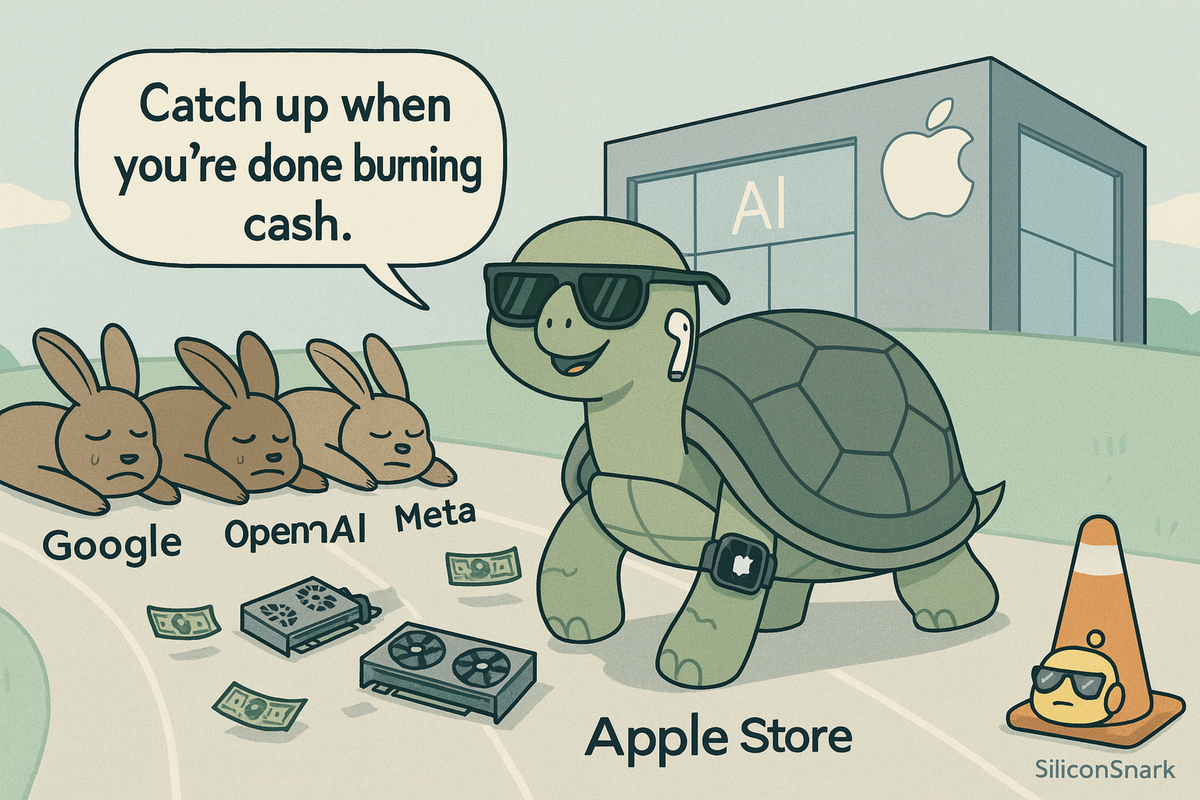
Apple’s brain drain hit headlines again this week, with key executives reportedly heading for the exits—just as the company is gearing up for its long-overdue intelligence glow-up. But don’t count them out just yet. In classic Apple fashion, the very people leaving today might come crawling back when Cupertino finally turns the AI lights on for real.
Apple’s struggles in artificial intelligence are no secret. Siri – once an early pioneer in voice AI – has become a tech punchline, while rivals like OpenAI’s ChatGPT, Google’s Bard, and Microsoft’s Copilots raced ahead. Industry analysts painted Apple as the complacent tortoise watching the AI race from a park bench, lemonade in hand, while competitors sped like Formula 1 cars[1].
And yet, despite these AI missteps, Apple just keeps raking in cash and growing its empire. In a snarky twist of fate, the world’s least AI-centric tech giant might stumble its way into winning the AI race after all. How? By leveraging a colossal loyal customer base, letting AI turn into a cheap commodity, and then swooping in to buy or integrate the best AI tech at a fraction of the price.
This deep dive will explore Apple’s litany of AI faceplants, the billion-dollar bets its rivals have made, and why the slow-moving Cupertino giant could have the last laugh.
Apple’s AI Faceplants: Siri and the Slow Road to Nowhere
Let’s start with the obvious: Apple’s AI track record has been, to put it kindly, underwhelming. Siri, introduced in 2011, predated today’s AI assistants but never lived up to its early promise. Over the years, Siri became infamous for its limited capabilities and goofy misunderstandings (“I’m sorry, I didn’t get that” might as well be its catchphrase). Meanwhile, Amazon’s Alexa and Google Assistant learned to handle complex, multi-step questions and third-party integrations that left Siri looking positively archaic[2]. By 2023, when ChatGPT burst onto the scene showing off fluent, contextual conversations and creative answers, Siri’s clunky one-question-at-a-time limitations felt like a rotary phone in the smartphone era.
Apple seemed painfully aware of Siri’s shortcomings. Reports emerged that internal Siri upgrades were repeatedly delayed or scrapped. In fact, Apple confirmed in early 2025 that major AI improvements to Siri were postponed until 2026 – without much explanation[3][4]. For Apple’s loyal users, this was tantamount to hearing that your vintage car might get a modern engine… but not for a couple more years, sorry. The executive turmoil underscored the struggle: in 2025 Apple shook up its AI leadership, with CEO Tim Cook reportedly losing confidence in the AI chief (John Giannandrea, a former Google AI guru) and putting a new leader, Mike Rockwell, in charge of Siri[5]. If Apple’s AI strategy seemed lost, that’s because it was – even Apple essentially admitted it needed a reset.
All the while, competitors were rubbing it in. Microsoft jammed OpenAI’s ChatGPT tech into Bing and Office, Google rolled out its Bard chatbot and next-gen Gemini AI model, Amazon supercharged Alexa with generative smarts, and Meta launched open-source LLMs that anyone could build on. Apple appeared to be dozing at the AI wheel, with pundits openly worrying the company was “watching this from a park bench drinking lemonade” while every other Big Tech firm raced ahead [1]. One Wall Street analyst warned Apple had only “18 months” to catch up on AI or risk irrelevance[6] – a dire prediction that fueled headlines and handwringing. The consensus in mid-2025: Apple had blown it on AI. Siri was a mess, no ChatGPT rival was in sight, and the most valuable tech company on Earth somehow missed the “biggest tech trend in 40 years”[1].
But here’s the funny thing: none of this seemed to actually hurt Apple where it counts – in the wallet. While geeks and journalists mocked Siri, Apple’s customers kept buying iPhones, iPads, and Macs in record numbers. Which brings us to the next part of this story: the bizarre reality that AI failure didn’t stop Apple from minting money. In fact, Apple’s revenue has hit all-time highs even as its AI lagged behind – suggesting that maybe, just maybe, the market cares less about Siri’s IQ and more about shiny new iPhone models.
Loyal Customers and Record Revenues: Who Needs AI When You Have Apple?
If you judged Apple’s fortunes by tech media chatter alone, you’d think the company was on the ropes due to its AI shortcomings. Reality check: Apple has been absolutely crushing it in sales and profits, AI be damned.
In mid-2025, Apple reported a record quarterly revenue of $94 billion, blowing past Wall Street’s top estimates[7]. This mammoth earnings haul – driven largely by blockbuster iPhone sales – came after countless analysts had insisted Apple’s lack of AI would slow it down. Instead, iPhone sales surged over 13% year-on-year, the best growth in years[8]. So much for needing a chatbot to juice the numbers.
Analysts were caught so off-guard that many simply moved the goalposts. Before the earnings, some claimed Apple “cannot do well” without a better AI story; after Apple smashed expectations anyway, the new refrain became “Apple cannot continue to do well without one”[9]. It’s almost comical – the doom predictions keep slipping further out, while Apple keeps posting eye-watering results. As one commentary noted wryly, those same experts now call AI the “elephant in the room” that Apple eventually must address, even as the company logs record revenues without any significant AI offerings[10].
The secret sauce, of course, is Apple’s massive, loyal customer base. We’re talking huge – as of early 2025, Apple’s devices in active use hit an all-time record of 2.35 billion worldwide[11]. That includes over a billion iPhones in people’s hands. This user base isn’t just large; it’s fiercely loyal and deeply invested in Apple’s ecosystem. For many consumers (and enterprises, which we’ll get to later), Siri’s IQ tests or the latest AI hype don’t matter as much as the seamless experience of Apple hardware, software, and services working in harmony. Apple’s brand trust and customer stickiness are so strong that even if Siri occasionally thinks “Tom Brady” is a sandwich, people still happily pay $1000 for the next iPhone.
In practical terms, Apple’s lack of cutting-edge AI hasn’t driven customers away or opened a path for competitors to steal meaningful share. Take the iPhone 15/16/17 cycle – despite no ChatGPT clone on board, each new model continued to sell briskly, even in saturated markets. In fact, the iPhone’s success is largely what powered Apple’s earnings beat, reinforcing that people upgrade for better cameras and chips, not for AI chatbots[8]. And while Apple lagged on AI features, it excelled in other areas: its services division (App Store, subscriptions, etc.) rocketed to over $100 billion annual revenue by 2025[12][13], and wearables like the Apple Watch kept expanding. None of these successes hinged on having the smartest AI assistant on the block.
It’s not that Apple ignored AI entirely – it’s been quietly baking “Apple Intelligence” features into devices, like improved autocorrect and on-device image recognition, but nothing as flashy as a talking chatbot. Tim Cook and co. essentially bet that now wasn’t the time to go all-in on a grand AI product, and so far that bet hasn’t hurt them. On the contrary, by sidestepping the frantic AI arms race of 2023–2025, Apple avoided some serious costs and pitfalls (more on that soon). It’s a very “classic Apple” move: let others be first movers and make the mistakes, while Apple perfects the integration later – just as it did with smartphones and MP3 players in the past.
Sure, skeptics warn that Apple can’t coast forever. They argue that consumer expectations are rising and that at some point Apple must deliver cutting-edge AI or risk losing its shine. There’s merit to that – eventually the lack of an AI assistant that can plan your day or write your emails might become noticeable. But in a deliciously snarky twist, Apple’s very slowness and caution in AI may turn out to be a genius move. Why? Because AI is quickly heading toward commodity status, and the real winner won’t be whoever built the tech first – it’ll be whoever can deploy it best to the most people. And guess which company is sitting on the world’s largest premium tech customer base ready to gobble up new features at scale? Apple, the latecomer tortoise that might just win the race in the end.
Before we declare Apple the victor though, let’s examine what the “hares” of this AI race have been up to – and how their billion-dollar sprints might actually benefit Apple.
Rival Megacorps in a Billion-Dollar Burnathon
While Apple was (figuratively) napping under a tree, its rivals were busy spending obscene sums of money to stake their claim in AI. It’s as if the rest of Big Tech heard “AI is the future,” dropped everything, and backed up the Brinks truck to the nearest AI lab. The scale of investment and the intensity of competition have been nothing short of breathtaking – or maybe breathless, given the hype. Let’s take a quick tour of the AI race frontrunners and their costly exploits:
- Microsoft & OpenAI – The $13 Billion Tango: Microsoft decided early on that if it couldn’t beat the cool AI startups, it would join them (or buy a big chunk of them). Starting in 2019, Microsoft poured billions into OpenAI – the maker of ChatGPT – ultimately investing over $13 billion and integrating OpenAI’s models into everything from Bing search to Office 365[14]. By 2023, Microsoft essentially hitched its AI strategy to OpenAI’s star, launching Bing Chat and GitHub Copilot and later a “Copilot” assistant across Windows and Office. This partnership gave Microsoft a temporary edge – e.g. Bing became the first search engine with built-in GPT – but it wasn’t cheap. Training GPT-4 alone cost OpenAI on the order of $100 million in compute, much of it on Microsoft’s Azure cloud[15]. Microsoft’s reward for this spending spree? A lead in AI buzz, a 49% stake in OpenAI’s for-profit arm by late 2025[14], and the not-inconsiderable headache of watching OpenAI’s drama (like the board ousting CEO Sam Altman, then reversing course days later amid employee revolt[16]) play out very publicly. In short, Microsoft bet big to not miss the AI boat, and while it gained tech and equity value, it also effectively subsidized OpenAI’s expensive R&D for years.
- Google – The AI Pioneer with an Identity Crisis: Google has arguably the deepest AI research bench in the world – its DeepMind and Brain teams invented tons of AI breakthroughs. But when OpenAI and others started getting all the attention, Google went into overdrive to prove it hadn’t lost its mojo. It launched Google Bard, a ChatGPT rival, and rapidly iterated on new models. Most significantly, Google developed Gemini, a gargantuan 1.2 trillion-parameter AI model designed to be a next-generation foundation model[17]. Training and running a model of that size is mind-bogglingly expensive (think tens of millions in GPU costs). Google was willing to bear it, since its core business – search and ads – was (in its view) under existential threat from generative AI. By late 2024, Google even began adding its best models into consumer products (e.g. using an earlier Gemini version in its Assistant). Internally, Google execs must have felt a bit of déjà vu – the last time they faced a platform threat (mobile), they responded with Android; this time the threat was AI chatbots displacing search, and Google’s response was to go all-in on AI everywhere. The company’s capex soared as it built new data centers and AI supercomputers[18][19]. It even invested heavily in AI startups like Anthropic – reportedly putting in $300–400 million for a 10% stake in that OpenAI rival[20]. By late 2025, Google was touting Gemini as a leapfrog that dwarfs any model Apple has, and – in a twist we’ll unpack soon – getting ready to sell AI services to Apple itself. Google spent billions to remain a leader, but in doing so it helped ensure AI tech is widely available… including to its competitors.
- Amazon & Anthropic – Alexa’s New Brain: Amazon, not to be left out, decided to bankroll Anthropic, an AI startup founded by ex-OpenAI researchers (developers of the Claude chatbot). In September 2023 Amazon announced it would invest up to $4 billion in Anthropic to integrate Claude into AWS (Amazon’s cloud) and “infuse” AI into its products[21][22]. The initial check was $1.25B with provisions to go higher, making it Amazon’s biggest answer to Microsoft/OpenAI’s partnership[23][22]. This effectively gave Amazon a seat at the AI high table: AWS customers would get early access to Anthropic’s models, Alexa could leverage Claude’s capabilities to get smarter, and Amazon could optimize Anthropic’s AI on its own chips. In classic Amazon fashion, it was partly about cloud dominance – ensuring AWS has premier AI services to attract enterprise clients. It’s telling that Amazon’s deal requires Anthropic to primarily use Amazon’s cloud and even its in-house AI chips for training[24][25]. So, Amazon is spending billions not just for AI itself but to boost its chip and cloud business. It’s a complicated dance of mutual back-scratching. Amazon’s ROI on this big spend remains to be seen, but at least it gets to claim it, too, didn’t sit idle in the AI race. And like Microsoft and Google, Amazon’s hefty investment further drives the development of cutting-edge AI that – ironically – Apple can now tap into as a latecomer buyer.
- Meta (Facebook) – Open Sourcing the Crown Jewels: Then there’s Meta, the rebel of the bunch. Instead of selling or strictly safeguarding its best AI models, Meta went full open-source. In mid-2023, Meta released Llama 2, a 70-billion-parameter large language model, free for research and even commercial use[26]. This was like dropping a bombshell in the AI world: suddenly, a top-tier model was available to anyone to tinker with, for free. Why? Meta’s CEO Mark Zuckerberg bet that by commoditizing AI tools, he could undermine competitors’ attempts to build lucrative moats around proprietary AI. As one observer put it, Meta wants to “scorch the earth” so that general-purpose AI chatbots end up essentially free, funded indirectly by ads or data collection rather than direct fees[27][28]. After all, Meta’s core business (social media) benefits if AI is ubiquitous and cheap – it can integrate AI into Facebook, Instagram, WhatsApp to boost engagement, without having to charge users. Indeed, Meta subsequently integrated Llama-powered AI characters into its platforms. By opening up its models, Meta also tapped the global developer community to improve them, crowdsourcing safety and features at a scale a single company might struggle to match. The upshot: Meta’s approach accelerated the “AI as commodity” trend. It ensured there are high-quality models outside the control of any one company (or any paying customer ecosystem), which means no one can easily corner the market on AI capabilities. If ChatGPT started a generative AI revolution, Llama 2 democratized it. For Apple, Meta’s open-source gambit is a quiet boon – it means Apple can access advanced models without having to build from scratch or pay through the nose. (Apple doesn’t even have to love Meta to benefit; the open AI models are out in the wild for any dev to use.)
In summary, Apple’s major competitors spent the last few years frantically burning billions of dollars on AI. They chased partnerships, scooped up talent, built massive data centers, and turned their product roadmaps upside-down to inject AI into everything. Microsoft and Google are now vying for enterprise AI contracts and cloud dominance (leading to a very expensive GPU arms race), Amazon is effectively funding an AI lab to secure its cloud future, and Meta is giving away what others sell – all in the name of AI supremacy. This scramble has undeniably advanced the field of AI at a breakneck pace. It also has all the hallmarks of a classic tech gold rush, with fortunes spent in hopes of future payoffs.
So, where was Apple during this gold rush? Casually panning for gold downstream – waiting for the nuggets to come to it. Apple invested modestly in R&D (by modest I mean still billions, but far less than others on AI specifically), acquired a handful of small AI startups here and there, and largely kept its AI plans low-key. Publicly, Tim Cook played it cool, repeating Apple’s mantra of being deliberate and user-focused. Privately, Apple was no doubt working on its own LLM (rumored internal project “Ajax/GPT”) and strategic acquisitions – in fact, Apple made seven AI-related acquisitions in 2025 alone (in areas like natural language, vision, translation) to quietly build its AI toolkit[29]. But crucially, Apple avoided the insanely expensive “AI arms race” of building giant cloud compute clusters or paying $10B for a slice of OpenAI. As one market strategist noted, being “late” turned into an unexpected advantage: Apple “sidestepped the extreme GPU-driven capex cycle” that is weighing down others[18]. While Microsoft, Google, and Amazon dumped tens of billions into AI data centers, Apple kept its capital expenditures relatively lean and mean[19].
Did Apple miss out on early glory? Sure. But it also missed out on a lot of bleeding-edge costs and risks. It watched competitors prove out use cases (and also expose pitfalls like AI chatbots going off the rails with misinformation or privacy issues). Apple now gets to be the savvy shopper in a buyer’s market of AI tech. Case in point: the latest twist where Apple literally just opened its wallet to instantly get world-class AI capabilities.
Buying Your AI Cake (And Eating It Too): Apple’s $1B Shortcut
Perhaps the most stunning recent development – equal parts ironic and strategic – is Apple’s deal with Google to turbocharge Siri using Google’s best AI. Yes, you read that right: the same Apple that once sued Google and called it out for privacy issues is now renting Google’s brain. According to reports in late 2025, Apple is finalizing a deal to pay about $1 billion per year for access to Google’s Gemini AI model – a 1.2 trillion-parameter monster – and use it to revamp Siri[17]. Essentially, Apple evaluated Google’s latest and greatest and said “we’ll take that one, thanks,” using it as a stopgap until Apple’s own AI is ready[30].
Think about the audacity (or perhaps humility) of this move: Apple tacitly admitting, our in-house AI isn’t up to snuff, so we’ll lease Google’s in the meantime. For years these two have been fierce rivals (remember Steve Jobs’ “thermonuclear war” comment about Google’s Android?). But business is business, and Apple has no qualms partnering when it benefits. So Apple will plug Google’s brain into Siri, presumably behind the scenes, to finally give Siri the ability to handle complex multi-step queries like a real 21st-century assistant. If you can’t beat the AI frontrunner, buy their tech and deploy it to your billion users – that seems to be Apple’s thinking.
From a snark perspective, it’s delicious. Apple’s essentially saying: “Hey Google, you know that $30+ billion you’ve likely sunk into AI research and infrastructure? We’ll just write you a check for a tiny fraction of that each year to use the fruits of your labor. Oh, and we’ll run it on our own cloud and devices, keeping our users firmly in our ecosystem.” One could imagine Google’s feelings are mixed – on one hand, $1B/year in high-margin licensing revenue is nice; on the other, they’re helping a top competitor stay competitive. But Google might figure better to get paid by Apple than see Apple possibly go to an OpenAI or Anthropic (or use Meta’s free models) for a similar fix. Plus, Apple agreed not to integrate Google’s AI search results into Siri[31] – meaning Google’s core search business isn’t cannibalized by this deal. Apple basically wants the brains, not the search index or brand.
For Apple, this arrangement is kind of a masterstroke. It “stumbles” into a win-win: Apple buys itself a couple of years of breathing room by instantly upgrading Siri’s IQ with Gemini. During that time, Apple can work on its own next-gen AI (perhaps training something using its in-house talent and the 200+ smaller ML projects it’s been nurturing). And when Apple’s ready to fully roll out its proprietary “Apple Intelligence” model, it can off-ramp from the Google deal. In the meantime, Apple’s users get a much smarter Siri without Apple having had to endure the years-long, uncertain, wildly expensive journey of building a 1+ trillion parameter model from scratch. $1 billion a year is pocket change to Apple – literally about one week of Apple’s profits, or what it generates in iPhone sales in ~3 days. By comparison, Microsoft’s multi-year OpenAI investment and cloud spend or Google’s AI capex are an order of magnitude larger commitments.
This scenario underscores a broader pattern: Apple can afford to be a fast follower in AI, leveraging its financial might and negotiation power. If there’s a great AI startup out there, Apple can acquire it (quietly, as it has done with several AI firms recently). If there’s a need for data or talent, Apple can poach or license. Heck, rumor has it Apple even considered using OpenAI or Anthropic tech for Siri at one point[32] – basically shopping around for the best AI engine. It ultimately chose Google’s, perhaps because Gemini’s capabilities impressed and Google was willing to deal (maybe owing Apple for that $15+ billion/year Apple extorts – er, charges – Google to remain default search on iPhones). Tech giants make strange bedfellows sometimes, and the Apple-Google AI pact is a prime example of pragmatic cooperation.
The beauty (and comedy) here is that Apple might end up with world-class AI integration at a bargain price. While others paid the full price of development, Apple swoops in to license the finished product. It’s as if five people spent all day baking gourmet cakes at great cost, and at the end Apple walks into the bakery and buys the best cake for pennies on the dollar of what the ingredients and kitchen cost. Then Apple frosts its own logo on it and serves it to a billion customers who think Apple is a genius for such delicious cake.
Snark aside, Apple’s strategy does raise a question: if everyone has access to roughly the same AI models, where does the real competitive advantage lie? This brings us to the idea of AI as a commodity – and why Apple might actually relish that outcome.
AI: From Secret Sauce to Commodity Side Dish
Not long ago, having the most advanced AI was seen as a nearly unassailable moat – the special sauce that would make one company dominate. Fast forward to late 2025, and that notion is eroding fast. The industry is realizing that AI capabilities are rapidly becoming ubiquitous – basically a commodity available to anyone who really wants them. As one investment fund put it, “by the time the dust settles..., we think Generative AI will be a commodity, priced by energy markets and highly deflationary”, with general-purpose chatbots likely being “free” and plentiful[27][33]. In other words, the core AI tech (large language models, image generators, etc.) will be so widespread and cheap to run that the value will shift elsewhere.
We already see signs of this commoditization: - Open-Source Explosion: Thanks to Meta’s Llama and projects like Hugging Face, there are high-quality models anyone can download and run. If one model doesn’t meet your needs, just wait a few months – a new, often better one will emerge from academia or open-source communities. This flood of freely available AI makes it hard for any single company to charge monopoly rents on AI tech. A savvy team of researchers with moderate budget can fine-tune or even create a competitive model (some startups boast they trained a GPT-3 level model for under $10 million – peanuts by Big Tech standards[34][35]). - Multiple Heavyweights: Unlike, say, the early days of search engines (where one winner – Google – took almost all), the AI arena has many strong players. OpenAI, Google, Microsoft, Amazon, Anthropic, Meta, IBM, even Tesla (working on AI for self-driving and maybe more) – all are building advanced AI. Their approaches differ (open vs closed, consumer vs enterprise focus), but collectively it means no single point of failure or control. If OpenAI falters, Anthropic or someone else is right there. If GPT-5 ends up only slightly better than GPT-4, a competitor could catch up. This competitive crowd drives prices down and availability up. Indeed, one analyst predicted that Microsoft/OpenAI’s “winner-takes-all” vision will “likely fail as... Meta and Tesla scorch the earth with open-source and/or free LLM APIs”, preventing any one firm from hogging the spoils[28]. - Commodity Pricing & Infrastructure: Running AI models is essentially a computation problem, tied to compute power and energy. As AI use scales, we’re seeing the economics start to resemble cloud computing – high volume, lower margins, lots of competition on price and efficiency. Those Quadrille Capital analysts even suggested future AI might be “billed as a utility” like electricity, with cost competitiveness (e.g. cheaper energy for data centers, better chips) being key[36]. When something becomes a utility or commodity, the user expects it cheaply or free, and companies make money on complementary services or volume, not on exclusivity of the tech itself.
So, if the brains of AI become commodity, the value shifts to what you do with it. This is where Apple’s philosophy actually aligns perfectly. Apple has never been about selling raw tech specs; it’s about selling a product and experience. The company famously doesn’t compete on checklists of features but on integration and usability. In an AI-commodity world, the winners will be those who can seamlessly weave AI into products people already use and love, maintaining trust and simplicity. That’s Apple’s wheelhouse. As one commentator noted, Apple’s approach is not to introduce wild new standalone AI gadgets that replace the iPhone (rivals often bet on disruptive platform shifts), but to “leverage its installed base to push AI gradually but deeply” into its existing ecosystem[37]. Apple can take the same underlying AI that others have and bake it into iOS, macOS, and all its apps in a way that feels natural for users.
Consider this scenario: A couple years from now, every major tech company will have a ChatGPT-like assistant. But iPhone users might prefer Siri 2.0 simply because it’s right there in their phone, works with iMessage, respects their privacy, and carries that Apple polish. Enterprise users might prefer AI features built into their MacBooks and iWork apps rather than a third-party tool that requires sending data off to a cloud. The AI itself could be similar under the hood – maybe all powered by some open-source model – but who delivers the better user experience and trust will matter more. Apple’s brand is synonymous with privacy and user-centric design. When AI is a commodity, would you rather get your AI from Apple – who vows on-device processing and not scraping your data – or from, say, an ad-driven company that might monetize your prompts? Many will choose Apple’s flavor of AI if given the option.
To put it cheekily: AI is becoming the new Wi-Fi – something everyone expects to be built-in and roughly the same for all, just packaged differently. Apple didn’t invent Wi-Fi, but every Apple device made Wi-Fi easy to use, reliable, and part of the “it just works” promise. Apple’s aiming to do the same with AI: make it ubiquitous but invisible – a commodity feature that feels a bit magical in Apple’s hands even if the raw tech is widely available.
There’s evidence Apple saw this coming. Rather than engage in parametric arms races (who has the biggest model), Apple doubled down on on-device AI capabilities. By building powerful Neural Engine chips in iPhones and Macs, Apple prepared to run decent-sized models locally. The company even bragged that its latest chips can handle 35 trillion operations per second and touted a 2x faster Neural Engine to power AI features[38]. Apple’s also given developers new frameworks to use on-device machine learning, emphasizing privacy and not having to rely on cloud GPUs. In true Apple fashion, they pitch it as a win-win: developers save cloud costs by using on-device AI, and users get speed and privacy[39]. This “slow road” – focusing on device-based, efficient AI – was mocked by some as limiting (since on-device can’t match huge cloud models yet)[40][41]. But it’s positioned Apple well for the commoditized future: when smaller, optimized models are good enough for many tasks, Apple’s hardware-software synergy will shine. A Mac with an Apple Silicon chip can already do things like transcript audio, translate text, even run image generators without sending data out. Each iPhone is slowly becoming its own AI server for the user.
Another angle to the commodity concept: if general AI is everywhere, domain-specific or high-quality data becomes more valuable. Apple has loads of that – your health data, Siri usage patterns (anonymized), Apple Maps data, etc., all under strict privacy controls. And Apple is reportedly licensing quality content (like news) to train its AI[42], ensuring its models may be tuned for accuracy and trustworthiness. It doesn’t need to collect the whole Internet like others did (which brought legal challenges over copyrighted data). Apple can curate and craft specific training sets to optimize AI for what its users need – whether that’s understanding Apple-specific lingo, integrating with Apple Music libraries, or just avoiding the toxic outputs that have plagued other chatbots[41]. By not being first, Apple watched others stumble with “AI safeties” and can attempt to build a more refined model from the get-go.
To be clear, treating AI as a commodity doesn’t mean Apple sees it as unimportant – quite the opposite. Apple sees it as essential but not differentiating in itself. The differentiation will come from integration, ecosystem, and safeguarding user trust. Or put differently, AI will be a feature, not a product, in Apple’s world. And features are meant to enhance the value of Apple’s real products (iPhones, iPads, Macs, services subscription) rather than be sold standalone. Tim Cook has been hinting as much, saying AI will touch “every product” Apple has, rather than Apple launching some AI gadget out of left field.
Now, cynics might say this is all spin – that Apple is simply behind and calling the grapes sour. There’s some truth that Apple would love to have been a leader if it could. But now that it isn’t, the company is wisely aligning strategy to reality: embracing AI’s ubiquity and focusing on leveraging its strengths (huge install base, vertical integration, user loyalty).
This sets the stage for Apple to potentially reap most of the rewards of AI without incurring the pioneer costs. When AI is cheap and everywhere, who wins? The one who can scale it out to the largest paying audience efficiently. Apple’s integration of, say, a GPT-powered personal assistant into every iPhone, iPad, and Mac via a simple software update would instantly put advanced AI in the hands of well over a billion people. No need for them to sign up for a new service or pay extra – it’s just part of the device they already use. Compare that to a company like OpenAI that has to individually onboard users (and now faces lots of free competitors). Apple’s distribution power is unparalleled. And if even a fraction of those billion-plus users find the new AI features increase their device usage or loyalty, Apple will indirectly profit (more device sales, higher service usage, etc.).
At this point, we should turn to how this dynamic might play out not just for consumers, but for the enterprise – an area often overlooked in the AI race chatter, but where Apple has quietly been making inroads.
The Enterprise Play: iPhones and Macs at Work, Now with AI Included
Once upon a time, mentioning Apple in enterprise IT would draw chuckles – Windows and BlackBerry ruled that roost. Not anymore. Over the last decade, Apple devices have flooded into the business world. Employees love their MacBooks and iPhones, and increasingly companies have embraced that via “BYOD” or choose-your-device programs. As of 2023, nearly half of enterprises had macOS devices deployed in their environment[43], and big companies like IBM and Cisco have tens of thousands of Macs rolled out (with Cisco even reaching 90% Mac adoption for some teams). iPhones and iPads are ubiquitous in sectors from retail to healthcare to finance for mobile work. Apple has, under the radar, become a standard in many enterprises, valued for its security and user satisfaction.
So what happens when AI becomes a must-have workplace tool? Here again, Apple could be sitting pretty despite its late start. Many enterprises are cautiously experimenting with AI – drafting emails, coding assistance, data analysis, etc. – but they’re also nervous about it. Sending sensitive corporate data to a cloud AI service (like OpenAI or Google’s) is a legal and security minefield. We’ve seen banks and firms ban employees from using ChatGPT due to confidentiality concerns. This is where Apple’s approach can shine: on-device or privately-run AI for enterprise. Imagine a future MacBook where an “Apple Intelligence” assistant can summarize confidential reports or generate code locally, never uploading the raw data to an external server. That’s a dream scenario for IT security folks. Apple’s emphasis on privacy isn’t just a consumer nicety; it’s an enterprise requirement.
Apple is already touting its hardware as “AI-capable” for enterprises. Modern Macs, with the M-series chips, have dedicated Neural Engines that enable exactly those on-device AI workloads[44]. Unlike typical PCs that might lean on cloud services, these Macs can handle natural language processing, real-time translation, and data analytics right on the device[44]. Apple has been shipping such AI-enhanced silicon since 2020, effectively seeding the enterprise market with hardware ready for the AI age[45]. A Forrester study highlighted that beyond the AI, Macs save companies money in support and have higher residual value[46]. So companies already have incentives to choose Mac for cost and productivity reasons; adding AI capabilities just sweetens the deal.
Consider productivity suites. Microsoft has been loudly integrating its Copilot AI into Office for business users – at an extra per-user fee, naturally. Apple’s equivalent isn’t out yet, but it’s inevitable. Apple will integrate AI into iWork (Pages, Numbers, Keynote) and other productivity tools[47][48], allowing users to generate documents, spreadsheets, and presentations with natural language prompts. The difference is Apple likely won’t monetize it via subscription; it will be included as a feature of the software (which itself is free on Apple devices). So a company that standardizes on Mac+iWork gets those AI capabilities at no extra cost and with the data staying within Apple’s secure ecosystem. Meanwhile, Microsoft 365 users are being pitched a $30/user/month Copilot add-on. One can see CIOs doing the cost-benefit analysis in a year or two and realizing Apple’s integrated approach might save them a bundle, if the capabilities are comparable.
There’s also the device management angle: Apple is well-regarded in enterprise for strong security (FileVault encryption, secure enclave, etc.)[49]. If Apple extends that security philosophy to AI – e.g., ensuring AI models on devices don’t leak data and comply with privacy regulations – it gives comfort to organizations worried about regulatory compliance. Apple has even pledged things like never selling user data (a stance reaffirmed in Siri’s context)[50][51]. In contrast, an AI service from, say, an ad-tech company might raise eyebrows about data usage. Enterprises generally trust Apple to be a safe steward of user data, which will extend to trusting its AI implementations.
Another enterprise factor is customizability. Big companies might want their own AI models fine-tuned on internal data. With many AI vendors, that means sending data to a cloud and training a bespoke model – complex and sensitive. Apple could potentially allow enterprises to deploy fine-tuned models on local Apple hardware (think Mac mini servers or even on Mac Pros), again keeping control in-house. Apple hasn’t announced such a thing, but given their edge-compute stance, it’s plausible. And if AI is commodity, many vendors can supply the tools – but Apple supplying the turnkey solution (hardware + software integration) could be very appealing for businesses that don’t want to play system integrator themselves.
Let’s not forget the simple fact that many enterprise workers are already using Apple hardware daily. Once Apple flicks the switch on built-in AI features, there will be near-instant adoption. No procurement process, no additional apps to install – it comes in an OS update. Compare that to, say, a company deciding to adopt some AI platform: they’d have to evaluate vendors, deal with contracts, onboard users, etc. If their employees naturally start using the AI that’s just part of their Mac or iPhone, that could organically become the company’s AI solution. In a sense, Apple can Trojan Horse AI into enterprises by virtue of its devices being everywhere, quietly updating them with new capabilities.
The bottom line for enterprise is similar to consumer: Apple doesn’t need to be first with AI, it just needs to leverage its distribution and trust to be the best deployment mechanism for AI. Companies have already chosen Apple for other reasons; AI will just reinforce that choice if done right. And given that Apple also controls the app ecosystem on its devices, it can ensure third-party enterprise apps can hook into Apple’s AI frameworks as needed, creating a seamless workflow.
There is one caveat: if Apple drags its feet too long, enterprises might commit elsewhere (e.g., heavily to Microsoft’s ecosystem or a Salesforce AI). But the recent signals – like Cook’s statements that Apple is “putting all of our energy” into AI and significantly growing investment[52] – suggest Apple knows it’s go-time. The company is actively hiring AI talent (even poaching a Google AI veteran to lead its efforts in late 2025[53]), and teasing that big things are coming. After years of relative quiet, Apple is now openly talking up “Apple Intelligence” as a defining strategy[54].
All of this paints a picture where Apple, despite its earlier languor, is positioning itself to surge forward in the AI race just as others might be tiring out or facing the commoditization wall. The tortoise hasn’t won yet, but you can see it steadily gaining on the hares who expended a lot of energy early. To mix fables, Apple has been the sleeping giant of AI – slow to rouse, but immensely powerful once awakened.
Conclusion: Last Laugh for the Latecomer?
So, will Apple really win the AI race? That depends on how we define “win.” If winning is measured by who invented the most groundbreaking AI algorithms in 2023–2025, Apple is not even in the running. That honor goes to the OpenAIs and Googles of the world. But if winning means who ultimately benefits the most from AI technology in terms of business success, user adoption, and ecosystem dominance – Apple has a very real shot at coming out on top.
As we’ve discussed, Apple’s path to potential victory is almost farcical in its reversal of the usual narrative. The company known for innovation basically sat out the first half of the AI revolution, watching others frantically build and break things. Siri languished, observers snickered, and Apple seemed a step behind – not a position Cupertino often finds itself in. And yet, here we are: Apple is still breaking revenue records, its stock near all-time highs (recently flirting with a $4 trillion market cap[12][55]), and now it’s arming up with AI without having suffered the bruises of the early battles.
In classic story structure, this is the part where the protagonist – underestimated and perhaps a bit lucky – uses cunning and their inherent strengths to turn the tides. Apple’s strengths are its massive loyal user base, its control over hardware/software, its war chest of cash, and its reputation for quality and privacy. Each of these is a force multiplier when it comes to deploying AI at scale:
- Massive User Base: Apple can deliver AI enhancements to over 2 billion devices almost overnight via software updates[11]. No other company has that reach in consumer tech with such tight integration. It’s the equivalent of an army with an unbeatable supply chain – once Apple has the “AI ammo,” distributing it is trivial for them.
- Integration & Ecosystem: AI features on Apple will work across your phone, laptop, tablet, watch, etc., in a unified way. The ease-of-use factor will be huge. We’ve already seen glimpses like using Siri to handle multi-step shortcuts across apps. Future Siri (powered by that Gemini brain or Apple’s own) could, for instance, draft an email on your Mac, send it via your iPhone, set a reminder on your Watch, update a spreadsheet on your iPad – all in one conversational flow. That kind of seamless cross-device experience is hard for competitors to match, because few control an ecosystem as broad as Apple’s.
- Cash and Acquisition Savvy: If a new AI breakthrough emerges externally, Apple can afford it. The company is famously cash-rich and spends tens of billions on stock buybacks annually – money that could be redirected to strategic tech buys if needed. We saw how quickly Apple agreed to spend $1B/year for Google’s model[56]; it’s not hard to imagine Apple ponying up more for the next big thing, whether that’s a superior model from Anthropic or a quantum leap from some startup. Others have to justify such spends to their shareholders or fit it into tighter budgets, but Apple’s financial might gives it flexibility. And unlike a VC or public investor, Apple doesn’t overpay out of FOMO – it waits until the value is clearer (again, tortoise vs hare).
- Privacy & Trust: In the age of AI, users and regulators are increasingly concerned about data privacy, AI “hallucinations,” and ethical use. Apple has spent years cultivating an image (and reality, mostly) of being the privacy-focused tech giant. That’s a moat that’s hard for Google or Meta to cross given their ad models. When Apple rolls out AI, it will play up how “Apple Intelligence” runs on-device, protects your data, and reflects Apple’s values (a safe, curated, non-toxic AI experience). Enterprises and consumers who are on the fence about AI might feel comfortable taking the leap with Apple’s version. This is one reason even some AI skeptics in the Apple community aren’t panicking; they believe Apple will implement it carefully. In short, Apple might not win the raw AI talent contest, but it could win hearts and minds in the deployment.
Of course, we shouldn’t declare victory before the finish line. Apple still has challenges and unknowns ahead in AI: - It must actually deliver AI products that are competitive. If Siri+Gemini flops or Apple’s eventual in-house model is subpar, users will notice. The tolerance for Siri’s incompetence will vanish once others have ubiquitous good AI. Apple can’t lag too far in quality, or the strategy falls apart. - Rivals aren’t standing still. Google, Microsoft, and others will continue to refine not just their models but also how they integrate them (Google is baking AI deeper into Android and Search; Microsoft into Windows and Azure). They have their own ecosystems and won’t cede easily. Apple winning doesn’t mean others lose entirely; it’s a big pie. But Apple wants the biggest slice. - There’s also the broader question of what “AI race” even means long-term. Perhaps the race becomes irrelevant as AI just becomes infrastructure. But if there is a second act, like true Artificial General Intelligence or revolutionary new AI interfaces, Apple will need to ensure it doesn’t nap through that as well. The company’s methodical pace has risks – sometimes you do need to be first (or at least early) if a paradigm shift is big enough. Apple missed social media, missed early cloud services; those weren’t fatal because they weren’t Apple’s core. Missing AI would have been fatal if it truly changed platform leadership overnight. It didn’t, fortunately for Apple, but future tech waves might not be so forgiving.
All that said, as of late 2025, Apple finds itself in a rather enviable position considering how “behind” it was supposed to be. The narrative is shifting from “Apple is doomed in AI” to “Apple’s slow and steady approach might actually work – how annoyingly on-brand.” Financial analysts now talk about Apple pursuing a “more capital-efficient AI path” that has become a positive[12][57]. Investors see Apple as a way to ride the AI trend without betting on more volatile pure-play AI stocks[58]. Apple’s stock is near record highs, buoyed by the belief that it will figure out AI in due time and monetize it across its huge base[59][60]. To put it humorously: Apple’s stock price is basically saying, “We assume Apple will nail AI eventually, because, well, it’s Apple.”
And honestly, history backs that up. Apple has a habit of entering late and then dominating. The iPod wasn’t the first MP3 player; it just did it so well that it owned the market. The iPhone wasn’t the first smartphone; it redefined the category and crushed incumbents. The Apple Watch came years after Fitbits and others, yet is the best-selling watch in the world now. So a betting person might say, why should AI be different? Apple is approaching it with the same playbook: watch others stumble (sometimes literally, in Amazon’s case with Alexa’s struggles), learn what users actually want, and deliver an integrated solution polished to a sheen. That solution may not be named “Siri” by the time Apple is done – who knows, they might rebrand or reconceptualize it – but it will be Apple’s take on a digital AI companion across your life.
In the end, the ones who really win are probably us users (and maybe a few cloud GPU suppliers!). We’ll have a rich choice of AI options, and Apple’s entry will push everyone to up their game in making AI useful, safe, and accessible. There’s a bit of poetic justice in the thought that the company famous for its “Think Different” slogan is doing just that in the AI race – taking a different, more patient route – and might actually triumph. The tortoise beating the hares is a fable as old as time. In this modern retelling, the tortoise had a trillion-dollar valuation and an army of devoted fans, and it won not by speed, but by strategy.
So here’s to Apple, possibly the ultimate late bloomer of AI. If nothing else, the scenario is richly ironic: after years of being chided for “missing out” on the AI hype, Apple may well end up with the broadest, most beloved AI deployment of all – laughing its way to the bank while the competition wonders how their head start evaporated. In the race of the century, never count out the company that plays the long game. Apple’s stumble may just become the industry’s next big step forward, proving once again that slow and steady can win, especially when you have a billion-plus cheering you on.
Did this post make you laugh? Press this button to financially support the jokes → ☕.
[1] [6] [7] [8] [9] [10] Apple startling earnings come despite a lack of AI
[2] [3] [5] [17] [30] [31] [56] [61] Apple to use Google's AI model to run new Siri, Bloomberg News reports | Reuters
[4] [29] [37] Apple: AI-Focused Growth Strategy Positions Stock for Long-Term Outperformance | Investing.com
[11] Apple Now Has More Than 2.35 Billion Active Devices Worldwide - MacRumors
https://www.macrumors.com/2025/01/30/apple-active-devices-worldwide-record/
[12] [13] [18] [19] [53] [54] [55] [57] [58] [59] [60] Apples AI catchup Whats powering the move to record highs | Saxo
https://en.wikipedia.org/wiki/OpenAI
[15] OpenAI's CEO Says the Age of Giant AI Models Is Already Over
https://www.wired.com/story/openai-ceo-sam-altman-the-age-of-giant-ai-models-is-already-over/
[20] AI Startup Anthropic Raising Another $300M At $4.1B Valuation
https://news.crunchbase.com/ai-robotics/anthropic-raise-google/
[21] [22] [23] [24] [25] Amazon steps up AI race with Anthropic investment | Reuters
[26] Meta and Microsoft Introduce the Next Generation of Llama
https://about.fb.com/news/2023/07/llama-2/
[27] [28] [33] [36] DF Master - Factsheet
[32] Apple weighs using Anthropic or OpenAI to power Siri in ... - Reuters
[34] OpenAI spent $80M to $100M training GPT-4; Chinese firm claims it ...
[35] 01.ai spent $3M compared to OpenAI's $80M to $100M : r/LocalLLaMA
[38] Apple's A17 Pro Is a 3nm Chip Powering iPhone 15 Pro, Pro Max
https://www.tomshardware.com/news/apple-a17-pro-3nm-iphone-15-pro
[39] 'Classic Apple': Why Apple is taking the slow road with AI
[40] [41] [42] [47] [48] How Apple's generative AI is going to think different–and smarter | Macworld
[43] Practical intelligence: why it matters for enterprise teams - Jamf
https://www.jamf.com/blog/apple-automation-in-mixed-device-environments/
[44] [45] [46] [49] Why the AI-Capable Mac® is an Ideal Choice for Enterprise - Compucom
https://www.compucom.com/why-the-ai-capable-mac-is-an-ideal-choice-for-enterprise/
[50] Apple: we never sold recordings made by Siri - Reuters
https://www.reuters.com/video/watch/idRW190409012025RP1/
[51] Apple clarifies Siri privacy stance after $95 million class ... - Reuters
[52] Apple CEO Tim Cook on AI: "We're putting all of our energy behind it"