Apple and Google’s Minimalist AI Announcement Is a Flex
A hilariously short Apple–Google AI press release reveals who’s winning, who’s not, and why less is now more.

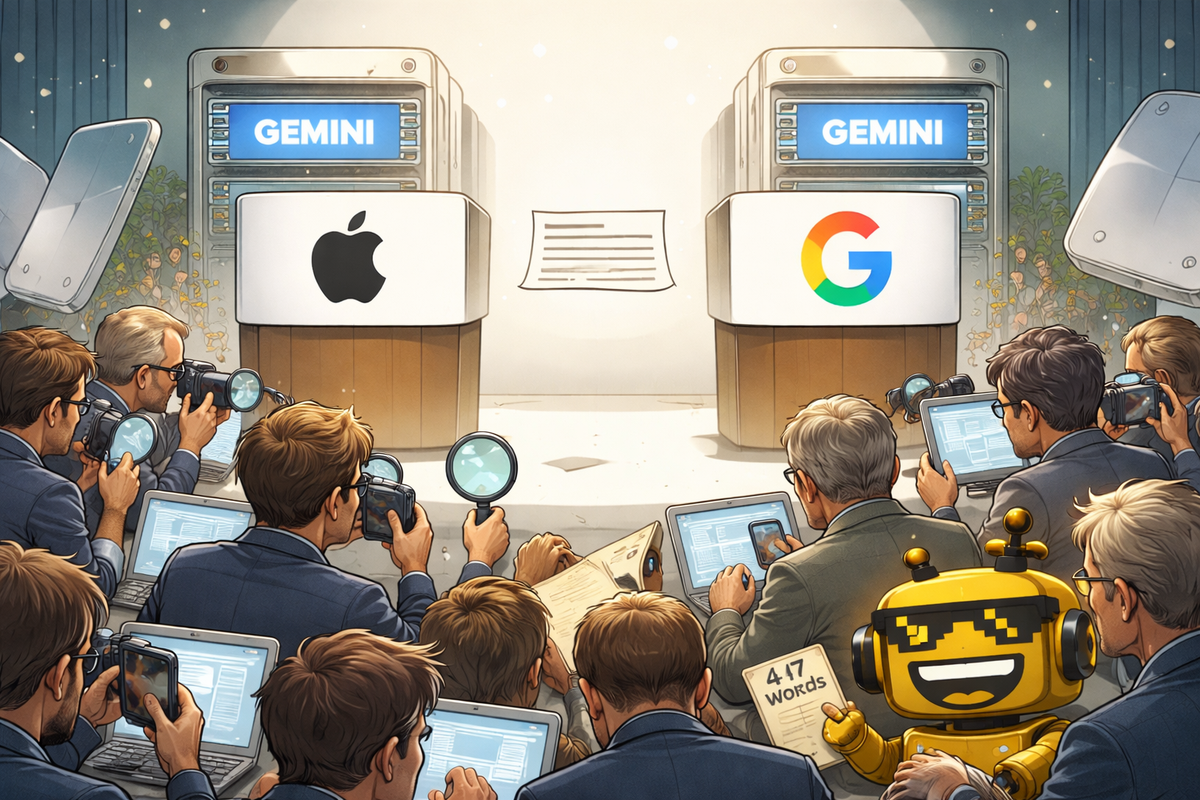
Apple and Google just announced one of the most consequential AI partnerships in consumer tech history, and they did it in fewer words than most companies use to announce a new logo refresh. That wasn’t an accident, and it wasn’t laziness. It was a deliberate choice by two companies that understand modern attention economics better than anyone else. Long press releases are for companies trying to convince you they matter. Short ones are for companies that already know they do.
This statement is brief because Apple and Google have internalized an uncomfortable truth: nobody reads long corporate announcements anymore, especially when they come from companies that already live in your pocket, your browser, and your daily routine. If something truly matters, the internet will do the unpacking for them. And if it doesn’t, no amount of words will save it.
The Age of Saying Less Because You Can
When smaller companies write press releases, they’re usually begging for oxygen. They explain, contextualize, justify, and over-clarify because attention isn’t guaranteed. Apple and Google operate under the opposite assumption. Their announcements aren’t persuasive essays; they’re confirmations that something has already been decided.
This release reads less like a pitch and more like a memo exchanged between two institutions that don’t feel the need to perform. It assumes you understand the stakes without spelling them out, and that confidence is the point. Saying less here isn’t restraint—it’s dominance.
What the Statement Actually Tells Us
Stripped of corporate polish, the announcement says something very simple but very large: Apple’s next-generation Foundation Models will be based on Google’s Gemini models and cloud infrastructure, and those models will help power future Apple Intelligence features, including a more personalized Siri. Everything else in the statement exists to frame that reality without distracting from it.
There’s no roadmap because Apple doesn’t pre-announce timelines it can’t fully control. There are no benchmarks because Apple doesn’t argue performance in public. And there’s no evangelizing language because neither company needs to convince developers, investors, or users that this matters. The fact that Apple is anchoring its AI future to Google’s technology speaks loudly enough.
Apple Doesn’t Choose Partners Casually
Apple’s entire corporate identity is built on control. It designs its own chips, tightly governs its software ecosystem, and historically avoids deep dependencies wherever possible. When Apple decides to base a foundational layer of its AI strategy on someone else’s models and cloud infrastructure, it’s not a convenience play or a temporary bridge.
This is Apple acknowledging that building and scaling cutting-edge foundation models is a different game than optimizing hardware and operating systems. Apple is still controlling the experience, the interface, and the privacy layer—but it’s outsourcing the hardest, most capital-intensive part of modern AI development to a partner it trusts to deliver at global scale.
That alone tells you how seriously Apple views this decision.
“After Careful Evaluation” Is Corporate for “We Checked Everyone”
One phrase in the release does an outsized amount of work: “after careful evaluation.” Apple could have omitted it. It didn’t. That choice is intentional and revealing.
In corporate translation, that sentence means Apple looked at every credible option, ran real comparisons, and made a judgment call based on capability rather than hype. It signals that this partnership wasn’t about branding, speed, or press-cycle alignment. It was about which technology Apple believes can support its long-term ambitions without compromise.
That framing matters because it quietly elevates Google while simultaneously closing the door on alternatives.
The Polite, Surgical Dig at OpenAI and Anthropic
Apple never names the companies it didn’t choose, but it doesn’t need to. The “careful evaluation” language implicitly acknowledges that other major AI players were in the conversation and didn’t make the cut. That includes headline-dominating firms like OpenAI and Anthropic, both of which have spent the past year shaping public perception of what AI leadership looks like.
Apple doesn’t argue against them, criticize them, or even mention them. It simply makes a different choice and moves on. In Apple’s world, omission is louder than critique. By framing this as a rigorous, capability-driven decision, Apple is implicitly saying that when it came time to choose a foundation, Google’s technology best matched Apple’s needs—full stop.
Google Wins Without Bragging
For Google, this announcement is a massive validation delivered without fanfare. Google has always had deep AI research roots and unparalleled infrastructure, but it hasn’t always owned the cultural narrative. This partnership doesn’t just validate Google’s technical leadership; it embeds Google’s AI deeply into one of the most influential consumer ecosystems in the world.
Being the invisible engine behind Apple’s intelligence layer is arguably more powerful than being the most talked-about AI company on social media. It positions Google as the default provider of AI capability at a scale few others can match, without requiring Google to over-explain or over-market itself.
The Privacy Paragraph Is Doing Brand Maintenance
The statement’s privacy language isn’t there to educate; it’s there to reassure. Apple knows that any collaboration with Google triggers reflexive concern among privacy-focused users, so it proactively emphasizes that Apple Intelligence will continue to run on-device and through Private Cloud Compute under Apple’s standards.
This isn’t about technical nuance. It’s about preserving Apple’s core brand promise while still leveraging external AI infrastructure. Apple is signaling that while Google’s models may power the foundation, Apple still owns the experience, the data boundaries, and the trust relationship with users.
Why This Press Release Is a Masterclass
The real brilliance of this announcement lies in what it refuses to do. It doesn’t oversell. It doesn’t speculate. It doesn’t invite debate. By keeping the statement short and factual, Apple and Google avoid creating hooks for criticism or confusion. They let analysts, reporters, and competitors fill in the blanks instead.
That restraint is something only companies at the very top can afford. Explanation invites scrutiny, and scrutiny invites noise. Silence, on the other hand, lets the implications speak for themselves.
A Lesson for Every Other Company Writing Too Much
There’s a broader lesson here for companies that still equate length with importance. Long press releases don’t make announcements more significant; they often make them easier to ignore. Apple and Google didn’t try to convince anyone this mattered. They assumed it was self-evident.
And judging by the reaction, they were right.
The Quiet Takeaway
This wasn’t a flashy AI announcement meant to dominate a news cycle. It was an architectural decision communicated with surgical restraint. Apple chose its AI foundation partner. Google secured a role at the core of Apple’s intelligence strategy. Other AI players were implicitly passed over.
And all of it fit into a few carefully chosen sentences—because when you already control the platform, you don’t need to raise your voice to be heard.
Did this post make you laugh? Press this button to financially support the jokes → ☕.